3th Sunday of Easter (A)
Luke 24:13-35
Readings
- First Reading: Acts of the Apostles 2:14, 22-33:
God raised this Jesus; of this we are all witnesses. - Psalm 16:
Lord, you will show us the path of life. - Second Reading: 1 Saint Peter 1:17-21:
God raised him from the dead and gave him glory. - Gospel Reading: Luke 24:13-35:
And it happened that while they were conversing and debating,
Jesus himself drew near and walked with them,
but their eyes were prevented from recognizing him.
Background on the Gospel Reading
On most Sundays during the Easter season in Cycle A, our Gospel is taken from the Gospel of John. This week’s Gospel, however, is taken from the Gospel of Luke. As in last week’s Gospel, today’s Gospel shows us how the first community of disciples came to believe that Jesus had risen from the dead. In these stories we gain insight into how the community of the Church came to be formed.
When we read today’s Gospel, we may be surprised to learn that these friends of Jesus could walk and converse with him at some length yet not recognize him. Again we discover that the risen Jesus is not always easily recognized. Cleopas and the other disciple walk with a person whom they believe to be a stranger; only later do they discover that the stranger is Jesus. We learn that the first community met and recognized Jesus in the breaking of the bread, just as we meet Jesus in the Eucharist.
We can imagine the feelings of the two disciples in today’s reading. They are leaving their community in Jerusalem. Their friend Jesus has been crucified. Their hope is gone. They are trying to make sense of what has occurred, so that they can put the experience behind them.
Jesus himself approaches the two men, but they take him for a stranger. Jesus asks them what they are discussing. He invites them to share their experience and interpretation of the events surrounding his crucifixion and death. When the two disciples have done so, Jesus offers his own interpretation of his crucifixion and resurrection, citing Jewish Scripture. In that encounter we find the model for our Liturgy of the Word—what we do each time we gather as a community for the Eucharist. We reflect upon our life experiences and interpret them in light of Scripture. We gather together to break open the Word of God.
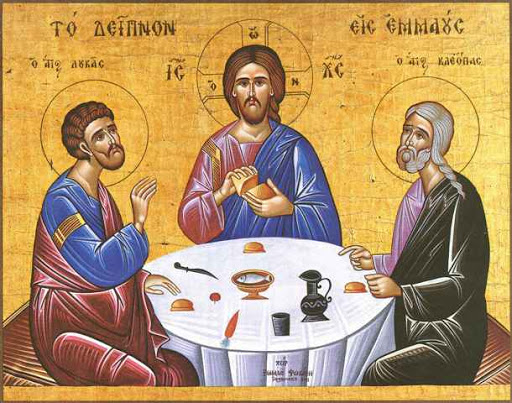
In the next part of the story, we find a model for our Liturgy of the Eucharist. The disciples invite the stranger (Jesus) to stay with them. During the meal in which they share in the breaking of the bread, the disciples’ eyes are opened; they recognize the stranger as Jesus. In the Eucharist too we share in the breaking of the bread and discover Jesus in our midst. Just as the disciples returned to Jerusalem to recount their experience to the other disciples, we too are sent from our Eucharistic gathering. Our experience of Jesus in the Eucharist compels us to share the story with others.
From Emmaus to the world:
To announce the experience with the Risen Lord
Romeo Ballan, MCCJ
The Easter experience of the two disciples of Emmaus (Gospel) is clearly discernible by the stages that have recurred in the spiritual journey of many people. This is a symbolic and emblematic example. The evangelist has built his whole story around the icon of a journey: an outward journey and a return journey. A journey that moves from Jerusalem (with feelings of disappointment, sadness, isolation) and a return journey (with open eyes, hearts on fire, a quick pace, a joy to bring a ‘good news’). The road to Emmaus is, indeed, the journey of every Christian and every man. Luke’s text also indicates a clearly missionary and catechetical methodology, where we find the stages of a pastoral method: see, judge, act and celebrate.
– 1. The experience starts from a situation of disappointment and failure: the two disciples, unable like the others to make sense of the events of that Easter, isolate themselves by getting away from the group (v. 13-14), have a sad face (v. 17), “our hope had been that… two whole days have gone by since…” (v. 21).
– 2. The change of scenario occurs with the coming up of a traveller, who seems to be ignorant of the facts of the day (v. 15-18). The two agree to share the journey with him and listen to him. Thus they enter into a stage of enlightenment on the events, made by Jesus himself, who “explained to them the passages throughout the Scriptures that were about himself” (v. 27).
– 3. Now they are ready for the celebration and contemplation: the hearts of the two disciples are on fire (v. 32); they ask the Risen Lord: “Stay with us” (v. 29); they are at table together (v. 30); Jesus performs the ritual act of taking the bread, recites the blessing, breaks it and gives it (v. 30); their eyes are opened and they recognise him (v. 31).
– 4. And finally comes the time to act, the time of the mission: they set out that instant and return to Jerusalem, as an imperative that is born from their encounter with Jesus. They rejoin the community of the other disciples and they share their experiences with the Risen Lord (v. 33-35). Now the disciples are assured that Christ is risen and are all witnesses, as Peter boldly proclaims (I Reading) on the square of Jerusalem on the morning of Pentecost (v. 32).
What has changed? The Jerusalem-Emmaus journey, the landscape, the miles there and back, the events of Jesus’ death and the empty tomb… These events are still the same. But now there’s a new perspective: faith which has permanently changed the way to see and experience these events. Faith makes the difference. “The Gospel narrative attributes the transformation to the explanation of Scripture… The journey, opened up by the word of Jesus, crosses the desolate return journey of the two disciples back to Jerusalem and turns it into a journey of hope, a progressive drawing near to God’s plans, a pilgrimage to the Passover, the Eucharist, the Church and the mission to the ends of the earth” (Cardinal Carlo M. Martini).
“Stay with us, it is nearly evening” (v. 29). This is the first and the most touching prayer of the Christian community addressed to the Risen Lord. Pope John Paul II has used these words to entitle an apostolic letter, commenting, from the Eucharist and Mission viewpoint, the story of the two disciples of Emmaus, and presenting the Eucharist as a mystery of light, source and manifestation of communion, strength and plan of mission. We let ourselves be guided by the Pope who, in the letter Mane Nobiscum Domine (Stay with us, Lord) highlights the missionary zeal made present in the Eucharist.
On the road to Emmaus
It is the month of April in the year 30 A.D. Two disciples of Jesus who lost all their hope with the killing of Jesus their teacher and prophet, are on their way back to Emmaus, a village twenty miles away from Jerusalem. Luke’s Gospel says Emmaus was just seven miles from Jerusalem, which is a mistake. This episode alsoraises in us a number of questions: Why couldn’t the disciples recognize Jesus during their whole day’s journey and conversation? The text says that their eyes were kept from recognizing him – a kind of blindness!
It indicates that the Risen Christ had something different in his appearance, that Mary Magdalene, Peter and other apostles could not recognise him when they first met him after the resurrection. Because, resurrection from death does not mean going back to one’s previous life, but entering the World of God.
We must also pay attention to the sentence describing Jesus at table with thedisciples: “When he was at table with them, he took bread, said the blessing, broke it, and gave it to them” – Luke explicitly recreates the celebration of the Eucharist. While they were still on the road, Jesus presided over the liturgy of the Word: “beginning with Moses and all the prophets he explained to them in all the Scriptures” what was written about the Messiah [v. 27]. And later at the Breaking of the Bread, they recognise the Lord.
Luke wrote the Gospel around the years 80-90 A.D. Almost all the witnesses to the Risen Lord are by now dead. The rabbis taught that the Messiah would live a thousand years. They expected a glorious Messiah, a mighty and triumphant king.But, Jesus instead was defeated and killed. Their dreams are collapsed, and their plans have failed.
It is the story of the Christian communities of Luke. They are persecuted, victims of abuse. They see the victory of the evil; the wicked are better off than the pure in heart. They find themselves in the same state of mind as the disciples traveling to Emmaus. Many Christians behaved that way in the face of difficulties and persecution: some abandoned their communities; others refused the answers that came from faith.
It is our own story. We, too, are like the two disciples to Emmaus. We know well what Jesus did and taught. But this knowledge is incomplete. Without faith in the resurrection, our defeats are defeats, and life ends with death, a senseless tragedy.
An important element of this passage: the disciples on the road to Emmaus, as soon as they recognise the Lord, they rush to announce their discovery to their brothers and sisters and with them proclaim their faith: ‘The Lord is truly risen ….’
Why does a bride cry?
Fernando Armellini
The loved one experiences an irrepressible need to be on the side of the man she loves. In the silence of the night, she thinks of him. She says his name and dreams his caresses: “His left hand is under my head and his right hand embraces me” (Song 8:3). She is desolate unless she receives a message from him. When she hears his voice, she is seized by a tremor. She runs to open, turns the lock and unlocks the door. But the loved one is not there anymore. He turns, goes, and disappears and my soul goes after him (Song 5:5-6).“They have taken away my Lord” (Jn 20:13). —Mary Magdalene exclaims through her tears. The two disciples of Emmaus walk sadly. The women bowed their faces to the ground, looking for him who is alive at the tomb (Lk 24:5).
They are the living portrait of the community that does not notice any longer “the beloved of her heart.” With him every night was transformed into light, the sunset a prelude to dawn, the pain in the announcement of a birth, tears in the blossoming of a smile.
“Stay with us”—the bride begs—when the Lord appears to act “as if he were going farther.” He promised to stay with her, every day, until “the end of the world” (Mt 28:20). Why does he leave her alone? But it is not he who turns away, she is the one incapable of recognizing him.
As soon as he begins to explain the Scriptures, her heart starts to burn. As the beloved in the Song of Songs, she recognizes the voice of her beloved, and at the breaking of the bread, her eyes light up and recognize him. He had not left her; and will never leave her.
First Reading: Acts 2:14a,22-28
As on Easter day, today’s First Reading is also taken from a discourse of Peter. If these two passages are compared, one can easily verify that they follow the same pattern: they present the life of Jesus in four stages:
- They tell the wonderful works of good done by him.
- They indicate the people’s response to these gestures of love and salvation; instead of welcoming him, they rejected, crucified, and killed him because they deemed him an impostor.
- The stone of the tomb did not put an end to his story: God intervened and freed him from the power of death.
- In the end, we have a reference to the Scriptures: everything that happened was foretold by the prophets.
These speeches are not the transcript of what Peter said. They are a summary of the catechesis about Jesus given in the early days of the Church. This catechesis is placed on the lips of the first of the apostles to emphasize its importance and officialdom.
In the third part of the discourse (v. 24), God’s intervention on death is introduced with an image that, in the original Greek text, is particularly incisive. “God—Peter says—forced death to give birth.” The ancient people imagined that the fetuses were retained in the mother’s womb by laces that, at the time of childbirth, were broken thus causing pains. Death always wanted to hold Jesus in her womb, but God intervened. He removed the laces, untied, released, and made him be born. This was the most important of his works of power: from the womb of death he has drawn life.
Second Reading: 1 Peter 1:17-21
The baptismal catechesis that started last Sunday continues.
The preacher—who speaks in Peter’s name—invites the newly baptized to reflect on their status as children. You—he says—you are born again and now you can turn to God calling him Father. You have received from him a new life. That in which you’ve been introduced is a sublime condition, but it also entails serious responsibilities. It requires a coherent moral conduct. God is no respecter of persons. If, during your “pilgrimage” in this world, you will not be faithful to the baptismal commitments that you have taken, receiving the sacraments materially is of no use to you (v. 17).
Then the newly baptized are reminded of the condition they were in before becoming Christians. They led a dissolute life. They adapted themselves to the immoral principles learned from their pagan fathers. They were slaves subjected to a tyrant: sin. Their ransom is dearly paid for: Christ shed his blood to liberate them (vv. 18-19). The paschal lamb, white, without spot and without blemish that the people of Israel sacrificed during the celebration of Easter, was just an image. It is Jesus, the true Lamb without blemish who, with his own blood, redeems people from evil.
These are the exhortations with which the preacher of Rome encourages neophytes to lead a holy and blameless life. They cannot render vain the sacrifice of Christ.
Gospel: Luke 24:13-35
It is the month of April in the year 30 A.D. Two disciples of Jesus went to Jerusalem to celebrate the Passover. They have witnessed dramatic events: the execution of their teacher, a prophet, who was mighty in work and word.
The days of this sad feast passed. They prepare to return to Emmaus when, early in the morning, someone run towards them with the shocking news: the tomb was found empty. Some women claim to have had a vision of angels and that Jesus is alive. At home, however, they have families waiting for them. It is spring and it’s the time to harvest barley and they must leave. Along the way, a traveler joins them. He accompanies them and in the evening something extraordinary happens.
The story of the disciples of Emmaus is one of the most beautiful pages of the Gospels. It introduces in a celestial world, where dream, instead of being dissolved, is transformed into reality. After this lovely first impression, however, perplexities and questions arise: Where is Emmaus? There was, yes, but twenty miles from Jerusalem, not ten as the text says (Lk 24:13). Some ancient manuscripts, probably to remedy this difficulty, speak of one hundred and sixty stage (about thirty miles), but it will create another problem: it transforms the two disciples into marathon runners.
It is also unlikely that having heard that something extraordinary had happened (vv. 21-24) the two left without having first checked what could really have happened.
Why couldn’t they recognize Jesus in the traveler? What sense has a miracle of this kind: is it used to create suspense? One notices that the text does not say that Jesus was hidden under a false guise, but that their eyes were kept from recognizing him … and it will be important to establish the reason for this blindness.
Why is the name of the second disciple not told to us? Did Luke already forget it?
Back in Jerusalem, the two recount to the apostles their experience of the Risen One. They were informed that the Lord appeared also to Simon (vv. 33-35). Then the story continues. While they are gathered and are talking about these things, Jesus appears in their midst. Astonished and frightened, they are convinced of seeing a ghost. They are unable to believe that he is alive. To convince them, Jesus must eat of the bread and fish in front of them (Lk 24:36-42). The reaction of the disciples is really inexplicable. They seemed taken by surprise as if nothing had happened before.
These are just some of the difficulties that are raised by a literal interpretation of the text. But some indexes orient us toward a less superficial reading. How could one not notice, for example, that the sentence: “When he was at table with them, he took bread, said the blessing, broke it, and gave it to them” explicitly recalls the celebration of the Eucharist? And, before sitting down at the table, the mysterious traveler also presides over a solemn liturgy of the Word with its three readings (“and beginning with Moses and all the prophets he explained to them in all the Scriptures …” [v. 27]) and his good sermon (“Were not our hearts burning within us when he opened to us the Scriptures …” [v. 32]). In short, he officiated a full-blown liturgy.
Then again, the phrase: “Is it not written that the Christ should suffer all this, and then enter his glory?” (v. 26) is the unopposed proof that the person who is talking is the Jesus already ascended to heaven. This situation, more than that of the two disciples of Emmaus, resembles that of the Christians of the communities of Luke. Let’s try to rebuild it.
We are in Asia Minor in the years 80-90. Almost all the witnesses of the Risen Lord have already disappeared. The Christians of the third generation are asking themselves: will it be possible for us to meet the Lord? How to testify that he is alive if we have never seen him with our eyes, nor touched him with our hands, and have never sat at table with him? Would we be led to believe just from what others have told us, as what happens in the courts where judges put their trust in credible witnesses? This, however, cannot be called an act of faith, but it’s the conclusion of a reasoning of common sense. We also would like to really meet the Risen Lord.
Let’s reread Luke’s story as a response to the aspirations and expectations of these Christians.
We begin with the name. One of them is called Cleophas (a very well-known figure in the early Church because he was the brother of Joseph, the “father” of the Lord) and the other? The other, could be an invitation to every reader to insert one’s name. It is an invitation to go with Cleophas along the path that leads to recognizing the Risen Christ present where two are gathered in his name.
The two disciples are sad: they have seen the collapse of their dreams, the failure of their plans. They expected a glorious Messiah, a mighty and triumphant king but found themselves in front of a loser. The rabbis taught that the Messiah would have lived a thousand years, Jesus instead was dead.
It’s the story of the Christian communities of Luke. They are persecuted, victims of abuse. They see the triumph of the works of death; the wicked have the better situation over the pure in heart. They find themselves in the same state of mind as the disciples of Emmaus. They also stop with sad faces.
It is our story. We too find ourselves sometimes in the same state of mind. It happens when we have to admit that cunning prevails over honesty; when we are forced to acknowledge the lie becomes the official truth, imposed by those in power; when we see the prophets silenced or killed. Even then, we stop, sad, resigned in the face of an inevitable reality, forced to admit that the new world announced by Jesus probably would never come true.
But can a community born of faith in the Risen One indulge in these thoughts of death and give in to sadness? Are the sleepy and distracted but disappointed faces of the many participants in our Sunday assemblies mean anything? Are they signs of certainty in the victory of life or discouragement and despondency?
The two disciples of Emmaus are very familiar with the life of Jesus. They make a perfect summary of it, identical to what was taught in the catechism of the early Church (vv. 19-20), but their synthesis has a serious flaw. It stops upon seeing the triumph of death. “Our leaders—Cleophas explains—handed him over to be sentenced to death and then killed him” (v. 20) and three days have already passed. This death is to be considered final.
Luke deliberately puts on their lips the thoughts of many Christians of his communities. They know well what Jesus did and taught. They considered him a wise person, one who, with his messages of peace and love, has changed the hearts of many people, but he ended up in death like everyone else.
Whoever thinks in this way discovers only the outward appearance, the historical events in the life of Jesus. He does not have faith in him because he does not believe in his resurrection, which cannot be observed and demonstrated. The consequence of this incomplete knowledge is sadness. Without faith in the resurrection, defeats are defeats, life ends with death, and is a senseless tragedy.
How to get to this desperate situation?
The two of Emmaus have responsibilities. They have made mistakes.
First of all, they left the community whose members continued to search for an answer to what had happened. They preferred to go on their own, convinced that no one can make sense out of certain tragedies.
They have not verified if the women’s experience could be enlightening for them.
Many Christians were behaving as such in the time of Luke: in front of difficulties and persecutions, some abandoned their communities; others, almost on principle, refused the answers that came from faith. They did not even verify if they could have logic and sense.
A third error: The two disciples of Emmaus did not have the slightest doubt that their ideas about the triumphant messiah could be wrong. They were stubbornly clinging to tradition, to what they had been taught. They were impervious to the surprises and novelties of God.
Jesus does not abandon the people who choose the roads that lead to sadness. He becomes their companion in the journey.
As it always happens, the Risen One is not recognizable (someone thinks of seeing a ghost; Mary Magdalene takes him for a gardener; by the lake, he is considered a skilled fisherman). It’s not about miracles. It is a way to present the new situation of one who entered into the glory of God. It is a completely different condition from that of this world. The life of the resurrected ones is not an extension of the present life and the human eyes cannot capture it. That is the reason why the evangelists say that it was Jesus, but he was no longer the same. It was Jesus whom they touched, with whom they had eaten and drank. He was the one who was dead: “Look at my hands and my feet and see that it is I myself” (Lk 24:39)—but he was completely different.
How do Cleophas and the unnamed disciple come to discover that Jesus, the loser, is the Messiah? How can they understand that life is born from death?
The way that the Risen Lord makes them travel is through the Scriptures: It is the Word of God that reveals the mystery.
Not having understood the Bible, the two disciples reason out as men. They cannot see with God’s eye that which happened. For this Jesus reminds them: “How dull you are, how slow of understanding! Is it not written that the Christ should suffer all this, and then enter into this glory?” (vv. 25-26).
The way of the cross is inconceivable and absurd for people. The only one who reads the Scriptures discovers that God is big enough to be able to extract from the great crime of men his masterpiece ofsalvation. It is not enough to read the Word of God. One must understand it. For this, it is necessary that somebody explains it and possibly does it, not as one who transmits an arid theological culture but as one “warming the heart.”
In the evening of that first “Sunday,” the disciples arrive home and Jesus is with them. When they were at table, he “took the bread, said a blessing, broke it, and gave each a piece” (v. 30). It is easy to understand what Luke wants to teach: the eyes of a Christian open and recognize the Risen Christ during the Sunday liturgical celebration.
In the story of the disciples of Emmaus, all elements of the celebration of the Eucharist are present: there is the entrance of the celebrant, then the Liturgy of the Word with the homily, finally, “the breaking of bread.”
Only at the time of the Eucharistic communion are the eyes of the disciples opened and they realize that the Risen One is in their midst. But without the Word, they would not have come to discover the Lord in the Eucharistic bread.
All must experience the encounter with the Risen One.
In the communitarian celebration they can contemplate him through the sacramental signs, but when they recognize him, he does not disappear, even if the physical eyes cannot see him.
A final important element of this passage: the disciples of Emmaus, as soon as they recognized the Lord, rush to announce their discovery to their brothers and sisters and with them proclaim their faith: “The Lord is truly risen …” It is, we can say, the final hymn with which the Sunday celebration concludes. Its notes accompany the disciples for the rest of the week. They are the expression of the joy that they will bring to all people.
I said that Luke wrote for the Christians in the communities of the years 80-90 A.D., and aimed to offer them the way to meet and recognize the Risen Christ in the “breaking of bread.” The way we are invited to travel today is not different.
Fernando Armellini
Italian missionary and biblical scholar
https://sundaycommentaries.wordpress.com
Two key experiences
Jose Antonio Pagola
With the passing of years, there spontaneously arose a very real problem in the Christian communities. Peter, Mary Magdala and the other disciples have lived through very «special» experiences of encounters with Jesus alive after his death. Experiences that for them brought them to «believe» in the Risen Jesus. But those who joined the group of followers later on, how could they awaken and nourish that same faith?
This is also our problem today. We haven’t lived through the encounter with the Risen One that the first disciples did. What experience can we count on ourselves? This is what the story of the disciples of Emmaus presents.
Two people are walking toward their homes, sad and heartbroken. Their faith in Jesus has been extinguished. They no longer hope anything about him. All has been an illusion. Jesus, who follows them without revealing himself, reaches them and walks with them. Luke presents the situation thus: «Jesus came up and walked by their side; but their eyes were prevented from recognizing him». What could happen to cause them to experience his living presence next to them?
What’s important is that these disciples aren’t forgetting about Jesus; «they are talking and discussing» about him; they remember his «words» and his «actions» as those of a great prophet; they let an unknown person go on explaining what had happened. Their eyes don’t open right away, but «their heart begins to burn within».
It’s the first thing we need in our communities: remember Jesus, plunge into his message and his deeds, meditate on his crucifixion… If in a given moment Jesus moves us, his words reach us within and our heart begins to burn: this is the sign that our faith is waking up.
It’s not enough. According to Luke, what’s needed is the experience of the Eucharistic meal. Though they still don’t know who he is, the two walkers feel the need for Jesus. They enjoy his company. They don’t want him to leave: «Stay with us». Luke underlines it joyfully: «Jesus went in to stay with them». In the meal their eyes are opened.
These are the two key experiences: feel our heart burn when we remember his message, his deeds and his whole life; feel that when we celebrate the Eucharist, his person nourishes us, strengthens us and consuls us. That’s how faith in the Risen One grows in the Church.
José Antonio Pagola
https://www.feadulta.com
