The centenary of World Mission Day is not simply an anniversary to be celebrated, but an opportunity to look back over a century of transformation in the way the Church understands and lives out its mission. From “mission lands” to an awareness of a Church that is missionary in its entirety, from a one-way sending forth to an exchange between Churches, from proclamation understood chiefly as transmission to mission lived also as listening, encounter and service: one hundred years of history now confront us with a decisive question. What does it mean to be missionaries in the world of our time?
When, in 1926, Pius XI established the World Day for the Propagation of the Faith, the missionary world appeared to have a clearly defined geography. On the one hand were mainly the Churches of long-standing Christian tradition, particularly those of Europe, from which priests, men and women religious, and lay people departed; on the other were vast areas of Africa, Asia, Oceania and Latin America regarded as “mission lands”.
Mission was identified above all with setting out: crossing borders and oceans, learning new languages, proclaiming the Gospel, forming Christian communities, preparing catechists and local clergy, and opening schools, hospitals and dispensaries. It is a history of extraordinary generosity and sacrifice, which contributed decisively to the growth of the Church in many parts of the world.
But over the course of a hundred years, that geography has changed profoundly.
Communities that once depended to a large extent on the arrival of foreign missionaries have become mature local Churches. Dioceses, seminaries, religious institutes, universities and ecclesial communities deeply rooted in the cultures of different peoples have emerged. Many Churches that once “received” missionaries now send missionaries of their own.
An African priest may serve as a parish priest in Europe. An Asian religious sister may carry out her ministry in Latin America. Latin American missionaries may be sent to Africa or to other continents. Mission no longer moves in only one direction: it sets out from every continent and reaches every continent.
This is one of the great transformations of the past century: there has been a gradual shift from “the missions” to the mission of the Church.
The difference is not merely linguistic. Speaking of “the missions” suggested above all distant places and specialised people assigned to them. Speaking of the mission of the Church, by contrast, means recognising that mission belongs to the very nature of the Christian community.
It is not one activity among many. It is not a sector reserved for a few. It is a way of being Church.
The mission ad gentes naturally retains all its importance. There are still peoples among whom the Gospel is little known and Christian communities that are fragile. In the meantime, however, we have learnt to recognise other frontiers as well.
There are social, cultural and generational frontiers. There are religious indifference, urban peripheries, migration, loneliness, the world of young people and new digital environments. One may live in a city shaped by centuries of Christianity and still find oneself in missionary territory.
For this reason, mission does not necessarily begin by crossing an ocean. It begins when a Christian community is willing to move beyond its usual boundaries, when it stops organising itself solely around those who already take part and asks whom it is failing to reach, who remains on the margins, and who is searching without finding anyone with whom to engage.
Over these hundred years, our understanding of who the protagonist of mission is has also changed.
For a long time, the missionary imagination was dominated by the figure of the person who left. Missionaries proclaimed the Gospel, founded communities and built institutions; other Christians accompanied them mainly through prayer and financial support.
The Church’s journey through the twentieth century brought about a further awareness: every baptised person is involved in mission.
Not everyone is called to leave. Not everyone carries out the same task. But no one is merely a spectator.
The vocation of those who physically cross borders remains an especially powerful sign, because it makes visible something that concerns the whole Christian community: the willingness to go beyond oneself in order to encounter the other.
Every Christian, in different ways, has a frontier to cross: the distance separating us from the poor, mistrust of the foreigner, indifference towards those who do not believe, or the inability to understand a different generation or culture.
Over the course of the century, the style of missionary activity has also changed profoundly.
History should not be idealised. Modern evangelisation sometimes took place within colonial contexts and could adopt attitudes shaped by a belief in the superiority of Western culture. In some cases, the proclamation of the Gospel and the transmission of European cultural models were difficult to distinguish from one another.
The growth of local Churches and the encounter with different cultures gradually changed this perspective. It became increasingly evident that evangelising does not mean exporting a civilisation.
The Gospel does not belong to any particular culture. It can take root among different peoples, languages and traditions, and find original forms of expression in each of them.
From this there also emerged a new awareness: the missionary is not only someone who brings something, but also someone who receives.
Entering another culture means learning its language, listening to its questions, understanding its history, respecting its rhythms and recognising the good that is already present. God does not begin to act in a place when the missionary arrives.
This conviction radically changes the style of encounter. It is not enough to speak: we must listen. It is not enough to have answers: we need to understand the questions. It is not enough to arrive with programmes already defined: we must share in people’s lives.
Mission thus becomes ever more clearly an encounter.
The relationship between evangelisation and human development has also deepened.
The missionary history of the twentieth century is marked by schools, hospitals, dispensaries, childcare centres, educational programmes and social initiatives. For millions of people, the first face of the missionary Church was that of someone who taught, cared for them, accompanied them or defended the dignity of the most vulnerable.
Over time, it became increasingly clear that these actions are not simply secondary tools of evangelisation.
Caring for the person is part of mission.
To proclaim a God who loves humanity means making that love visible in the concrete conditions of human existence.
The Church cannot reduce itself to a humanitarian organisation, but neither can it proclaim the Gospel while remaining detached from hunger, illness, war, injustice and marginalisation.
From this comes another decisive transition: the move from assistance to reciprocity.
For a long time, missionary cooperation was represented according to a simple model: wealthier Churches offered resources, personnel and structures; Churches in mission territories received this support.
Financial solidarity remains necessary, but today we know that this relationship cannot be described solely in terms of those who give and those who receive. Every Church has something to give and something to receive.
A community poor in material resources may possess an extraordinary wealth of faith, vocations, community life and resilience in the face of hardship. A materially wealthy community may possess structures and expertise but be experiencing spiritual or vocational fragility. Exchange therefore becomes reciprocal.
Churches that once received priests from Europe now send priests to Europe. Young Churches offer Churches of long-standing Christian tradition a witness of faith and vitality that can help them rediscover what they are in danger of losing.
To evangelise, in this sense, also means allowing oneself to be evangelised.
This reversal is particularly evident in Europe itself. For generations, the European continent was one of the principal points of departure for Catholic mission. Today it is discovering that it too is mission territory.
Secularisation, the decline in religious practice, the difficulty of transmitting the faith and growing cultural plurality have radically changed the context.
The issue is not simply to bring people back to practices they have abandoned. It is to find languages and forms of presence capable of meeting men and women for whom many words from the Christian tradition no longer have an immediate meaning.
Mission therefore also becomes a question of communication and credibility.
It is not enough to say things that are true. They must be made understandable. And it is not enough to make them understandable: they must be supported by witness.
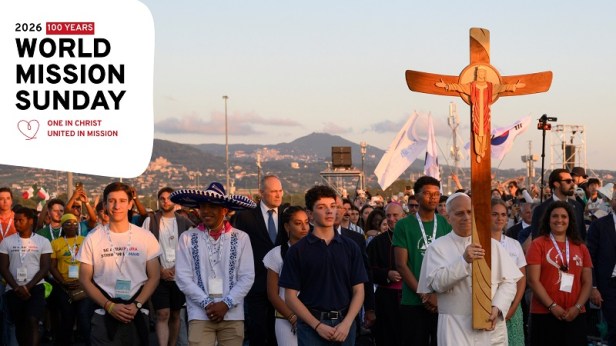
It is here that the centenary theme, “One in Christ, United in Mission”, acquires particular force.
Christ comes before strategy.
Christ is the origin of mission, because it is he who sends. He is its content, because the Church does not proclaim itself. He is its style, because the Gospel cannot be proclaimed in ways that run contrary to the freedom and dignity of the person. And he is its horizon, because mission tends towards communion between humanity and God, and among human beings themselves.
This centrality also enables us to understand more clearly the value of unity. A community that is divided, closed in on rivalries or primarily concerned with its own preservation may multiply its initiatives, but it will find it difficult to offer convincing witness.
Communion is already mission.
And it is so in a particular way in an age marked by polarisation, nationalism, wars and social fractures. A community in which people of different origins, cultures and circumstances are able to recognise one another as brothers and sisters possesses a power of proclamation that precedes words.
Unity, however, does not mean uniformity.
Another fruit that has matured over the course of the century is the discovery of the plurality of the Churches. Africa, Asia, Latin America and Europe do not live and express the faith in the same way. Differences are not a problem to be eliminated, but a richness to be brought into communion.
Mission itself thus becomes a collective endeavour.
Some proclaim, some educate, some provide care, some study, some accompany the poor, some build bridges between cultures, some pray, some offer financial support, and some bear witness to the Gospel through their work and relationships. No single voice can exhaust the mission of the Church.
Prayer, too, retains a decisive centrality within this framework.
In an age that tends to measure everything in terms of results, mission may be tempted to rely chiefly on planning and efficiency. These are necessary tools, but they are not the source of Christian action.
Prayer reminds us that God’s action precedes that of the Church, brings distant communities close to one another, and transforms unknown problems into shared responsibilities.
A century of missionary experience also reveals the power of small gestures.
A prayer, a small offering, a formation meeting, a child discovering how children of the same age live on the other side of the world: none of these gestures, taken alone, seems capable of changing history.
Yet mission lives precisely through a multitude of connected gestures. It teaches a logic different from that of seeking to be the main protagonist: no one can do everything, but everyone can take part.
After a hundred years, then, mission appears no less necessary. Rather, it has become more universal and more complex.
We no longer possess a simple map that clearly distinguishes countries that evangelise from countries that are to be evangelised.
Mission crosses villages and great cities, societies of long-standing Christian tradition and territories where the Gospel is little known. It encounters the great religions and new forms of unbelief. It passes through migration, youth cultures and the digital continent.
The question itself has also changed.
In 1926 it was natural to ask above all: where should we send missionaries?
In 2026 we must also ask: how must a Christian community change in order to become missionary itself?
This is perhaps the most demanding question posed by the centenary.
It is not enough to increase activities. A missionary Church must learn not to live only for itself.
It must ask who is missing, whom it is failing to reach, which questions it is not hearing, which languages it does not understand and which frontiers it is afraid to cross.
The past century shows that the idea of mission has been able to undergo profound transformation without losing its heart.
It has moved from “mission lands” to the awareness of a wholly missionary Church; from a one-way sending forth to exchange between Churches; from the transmission of models to inculturation; from assistance to reciprocity; from an almost exclusive focus on those who leave to the co-responsibility of the entire People of God; from proclamation understood mainly as words to witness expressed also through listening, service, dialogue and the promotion of human dignity.
Yet its core remains the same.
Mission is born from an encounter with Christ and from the conviction that the gift received cannot be kept to oneself.
For this reason, the centenary does not close a chapter. It opens up new questions. How can the Gospel be proclaimed in a world in which geographical distances have grown shorter while other distances have increased? How can communion be witnessed to in increasingly polarised societies? How can we encounter without imposing, engage in dialogue without giving up proclamation, listen without losing our identity? How can we learn from Churches that were once regarded merely as recipients of missionary activity?
Mission remains young for as long as it compels the Church to ask itself these questions.
For as long as it keeps the Church moving.
For as long as it prevents the Church from identifying the Gospel with a single culture.
For as long as it reminds every community that it has something to offer and something to receive.
After a hundred years, the missionary frontier is not found only where the Gospel has not yet been proclaimed.
It is wherever the Church is called to go beyond itself in order to encounter the men and women of its time.
This is perhaps the most important legacy of a century of mission: the increasingly clear understanding that mission is neither one sector of ecclesial life nor an extraordinary task entrusted to a few.
It is the movement through which the Church, going beyond itself to encounter the world, continues to become what it is called to be.
