One of the twentieth century’s most widely loved saints, Thérèse of Lisieux hardly fits the conventional image of the mystic. There are no spectacular ecstasies, visions or supernatural phenomena at the heart of her story. Instead, her “little way” places the experience of God within ordinary life, vulnerability, trust and self-surrender. Her spiritual journey — from an intense desire for holiness to the profound darkness of God’s apparent silence — gives her an unexpectedly contemporary voice.
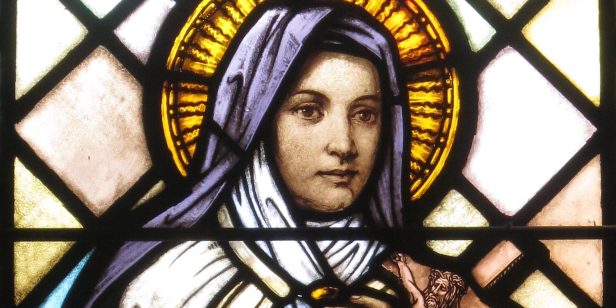
St Peter’s Catholic Church, Millersburg, Ohio – Thérèse of Lisieux © Nheyob/Wikimedia
Translation of:
Teresa de Lisieux
Dominique Salin
https://www.laciviltacattolica.es
N.B. The notes apparatus has been omitted from the translation.
A mystic — really? The most famous saint of the twentieth century, certainly. But a mystic? In traditional representations of mystical experience, what strikes ordinary people above all is the extraordinary, the spectacular, the “supernatural”. The supernatural makes itself visible through ecstasy, rapture, levitation and stigmata. This language of the body is echoed by articulated, sometimes obscure speech that likewise seems to come from another world: the language of prophecy, oracle and glossolalia. Not to mention, of course, “miracles”: healings, bilocations and so forth.
None of this is found in Thérèse of Lisieux. There is no observable supernatural element, only what she calls her “little way”, her “little doctrine”: what her sisters in the community came to call “the way of childhood”, although Thérèse herself never used that expression. Can the “little way” — this consecration of the banal, the everyday, the simple, of whatever does not exceed the norm, in short, of the insignificant — truly be regarded as a path of mystical experience? Perhaps it can: an experience attuned to our own age.
A successful saint
If there is anything extraordinary and “miraculous” in Thérèse’s story, it lies first of all in the publishing success of Story of a Soul. A year after her death, the book was printed in 2,000 copies. Its principal destination was other Carmelite convents and friends of the Carmel. It was customary, after the death of a Carmelite nun, for a “circular” to be distributed among other Carmels and their associates: a kind of obituary that often included notes and writings by the deceased. It was in this spirit that Thérèse wrote her final autobiographical work, Manuscript “C”, three months before her death, at the request of the prioress. Thérèse was perfectly aware that the account of her life would be used to prepare this kind of obituary. There is therefore no miracle or prophecy in the words she spoke during her final days about the publication of her writings and the effect they might have on souls. When she calmly says that the reading “will do much good to souls”, she is of course thinking of the Carmelites and of the network of friends and benefactors who would receive her obituary. From her deathbed she added: “There will be something for every taste, except extraordinary ways” (9 August 1897).
Who could then have suspected that these writings would move beyond the restricted circle of friends of the Carmel, resonate so widely and become a mirror in which an entire century would recognise itself? Within a few months, the initial 2,000 copies had sold out. By the end of that year, sales had already reached 4,000. Twenty-five years later, when the decision was made to publish the Novissima Verba (“Last Words”), which were also enormously successful, Story of a Soul had sold 200,000 copies — an extraordinary figure for the period. Two years after Thérèse’s death, pilgrims were already coming to pray at her grave, accounts of miraculous healings were beginning to circulate, and Story of a Soul was being translated into English. Such is the power of the written word. The real miracle, if it can be called that, lies in the extraordinary speed with which Thérèse’s image spread. During the First World War, her photograph was carried in the wallets of soldiers on both sides, French and German alike.
How can such success be explained in a life as brief and apparently uneventful as that of Thérèse Martin, who died at the age of 24? It has sometimes been suggested that the time had come for a reaction against Jansenism, which had long constricted Catholic piety. The “way of charity” answered the unconscious expectations of popular devotion. Religious feeling could project itself on to a figure who was simultaneously feminine and childlike, virgin and little girl, fitting perfectly with the sentimentalism characteristic of a certain Belle Époque aesthetic, especially as illustrated in painting and literature by the final phases of Pre-Raphaelitism and Symbolism.
There is probably some truth in this kind of explanation. Yet Thérèse’s success has far outlived fin-de-siècle sensibility, the reaction against Jansenism and the Victorian spirit that had poisoned the bourgeoisie. Fifty years after her death, and still today, Christian sensibilities that can hardly be described as sugary or decadent continue to find in her writings reasons to live and to believe. One example is the Mission de France, which in 1941 placed its existence and spirituality under the sign of Thérèse at Lisieux. This mission certainly did not represent an especially sentimental form of Christian sensibility. Thérèse — already patron saint of the missions alongside St Francis Xavier — was proclaimed a Doctor of the Church by John Paul II in 1997. In short, the entire twentieth century seems to recognise in this “little flower” the strong sap capable of nourishing it.
Her experience is found above all in her writings. Only for around the past fifty years have we been able to read them in their authentic form. Story of a Soul is not the original text but a compilation and rearrangement of Thérèse’s three writings, Manuscripts A, B and C. Taken together, her writings form a remarkable body of work, especially for someone who died at 24, had left school at 13 and was neither an intellectual nor a great reader. Life in Carmel also left her little time to write, roughly one hour a day.
What do these writings tell us? Above all, they speak of a God who hides in the everyday, the banal, the insignificant, the small and sometimes the apparently irrelevant. Many people, encountering Thérèse’s writings without preparation or commentary, simply let the book fall from their hands. For fifty years historians have had to work hard to draw out from these apparently saccharine texts the extraordinary spiritual experience they express, an experience that lies between the lines. For half a century Thérèse was admired for reasons that were not always the right ones. Theologians did not take her seriously until Urs von Balthasar wrote about her in 1950.
Choosing everything
Two famous expressions of Thérèse can serve as an epigraph for her brief life and personality. The first comes from her earliest childhood, from an incident which, she says, sums up her whole life. One day her sister Léonie told her she wanted to give her a present and asked her to choose an object from among the little treasures in a basket. Thérèse exclaimed: “I choose everything!” and took the whole basket. The saint comments: “This little episode from my childhood is a summary of my whole life. Later, when I understood what perfection was, I realised that to become a saint one had to suffer greatly, always seek what was most perfect and forget oneself. I understood that there were many degrees of perfection and that each soul was free to respond to Our Lord’s calls, to do little or much for Him, in a word, to choose among the sacrifices He asks of us. Then, as in the days of my childhood, I exclaimed: ‘My God, I choose everything. I do not want to be a saint by halves.’”
Her other expression occurs in the equally famous passage in which she recalls discovering the way of Love. She feels within herself the vocation of all vocations: warrior, priest, apostle, doctor and martyr. Then she discovers that her vocation contains all the others: “Yes, I have found my place in the Church, and this place, my God, You Yourself have given me: in the Heart of the Church, my Mother, I will be Love… Thus I will be everything… thus my dream will be fulfilled!” “I choose everything!” “I will be everything!” For the psychologist, what is expressed here is more than the classic megalomania of childhood: it is a formidable will to live, an affirmation of self. Thérèse’s existence was a triumph over the desire for death.
Desires for death
Jean-François Six, in his book on Thérèse’s childhood, and Jacques Maître have clearly shown the terrifying weight of death in the desires of Thérèse’s parents, especially her mother — an unconscious burden of death, of course. It should be remembered that Louis and Zélie Martin — who married relatively late and both regarded themselves as cases of unfulfilled religious vocation — spent the first six months of married life in complete continence, apparently through the will of one and the naivety of the other. Following the advice of a confessor, they put an end to this state of affairs, and over thirteen years Zélie gave birth to nine children, of whom only five survived. Thérèse was the last. She bore the name of another little Thérèse, born and dead three years before her. Three other children — two boys and a girl — also died young. Four “little angels” were waiting for her in heaven. This expectation marked her childhood deeply. A longing for heaven was felt very early in the family.
When Thérèse was born in 1873, her father was 50 and her mother 41. Zélie was exhausted by pregnancy and, above all, by her work: she ran a team of lace-makers. It was demanding and profitable work: within a few years — according to biographers’ calculations — Zélie’s efforts had made her husband a prosperous property owner. But she had literally worked herself to death: she died of cancer at 45. Around the cradle of little Thérèse were four sisters, all of whom would eventually become nuns:
- Marie, of the Sacred Heart, aged 13. She was the second to enter Carmel, when Thérèse was 13.
- Pauline, Mother Agnes, aged 12. Thérèse chose her as a mother figure. Pauline was the first to enter Carmel, when Thérèse was nine. This event marked the beginning of Thérèse’s vocation.
- Léonie, aged 10. She was the last to become a nun, though not a Carmelite but a Visitandine, two years after Thérèse’s death, following a difficult childhood and much uncertainty about her vocation.
- Céline, Sister Geneviève, aged four. She entered Carmel after Thérèse, who would become her novice mistress.
If there had been so much death before Thérèse, it was because her mother’s womb seemed to distil death. Most of her children suffered from enteritis, a serious inflammation of the intestine. Thérèse nearly died of it. She was a survivor. When her mother conceived her, she already knew that she had had a breast tumour for years, from which she would soon die. Thérèse’s childhood is a succession of victories over death. Three in particular, as we shall see. Above all, Thérèse represents a formidable desire for life.
Desire for life
How did Thérèse escape death? The first time, by refusing her mother’s poisoned breast. At 15 days old she showed symptoms of enteritis. At one month she was “very ill”. At 40 days she refused the breast and risked starving to death. Her exhausted and desperate mother turned for help to a wet nurse, Rose Taillé, whom she virtually dragged back to the house. Thérèse latched on to Rose’s breast and fed greedily. She was saved. She lived with Rose until the age of 15 months. She was a delightful child. This near-resurrection was Thérèse’s second birth. She would experience two more: two further victories over death on her path towards true life.
Thérèse, however, was not out of danger. Already psychologically fragile, though in her earliest years displaying astonishing physical and moral vitality, she lost her mother to cancer at the age of four. A terrible ordeal. Yet it was later that, on two occasions, disturbing psychosomatic symptoms and remarkable recoveries appeared. The second crisis was triggered — as if by coincidence — when Pauline entered Carmel in the autumn of 1882: Thérèse was nine. During the winter she suffered headaches, insomnia and skin eruptions. Then came a nervous illness: convulsions and delirium. The doctor was extremely pessimistic. At Pentecost in 1883, Thérèse recovered through the statue of the “Virgin of the Smile”, placed above her bed. It was a spectacular but passive recovery; one might call it a passive victory. The third crisis, by contrast, was different: it was entirely psychological and spiritual.
This crisis was longer and more gradual. It all began with a crisis of scruples in May 1885, provoked by the retreat preparing for the renewal of Communion, preached by Father Domin at the school Thérèse had attended for three years. His preaching might be described as “terroristic”: “Sin is everywhere!” Thérèse was 12. She was seized by tormenting scruples revolving around one question: “Was my nervous illness in the winter of 1882 real? Did I not pretend to be ill? Did the Virgin really cure me?” The crisis began in the winter of 1885-86 with unbearable headaches. Thérèse had to leave school and never returned. In the summer of 1886 she suffered another shock when she learned that Marie, who had been a second mother figure to her, was leaving.
In October, through her pleas to her “little angels”, she was freed from her scruples. It was a first step. “I was truly unbearable,” she says, “because of my excessive sensitivity.” For the slightest reason the “little queen” would cry, and then “cry because she had cried”. At Christmas 1886 the “miracle” occurred. God made her “grow up in an instant […]. He made me strong and courageous, He clothed me in His armour […]. The source of my tears dried up […]. It was on 25 December 1886 that I received the grace of leaving childhood behind, in a word, the grace of my complete conversion.” How did it happen?
Returning from Midnight Mass came the ritual of the shoes by the fireplace, the equivalent of Christmas stockings. Thérèse heard her elderly father say, believing she could not hear him: “Well, thank goodness this is the last year…” She was 13. She did not collapse. “Holding back my tears, I went quickly down the stairs and, controlling the beating of my heart, took my shoes […]. Little Thérèse had recovered the strength of soul she had lost at the age of four and a half, and she would keep it for ever!” Thérèse stresses the definitive character of her conversion: “On that night of light began the third period of my life, the most beautiful of all.” That very day, a few hours later, Paul Claudel, standing near the second pillar from the entrance to the choir of Notre-Dame Cathedral in Paris, heard the children singing the Magnificat at Christmas Vespers and received the gift of faith in God: faith in what he would call “the eternal childhood of God”. Thérèse left childhood behind. Or rather, she left childishness behind in order to enter true spiritual childhood.
The rest is well known. First came her entry into Carmel after the famous journey to Rome. When she took the habit, her father was committed because of dementia. Thérèse made her profession at 17. In 1895 she wrote Manuscript “A”, recounting her childhood, youth and entry into Carmel. At Easter 1896, aged 23, she suffered her first haemoptysis. She entered the spiritual night from which she would never emerge, what she called her “trial of faith and hope”. In September, during her retreat, she wrote Manuscript “B” — her doctrine, her “little way”, the way of love — for her sister Marie. In April 1897 she began the life of an invalid. Pauline started recording her words. In June she was moved to the infirmary, where she wrote Manuscript “C” in pencil at a rate of two pages a day. Finally, on 30 September 1897, she died from asphyxiation after atrocious suffering.
Desires for holiness
“I have always wanted to be a saint.” In Thérèse, remarkably, the desire for life very quickly took the form of a desire for holiness, and for holiness in its most “militant” version: that of Joan of Arc. Joan had not yet been canonised. Ever since the historian Michelet had rescued her from purgatory, she had become a figure of great importance to the age, among Catholics and non-Catholics alike, in a context of secularisation. Thérèse herself describes the origin of this desire in her earliest childhood reading: “When I read accounts of the patriotic deeds of French heroines, especially those of the Venerable JOAN OF ARC, I felt a great desire to imitate them. I seemed to feel within myself the same ardour that inspired them […]. I thought I was born for glory.” In 1888 she told her father: “I shall try to be your glory by becoming a great saint.” The following year, in a note to a Carmelite, she wrote: “Ask Jesus that I may become a great saint.” The quotations could be multiplied. Always: “a great saint”. Vehemence and persistence in her desire, expressed with clarity and serenity.
It is no minor detail that the figure of the saint constantly occupying her mind was Joan of Arc: a girl-woman and a courageous soldier. Thérèse was fascinated by Joan. She devoted two plays to her, taking the leading role herself. There is a martial and chivalric vein in Thérèse. Recall the famous passage in which, reflecting on her vocation and evoking her “great desires”, she writes: “I feel the vocation of the Warrior, the Priest, the Apostle, the Doctor, the Martyr; in short, I feel the need, the desire to accomplish for You, Jesus, all the most heroic deeds… I feel in my soul the courage of a Crusader, of a Papal Zouave: I would like to die on a battlefield in defence of the Church…”
This should be taken literally. The spoilt and capricious child, predisposed to neurosis, found in her religious convictions an indomitable and serene energy that enabled her to become a true adult, facing in an unusual way the trials of monastic life — trials that were not spectacular, but exhausting. This is the portrait drawn by one Carmelite sister in a letter to a nun in another monastery, when Thérèse was 20: “Sister Thérèse of the Child Jesus. Novice and jewel of Carmel, its favourite […]. Tall and strong, with a childlike air, a tone of voice and even an expression that conceal the wisdom, perfection and insight of a person of 50. A soul always serene and master of herself, in everything and with everyone. A little saint one would send to God without confession, yet mischievous enough to do whatever she wants. Mystic and comic at once, everything suits her. […] She knows how to make you weep with devotion and, just as easily, laugh out loud during our recreations.” In this beautiful portrait, what is most striking is her perfect self-mastery. Even more astonishing is the energy that allowed Thérèse to face, alongside the rigours of community life, physical suffering and death by asphyxiation without resorting to morphine.
She herself describes her courage during the final days of her life. One must appreciate the modesty and humour of her words: “I have been told so often that I am brave, and as it is so little true, I said to myself: ‘Well, after all, one must not make people look foolish!’ And so, with the help of grace, I set about acquiring that courage. I did as a warrior would who, hearing himself praised for his bravery, although deep down he knows perfectly well that he is a coward, would eventually become ashamed of the praise and want to deserve it.” This strength in the face of impulses towards death lies at the heart of what Thérèse called her “little doctrine”, her “little way”.
The “little doctrine”
It should now be clear that Thérèse’s “little doctrine”, her “little way”, is neither the continuation nor the consecration of a childhood experience. On the contrary, it involves a break with childhood, with dreams of glory, heroism and heroic holiness that belonged to her early years. Thérèse came to recognise these dreams of heroism and holiness as an attempt to escape the anguish of death and finitude. The anguish of death and finitude, together with the “humiliation” they entail, are faced, accepted and endured with Jesus, who passed through the same anguish of death and finitude. The “little way” consists in abandonment into the hands of the Father, in absolute trust in Him. It means renouncing trust in oneself. Renouncing the idea that one is one’s own origin. Accepting that one receives oneself as a gift. The “little way” begins on the day when the soul can acknowledge, as Thérèse did, simply and joyfully: “I have no works.” That is to say: I have no works to present before God, no merits in which I can take pride; I stand before God with empty hands, like a child. This is the fundamental experience in its “theological” formulation: “I have no works.” The expression appears at both the beginning and the end of Thérèse’s writings.
At the very start, on the first page of Manuscript “A”, Thérèse reflects “on the mystery of her vocation, of her whole life and above all on the mystery of Jesus’s privileges for her soul…” Nothing could be more concise or more revealing. How does Thérèse express this mystery? She borrows her formula from St Paul in Romans: “God has mercy on whom He wills and compassion on whom He wills. Therefore it does not depend on human will or effort, but on God who shows mercy.” Nothing that I am is my own work, but God’s. At the end of Thérèse’s writings we find the same theological affirmation: “I have no works.” She writes: “I am very happy to be going soon to Heaven, but when I think of this word of the Good God: ‘Behold, I am bringing my reward with me, to give to each according to his works’, I say to myself that, as far as I am concerned, He will be in quite a predicament! I have no works! Therefore He will not be able to reward me ‘according to my works’… Well then! He will reward me ‘according to His own works’.”
What an astonishing exegesis of this verse from Revelation! Thérèse calmly contradicts the word of God. Or rather, she offers a remarkably free interpretation that in another age might have been accused of Lutheranism. God does not need our works; we shall not be judged according to our works. This conviction is deeply rooted in Thérèse. We find it, for example, in Manuscript “B”. She reads in Psalm 49: “I have no need of the goats of your flocks […]. Offer to God sacrifices of praise and thanksgiving.” And she comments: “That, then, is all Jesus asks of us. He has no need whatsoever of our works, but only of our love”; “Indeed, Jesus asks for no great deeds, but only abandonment and gratitude.”
St Paul had written of being “united with him, not with my own righteousness — the kind that comes from the Law — but with that which comes through faith in Christ, the righteousness that comes from God and is based on faith”. What Thérèse rediscovers, with a boldness and theological sense that might easily escape us, is essentially the Pauline doctrine of justification by faith: the triumph of love over justice. It is in this light that we must understand her famous offering of 9 June 1895: her “Offering of Myself as a Victim of Holocaust to the Merciful Love of the Good God”. If we focus only on the words “victim” and “holocaust”, we might recoil from a sacrificial and victim-centred theology, from that spirituality of suffering supposedly “typical of the period” within which the prayer might appear to belong. In reality, however, it is a prayer grounded in very firm theology: the human being cannot attain righteousness by himself, but only through God.
Thérèse begins by expressing her desire to serve God and do His will: “In a word, I desire to be a Saint, but I feel my powerlessness and I ask You, my God, to be Yourself my Holiness.” At the centre of her act of offering we find this affirmation: “At the end of this life, I shall appear before You with empty hands, for I do not ask You, Lord, to count my works. All our righteousness is imperfect in Your eyes. Therefore I wish to clothe myself in Your own Righteousness and receive from Your Love the eternal possession of Yourself.” This is the essence of Thérèse’s “little doctrine”.
Defeating the Angel of Judgement
This “little doctrine” of Love defeats Jansenism, which was still present in Catholic consciousness and sensibility at the beginning of the twentieth century. Thérèse seems to have been aware of this. Jansenism, as is well known, saw God above all as a judge. She explains why she felt the need to make this offering to love: “I was thinking of souls who offer themselves as victims to God’s Justice, with the purpose of diverting and drawing upon themselves the punishments reserved for the guilty; this offering seemed to me great and generous, but I was far from feeling inclined to make it.” An admirable euphemism. In reality, Thérèse utterly rejects this image of a punitive God, a Moloch demanding tribute from the guilty. This image was widespread in her time. Nor can it be said that the image of a perverse and sadistic God has entirely disappeared from our own consciousness. There were souls, as Thérèse says, willing to offer themselves as substitute victims. Not for me, she says; if others want to make such an offering, let them, but I shall not.
One did not have to look far. Carmelite historians have discovered that the day before Thérèse made her “Offering as a victim of holocaust to Merciful Love” — and not to Justice — a particular obituary had arrived at the monastery and was no doubt read in the refectory. It concerned Sister Marie of Jesus, a Carmelite of Luçon, who “very often offered herself as a victim to divine Justice”. The same account reveals that her agony on Good Friday 1895 was terrible. The dying nun cried out in anguish: “I am suffering the rigours of divine Justice!… Divine Justice!… Divine Justice!…” And again: “I do not have enough merits; they must be earned.” This may be edifying, but it is a very long way from Thérèse’s spirituality.
It is this spirituality of trust in spiritual poverty, this spirituality of abandonment, that ultimately explains the appeal of Thérèse. Yet this trust — another name for faith — was not as simple as it might seem. If this sketch of Thérèse’s portrait is not to remain too incomplete, we must also evoke the dark side of her experience of God. God had been the sun of her life; but the last eighteen months of her existence passed in a dense spiritual night whose end she would never see. It is important to understand the scope of this experience.
The trial of darkness: the hidden God
At the end of her life, Thérèse underwent what would later, in the century of the Shoah and the Gulags, become a widely shared trial: the mystery of a God who hides Himself in human history more than He “reveals” Himself within it. God had hidden Himself from her eyes and withdrawn from the gaze of her faith, to the point that Thérèse saw herself, in her own words, “sitting at the table of sinners”, placed among those who say: “God does not exist.”
Thérèse does not dwell at length on this experience. It is for us to read between the lines. Her account occupies four pages of Manuscript “C”. Suddenly, in the first days of Easter 1896, eighteen months before her death, the thought of Heaven, of God, of Christ — a thought that had always enchanted her and had been the source of her joy and spiritual life — ceased to say anything to her. God was silent. When she prayed, she found herself facing a wall. No opening. In her life she felt as though she were in a dark tunnel. Thick darkness, fog. These are her own words. Previously, she could not believe — to quote her directly — “that there were unbelievers without faith. I believed they were saying things contrary to their own thoughts when they denied the existence of Heaven.” Now, she says, “Jesus has made her feel that there really are souls who have no faith.” “When I wish to rest my heart, tired by the darkness surrounding it, by remembering the luminous homeland for which I long, my torment doubles. It seems to me that the darkness takes on the voice of sinners and says mockingly to me: ‘You dream of light, of a homeland filled with the sweetest perfumes; you dream of eternal possession of the Creator of all these wonders; you believe that one day you will emerge from the mists surrounding you. Go on, go on! Rejoice in death, which will not give you what you hope for, but an even deeper night: the night of nothingness.’”
There is also this confidence, spoken to Mother Agnes only a few weeks before her death: “If you knew,” she said to me, “what terrible thoughts obsess me! Pray a great deal for me, so that I do not listen to the devil, who wants to sow so many lies within me. It is the reasoning of the worst materialists that forces itself upon my mind: in the future, with continual progress, science will explain everything naturally; the reason for everything that exists and is still mysterious will become known, because there are still many things to discover…, and so on and so on.” No one around her suspected the depth of this night of faith. Thérèse remained so cheerful and serene, so full of humour. She truly knew and experienced what pure faith was. To believe when one has some reasons for believing may be an act of faith. But to believe when every reason for believing disappears is the beginning of pure faith, of mystical faith.
Conclusion
Thérèse’s experience points to ordinary life, with all its banality and apparent lack of meaning, as the place of mystical experience. Monastic life as family life. The mystery of Nazareth. Charles de Foucauld also lived this mysticism of burying love within the everyday and the simple. Our age recognises itself in this modesty. This kind of holiness speaks to all those who are tired of looking for meaning in the exceptional and wish to find it in ordinary life — even in what appears most insignificant within the everyday.
There is undoubtedly a deep affinity between Thérèse and our own age. One need only observe that in modern literature, in writers as different as Kafka, Bernanos, Ionesco and Beckett, the characters portrayed are far removed from the traditional heroes of literature. They are generally ordinary figures, “anti-heroes”, as has been said, for example, of Meursault, the protagonist of Albert Camus’s The Outsider. The same is true of Thérèse: at first sight she has nothing of the dazzling heroic saint, of a Joan of Arc or a Teresa of Ávila.
Modern literature, moreover, bears witness to what remains the great novelty and enigma of our time: the silence of God, the absence of God, the apparent absence of God from human history. Thérèse knew something of this. Today her everyday life is readily accessible to us thanks to the work of recent historians. They reveal a daily existence infinitely richer and more complex than even Thérèse’s own sisters supposed. Yet it was an ordinary life lived, in any case, under the sign of trust and abandonment to the God of mercy. A holiness within everyone’s reach.
