A truly hidden genocide: for 13 centuries, the Arab-Islamic colonizers of Africa deported between 12 and 18 million people, selling them into slavery. The study by anthropologist Tidiane N’Diaye has now arrived in Italy. A chapter of history deliberately ignored.
Anna Bono
29 August 2026
Courtesy of
https://lanuovabq.it
In Italy, one can say whatever one wishes against our civilization, and even when accusations and criticism are unfounded, those who make them suffer no consequences and are not held accountable. Speaking about the faults of the West, indeed, opens many doors. Criticizing other cultures, on the other hand, means venturing into a minefield. One risks accusations—and legal complaints—of racism, ethnocentrism, Islamophobia, when the Muslim world is involved, or fascism. The systematic delegitimization of the West, which has been under way for decades, in fact requires that, by comparison, only positive things be said about other cultures and societies or, when that is impossible, that nothing be said at all.
This is why practically no one ever talks, for example, about the Arab-Muslim slave trade in Africans. The publisher Massari has therefore shown courage in deciding to publish Tidiane N’Diaye’s book The Arab-Muslim Slave Trade: 13 Centuries of Racism and Extermination, which is being distributed in Italy in these weeks. The publisher has shown courage and deserves our thanks, because it is thanks to him that in Italy, too, it is finally possible to learn about this deeply painful chapter in the history of Black peoples and of humanity as a whole.
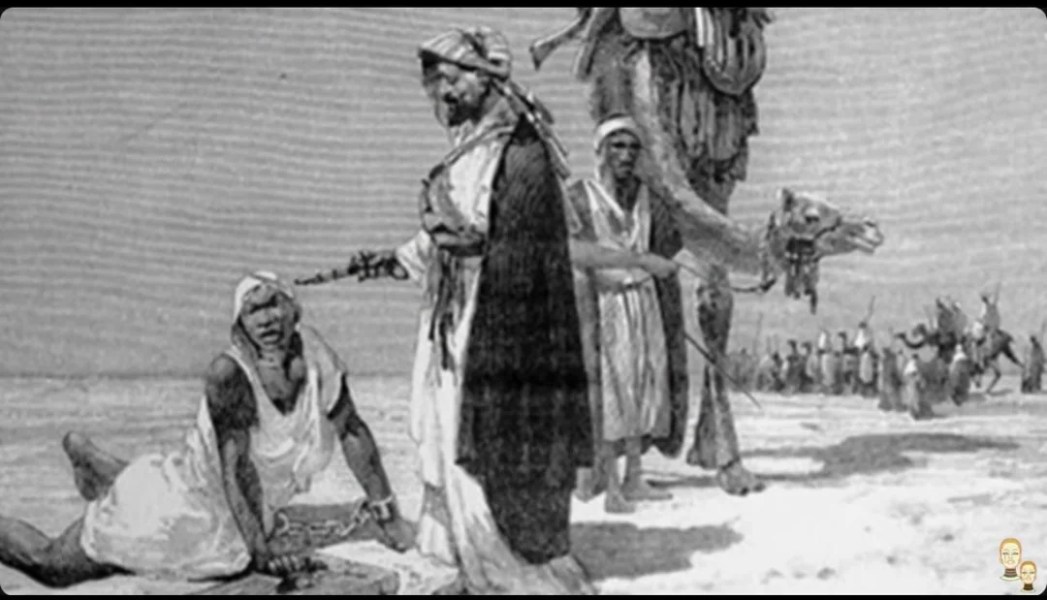
The Arab-Muslim slave trade in Africans lasted from the seventh to the twentieth century, without interruption. It enslaved and deported between 12 and 18 million people. The trade developed along two routes: an overland trans-Saharan route, which carried people from Central and West Africa to North Africa, and a maritime route, from the coasts of the Indian Ocean toward the Middle East, Persia and India.
It was made possible by another historical event that has been kept silent or even denied: the Arab-Muslim colonization of the African continent, which began shortly after the death of the Prophet Muhammad in 632. It is in fact widely believed that there was only one colonization of Africa, the European colonization that took place many centuries later, and the only deportation of enslaved Africans that is recounted and commemorated is the transatlantic slave trade, which brought approximately 12 million Africans to the Americas over four centuries, between the sixteenth and nineteenth centuries.
In 2007, the United Nations established the International Day of Remembrance of the Victims of Slavery and the Transatlantic Slave Trade, observed on 25 March every year. On that occasion this year, by 123 votes in favor, 3 against and 52 abstentions, the United Nations General Assembly approved a resolution submitted by Ghana recognizing the transatlantic slave trade as “the gravest crime against humanity.” Before the vote, Ghanaian President John Mahama had said: “Let it be written for the future that we did what was right for the memory of the millions of people who suffered the humiliation of the slave trade and of those who continue to suffer racial discrimination. The adoption of this resolution serves to safeguard against the risk of oblivion and challenges the enduring scars of slavery.”
The General Assembly thus endorsed the demands of the African Union and the Caribbean countries for reparations for the damage caused by the slave trade through the deportation of millions of Africans, as well as for the harm it allegedly continues to inflict today, in the form of “structural racism,” racial inequality and underdevelopment, on Africans and people of African descent throughout the world. The UN resolution urges the countries responsible to acknowledge their wrongdoing, issue formal apologies, grant financial reparations to the peoples harmed, return artifacts stolen from them and ensure that such actions are never committed again.
Nothing of this kind has ever been done with regard to the Arab-Muslim (or Islamic) slave trade in Africans, either to commemorate the victims, identify those responsible or demand justice. It is obviously not mentioned on 25 March, but neither is it mentioned on 23 August, the International Day for the Remembrance of the Slave Trade and its Abolition, which might appear to include all slave trades, in every place and period. Instead, this commemoration too was promoted by UNESCO, in 1997, in order to “inscribe in the memory of all peoples the tragedy” of the transatlantic slave trade and to “offer an opportunity for collective consideration of the historic causes, methods and consequences of this tragedy, and for an analysis of the interactions to which it has given rise between Africa, Europe, the Americas and the Caribbean.” The date of 23 August was chosen because, during the night of 22 to 23 August 1791, a slave uprising began in Santo Domingo that played a decisive role in the abolition of the transatlantic slave trade.
Tidiane N’Diaye was a Senegalese anthropologist (he died last October). He published the book, now also available in Italy, in 2008 under the title Le génocide voilé, The Hidden Genocide. In the Preface to his book he writes: “For 13 uninterrupted centuries, the Arabs raided sub-Saharan Africa. Most of the millions of people they deported disappeared as a result of the inhuman treatment inflicted upon them, compounded by the practice of castration. It is truly time for the genocidal Arab-Muslim slave trade to be examined and included in the debate on the same footing as the transatlantic slave trade. Indeed, although there are no degrees of horror and no monopoly on cruelty, it can be argued, without fear of being mistaken, that the Arab-Muslim slave trade and the jihads (holy wars)—carried out by ruthless predators in order to obtain prisoners—were far more devastating for Black Africa than the transatlantic slave trade.”
In the following nine chapters, Tidiane N’Diaye recounts where, how and why it happened: the Arab conquest of Africa; the subsequent Islamization of the territories as they were conquered; and the pre-existing forms of servitude that Islam, according to the author, transformed from tribal institutions imposed by founding ancestors into the will of Allah. An appendix reproduces verses from the Quran said to encourage the enslavement of non-Muslims by Muslims. One important chapter of the book explains the work’s original title. According to N’Diaye, the deportations served not only to sell human beings for profit in response to the demand for labor. They were also, he argues, “a genuine, planned undertaking of what might be called ‘ethnic extinction through mass castration,’” carried out on the basis of the belief that, as the historian Ibn Khaldun wrote, “the only peoples who accept slavery are the Negroes” because of “their humanity being close to the animal stage,” and that they therefore had to be prevented from reproducing in Arab-Muslim lands.
The book concludes by describing as a kind of “Stockholm syndrome” the suppression of the slave trade successfully carried out, according to the author, by Arab-Muslim scholars and intellectuals out of “religious solidarity.” But this does not explain the selective amnesia affecting just as many Western scholars and intellectuals.
