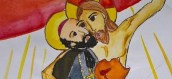
Jesus, Archer of Faith
Year A – 20th Sunday in Ordinary Time
Matthew 15:21–28: ‘Woman, great is your faith!’
The Gospel for this twentieth Sunday presents us with Jesus’ encounter, beyond the borders of Israel, with a Canaanite woman who begs him to heal her daughter. At first sight, the episode may seem bewildering and even scandalous: in response to the woman’s anguished cries, Jesus initially remains silent — ‘he did not answer her a word’; then, despite the disciples’ intervention, he refuses her request: ‘I was sent only to the lost sheep of the house of Israel’; finally, he uses a very harsh expression: ‘It is not right to take the children’s bread and throw it to the little dogs.’ Only after this dramatic sequence does Jesus grant the woman’s request and praise her faith.
The account is also found, in a more concise form, in the Gospel of Mark (Mark 7:24–30). Luke does not include this episode, perhaps because in other narratives he develops the theme of openness towards the Gentiles.
How are we to understand this Gospel passage? We may propose three keys to its interpretation.
- An explanation linked to the circumstances. Jesus had withdrawn from Galilee to spend time apart with his disciples, following an extremely bitter confrontation with the scribes and Pharisees sent from Jerusalem concerning the question of what is pure and impure. He therefore wished to pass unnoticed. Mark 7:24 confirms this: ‘He did not want anyone to know it, yet he could not remain hidden.’
- A methodological explanation. During his earthly ministry, Jesus gives priority to the mission among the people of Israel, without excluding significant openings towards the Gentiles.
- A pedagogical explanation. According to one possible pedagogical interpretation, through this intense exchange Jesus leads the Gentile woman to manifest extraordinary faith and presents her as an example to his disciples and to us. The contrast with Peter is particularly significant: in the Gospel of the previous Sunday, Jesus had called him a ‘man of little faith’.
But let us proceed step by step.
1. Jesus, a man willing to be… interrupted!
Jesus was not a prophet who wandered aimlessly, guided only by circumstances or chance encounters. He had received a mission from the Father and carried it out with constancy and determination, directing both where he went — ‘I must proclaim the good news of the kingdom of God to the other towns also, because that is why I was sent’ (Luke 4:43) — and the timing of his work: ‘Go and tell that fox [King Herod], “Behold, I cast out demons and perform cures today and tomorrow, and on the third day my work is completed”’ (Luke 13:32).
And yet, how often Jesus allowed himself to be ‘interrupted’ by events and by people! Let us recall, for example, when he wished to withdraw with his disciples to a lonely place, but changed his plans because he found a great crowd before him and had compassion on them (cf. Mark 6:30–34). The same thing happens here, in his encounter with the Canaanite woman. Something similar had already occurred at Cana, when Mary, his mother, prompted him to act before ‘his hour’ had come.
Jesus allows himself to be reached by people’s real suffering. His is a life open to the unexpected, even to the extreme and dramatic interruption of the cross.
This should lead us to reflect on our own lives — and also on the life of the Church — which can sometimes be so programmed and planned that they leave no room for interruption, not even the interruption required to stop before the abandoned man lying half-dead by the roadside.
2. Jesus, the prophet who… crosses boundaries!
Jesus’ crossing into Gentile territory highlights a characteristic feature of his mission: he overcomes the divisions and barriers produced by rigid interpretations of the Law, by certain social customs and by every form of religious exclusivism. Although he declares that, at this stage of his mission, he is addressing the ‘lost sheep of the house of Israel’, Jesus does not allow himself to be imprisoned by rigid, preconceived schemes.
He draws near to those whom religious society considers impure or sinful; he does not divide the world simplistically into good and bad people, and he knows how to recognise goodness wherever it is found. He is like a bee that gathers nectar from every flower and turns every encounter into an opportunity for life.
Here too we find a genuine challenge for us as believers. We often ‘overstep the boundaries’ through criticism, gossip and undue interference in the lives of others; at the same time, however, we confine our relationships, erect fences, burn bridges and cultivate parochial attitudes that create separate worlds incapable of communicating with one another. Jesus invites us instead to ‘cross boundaries’ through dialogue and encounter with those who are different from us.
3. Jesus, … archer of faith!
Commenting on the episode of the Canaanite woman, Cardinal Carlo Maria Martini used an image that struck me: that of an archer testing a new bow and assessing its strength.
This is what Jesus seems to do with the woman’s faith through the dramatic sequence of his three responses: first silence, then refusal and, finally, the comparison between the children and the little dogs, which could have sounded humiliating to her. The exchange seems to push her faith to its limits, almost risking breaking it. That mother could have walked away, indignant at Jesus’ apparent insensitivity and his cutting words.
Instead, Jesus shows that he has confidence in her and gives her the opportunity to reveal the full strength of her faith. The woman thus becomes a shining example: ‘Woman, great is your faith!’ Her perseverance, humility and quick-wittedness transform the confrontation into an encounter of salvation.
No one likes to be put to the test. For this reason, in the Lord’s Prayer we ask: ‘Do not abandon us to temptation’, invoking the Father’s help so that we may not succumb in times of trial. ‘Do not put us to the test’ is one possible rendering of ‘Do not abandon us to temptation’. God does not tempt us to do evil; nevertheless, he allows our faith to be tested and, through the trial, purifies it and brings it to maturity. Sirach warns us: ‘My child, when you come to serve the Lord, prepare yourself for testing’ (Sirach 2:1). Awareness of our weakness may make us fear the hour of trial, but God’s faithfulness sustains us and opens our hearts to trust.
Three points for reflection
- Do I allow myself to be ‘interrupted’ by people and their needs, or am I possessive of my time and plans? Do I welcome with openness and a smile those who interrupt my plans?
- Am I broad-minded and open to dialogue and encounter, or do I become rigidly attached to my own positions?
- How do I react to the trials of life: with impatience and pessimism, or with patience and trust?
Khalil Gibran, a Lebanese Maronite Christian writer (1883–1931), uses a metaphor — one that is illuminating for us too — in which God is the Archer, parents are the bows and children the arrows:
‘You are the bows from which your children, as living arrows, are sent forth. The Archer sees the target upon the path of the infinite, and he bends you with his might so that his arrows may fly swiftly and far. Let your bending in the Archer’s hand be joyful and glad; for even as he loves the arrow that flies, so he also loves the bow that is steadfast.’
Fr Manuel João Pereira Correia, MCCJ
Fr. Manuel João, comboni missionary
Sunday Reflection
from the womb of my whale, ALS
Our cross is the pulpit of the Word
