
Pentecost Sunday (A)
John 20:19-23
This Sunday’s Readings
First Reading
Acts of the Apostles 2:1-11
The Holy Spirit descends upon the apostles gathered in Jerusalem.
Responsorial Psalm
Psalm 104:1,24,29-31,34
God’s Spirit renews the earth.
Second Reading
1 Corinthians 12:3b-7,12-13
We are all one in Christ Jesus.
Gospel Reading
John 20:19-23
Jesus appears to his disciples and gives them the gift of the Holy Spirit.
Background on the Gospel Reading
The Season of Easter concludes with today’s celebration, the Feast of Pentecost. On Pentecost we celebrate the descent of the Holy Spirit upon the apostles gathered in the upper room in Jerusalem; this event marks the beginning of the Church. The story of Pentecost is found in the Acts of the Apostles, today’s first reading. The account in today’s Gospel, John 20:19-23, also recounts how Jesus gave the gift of the Holy Spirit to his disciples. Yet the event in John’s Gospel takes place on Easter Sunday. There is no need to try to reconcile these two accounts. It is enough that we know that after his death, Jesus fulfilled his promise to send to his disciples a helper, an advocate, who would enable them to be his witnesses throughout the world.
We already heard today’s Gospel proclaimed on the Second Sunday of Easter this year (Lectionary Cycle A). That Gospel passage, however, also included the description of Jesus’ appearance to Thomas. In that context, we were led reflect on belief and unbelief.
In the context of the Feast of Pentecost, John 20:19-23 reminds us about the integral connection between the gifts of peace and forgiveness and the action of the Holy Spirit. Jesus greets his disciples with the gift of peace. Jesus then commissions his disciples to continue the work that he has begun, “As the Father has sent me, so I send you.” He breathes the Holy Spirit upon the disciples and sends them to continue his work of reconciliation through the forgiveness of sins. Jesus’ act of breathing the Holy Spirit mirrors God’s act of breathing life into Adam at the time of Creation. In fact, both the Greek and Hebrew words for “spirit” can also be translated as “breath.”
This Gospel reminds us that the Church is called to be a reconciling presence in the world. The reconciling presence of Christ is celebrated in the Church’s sacramental life. In the Sacrament of Baptism, we are cleansed of sin and become a new creation in Christ. In the Sacrament of Penance, the Church celebrates the mercy of God through the forgiving of sins. This reconciling presence is also to be a way of life for Christians. In situations of conflict, we are to be agents of peace and harmony among people.
Solemnity of Pentecost
The Solemnity of Pentecost is celebrated fifty days after Easter. It is the feast on which we remember the gift of the Holy Spirit that overturns the confusion of Babel (see Gn. 11:9). In Jesus, who died, rose and ascended into Heaven, the peoples once again understand each other through one sole language, the language of love.
During the first half of the 3rd century, Tertullian and Origen were already speaking of Pentecost as a Feast that followed the Ascension. As the pilgrim Egeria attests, Pentecost was a Feast that was already celebrated in Jerusalem in the 4th century. It proposed the theme of the renewal that the coming of the Spirit works in the hearts of men and women.
Pentecost has its roots in the Feast of Weeks celebrated by the Jewish people. This was an annual agricultural festival surrounding the first fruits of the spring harvest and celebrated the year’s harvest. Later, it was connected with the revelation of God to Moses, the Ten Commandments. Then, for Christians, it would become the moment in which Christ, having returned to the glory of the Father, would make himself present in the hearts of men and women through His Spirit, the law given by God written in their hearts: “The new and definitive Covenant is no longer founded on a law that is written on two stone tablets, but on the action of the Spirit of God which makes all things new and is etched on hearts of flesh” (Pope Francis, General Audience, 19 June 2019). With Pentecost, the Church was born and her evangelizing mission began.
On the evening of that first day of the week, when the doors were locked, where the disciples were, for fear of the Jews, Jesus came and stood in their midst and said to them, “Peace be with you.” When he had said this, he showed them his hands and his side. The disciples rejoiced when they saw the Lord. Jesus said to them again, “Peace be with you. As the Father has sent me, so I send you.” And when he had said this, he breathed on them and said to them, “Receive the holy Spirit. Whose sins you forgive are forgiven them, and whose sins you retain are retained.”
Closed doors
The evangelist John has no fear of recalling the “closed doors” behind which the disciples found themselves imprisoned by fear. Being behind closed doors certainly did not allow their enemies to gain entrance, but it also did not allow them to go out. At first it might seem to be a situation that may have made them feel safe, at peace. In the long run, however, all the limitations would surface because those closed doors revealed the fright of the disciples, their insecurity, their cowardice. In a word, they manifested what little faith they had in what Jesus had shared with them during the previous three years of their lives. From the beginning of his pontificate, Pope Francis has invited the Church to “go out”, to be a Church capable of giving testimony, despite its fears and doubts.
The unexpected
Fear is a symptom of not understanding that what had happened was part of God’s plan of salvation. Yet, Jesus “enters” through those doors, he breaks through their fear with His love, He touches with His peace those who were imprisoned by their fears. He does not rebuke them, nor does He ask for explanations. He already knows everything anyway. What He does is “he showed them his hands and his side”. The Risen One presents Himself to His disciples through the signs of His Passion and Cross, indicating to them that He has conquered death.
Sending forth
There is another passage that is worth being emphasized. After having “showed himself to them”, Jesus “sends” the disciples. These same fearful disciples, closed behind the doors of their apparent security, are now “sent” to testify to what they had seen and touched. For fear, suspicion and timidity are overcome in going out toward others, in becoming neighbours to others. And at the heart of this testimony is Mercy. In the end, this is the experience the disciples have just experienced with Jesus, and it is this experience they are now called to “recount” to others, fortified with the gift of the Spirit.
Prayer
Come, Holy Spirit, come!
And from your celestial home
Shed a ray of light divine!
Come, Father of the poor!
Come, source of all our store!
Come, within our bosoms shine.
You, of comforters the best;
You, the soul’s most welcome guest;
Sweet refreshment here below;
In our labor, rest most sweet;
Grateful coolness in the heat;
Solace in the midst of woe.
O most blessed Light divine,
Shine within these hearts of yours,
And our inmost being fill!
Where you are not, we have naught,
Nothing good in deed or thought,
Nothing free from taint of ill.
Heal our wounds, our strength renew;
On our dryness pour your dew;
Wash the stains of guilt away:
Bend the stubborn heart and will;
Melt the frozen, warm the chill;
Guide the steps that go astray.
On the faithful, who adore
And confess you, evermore
In your sevenfold gift descend:
Give them virtue’s sure reward;
Give them your salvation, Lord;
Give them joys that never end.
THE SPIRIT: HOPE FOR A NEW WORLD
FernandoArmellini
Introduction
The natural phenomena that most impress the human imagination—fire, lightning, hurricane, earthquake, thunder (Ex 19:16-19)—are used in the Bible to describe manifestations of God. The sacred authors also used images to depict the outpouring of the Spirit of the Lord. They said that the Spirit is a breath of life (Gen 2:7), the rain that irrigates the land and transforms the desert into a garden (Is 32:15; 44:3), a force that restores life (Ex 37:1-14), a rumble from the sky, the wind that blows strongly, claps of thunder and tongues of fire (Acts 2:1-3). All robust images suggest an uncontrollable burstof strength.
Where the Spirit touches, radical upheaval and transformation always occur; barriers fall, doors are opened wide; all the towers built by human hands and designed by “the wisdom of this world” shake; fear and passivity disappear; initiatives are developed, and courageous decisions made.
Whoever is dissatisfied and aspires to renew the world and humanity can count on the Spirit: nothing can resist its power. One day, the prophet Jeremiah asked himself discouragingly: “Can an Ethiopian change his skin or a leopard his spots? And can you do good, you who are accustomed to do evil?” (Jer 13:23). Yes—we can answer—anything is possible where the Spirit of God erupts.
To internalize the message, we repeat:
“The Spirit of the Lord fills the earth and renews the face of the earth.”
First Reading: Acts 2:1-11
Jesus promised his disciples he would not leave them alone and would send the Spirit (Jn 14:16.26). Today we celebrate the feast of this gift of the Risen One. Reading the passage from the Acts, we are amazed at what occurred on the day of Pentecost: thunder and strong wind, flames of fire coming down from heaven, the apostles speaking in many languages.
We also wonder why God waited 50 days before sending his Spirit upon the disciples. To understand this page of theology (not news), we need to delve a little into the symbolic language used by the author. Luke places the descent of the Spirit at the Pentecost event. Yet, in today’s Gospel, John tells us that Jesus imparted the Spirit on the day of the Resurrection (John 20:22). How do we explain this discrepancy?
We must say clearly: The Paschal Mystery is unique. Death, Resurrection, Ascension, and the gift of the Spirit took place at the exact moment, at the moment of Jesus’ death. Recounting what happened on Calvary on that Good Friday, John says, “he bowed his head and Jesus gave up the Spirit” (Jn 19:30).
Why was this unique, sublime and ineffable mystery of Easter presented by Luke as if it occurred over three successive events? He did it to help us understand many of its aspects. John has placed the outpouring of the Spirit on the day of Easter to show that the Spirit is the gift of the Risen One. Now we see why Luke situates it in the context of the feast of Pentecost.
Pentecost was an ancient Jewish holiday celebrated 50 days after the commemoration of the Passover. It commemorated the arrival of the people of Israel at Mount Sinai. We all remember what happened in that place: Moses climbed the mountain; he encountered God and received the Law to communicate to his people. The Israelites were proud of this gift. They said that God had offered the Law to other peoples before them, but they had refused it, preferring to continue in their vice and excess. To thank God for choosing them, the Israelites set up a feast: Pentecost. Saying that the Spirit descended upon the disciples on the day of Pentecost, Luke wants to teach that the Spirit has replaced the old law and became the new law for the Christian.
To explain what he means, we resort to a comparison. One day, Jesus said: “Do you ever pick grapes from thornbushes or figs from thistles?” (Mt 7:16). It would be foolish to imagine that surrounding the bramble with attention, pruning it, creating a milder climate around it would make it produce grapes. However, if—with the marvel of genetic engineering—we could turn it into a vine, then external intervention would not be necessary. As it would no longer be a bramble, it would then produce grapes. Before receiving the outpouring of the Spirit, the world was like a big bramble. God had given people excellent guidance—a set of rules, precepts, and recommendations. He expected fruit to ripen in the form of the work of justice and love (Mt 21:18-19), but these had not eventuated, because the tree was not good: “No poor tree bears good fruit … and the evil person draws evil things from the evil stored in his heart” (Lk 6:43.45).
What did God do then? He decided to change the hearts of people. With a new heart—he thought—they would no longer need an external law. They would do good by following the impulses within them. Here is the Spirit’s law: it is the new heart; it is God’s life. When the Spirit enters into a person, it transforms them and, from a bramble, becomes a fruitful tree, able to produce the works of God spontaneously.
When a person is filled with the Spirit, something unheard of happens within them. They love with the love of God himself. From that moment, “he does not need someone to teach him” (1 Jn 2:27); he won’t require another law. John goes as far as to say that the man animated by the Spirit even becomes incapable of sinning: “Those born of God do not sin, for the seed of God remains in them; they cannot sin because they are born of God” (1 Jn 3:9).
And the thunder, the wind, the fire? It is clear: we are going to see in the book of Exodus what accompanied the gift of the old law: “On the morning of the third day there was thunder and lightning and a dense cloud over the mountain. All the people in the camp trembled” (Ex 19:16). “All the people witnessed the thunder and lightning and heard the blast of the trumpet and saw the mountain smoking” (Ex 20:18). The rabbis said that at Sinai, on the day of Pentecost, when God gave the Law, his words took the form of 70 tongues of fire, indicating that the Torah was destined for all peoples (thought to be precisely 70 at that time).
If the old law was given amid thunder, lightning, flames of fire, how could Luke present the gift of the Spirit in a different way —the new law? If he wanted to be understood, he had to use the same images.
And the many languages spoken by the apostles? Probably, Luke is referring to a common phenomenon in the early Church. After receiving the Spirit, the believers began to praise God in a state of exaltation. As if in ecstasy, they uttered strange words in other languages. Luke has used this phenomenon in a symbolic sense to teach about the universality of the Church. The Spirit is a gift meant for all peoples. Faced with this gift of God, all barriers of language, race, and tribe collapse. On the day of Pentecost, the opposite of what happened at Babel occurred (Gen 11:1-9).
People began to misunderstand and distance themselves from each other. Here, the Spirit reverses the movement. He brings together those who are scattered. Whoever lets himself be guided by the Word of the Gospel and by the Spirit speaks a language that everyone understands, and everyone joins in the language of love. It is the Spirit who transforms humankind into one family where all understand and love each other.
Second Reading: 1 Corinthians 12:3b-7,12-13
What causes divisions within the community? Envy, mutual jealousy. Those who have good qualities (intelligence, strength, good health, and education …), instead of humbly putting their talents at the service of their brothers and sisters, begin to expect honorary titles. They demand more respect and believe they are entitled to privileges. They want to occupy the first places. Thus, from opportunities to serve, the community ministries become opportunities to establish and assert their own power and prestige.
In the community of Corinth, Christians were no better than those of today. They were committing the same sins; they had the same defects. Specifically, they were divided because of the different charisms (that is, of the various gifts) that each had received from God.
Paul writes to these Christians to remind them that the many gifts, qualities theypossess, are not given to create division but to promote unity. Paul says: “the Spirit reveals his presence in each one with a gift that is also a service” (v. 7). And this is so because the source of all gifts is one. It is the Spirit. Paul says: “There is diversity of gifts, but the Spirit is the same” (v. 4).
To clarify this idea of unity and mutual service, Paul compares it with the body. Christians form one body, made up of many members. Each part must perform its function for the good of the whole organism. So it happens with different gifts of which every member of the community is enriched: they serve so that everyone can show love through their humble availability and service of others.
Gospel: John 20:19-23
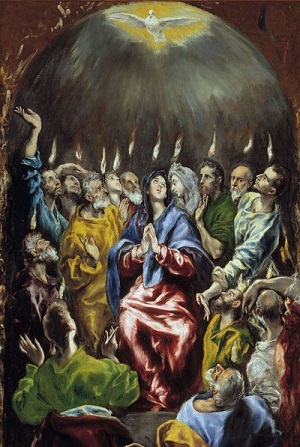
For the first Christians, the first day of the week is important because it is the day of the Lord (Rev 1:10). It is that day in which the community usually reunites to break the Eucharistic bread (Acts 20:7; 1 Cor 16:2).
It is evening. The temporal indication with which the evangelical passage starts is precious. Perhaps it indicates the late hour in which the early Christians were used to gather for their celebration.
The doors are locked for fear of the Jews (v. 19). Jesus certainly did not announce triumphs and easy life to his disciples. “You will have trouble in the world,” he said (Jn 16:33). However, the main reason for insisting on closed doors (Jn 20:26) is theological. John wants to make it clear that the Risen One is the same Jesus that the apostles have seen, known, heard, touched, but is in a different condition. He is not back to his previous life (as Lazarus did). He enters into a completely new existence. The body is no longer made of material atoms. It is imperceptible to the verification of the senses.
The resurrection of the flesh is not equivalent to the resuscitation of a corpse. It is the mysterious blossoming of a new life from a finite being. Paul explains this fact through the image of the seed. He says that “the body is sown in decomposition; it will be raised never more to die. It is sown in humiliation, but it will be raised for glory. It is buried in weakness, but the resurrection shall be with power. When buried it is a natural body, but it will be raised as a spiritual body” (1 Cor 15:42-44).
When Jesus shows his hands and his side, the disciples rejoice. A surprising reaction: they should be sad seeing the signs of his Passion and Death. Instead, they rejoice, not because they find themselves in front of the Jesus whom they accompanied along the roads of Palestine, but because they see the Lord (v. 20). They realize that the Risen One, who is revealing himself to them, is the same Jesus who gave up his own life.
John places the manifestations of the Risen One in the context of the first day of the week. He wants to tell the Christians of his community that they too can meet the Lord. They will not encounter Jesus of Nazareth with the material body he had in this world, but the Risen One, every time they come together “in the Lord’s day.” After having twice addressed them the greeting: Peace be with you! (vv. 19:21) Jesus gives His Spirit to the disciples and confers them the power to forgive sins (vv. 21-23).
The disciples are sent to fulfill a mission: “As the Father has sent me, so I send you.”
When he was in the world, Jesus made the face and the love of the Father present (Jn 12:45). Now, having left this world, he continues his work through the disciples on whom he confers his Spirit.
Welcoming him was welcoming the Father who sent him, now welcoming his envoys are welcoming him (Jn 13:20).
To understand the mission entrusted to the apostles, the forgiveness of sins through the outpouring of the Spirit, we must refer to the religious conceptions of the people of Israel and to the words of the prophets.
At the time of Jesus, it was widely thought that the people were acting badly. They defiled themselves with their idols. They were unclean because they were moved by an evil spirit. We wondered when God would intervene to rescue them and to instill in them a good spirit.
In the Letter to the Romans, Paul makes a dramatic description of the miserable condition of the person who is at the mercy of the evil spirit: “I cannot explain what is happening to me because I do not do what I want, but on the contrary, the very things I hate. I know that what is right does not abide in me, I mean in my flesh. I can want to do what is right, but I am unable to do it. In fact, I do not do the good I want, but the evil I hate” (Rom 7:15-19).
Through the mouth of the prophets God promised the gift of a new spirit, of His Spirit: “Then I shall pour pure water over you and you shall be made clean—cleansed from the defilement of all your idols. I shall give you a new heart and put a new spirit within you. I shall remove your heart of stone and give you a heart of flesh. I shall put my spirit within you and move you to follow my decrees and keep my laws” (Ezk 36:25-27).
This outpouring of the Lord’s Spirit would renew the world. He will flood it—said the prophet Ezekiel—like a rushing torrent of water which, when it enters the desert, makes it fruitful and turns it into a garden. “Near the river on both banks there will be all kinds of fruit trees will foliage that will not wither and fruit that will never fail; each month they will bear a fresh crop because the water comes from the temple. The fruit will be good to eat and the leaves will be used for healing” (Ezk 47:12). They are delightful images that admirably describe the life-giving work of the Spirit.
On Easter day these prophecies are fulfilled. In a symbolic gesture—Jesus breathed on them—the Spirit is consigned. This breath recalls the moment of creation, when “the Lord God formed man, dust drawnfrom the clay, and breathed into his nostrils a breath of life” (Gen 2:7). The breath of Jesus creates the new person, one who is no longer a victim of the forces that lead to evil but is animated by a new energy that drives him to do good.
Where the Spirit goes, evil is overcome, sin is forgiven—cancelled, destroyed—and the new being, modelled on the person of Christ, is born.
The mission that the Risen One entrusts to his disciples is to forgive sins, thus continuing his work as the “Lamb of God, who came to take away the sins of the world” (Jn 1:29).
What does it mean to forgive sins? These words have been interpreted—in the right way but limited—as the conferment on the apostles the power to absolve from sins. It’s not the only way to forgive, that is, to neutralize in order to overcome sin. The rights conferred by Jesus is much more extensive and involves all the disciples who are animated by his Spirit; it is that of cleansing the world of every form of evil. The powers are not two, but one—to forgive or to retain—at the discretion of the confessor that evaluates each case.
The power is only one, that of annihilating sin, in all ways. But this can also be not forgiven, if the disciple is not committed to creating the conditions that all may open their hearts to the action of the Spirit, the sin is not remitted.
Of this failure of the mission, the disciple is responsible.
READ: Jesus breathes the Holy Spirit onto the disciples. On the day of the Pentecost, the Spirit descends on them as tongues of fire. In baptism, we have all received the same Spirit who unites us into one body of Christ.
PRAY: Pray for an increase in the power of your faith. Pray that the Spirit will rekindle the passion to live with God and for God. Pray for the gifts and the fruits of the Holy Spirit.
REFLECT: The Holy Spirit is the life of the Church and every Christian. He animates us and gifts us with the charisms for the good of the society. He helps us relate to one another as sisters and brothers of Christ, thus uniting us into one body of Christ. The Holy Spirit is the union and understanding among peoples.
ACT: Take a leisurely, solitary walk and feel your kinship with the entire creation, giving thanks to the Spirit.
Fernando Armellini
Italian missionary and biblical scholar
https://sundaycommentaries.wordpress.com
Spirit of mercy, peace, unity and mission
Romeo Ballan, MCCJ
Pentecost Sunday is a feast of wonders! “We hear them preaching in our own language about the marvels of God”. (1st Reading).
So many different nations (17 groups of people are mentioned), with different languages, now speak a common language: they are all in tune in speaking of the great works of God (v.8-11).
The author of the wonders is the Holy Spirit, who has just descended on the community gathered in the Upper Room, in the Cenacle.
Let us first of all remark and contemplate the presence of the Virgin Mary in the Cenacle, among the disciples. We know that, since her Conception and the annunciation of the Angel, Mary was filled with the Holy Spirit (Lc 1,30…) and she enjoyed a very special friendship with the Holy Spirit.
So, in the days before the coming of the Holy Spirit, when the first Christian community was still like a beginner, like a baby, the Virgin Mary was teaching the disciples how to pray, and, like a Mother, patiently she taught the Apostles how to stand up, how to walk.
When the Spirit arrived and filled the heart of the disciples, their life change completely. Then Mother Mary pushed the disciples to go out, to preach the Gospel with courage and confidence.
The missionary Church has just born in that very day and the disciples become the witnesses of Jesus until the ends of the earth.
The Holy Spirit is the greatest fruit of Easter. In fact, we see in today’s Gospel how the Risen Lord breathes out the Spirit over his disciples and says: “As the Father sent me, so am I sending you. Receive the Holy Spirit. For those whose sins you forgive, they are forgiven. (v. 21-23).
The holy Spirit is the Spirit of the mercy for the forgiveness of sins. Therefore, He is also the Spirit of peace: peace with God and among our brothers and sisters.
He is the Spirit of the universal mission, indeed, the leader and main agent of mission (cfr. RMi cap. III: EN 75s), which Jesus entrusts to the Apostles.
“As the Father sent me…” These words link forever the mission of the disciples to the life of the most Holy Trinity.
Pentecost is the overcoming of Babel and a transition to a life of brotherly communion. Indeed, the confusion of languages had caused the dispersal of the nations, of the proud people wanting to build a city and make themselves a great name (Gen. 11:1-9); but in Jerusalem, when the Spirit comes down, diverse nations are able to understand and to communicate to one another the great works of God.
At Babel all spoke the same language but no one was able to understand the other.
At Pentecost all speak different languages, but all understand one another.
In our human hearts the Spirit moves the centre of concern: no longer a selfish looking out for self, but to live in God, to love one another, and proclaim the works of God for the good of the whole human family.
The Holy Spirit is the beginning of a new life; He is the Spirit of unity, of faith, of love, of the plurality of charisma and cultures.
Unity and diversity are two gifts of the same Spirit: diverse peoples understand a language that is common to them all. St. Paul (II Reading) attributes clearly to the Spirit the ability to make the Church one and many in the plurality of charisma, ministries and activities (v. 4-6).
The Spirit wants a Church that is rich in a variety of gifts, but united; a Church that does not cancel differences, but is able to make the best use of all of them.
The breath of Jesus over the Apostles in the evening of Easter (v. 22) calls to mind the new creation which is the work of the Spirit. The gesture of breathing over the Apostles symbolises the appearance of a new life for a new humankind.
Every person from every people in the world is called to enter this new people / new family of God, grace to the personal work of the Holy Spirit.
The Spirit is always at work in the heart of every person, even before the first missionaries arrive to a certain, new place. So the new people/family of God is open even for those who are not baptised yet.
In fact, in a real action, by ways not visible to us, the Spirit disposes peoples’ hearts, even those of non-Christians, for the necessary saving encounter with Christ, as the Council teaches us: “We believe that the Holy Spirit in a manner known only to God offers to every man and woman the possibility of being associated with the paschal mystery (of Jesus)”. (Gaudium et Spes 22; a text quoted three times by John Paul II in his Encyclical Redemptoris Missio, n. 6.10.28).

I commenti sono chiusi.