
Ascension of the Lord (A)
First Reading: Acts 1:1-11
“Men of Galilee, why are you standing there looking at the sky?
Second Reading: Ephesians 1:17-23
May the God of our Lord Jesus Christ, the Father of glory…
which he worked in Christ, raising him from the dead and seating him at his right hand in the heavens…
Gospel Reading: Mt 28:16-20
As for the Eleven disciples, they went to Galilee, to the mountain where Jesus had told them to go. When they saw Jesus, they bowed before him, although some doubted. Then Jesus approached them and said, “I have been given all authority in heaven and on earth. Go, therefore, and make disciples from all nations. Baptize them in the Name of the Father and of the Son and of the Holy Spirit, and teach them to fulfill all that I have commanded you. I am with you always until the end of this world.”
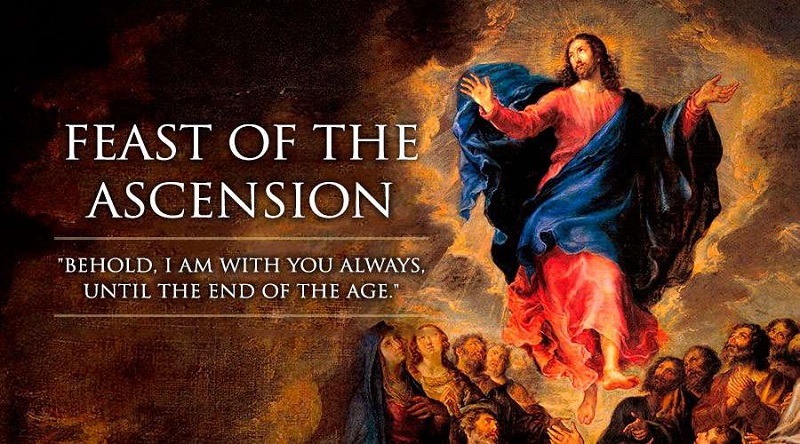
Background on the Gospel Reading
Today’s Gospel is taken from the conclusion of the Gospel of Matthew. Matthew’s Gospel quickly moves from the disciples’ discovery of Jesus’ empty tomb, to Jesus’ appearance to Mary Magdalene and the other Mary, to the commission that Jesus gives his disciples in today’s Gospel.
The Final Commission, as this Gospel is sometimes called, is given on the mountaintop. Throughout Scripture, the most important events happen on the mountaintop, and Matthew has used this motif throughout his Gospel. Earlier in Matthew’s Gospel, Peter, James, and John had seen Jesus transfigured on the mountaintop (Matthew 17:1-8). Also in the Gospel of Matthew, Jesus taught the crowds from the mountaintop in what we now call the Sermon on the Mount.
Here we are told that the eleven disciples go the mountaintop in Galilee, as Jesus had instructed through Mary Magdalene and the other Mary (cf. Matthew 28:9-10). They see Jesus, and both worship and doubt at the same time. Jesus approaches them and commissions them to baptize and teach, “to make disciples of all nations.” It is a task which Jesus had previously prepared his disciples for; recall that Jesus had sent the twelve apostles to preach the Kingdom of God and to heal (cf. Matthew 10:1-15). However, earlier the Twelve were sent only to the House of Israel; in this Final Commission, the eleven are told to go to “all nations.” The mission of Jesus is now to be taken to all people; the task now is to baptize and to teach.
Jesus commissions his disciples to baptize in the name of the Trinity, one of the clearest attestations found in Scripture for baptism in the name of the Trinity. In the Acts of the Apostles and in the Letters of Paul, baptism is more frequently offered “in the name of Jesus.”
The ending of Matthew’s Gospel can be understood as the beginning of the Church. Jesus commissions his disciples to continue to teach in his name and to bring others into the community of disciples through baptism. The Gospel ends, as it had begun, with the promise that Jesus will continue to be Emmanuel, “God with us” (cf. Matthew 1:23), for all eternity.
Christians are missionaries,
“hopeful marathon runners”
Pope Francis
We have heard what Jesus tells the disciples before his Ascension: “All authority in heaven and on earth has been given to me” (Mt 28:18); the power of Jesus, the strength of God. This theme runs through today’s readings: in the first, Jesus says that it is not up to the disciples to know the “times or seasons which the Father has fixed by his own authority”, but he promises them the “power” of the Holy Spirit. (Acts 1:7-8). In the second, Saint Paul speaks about the “immeasurable greatness of his power in us who believe” and of the “working of his great might” (Eph 1:19). But in what does this strength, this power of God consist?
Jesus declares that there is a power “in heaven and on earth”. It is, first and foremost, the power to connect heaven and earth. Today we celebrate this mystery because when Jesus ascended to the Father, our human flesh crossed the threshold of heaven: our humanity is there, in God, forever. Therein lies our trust, because God will never distance himself from mankind. And we are consoled in the knowledge that in God, with Jesus, a place has been prepared for each of us: a destiny as risen children awaits us and for this, it is truly worth the while of living here below, seeking the things from above, where our Lord is found (cf. Col 3:1-2). This is what Jesus did for us through his power to connect earth to heaven.
But his power did not end once he ascended into heaven. It continues even today and it endures forever. In fact, just before ascending to the Father, Jesus said, “I am with you always, to the close of the age” (Mt 28:20). It is not just a saying, a simple reassurance like when we tell our friends before leaving for a long trip: “I will be thinking of you”. No. Jesus is truly with us and for us. In heaven, he shows the Father his humanity, our humanity. He shows the Father his wounds, the price he paid for us, and thus, he “always lives to make intercessions” (Heb 7:25) on our behalf. This is the key word of the power of Jesus: intercession. Jesus, with the Father, intercedes on our behalf every day, in every moment; in every prayer, in each of our requests for forgiveness, especially in every Mass. Jesus intervenes: he shows the Father the signs of the life he offered — as I have said — his wounds, and he intercedes, obtaining mercy for us. He is our “advocate” (cf. Jn 2:1), and when we have some important “cause”, we would do well to entrust it to him and to say, “Lord Jesus, intercede for me, intercede for us, intercede for that person, intercede for that situation…”.
Jesus also gave this capacity to intercede to us, to his Church that has the power and also the duty to intercede, to pray for everyone. We can ask ourselves, each of us can ask him- or herself: ‘Do I pray? And everyone, as the Church, as Christians: do we exercise this power by bringing people and situations to God? The world needs this. We ourselves need it. We spend our day running around and working a lot. We put effort into many things. However, we run the risk of reaching home in the evening weary and with our soul weighed down, similar to a ship laden with merchandise which, after an arduous voyage, returns to port with the sole desire of docking and switching off the lights. Always living between the rushing about and the things to be done, we can become lost, withdrawn into ourselves and anxious over nothing. In order to avoid being drowned by this “pain of living”, let us remember to “drop the anchor in God” every day. Let us take to him our burdens, people and situations; let us entrust everything to him. This is the strength of prayer which connects heaven and earth, which permits the Lord to enter into our time.
Christian prayer is not a way of being more at peace with oneself or finding some inner harmony. We pray in order to take everything to God, to entrust the world to him. Prayer is intercession. It is not tranquility; it is charity. It is asking, seeking, knocking (cf. Mt 7:7). It is putting ourselves on the line to intercede, insisting assiduously with God, one for the other (cf. Acts 1:14). To intercede without tiring is our first responsibility because prayer is the power which moves the world forward. It is our mission, a mission which requires effort and, at the same time, brings peace. This is our power: not to dominate or to cry out more loudly, according to the logic of this world, but rather to exercise the gentle power of prayer which can even end wars and bring about peace. Just as Jesus always intercedes for us with the Father, so should we, his disciples, never tire of praying to bring earth closer to heaven.
After “intercession”, a second key word emerges from the Gospel which reveals Jesus’ power: proclamation. The Lord sends his own to proclaim him with the sole power of the Holy Spirit: “Go therefore and make disciples of all nations” (Mt 28:19). Go! It is an act of utmost trust in his own. Jesus trusts us. He believes in us more than we believe in ourselves! He sends us forth, despite our shortcomings. He knows we will never be perfect and that, if we wait to become better in order to evangelize, we will never begin.
However, it is important to Jesus that we overcome one great imperfection from the onset: closure. Because the Gospel cannot be locked up and sealed off, because God’s love is dynamic and seeks to reach everyone. In order to proclaim then, it is necessary to go out, to go beyond ourselves. With the Lord, we cannot be calm and comfortable within our world or our nostalgic recollections of the past. With him, we are forbidden to lull ourselves in acquired confidence. For Jesus, confidence means going forth with trust. That is where his strength is revealed. Because the Lord does not value ease and comfort; he always inconveniences and challenges [us]. He wants us to set forth, free from the temptation of being satisfied once we are doing well and have everything under control.
“Go”, Jesus tells us, even today. In Baptism he conferred upon each of us the power to proclaim. Thus, going out into the world with the Lord is part of the Christian identity. It is not only for priests, nuns or the consecrated. It is for all Christians. It is our identity; going into the World with the Lord is our identity. Christians are not stationary, but on a journey: with the Lord towards others. However, Christians are not sprinters running madly, or conquerors who must arrive before the others. They are pilgrims, missionaries, “hopeful marathon runners”, meek but decisive in walking, trusting and, at the same time, active, creative, but always respectful, resourceful and open, hard-working and supportive. Let us walk the roads of the world in this manner!
As for the original disciples, our places of proclamation are the roads of the world. It is there above all that the Lord is waiting to be known today. Just as then, he desires the announcement to be brought not through our strength, but rather through his strength: not with the strength of the world, but with the limpid and gentle strength of joyful witness. And this is urgent, brothers and sisters! Let us ask the Lord for the grace not to become fossilized on issues that are not central, but to dedicate ourselves fully to the urgency of the mission. Let us leave to others the idle gossip and false disputes of those who only listen to themselves, and let us work in a practical manner for the common good and for peace. Let us take up the challenge with courage, confident that there is more joy in giving than in receiving (cf. Acts 20:35) May the risen and living Christ who always intercedes for us be the strength of our setting forth, the courage of our journey.
Pope Francis
Genoa 27 May 2017
A DIFFERENT WAY OF BEING NEAR
Fernando Armellini
Introduction
With the coming of Jesus in the glory of the Father, did anything on earth change? Outwardly, nothing. The people’s lives continued to be what they were before: sowing, reaping, trading, building homes, traveling, crying and partying as usual. Even the apostles did not receive any relief from the dramas and anxieties that other people experienced. However, something incredibly new happened: a new light was projected on the existence of people.
On a foggy day, the sun can suddenly appear. The mountains, the sea, the fields, the trees of the forest, the scent of the flowers, the songs of the birds may remain the same, but the way of seeing, hearing, or smelling them is different.
It also happens to anyone enlightened by faith in Jesus after his ascension into heaven: they see the world with new eyes. Everything makes sense, nothing saddens, and nothing scares. The Lord who builds his reign is seen above and beyond human frailty, misery, and ineptitude.
An example of this completely new perspective could be a way of considering the years that span our lives. We all know, and maybe we smile over the octogenarians who envy those with more years left in their lives. They regret the passing of the years, so they turn their gaze to the past, not the future. The certainty of the Ascension reverses this perspective. As the years pass, the Christian is satisfied because he sees the days of a definitive encounter with Christ as imminent. He is happy to have lived, does not envy the young, and looks at them with tenderness.
To internalize the message, we repeat:
“The sufferings of this present time are not worth comparing to the future glory that will be revealed in us.”
First Reading: Acts 1:1-11
On the Mount of Olives, a small octagonal sanctuary was built during the Crusades. It was later converted into a mosque by Muslims in the year 1200. I explained to a group of pilgrims that this small structure today has a roof, but it was initially uncovered in commemoration of the Ascension of Jesus into heaven. A light-hearted person in the group commented: ‘It had no roof because otherwise Jesus would have hit his head when he was going up.’ Some did not like the irreverent joke, but others considered it a challenge to deepen their understanding of the text in the Acts of the Apostles.
At first glance, the Ascension story flows smoothly, but there is a feeling of embarrassment when all the particulars are considered. It seems rather unlikely that Jesus was like an astronaut hurtling up from the ground, rising to the sky and disappearing beyond the clouds. It is also difficult to explain inconsistencies.
At the end of his Gospel, Luke—the author of Acts—says that the Risen Lord led his disciples to Bethany. “And as he blessed them, he withdrew and was taken to heaven. They worshiped him and then returned to Jerusalem full of joy” (Lk 24:50-53). Forget the odd remark about the ‘full of joy’ bit (and who among us is happy when a friend departs?) and the disagreement about the location (Bethany is a little off-the-beaten-path to the Mount of Olives). What surprises is the apparent discrepancy about the date: according to Luke 24, the Ascension takes place on the same day of Easter, while in Acts, it was 40 days later (Acts 1:3). Surprisingly, the author gives two conflicting pieces of information. If we take the second version (the one of the forty days) as the credible one, the question spontaneously arises: What did Jesus do during this time? On Calvary, did he not promise the thief: Today you will be with me in paradise? So why didn’t he ascend to heaven immediately?
These apparent discrepancies are enough to warn us that perhaps Luke’s intention was not to inform us about the where, when, and how Jesus went up to heaven. Perhaps (indeed, surely) his concern lies elsewhere: he wants to respond to problems and dissolve doubts that have arisen in his community. He wants to enlighten the Christians of his time on the ineffable mystery of Easter. For this reason, as the artists of words do, he composes a page of theology using a literary genre and images easily understood by his contemporaries. The first step is to understand the literary form.
At the time of Jesus, the coming of the Kingdom of God was anticipated as being a spectacular event. Apocalyptic writers announce it as imminent. They expect a flood of purifying fire from heaven, the resurrection of the righteous, and the beginning of a new world. Even in the minds of some disciples, an atmosphere of excitement is created. It is fueled by some expressions of Jesus that can easily be misunderstood: “You will not have passed through all the towns of Israel before the Son of Man comes” (Mt 10:23).
However, with the death of the Master, all hopes are dashed: the two on the road to Emmaus say, “We had hoped that he would redeem Israel” (Lk 24:21). The Resurrection awakens expectations: the conviction of an immediate return of Christ spreads among the disciples. Some fanatics based their predictions on alleged revelations and even began to announce the date. The invocation “Maranatha,” ‘Come, Lord!’ is repeated in all the communities.
The years pass, but the Lord does not come. Many begin to be incredulous: “What has become of his promised coming? Since our fathers in faith died, everything goes on as it was from the beginning of the world” (Ps 3:4). Luke writes about this crisis. He realizes that a misunderstanding lies at the origin of the bitter disappointment of Christians: The Resurrection of Jesus marked the beginning of the Kingdom of God, but not the end of the story.
The construction of the new world has just begun. It will take much time and effort on the part of the disciples. How to correct the false expectations? Luke introduces a dialogue between Jesus and the apostles on the first page of the book of Acts. Let us consider the question they propose: when will the Kingdom of God come? (v. 6) It is the same question that all Christians want to direct to the Master at the end of the first century. The response of the Risen One is directed to the members of Luke’s community rather than to the Twelve: “It is not for you to know the time and the steps the Father has fixed by his own authority. But you will receive power when the Holy Spirit comes upon you; and you will be my witnesses in Jerusalem, throughout Judea and Samaria, even to the ends of the earth” (vv. 7-8).
The scene of the Ascension follows this dialogue (vv. 9-11). Jesus and the disciples were seated at table (Acts 1:4) in the house. Why didn’t they say their goodbyes there? What was the need to go to the Mount of Olives? And the other details: the cloud, the eyes turned skyward, the two men in white robes, are they chronological records or literary devices?
There is a similar story in the Old Testament—the ‘snatching’ of Elijah (2 K 2:9-15).One day, this great prophet finds himself near the Jordan River with his disciple Elisha. Onlearning that the teacher will leave him, Elisha dares to ask Elijah for two-thirds of his spirit as an inheritance. The prophet promises it to him, but only on one condition: if you see me when I am taken from you. Suddenly, a chariot with a fire horse appears and, while Elisha looks heavenward, Elijah is snatched in a whirlwind. There and then, Elisha receives the spirit of the master and is enabled to continue his mission in this world. The book of Kings recounts the work of Elisha. It is a continuation of Elijah’s.
It is easy to reveal the common elements within the narrative of the Acts. So it could not end in any other way. Luke made use of Elijah’s grand and solemn scenario flying into the clouds to express a reality that the senses could not verify, nor adequately described in words: the Passover of Jesus, his Resurrection, and his entry into the glory of the Father.
In the Old Testament, the cloud identifies a spot where God is present (Ex 13:22). Luke uses it to affirm that Jesus, the defeated, the stone which the builders rejected, the one whom the enemies would have wished to remain forever a prisoner of death, was instead welcomed by God and proclaimed as Lord. The two men dressed in white are the same as those who appear at the tomb on Easter Day (Lk 24:4). The white of their clothing represents, according to the biblical symbolism, the world of God. The words put into the two men’s mouths are an explanation given by God to the events of Easter: Jesus, the faithful servant, put to death by men, is glorified. Their words are true (being two, they are credible witnesses).
Finally: the gaze turned skyward. As with Elisha, the apostles and the Christians of Luke’s time also contemplate the Master who distances himself. Their gaze indicates the hope of his immediate return, the desire that, after a short interval, he will resume his interrupted work. But the voice from the sky clarifies: he will not bring it to completion, but you will. You will do it; you will be qualified to do so because you have spent 40 days with him (in the language of Judaism, it was the time needed for the disciple’s preparation),and you have received the Spirit. For the apostles, as for Elisha, the image of the ‘rapture of the master’ means the passage of handover.
At the time of Luke, there were already Christians who ‘looked to the sky,’ that is, who regarded religion as an escape, not as an incentive to undertake measures to improve people’s lives. God says to them: “Stop looking at the sky. You need to prove the authenticity of your faith on earth. Jesus will come back, yes, but that hope should not be a reason for alienating yourselves from the problems of this world. Happy are those servants whom the master finds wide-awake when he comes” (cf. Lk 12:37).
Did Jesus then ascend into heaven? Of course, he did. To say that he ascended to heaven is equivalent to saying: he is risen, glorified, and entered into the glory of God. His body, it is true, was placed in the tomb, but God did not need the physical body to give him that ‘resurrected body’ that Paul calls ‘spiritual body’ (1 Cor 15:35-50). On the 40th day after Easter, no space displacement or ‘rapture’ joining the Mount of Olives with heaven occurred. The Ascension took place in the instant of death, even though the disciples began to understand and believe only from the ‘third day.’
The story of Luke is a page of theology, not a media report. On this page, he wants to tell us that Jesus was the first one to go through the ‘veil of the temple’ that separated the world of people from that of God. He showed how everything that happens on earth: successes, mishaps, injustice, suffering, and even the far more absurd, like his ignominious death, are not beyond God’s plan. The Ascension of Jesus is all that. So we should not be surprised that it was greeted with great joy by the apostles (Lk 24:52).
Second Reading: Ephesians 1:17-23
Paul asks God for wisdom for his Christians. It is not human wisdom but a type of intelligence that can give understanding to the mystery of the Resurrection. He asks God to enlighten their eyes and hearts so that they may understand the greatness of the hope to which they were called.
The First Reading called on Christians not to neglect their concrete duties in this world. The second fills out this thought and urges Christians not to forget that their life is not enclosed within the horizon of this world. It is because, even if engaged in the activities of this life, they are always waiting for Christ’s return to take them permanently with themselves.
Gospel: Matthew 28:16-20
Matthew does not describe the Ascension of Jesus as the Acts of the Apostles do but, using different images, he suggests the same message.
Unlike Luke and John, he places the encounter with the Risen not in Jerusalem but in Galilee. This geographical setting has a theological value: the evangelist wants to say that the mission of the apostles begins where their Master had begun.
Galilee was a despised region. Due to the frequent invasions from the north and east, it was inhabited by a diverse population, derived from a mixture of races. Isaiah designates it as “the land of the Gentiles,” that is, of the pagans (Is 9:1). The Orthodox Jews looked at it with suspicion and distrust. To Nicodemus, who shyly tried to defend Jesus, the Pharisees of Jerusalem objected: “Look it up and see for yourself that no prophet is to come from Galilee” (Jn 7:52).
It is exactly to these semi-pagans—Matthew wants to say—that now the Gospel is destined. Jerusalem, the city that rejected the Messiah of God, lost her privilege to be the spiritual center of Israel.
The Risen One meets the disciples on the mountain (v. 16).
Commenting on the Gospel of the Second Sunday of Lent, we have clarified the meaning of the mountain. It was the site of the manifestations of God; he was manifested to Moses and Elijah at the top of the mountain.
Matthew often uses this image: he places Jesus on the mount every time he teaches or performs some particularly important acts.
If one keeps this fact in mind, one can understand the meaning of the scene narrated in today’s passage: the sending of the disciples in the world is a decisive event. Not only that, but one who had the experience of the Risen Lord and has assimilated his message on the mountain is empowered to fulfill this mission.
The remark that “although some apostles doubted” (v. 17) is amazing. How could they still have doubts if they had already met the Risen Lord in Jerusalem on Easter Sunday?
From the point of view of catechesis, this particular remark is indicative. For Matthew, the Christian community is not made up of perfect people, but of people in whom good and evil, light and darkness continue to be present. We encounter this situation among the first disciples: they have faith, but they still have doubts and uncertainties.
It is possible to believe in Christ and have doubts. The contrary is impossible: faith cannot exist together with the evidence. One cannot “believe” that the sun exists; there is the certainty, one can see it. The effects of its light and its heat are scientifically verifiable. In the field of faith, this evidence is impossible. Like the apostles, we, too, have a deep conviction of the truth of the resurrection of Christ, but it cannot be proven.
In the second part of the passage (vv. 18-20), there is the sending of the apostles to evangelize the whole world.
During his public life, Jesus had sent them to announce the kingdom of heaven with these instructions: “Do not visit pagan territory, and do not enter a Samaritan town. Go instead to the lost sheep of the people of Israel” (Mt 10:5-6). After Easter, their mission expands; it becomes universal.
The light was enkindled in Galilee when Jesus, having left Nazareth, settled in Capernaum. “The people who lived in darkness have seen a great light; on those who live in the land of the shadow of death a light has shone” (Mt 4:16). Now its light must shine in the whole world. As the prophets have announced, Israel becomes “light of the nations” (Is 42:6).
The time is decisive, and Jesus refers to his authority: he was sent by the Father to bring the message of salvation; now he entrusts this task to the community of the disciples, giving them his own powers.
The Church is called to make Christ present in the world. Through Baptism, she generates new children that are inserted in the communion of the Trinity, the Father, the Son and the Spirit. It is a sublime but difficult mission; it inspires awe and trepidation in those who are called to carry it out.
Every vocation is always accompanied by human fear and by God’s promise that assures: “Fear not, I am with you.” God guarantees to Jacob on his journey to an unknown land: “I am with you and I will keep you safe wherever you go. I will not leave you” (Gen 28:15). To Israel deported to Babylon, God says: “Since you are precious in my sight, and important—for I have loved you. Fear not, for I am with you” (Is 43:4-5). To Moses who objects: “Who am I that I should go to Pharaoh and bring the people of Israel out of Egypt?” He replies: “I will be with you” (Ex 3:11-12). To Paul in Corinth, who is tempted to be discouraged, the Lord says: “Do not be afraid, for I am with you, so no one will harm you” (Acts 18:9-10).
The promise of the Risen Lord to his disciples, who are about to take their first tentative steps, cannot be different: “Behold, I am with you always, until the end of the world” (v. 20). The Gospel of Matthew closes as it had begun, with the appeal to the Emmanuel, the God-with-us, the name by which the Messiah was foretold by the prophets (Mt 1:22-23).
READ: The Gospel ends on a glorious and triumphant note. The eleven joyfully join Jesus on the mountaintop. Jesus has power over all, and he sends out his disciples to continue his ministry in all nations.
REFLECT: What a wonderful ending for the Gospel! So different from the other Gospels! The Church begins with Jesus commissioning the eleven. All are welcome to join!
PRAY: Pray for the evangelization of all people. Pray that the Gospel be preached from one end of the earth to the other.
ACT: Proclaim the Gospel by how you live. Let your actions flow from your beliefs. Jesus is risen! Alleluia!
Fernando Armellini
Italian missionary and biblical scholar
https://sundaycommentaries.wordpress.com
“Go, therefore, make disciples of all the nations”
Romeo Ballan mcci
Ascension is a new epiphany. The Bible texts and the liturgical texts present the Ascension as a glorious manifestation of God. In Reading I we see the cloud, common in theophanies; the men (angels) in white clothing; four references to heaven in just two verses and the promise of a future return… (v. 9-11). In Reading II, St. Paul presents the epilogue to a difficult and paradoxical, but successful, undertaking: Jesus seated at the right hand of God in heaven, above all authority and power, made the ruler of everything and head of the Church (v. 20-22). The final events of the life of Jesus on earth give meaning to and shed light on the tribulations that have gone before. “That is why John writes of being raised up, therefore of the ascension of Jesus on the same day as his death on the cross: death-resurrection-ascension make up a single Christian Paschal mystery which sees human history and the cosmos being restored in God. Even the forty days that are recalled in Acts 1:2-3 bring to mind a perfect and definitive period, and are certainly not to be seen as a chronological datum”. (G. Ravasi).
The completeness of the paschal event and mystery of Jesus lies at the root of the joyful hope of the Church and of the “serene trust” of the faithful to be one day “in the same glory” of Christ (Preface). From this, the undertaking of the Apostles and the optimism that drives the missionaries of the Gospel draw inspiration and strength, in the certainty of being bearers of a message and of an experience of a successful life, thanks to the Resurrection. It is not a disastrous experience, but a successful one: above all, totally successful in Christ, but also, even though still partially, successful in the life of the Christian and of the evangelizer, though still awaiting further development.
Motivated by this inner experience of new life in Christ, the Apostles – and the missionaries of all time – become “witnesses not only in Jerusalem but throughout Judea and Samaria and indeed tothe endsof the earth” (Acts 1:8), in a path that opens gradually from the centre (Jerusalem) to the suburbs as vast as the whole world. The field of the missionary work of the Church is all peoples (Gospel), to whom Jesus sends his disciples before ascending into heaven (v. 19). He sends them under a fullness of power (v. 18), which pertains to him as the Son of God and as the glorified Kurios (Lord): “Go, therefore, makedisciples of all the nations, baptizing them … teaching them…” (v. 19-20). A mission that is possible to carry out with the power of the Spirit, whom we invoke, along with Mary and the Apostles, as we await an ever new Pentecost.
That “therefore” (oun–ergo: in Greek and Latin, respectively) has the value of an inalienable consequence: it indicates, in fact, the root and the continuity of the universal mission, which are born of the Holy Trinity and are prolonged in time and space through the Church, sent to all nations, reassured by the permanent presence of his Lord: “I amwithyou always; yes, to the endof time” (v. 20). For Matthew, Jesus does not distance himself from his own followers, just changes his way of being present. He stays with them: He is always the Emmanuel, Godwithus, announced from the very beginning of the Gospel (cf. Mt 1:23).
The verbs of the mission retain their perennial interest. ‘To go’ indicate dynamism and courage to plunge into ever new situations of the world; ‘To makedisciples of all the nations’ means to make them followers not so much of a doctrine but of a Person; ‘To baptize’ indicates the sacrament that introduces people into the Church and transforms them into the life of the Trinity, ‘To teach to observe’ refers to the response of the disciples to the voice of the Teacher and Shepherd. He has completed the work of salvation for all peoples, and now calls andsendsotherdisciples to continue his own mission. In this world, Christians often live divided between looking at the sky and transforming the earth. If people look only at the sky, from there come the angels (Acts 1:11) to tell them of their tasks on earth. If people look only at the ground, St. Paul reminds them of the hope to which they are called (Eph 1:18). The synthesis is that the mission is done in the name of God but among the peoples. Such is the gift and mystery of every vocation in theserviceofthe Gospelin the world.
