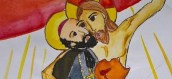
God is an insufficient word!
Year A – Eastertide – 5th Sunday
John 14:1-12: “I go to prepare a place for you”
With the final Sundays of Eastertide, we enter into the preparation for the feasts of the Ascension and Pentecost. These are the Sundays of farewell. In today’s Gospel and next Sunday’s, we shall listen to passages from chapter 14 of Saint John, taken from Jesus’ farewell discourse during the Last Supper. It is his testament, before his passion and death.
Why return to these texts precisely during the Easter season? The Church follows the ancient tradition of reading, during this time, the five chapters of John’s Gospel concerning the Last Supper, from chapters 13 to 17, in which Jesus presents the meaning of his Passover. Moreover, we could say that, since this is his legacy, the testament is to be opened after his death. Jesus leaves us his inheritance, his goods, to us who are his heirs.
Do not let your hearts be troubled!
Today’s Gospel text is one of the densest in John’s Gospel. The context — after the announcement of the betrayal and of his violent death — is sad and dramatic. Jesus does not hide from his disciples the gravity of this hour, but he consoles them, inviting them to trust. It is the hour of trial, of crisis. Night falls darkly upon the hearts of all.
It is a word addressed also to us who, after the joy of Easter, fall back into the harshness of our daily lives. “Believe in God, believe also in me” — this is the watchword!
I go to prepare a place for you!
In the Gospel passage, we find, around ten times, verbs and nouns connected with movement. The human being is a traveller, a wayfarer — homo viator, as Gabriel Marcel put it. Faith too implies setting out on a journey: “Go from your country… to the land that I will show you” (Genesis 12:1). So it was for Abraham, and so it still is for us. The Bible is full of roads and paths, of crossroads and junctions. “Blessed are those whose strength is in you, in whose heart are the highways to Zion!” (Psalm 84:6).
For biblical man, and for Jesus, the journey has a precise direction: God, the Father. Saint Ignatius of Antioch, in his Letter to the Romans, 7:2, expresses his experience in this way: “A living water murmurs within me and says: Come to the Father!”
Unfortunately, today the meaning of life, its direction, seems to be fading. What the French playwright Eugène Ionesco (1909-1994) once said is coming true: “The world has lost its way, not because there are no guiding ideologies, but because they lead nowhere. In the cage of their planet, human beings move in circles because they have forgotten that they can look up to heaven.”
Although we are on a journey, our heart seeks rest. God’s promise is precisely that of “entering into his rest” (see the Letter to the Hebrews 4:1). This is not a passing rest, but the rest of one who feels he has arrived home, at his dwelling place. Through his Passover, Jesus goes ahead of us: he goes to prepare this dwelling for us and will then return to take us with him. This dwelling is the Father’s house. For one lives where one is loved, as the Jesuit biblical scholar Silvano Fausti (1940-2015) comments.
And where is my dwelling place? Where do I feel at home, known, appreciated and loved? That is where my identity is found, my true self. Is the heart of the Father truly my dwelling place?
I am the Way, the Truth and the Life, THOMAS.
Jesus assumes that the apostles have understood him: “And you know the way to the place where I am going.” And yet they have not understood at all. Just as, perhaps, we have not understood either.
Thomas, a practical and concrete man, is their spokesman — and ours: “Lord, we do not know where you are going; how can we know the way?” And here Jesus gives us a surprising and entirely new definition of himself: “I am the Way, the Truth and the Life.” Way, Truth and Life: three words which, in the end, are equivalent and can be applied to God himself. The way is love, the truth is love, life is love. And Jesus adds: “No one comes to the Father except through me!” Jesus is the mediator between God and humanity. Not as a neutral intermediary between the two, but as the one who takes both into himself.
Whoever has seen me has seen the Father, PHILIP.
At this point, hearing Jesus speak so much of the Father, Philip intervenes. He is more idealistic and dreamlike, and he makes a beautiful prayer: “Lord, show us the Father, and that will be enough for us.” It is the dream of Moses (Exodus 33:18-20) and the secret desire of every human being: “When shall I come and behold the face of God?” (Psalm 42:3; 27:8-9). Yet at this request Jesus is disappointed: “Have I been with you all this time, Philip, and still you do not know me? Whoever has seen me has seen the Father… Do you not believe that I am in the Father and the Father is in me?” Three times, Jesus repeats this mutual indwelling: “I am in the Father and the Father is in me.”
It could be the same disappointment that Jesus feels towards us: “What? You have been with me for so many years, you see what I do and you listen to my word, and still you do not know me? When I washed your feet, it was the Father himself kneeling before you!”
The Italian biblical scholar Alberto Maggi comments provocatively: Jesus is not like God — whom we do not know! — rather, God is like Jesus. Christ is the full revelation of the Father, the perfect image of the invisible God (Colossians 1:15). “What was invisible in the Son was the Father, and what was visible in the Son was the Father,” concludes Saint Irenaeus.
What Jesus says completely revolutionises our notion of God. The monk Enzo Bianchi, founder of the Bose community, in an interview some years ago, when asked who God was for him, replied:
“The word ‘God’ has always seemed to me ambiguous, insufficient. I feel a deep relationship with Jesus Christ. I think I shall go to God, that I shall know him, through Jesus Christ, but I do not know who God is; we know nothing, no one has ever seen him, we speak too much about him without knowing him. In my view, one of the greatest mistakes is to continue speaking about God when God remains unknowable, ‘the mystery’. For me, Jesus Christ is enough; he will lead me to Him… I do not spend time arguing about God or announcing God.”
And in his commentary on today’s Gospel he says: “At times I ask myself whether we Christians, heirs of the Greek world, do not end up professing a theism with a Christian veneer. We must have the courage to say that, for us Christians, God is an insufficient word!”
In conclusion, in these times of uncertainty or even bewilderment, let us also be concrete like Thomas and ask: Jesus, where are we going? He will answer us: Follow me, I am the Way!
If we have a heart anxious to see the Father, in the context of a world and a history so deeply troubled, let us also repeat with Philip: “Lord, show us the Father.” And Jesus will continue to answer us: Look at me, listen to me. The Father is in my way of loving, of serving, of forgiving, of washing feet.
If you want to know who God is, do not seek him far away: look at Jesus. And let yourself be led by him to the Father’s house.
Fr Manuel João Pereira Correia, MCCJ
Fr. Manuel João, comboni missionary
Sunday Reflection
from the womb of my whale, ALS
Our cross is the pulpit of the Word
