Francis at the mass in Quito: “Giving of ourselves, this is our revolution”
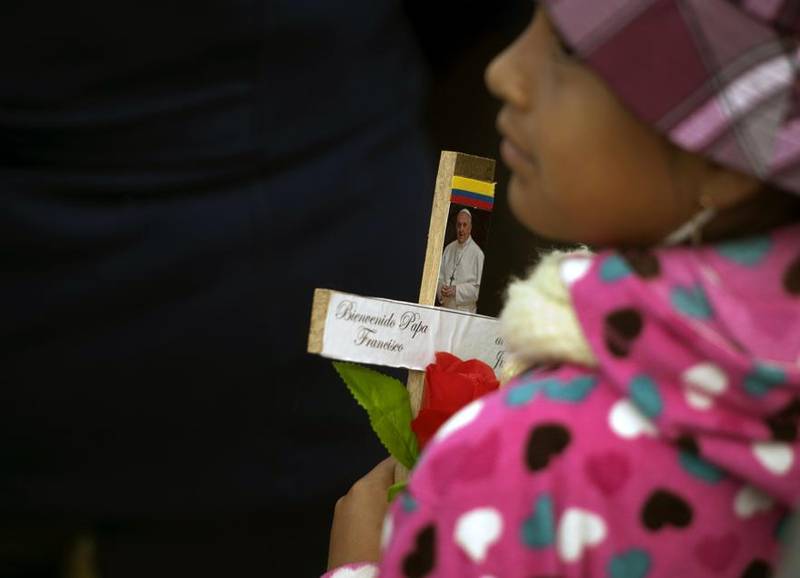
Pope Francis celebrated a mass for the evangelisation of peoples at the Bicentennial Park in Quito: “Evangelisation consists in attracting by our witness those who are far off, in humbly drawing near to those who feel distant from God and the Church, those who are fearful or indifferent” and in caring for one another (vaticaninsider. Andrea Tornielli, Quito)
“How beautiful it would be if all could admire how much we care for one another, how we encourage and help each other. Giving of ourselves establishes an interpersonal relationship; we do not give “things” but our very selves.” ““Giving of oneself” means letting all the power of that love” of God. “This is what it means to evangelize; this is the new revolution for our faith is always revolutionary.”
Francis celebrated a mass for the evangelisation of peoples in Quito’s Parque del Bicentenario (Bicentennial Park), where the airport that welcomed John Paul II back in 1985 once stood. The first ever Latin American Pope was greeted by a vast crowd. People arrived last night, bringing plastic seats and waterproof sheets to protect themselves against the wet and cold. The celebration was accompanied by traditional popular Ecuadorian songs and the first reading was pronounced in Quechua, a local indigenous language. Ecuador’s President Rafael Correa and his family were seated in the front row.
Francis spoke of a Christian “revolution” as he explained the meaning of evangelisation. The “hushed words of Jesus during the Last Supper” in support of Christian unity as a sign in order for the world to believe, become a “cry”, Francis explained. The Pope recalled that “it was a cry which arose from being conscious of a lack of freedom, of exploitation and despoliation, of being “subject to the passing whims of the powers that be,” of the American peoples, whose independence the Bicentennial Park commemorates.
“I would like to see these two cries joined together, under the beautiful challenge of evangelization. We evangelize not with grand words, or complicated concepts, but with “the joy of the Gospel,” Francis said. Jesus’ prayer was for his people to “be one…so that the world may believe”. “At that moment, the Lord was experiencing in his own flesh the worst of this world, a world he nonetheless loved dearly. Knowing full well its intrigues, its falsity and its betrayals, he did not turn away, he did not complain. We too encounter daily a world torn apart by wars and violence. It would be facile to think that division and hatred only concern struggles between countries or groups in society.”
In reality they are “that legacy of sin lurking in the heart of human beings, which causes so much suffering in society and all of creation. But is it precisely this troubled world into which Jesus sends us. We must not respond with nonchalance, or complain we do not have the resources to do the job, or that the problems are too big. Instead, we must respond by taking up the cry of Jesus and accepting the grace and challenge of being builders of unity.”
The Pope then recalled “that cry for freedom which arose a little more than two hundred years ago” for the independence of the Latin American people: “There was no shortage of conviction or strength … but history tells us that it only made headway once personal differences were set aside”. This is where evangelisation and freedom, the proclamation of the Gospel and the building of a more just society meet. Because “evangelization can be a way to unite our hopes, concerns, ideals and even utopian visions”. “The desire for unity involves the delightful and comforting joy of evangelizing, the conviction that we have an immense treasure to share, one which grows stronger from being shared, and becomes ever more sensitive to the needs of others.”
