
Missionary Figure of the Month
MARTIN OF TOURS
Mission and Holiness
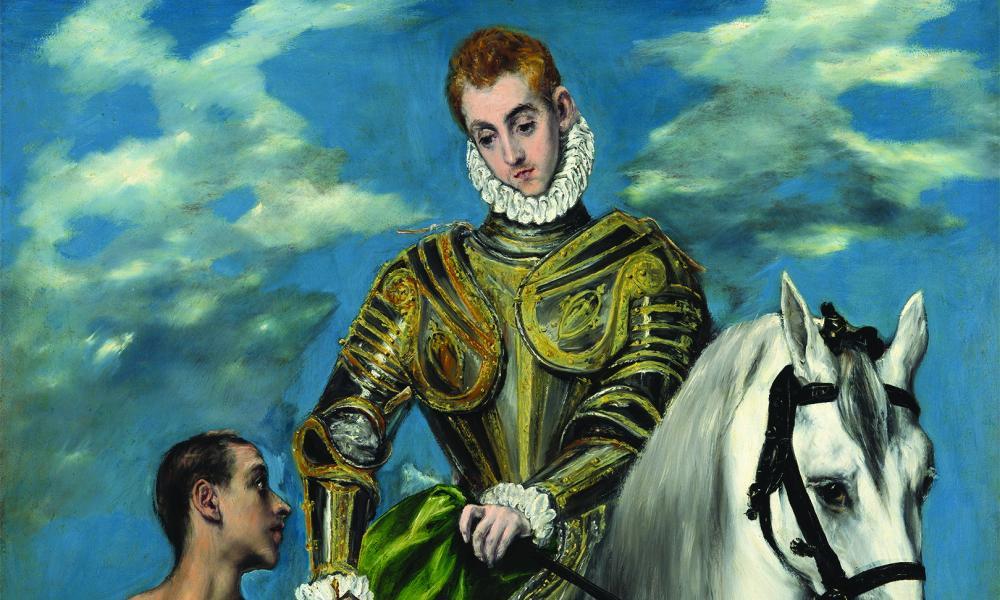
SHARING ONE’S CLOAK.
The life, spirituality and enduring relevance of a missionary bishop
In October, we launched a new feature to introduce our blog readers to a figure from the history of mission each month. The aim is not to practise missionary ‘archaeology’, but to rediscover, through the witness of these lives, what can still rekindle the missionary flame within us.
Last month, we remembered the Comboni missionary Teresa Grigolini on the 95th anniversary of her death, on 21 October 1931. Hers is a remarkable story in the history of mission. She was a nun, a wife and a mother, and she knew suffering in each of these roles. Her life can be read in the light of a threefold martyrdom.
In November, we meet Saint Martin of Tours, whose feast the Church celebrates on 11 November. The act of sharing his cloak with a poor man offers us a way into the life and spirituality of this missionary bishop. It also raises a question that concerns us too. What does it mean today to ‘share one’s cloak’ for a missionary Church?
Introduction. A saint for a missionary Church
Saint Martin of Tours (c. 316/317–397) is one of the most distinctive and influential figures of early Western Christianity. A soldier, catechumen, monk, bishop and evangelist, he lived through one of the most profound changes in the Church’s history, as the age of persecution gave way to public recognition of Christianity in the Roman Empire.
His own story reflects that change, yet it also marks a departure. At a time when the Church was gaining prestige and social influence, Martin chose poverty, Gospel simplicity, communal life and closeness to ordinary people. On becoming bishop, he did not abandon the monastic ideal but made it the foundation of his pastoral work.
His life shows a remarkable unity between contemplation and mission, prayer and social commitment, proclamation of the Gospel and care for the poor. More than sixteen centuries later, his witness remains surprisingly relevant to a Church called to renew its missionary presence in the world.
Between history and hagiography
We know Martin chiefly through Sulpicius Severus, a contemporary Christian writer who composed the Vita Martini in about 396, while the saint was still alive. This first biography is supplemented by the Dialogues, several letters and other writings by the same author. Gregory of Tours and Venantius Fortunatus later helped keep his memory alive and spread it further.
These are valuable sources, but they need to be read with care. Sulpicius was not writing biography by the standards of modern historiography. He set out to portray a model of Christian holiness, recounting historical events alongside miracles, visions and edifying episodes.
Behind the language of hagiography, however, a recognisable historical figure emerges: a man of deep spirituality and original initiative who played a leading role in spreading Christianity through rural Gaul and embodied a new way of exercising authority in the Church.
1. Between the Roman Empire and Christian Gaul
Martin was born at Sabaria in ancient Pannonia, now Szombathely in Hungary. His father was an officer in the Roman army. The family moved to Ticinum, present-day Pavia, where Martin grew up in a still predominantly pagan environment but came into contact with Christianity at an early age.
His world was changing rapidly. Following the recognition of freedom of worship in 313, the Church gradually emerged from its position as a persecuted minority and gained a growing role in imperial society. Christian communities multiplied, episcopal organisation took firmer shape, and fierce theological controversies arose, particularly over Arianism and the divinity of Christ.
Christianity was still chiefly an urban phenomenon, however. In the countryside, particularly in Gaul, Gallo-Roman cults and religious traditions endured. The Christian presence remained uneven, and evangelisation faced particular difficulties.
Martin’s military career took him to Amiens in Gaul, where tradition places the celebrated episode of the cloak. After his baptism and departure from the army, he became close to Hilary, Bishop of Poitiers, one of the most authoritative defenders of the Nicene faith. In the following years he travelled through Pannonia and Italy again, spending periods in seclusion and pursuing an ascetic life.
Around 361 he settled at Ligugé, near Poitiers, where he established one of the earliest documented monastic communities in the Latin West. In 371 he was elected Bishop of Tours, a city in the Loire Valley that would become the centre of his pastoral and missionary work.
He died in 397 at Candes, where he had gone to settle a dispute within a church community. His body was taken to Tours and buried on 11 November, which would become the date of his liturgical commemoration.
Martin’s travels from Pannonia to Italy and Gaul already tell us something of his character. He was a man on the move, able to cross borders, engage with very different communities and carry his experience of faith well beyond his birthplace.
2. A bishop who remained a monk
One of the most innovative aspects of Martin’s life was his choice of the monastic vocation.
Christian monasticism had developed chiefly in the East, especially in the deserts of Egypt, Palestine and Syria. Figures such as Antony the Abbot and Pachomius had embraced ways of life rooted radically in the Gospel, marked by the renunciation of possessions, prayer and ascetic discipline, and, in the case of cenobitic communities, by a shared life of fellowship.
These ways of life were becoming known in the West, chiefly through accounts and biographies such as the celebrated Vita Antonii by Athanasius of Alexandria.
There is no evidence that Martin visited the Egyptian monasteries himself, but his way of life clearly belonged to the ascetic movement spreading from the East into the Latin world.
His relationship with Hilary of Poitiers was also decisive. The bishop, deeply involved in the theological controversies of the day, was a guide to Martin in both Church affairs and spiritual life. At his side Martin gradually formed the ideal of a life wholly consecrated to Christ, in which fidelity to the Church went hand in hand with the demands of radical personal conversion.
At Ligugé, Martin began a monastic community of his own. Rather than following a codified rule of the kind Saint Benedict would later establish, he developed a way of life that grew out of his own spiritual quest, welcomed disciples and was deeply shaped by the Gospel ideal of poverty.
Elected Bishop of Tours in 371 despite his preference for a secluded life, Martin did not give up this ideal. After an initial period at the episcopal church, he founded a monastic community at Marmoutier, not far from Tours, where he continued to live with his disciples.
Sulpicius Severus says the community numbered about eighty men, some from families of high social standing. They led an austere life centred on prayer, the sharing of possessions, spiritual work and formation.
The novelty was not simply that a monk had become a bishop. Martin showed that pastoral responsibility could be exercised without renouncing the poverty and simplicity of life according to the Gospel.
At a time when the episcopate was gaining public prestige, his manner struck many as unusual, even uncomfortable at times. He sought not the honours of office but the opportunity to serve the community. His authority came chiefly from the way he lived what he professed.
In Martin we see a model of the bishop-monk take shape, in which contemplation does not draw him away from mission but becomes its wellspring.
3. The man and his spirituality: sharing the cloak
The best-known image of Martin is that of the young soldier at the gates of Amiens sharing his cloak with a poor man shivering with cold.
According to Sulpicius Severus, Martin had not yet been baptised. Passing through the city on a bitterly cold day, he came across a nearly naked man whom everyone ignored. Having nothing else to give, he drew his sword, cut his military cloak in two and gave one half to the poor man.
The following night, the biographer tells us, Martin saw Christ in a dream wearing that very half of his cloak. The story gives concrete form to the words of the Gospel: ‘I was naked and you clothed me’ (Mt 25:36).
One detail deserves a closer look. Why did Martin give away only half the cloak?
A later tradition holds that part of a soldier’s cloak belonged to the Roman army, or to the emperor, and part to the soldier himself. On this account, Martin was free to give away only his own half.
It is an appealing explanation, but the earliest source does not document it. Sulpicius Severus does not say that half the cloak was imperial property. He simply says Martin divided it in two, giving one part away and keeping the other to cover himself.
The heart of the story therefore lies elsewhere: Martin did not give away what he could spare. He shared something he himself needed.
The cloak becomes a symbol of charity born of personal encounter and involving real sacrifice.
The gesture also reveals an important feature of Martin’s spirituality. He discovered Christ through another person’s suffering before he had even completed his Christian initiation. Charity appears not only as a consequence of faith but also as a way for faith to mature.
This sensitivity stayed with him throughout his life. The sources describe a man of austere habits, little drawn to privilege, attentive to the poor, steadfast in prayer and capable of courageous action.
He also had a strong personality and could be energetic and combative. His humility was not weakness. It showed itself in his freedom to act according to conscience, without yielding to social prestige or political authority.
The many miracles reported by Sulpicius Severus should be read in the same light. Whatever can be verified historically, they testify to the conviction that Martin was deeply united to Christ and that his presence made the liberating power of the Gospel visible.
4. Missionary work: taking the Gospel to the countryside
If the cloak is Martin’s most familiar image, his missionary work is probably the most important historical contribution he made to the Church of his day.
As Bishop of Tours, Martin did not confine himself to governing the city’s Christian community. He travelled through the region, visited villages, met rural populations and encouraged Christian communities to take root where the Gospel was still little known.
The religious landscape of fourth-century Gaul was complex. While Christianity had gradually become established in the cities, many rural areas retained their temples, shrines, local cults and Gallo-Roman traditions.
Martin understood that mission required personal presence and that he had to meet people where they lived.
Sulpicius Severus recounts many missionary initiatives, often accompanied by extraordinary events. He describes the destruction of pagan places of worship, encounters and clashes with local populations, preaching and the formation of new communities.
These accounts must be read in context. Fourth-century evangelisation often involved forms of religious confrontation at odds with contemporary understandings of freedom of conscience and respect for other traditions.
What matters in Martin’s experience, then, is not that we should reproduce every historical method he used, but that we recognise his ability to go beyond the boundaries of a predominantly urban Church.
Martin also understood that mission could not be reduced to occasional preaching. It needed stable communities, places of worship, people properly prepared for their responsibilities and a Church presence that could accompany people in their everyday lives.
In this respect, his work made a significant contribution to the gradual Christianisation of rural Gaul.
5. The freedom of the Gospel in the face of power
Another episode brings out an important aspect of Martin’s missionary character: the case of Priscillian.
In the 380s, Priscillian, a bishop from the Iberian Peninsula, was accused of heresy and brought to trial before the imperial authorities at Trier. The proceedings ended, probably in 385 or 386, with a death sentence for him and several of his followers.
Martin tried to oppose the bloodshed and the intervention of the civil authorities in religious disputes.
He was not defending the doctrines attributed to Priscillian. He was refusing to accept that religious dissent should be punished by death.
The episode shows a pastor able to take an independent stand even before the emperor and the most influential figures in the Church.
For Martin, mission did not mean seeking the favour of the powerful. It also meant being free to defend human dignity and to remind those in power of their limits.
6. Martin’s influence on the history of the Church
Martin’s importance goes beyond his own work. His example helped change how Christian holiness itself was understood.
In the early centuries, martyrs had been among the most significant models of Gospel witness. Martin, by contrast, belonged to a generation that no longer lived through the great persecutions.
His holiness sprang not from a violent death but from a life wholly dedicated to Christ. He thus became one of the great Western models of the saint known as a confessor, someone who bears witness to the faith through everyday life, charity, prayer and service to the Church.
A second contribution was the bringing together of monastic life and episcopal ministry. Ligugé and Marmoutier offered the West a model of austere communal life that could also prepare men for responsibilities in the Church.
Finally, missionary work in the countryside helped reshape the Church’s presence, fostering the transition from a predominantly urban structure to a more extensive network of local communities.
After Martin’s death in 397, veneration of the saint spread rapidly.
His tomb at Tours became one of the great pilgrimage sites of the West. In the Frankish period he acquired particular religious and political importance and eventually became one of the kingdom’s principal patron saints.
Churches, monasteries, villages and towns were dedicated in his name. His cloak, preserved and venerated as a relic in Frankish tradition, became a symbol of religious protection.
The word chapel is also traditionally linked to Martin’s little cloak, or cappa, and to the place where it was kept.
The spread of his cult shows a remarkable ability to cross periods and cultures. The Roman soldier who became a bishop in Gaul gradually came to be known and venerated as a saint across much of Europe.
6. Saint Martin in European culture and folk traditions
Martin’s popularity is not confined to Church history. His memory has become deeply embedded in European culture, chiefly through the celebrations of 11 November.
The date of his burial coincides with an important point in the agricultural calendar, marking the end of the autumn harvests, preparations for winter and, in many regions, the conclusion of activities and agreements connected with rural life.
The meeting of the religious calendar and rural culture gave rise to traditions that are still widespread.
Saint Martin’s summer
In Italy, as in other European countries, the expression Saint Martin’s summer refers to a possible spell of relatively mild weather around 11 November.
Folk tradition linked this phenomenon to the sharing of the cloak, imagining that heaven rewarded Martin’s generosity with a few warm days.
The legend brings the Christian story together with an awareness of nature’s rhythms.
New wine: from Italy to Portugal
Another deeply rooted tradition concerns new wine.
In the Veneto, the saying ‘A San Martin el mosto se fa vin’ is still familiar: on Saint Martin’s Day, the must turns to wine. The feast falls at the time when people begin to taste the wine from the autumn harvest.
But the custom is not exclusively Italian. In Portugal, a well-known saying goes: «No dia de São Martinho, vai à adega e prova o vinho». On Saint Martin’s Day, go to the cellar and taste the wine.
The Portuguese feast includes traditional magustos, popular gatherings where people eat roasted chestnuts and sample the new wine, often alongside other drinks typical of rural life.
The resemblance between the Venetian and Portuguese proverbs is particularly striking. It shows how the same Christian feast came to be associated with similar farming practices and social customs in regions far apart.
Martin thus became a point of reference in the European farming calendar, where religion, work on the land and conviviality come together.
Lanterns, geese and sweets
In Germany, Austria and other parts of central Europe, Saint Martin’s feast is marked by children’s lantern processions.
The light of the lanterns evokes the saint’s generosity and the ability to bring light into dark situations. The celebrations often include a re-enactment of the sharing of the cloak.
The custom of Saint Martin’s goose is also widespread in several countries. According to a later legend, Martin tried to hide among the geese to avoid being made bishop, but their honking gave him away.
In Venice and elsewhere in the Veneto, by contrast, people make a sweet in the shape of Saint Martin on horseback, usually decorated with icing and sugared almonds.
These traditions are very different, but they all keep the saint’s memory alive and pass it on through familiar acts shared by families and communities.
Saint Martin in art
Art too has played a vital part in spreading his image.
The sharing of the cloak has been depicted countless times, from medieval illuminations to major cycles of paintings.
Among the best-known depictions is the fresco cycle by Simone Martini in the Lower Basilica of Saint Francis in Assisi.
The image of the young soldier bending down towards a poor man still speaks directly to us. Even without knowing the saint’s story, we can grasp its message of sharing and compassion.
Conclusion. Saint Martin and the Church’s mission today
What can a bishop who lived in the fourth century say to the Church today?
The historical distance is vast. Social, political and religious conditions have changed profoundly. It would be neither possible nor appropriate simply to reproduce the forms of evangelisation of his time.
Yet some of Martin’s insights remain remarkably relevant.
A mission born of encounter
The sharing of the cloak suggests a first and fundamental lesson: mission begins with the ability to see the other person.
Martin stops for someone everybody else ignores. He recognises a need and responds by sharing what he has.
It is a compelling image for a Church called to do more than organise its own activities and to recognise people’s suffering, hopes and questions.
The Christian message becomes credible when it takes the form of genuine closeness.
A Church that reaches those who are far away
Martin does not remain in his episcopal city. He travels through the countryside, reaches out to villages and meets people on the margins of Church life.
His initiative can inspire a missionary presence today that ventures beyond familiar settings.
Today’s peripheries are not only geographical. They can be cultural, social, generational or existential.
Think of young people who no longer find language that speaks to them in Church institutions, families facing new difficulties, people who are isolated, migrants, workplaces and settings where Christianity has become marginal.
Martin’s lesson is not about claiming new ground. It is about going out to meet people, building relationships and sharing experiences of life.
A mission nourished by prayer
Martin’s monastic life reminds us of another essential element.
Pastoral work cannot be sustained by programmes, structures and initiatives alone. It needs a spiritual source.
Martin tries to preserve time for silence and prayer even as his episcopal responsibilities multiply.
His experience invites Christian communities to consider the relationship between activity and contemplation, and between pastoral organisation and listening to the Gospel.
A missionary Church is not necessarily one that multiplies initiatives, but one that can recognise what is essential and draw the strength to serve from its relationship with Christ.
A mission rooted in community
Marmoutier also shows that Martin does not see Christian life as a solitary undertaking.
Disciples gather around him to share their lives, prayer and formation.
Evangelisation today still needs communities where faith can be lived, shared and handed on.
Occasional events are not enough. What is needed are lasting relationships, places where people are heard, opportunities for formation and settings where people can experience Christian fellowship in practice.
A free and credible Church
Martin’s personal simplicity, together with his willingness to challenge those in power, offers a further lesson.
The credibility of mission also depends on how authority is exercised in the Church.
Personal integrity, restraint, closeness to people and independence from political and economic interests are no mere details. They help make the Gospel message recognisable.
Martin’s intervention on behalf of Priscillian also reminds us that Christian witness must defend human dignity even in situations of conflict.
Authentic mission cannot disregard respect for conscience, religious freedom and human dignity.
A mission in dialogue with cultures
Finally, the many folk traditions associated with Saint Martin show that Christian experience can enter into dialogue with the cultures, memories and everyday lives of peoples.
Valuing these traditions need not mean preserving the past out of nostalgia.
It can instead be a chance to rediscover the human and spiritual meaning of simple acts: sharing food, welcoming others, celebrating together and caring for the most vulnerable.
It is a way of evangelising that starts from people’s lived experience and seeks to bring to light the deeper questions that run through their lives.
Conclusion. Saint Martin and a Church that goes forth
Saint Martin’s life can be read afresh in the light of Pope Francis’s invitation to become ‘a Church that goes forth’.
In the apostolic exhortation Evangelii gaudium, Francis calls for a missionary conversion capable of transforming the Church’s style, habits and structures. Rather than turning inwards towards its own organisation, the Church is called to go out to meet people, especially those living on the human and social peripheries.
Although he belongs to a very different historical context, Martin seems to anticipate aspects of this vision.
He is a man willing to step beyond what makes him feel secure. He leaves his military career, chooses a life of poverty, accepts the responsibilities of a bishop and travels through the countryside to meet people far removed from Christian life.
Above all, however, he is a man who makes himself available to others. His life suggests that mission begins not when the Church decides to speak to others, but when it allows their presence, suffering and questions to challenge it.
The Church that goes forth envisaged by Pope Francis is also a Church capable of drawing close, listening, fostering fellowship and bearing witness.
Martin gives this attitude concrete form: a bishop who never ceases to be a monk, a contemplative who does not shirk pastoral duties, an evangelist who reaches the peripheries of his time and a man of faith who recognises the very face of Christ in the poor.
Sharing the cloak thus becomes far more than an edifying episode. It symbolises a way of being Church and carrying out its mission.
Sources and selected bibliography
Ancient sources
- Sulpicius Severus, Vita sancti Martini, critical edition edited by Jacques Fontaine, Sources Chrétiennes, vols 133–135, Éditions du Cerf, Paris, 1967–1969.
- Sulpicius Severus, Dialogi, Epistulae and Chronica.
- Gregory of Tours, De virtutibus sancti Martini and Historia Francorum.
- Venantius Fortunatus, Vita sancti Martini, in verse.
Historical and hagiographical studies
- Clare Stancliffe, St Martin and His Hagiographer: History and Miracle in Sulpicius Severus, Clarendon Press, Oxford, 1983.
- Jacques Fontaine, introduction and historical-critical commentary on Vie de Saint Martin, Éditions du Cerf, Paris, 1967–1969.
- Rajko Bratož, Martin of Tours and His Contacts with Pannonia, 2006.
- Danny Praet, The Divided Cloak as Redemptio Militiae: Biblical Stylization and Hagiographical Intertextuality in Sulpicius Severus’ Vita Martini, 2016.
- Sharon Farmer, Communities of Saint Martin: Legend and Ritual in Medieval Tours, Cornell University Press, Ithaca, 1991.
- Eugen Ewig, Le culte de saint Martin à l’époque franque, in Revue d’histoire de l’Église de France, 1961.
- Enciclopedia Italiana Treccani, entry Martino di Tours, santo.
Fr Manuel João Pereira Correia, MCCJ
11 November 2026
Research conducted using AI
