Reflections on Eucharist
Ron Rolheiser
The Eucharist as a call to Justice
When the famous historian Christopher Dawson decided to become a Roman Catholic, his aristocratic mother was distressed, not because she had any aversion to Catholic dogma, but because now her son would, in her words, have to “worship with the help”. She was painfully aware that, in church at least, his aristocratic background would no longer set him apart from others or above anyone. At church he would be just an equal among equals because the Eucharist would strip him of his higher social status.
She intuited correctly. The Eucharist, among other things, calls us to justice, to disregard the distinction between rich and poor, noble and peasant, aristocrat and servant, both around the Eucharist table itself and afterwards outside of the church. The Eucharist fulfills what Mary prophesized when she was pregnant with Jesus, namely, that, in Jesus, the mighty would be brought down and that lowly would be raised up. It was this very thing that first drew Dorothy Day to Christianity. She noticed that, at the Eucharist, the rich and the poor knelt side by side, all equal at that moment.
Sadly, we often don’t take this dimension of the Eucharist seriously. There is a common tendency to think that the practice of justice, especially social justice, is an optional part of being a Christian, something mandated by political correctness rather than by the gospels. Generally we don’t see the call to actively reach out to the poor as something from which we cannot exempt ourselves.
But we are wrong in this. In the gospels and in the Christian scriptures in general, the call to reach out to the poor and to help create justice in the world is as non-negotiable as keeping the commandments and going to church. Indeed striving for justice must be part of all authentic worship.
In the New Testament, every tenth line is a direct challenge to reach out to the poor. In Luke’s gospel, we find this in every sixth line. In the Epistle of James, this occurs in every fifth line. The challenge to reach out to the poor and to level the distinction between rich and poor is an integral and non-negotiable part of being a Christian, commanded as strongly as any of the commandments.
And this challenge is contained in the Eucharist itself: The Eucharistic table calls us to justice, to reach out to the poor. How?
First, by definition, the Eucharistic table is a table of social non-distinction, a place where the rich and the poor are called to be together beyond all class and status. At the Eucharist there are to be no rich and no poor, only one equal family praying together in a common humanity. In baptism we are all made equal and for that reason there are no separate worship services for the rich and the poor. Moreover, St. Paul warns us strongly that when we gather for the Eucharist the rich should not receive preferential treatment.
Indeed, the gospels invite us in the opposite direction. When you hold any banquet, they tell us, we should give preferential treatment to the poor. This is especially true for the Eucharist. The poor should be welcomed in a special way. Why?
Because, among other things, the Eucharist commemorates Jesus’ brokenness, his poverty, his body being broken and his blood being poured out. Pierre Teilhard de Chardin expresses this aptly when he suggests that the wine offered at the Eucharist symbolizes precisely the brokenness of the poor: In a sense the true substance to be consecrated each day is the world’s development during that day – the bread symbolizing appropriately what creation succeeds in producing, the wine (blood) what creation causes to be lost in exhaustion and suffering in the course of that effort. The Eucharist offers up the tears and blood of the poor and invites us to help alleviate the conditions that produce tears and blood.
And we do that, as a famous church hymn says, by moving “from worship into service”. We don’t go to the Eucharist only to worship God by expressing our faith and devotion. The Eucharist is not a private devotional prayer, but is rather a communal act of worship which, among other things, calls us to go forth and live out in the world what we celebrate inside of a church, namely, the non-importance of social distinction, the special place that God gives to the tears and blood of the poor, and non-negotiable challenge from God to each of us to work at changing the conditions that cause tears and blood. The Eucharist calls us to love tenderly, but, just as strongly, it calls us to act in justice.
To say that Eucharist calls us to justice and to social justice is not a statement that takes its origin in political correctness. It takes its origin in Jesus who, drawing upon the great prophets of old, assures us that the validity of all worship will ultimately be judged by how it affects “widows, orphans, and strangers.”
August 2, 2009
A Eucharistic Prayer over an Awakening World
On the Feast of the Transfiguration in 1923, Pierre Teilhard de Chardin found himself alone at sunrise in the Ordos desert in China, watching the sun spread its orange and red light across the horizon. He was deeply moved, humanly and religiously. What he most wanted to do in response was to celebrate mass, to somehow consecrate the whole world to God. But he had no altar, no bread, and no wine. So he resolved to make the world itself his altar and what was happening in the world the bread and the wine for his mass. Here, in paraphrase, is the prayer he prayed over the world, awakening to the sun that morning in China.
O God, since I have neither bread, nor wine, nor altar, I will raise myself beyond these symbols and make the whole earth my altar and on it will offer to you all the labors and sufferings of the world.
As the rising sun moves as a sheet of fire across the horizon the earth wakes, trembles, and begins its daily tasks. I will place on my paten, O God, the harvest to be won by this renewal of labor. Into my chalice I will pour all the sap which is to be pressed out this day from the earth’s fruits. My paten and my chalice are the depths of a soul laid widely open to all the forces which in a moment will rise up from every corner of the earth and converge upon the Spirit.
Grant me, Lord, to remember and make mystically present all those whom the light is now awakening to this new day. As I call these to mind, I remember first those who have shared life with me: family, community, friends, and colleagues. And I remember as well, more vaguely but all-inclusively, the whole of humanity, living and dead, and, not least, the physical earth itself, as I stand before you, O God, as a piece of this earth, as that place where the earth opens and closes to you.
And so, O God, over every living thing which is to spring up, to grow, to flower, to ripen during this day, I say again the words: “This is my body.” And over every death-force which waits in readiness to corrode, to wither, to cut down, I speak again your words which express the supreme mystery of faith: “This is my blood.” On my paten, I hold all who will live this day in vitality, the young, the strong, the healthy, the joy-filled; and in my chalice, I hold all that will be crushed and broken today as that vitality draws its life. I offer you on this all-embracing altar everything that is in our world, everything that is rising and everything that is dying, and ask you to bless it.
And our communion with you will not be complete, will not be Christian, if, together with the gains which this new day brings, we do not also accept, in our own name and in the name of the world, those processes, hidden or manifest, of enfeeblement, of aging, and of death, which unceasingly consume the universe, to its salvation or its condemnation. Lord, God, we deliver ourselves up with abandon to those fearful forces of dissolution which, we blindly believe, will this cause our narrow egos to be replaced by your divine presence. We gather into a single prayer both our delight in what we have and our thirst for what we lack.
Lord, lock us into the deepest depths of your heart; and then, holding us there, burn us, purify us, set us on fire, sublimate us, till we become utterly what you would have us to be, through the annihilation of all selfishness inside us. Amen.
For Teilhard this, of course, was not to be confused with the celebration of the Eucharist in a church, rather he saw it as a “prolongation” or “extension” of the Eucharist, where the Body and Blood of Christ becomes incarnate in a wider bread and wine, namely, in the entire physical world which manifests the mystery of God’s flesh shining through all that is.
Teilhard was an ordained, Roman Catholic, priest, covenanted by his ordination to say mass for the world, to place bread on a paten and wine in a chalice and offer them to God for the world. We too, all of us Christians, by our baptism, are made priests and, like Teilhard, are covenanted to say mass for the world, that is, to offer up on our own metaphorical patens and chalices, bread and wine for the world, in whatever form this might take on a given day. There are many ways of doing this, but you might want to try this: Some morning as the sun is lighting-up the horizon, let its red and golden fire enflame your heart and your empathy so as to make you stretch out your hands and pray Teilhard’s Eucharistic prayer over an awakening world.
August 10, 2015
The Eucharist as Sacrifice
Once upon a time there was a Rabbi. Whenever he wanted God’s presence, he went to a special place in the woods, lit a fire, said some prayers, and did a dance. Then God would appear to him. When he died, his disciple did the same. If he wanted God’s presence, he went to the same spot in the woods, lit the fire, and said the same prayers, but nobody had taught him the dance. It still worked. God appeared. When he died, his disciple carried on the tradition. If he wanted God’s presence, he went to the same spot in the woods and lit the fire, but he didn’t know the prayers, nor the dance, but it still worked. God came. Then he died. He also had a disciple. Whenever he wanted God’s presence, he too went to the same place in the woods, but nobody had taught him how to light the fire or say the prayers or do the dance, but it still worked, God appeared.
In the end, he died, but he too had a pupil. One day this pupil wanted God’s presence. So he searched for the place in the woods, but couldn’t find it. And he didn’t know how to light the fire or say the prayers or do the dance. All he knew was how to tell the story. But it worked. He discovered that whenever he told the story of how the others had found God, God would appear.
In essence, this story explains how sacred ritual, liturgy, works. Judaism calls this “making zikkaron”. Christians call it “making memorial”. The idea is that a past event can be remembered, ritually recalled, in such a way that it becomes present again and can be participated in. How is this possible? We have no models in physics, metaphysics, or psychology by which to explain this. Like all ritual, it is beyond simple phenomenology. Ritual is best understood through metaphor, through story, as with the tale just told. God appears whenever certain stories get told.
This idea of making memorial can be helpful in understanding a very important aspect of the Eucharist, namely, the Eucharist as sacrifice. Among other things, the Eucharist is a memorial, a ritual re-enactment of Christ’s sacrifice of himself for us. Among all the dimensions of the Eucharist, this one, sacrifice, is perhaps the least understood. How is the Eucharist a sacrifice?
A sacrifice is any act of selflessness, of self-denial, which helps someone else. For example, the mother who freely gives up her own dreams of achievement so that her children might have her needed presence during their critical, nascent years is making a sacrifice for her children. They will mature more fully and healthily because of it. As Christians, we believe that Jesus, not unlike a loving mother, sacrificed his life for us, particularly in the way he gave himself for us in his death. Indeed we believe that we are “saved” by his death, by his sacrifice on Good Friday. But how? How can one person’s death help someone else, centuries later?
Through the Eucharist. The Eucharist, among other things, is a memorial of Jesus’ sacrifice for us, of his great act of “being broken”, of giving himself over in love. Properly understood, the Eucharist, as a ritual, gives us another kind of “real presence”. It makes present for us the reality of Christ’s dying as well as God’s response to that, the resurrection, and invites us to participate in that event. What the Eucharist makes present is not an iconic Christ to be adored or even consumed, but the reality of Christ’s dying nd rising as an event to be participated in. But how can we participate in an event now long past in history?
Through memorial, through “making zikkaron”. When we ritually tell the story of Jesus’ sacrifice (in the Eucharistic prayer, the very heart of liturgy) we experience the “real presence” of the event of Christ’s dying and rising. Moreover, that reality is given to us so that we might participate in it. How? We participate in Jesus’ sacrifice for us when we, like him, let ourselves be broken down, when we, like him, become selfless. The Eucharist, as sacrifice, invites us to become like the kernels of wheat that make up the bread and the clusters of grapes that make up the wine, broken down and crushed so that we can become part of communal loaf and single cup.
Occasionally when St. Augustine was giving the Eucharist to a communicant, instead of saying, “The body of Christ”, he would say: “Receive what you are.” That puts things correctly. What is supposed to happen at the Eucharist is that we, the congregation, by sacrificing the things that divide us, should become the body and blood of Christ. More so than the bread and wine, we, the people, are meant to be changed, to be transubstantiated.
The Eucharist, as sacrifice, asks us to become the bread of brokenness and the chalice of vulnerability.
March 18, 2001
The Healing Embrace of the Eucharist
There are different kinds of loneliness and different kinds of intimacy. We ache in many places.
When I was a young priest, newly ordained and barely beyond the loneliness of adolescence, certain words at the Eucharist touched me deeply. I was a young and lonely and words about being drawn together inside one body and one spirit would incite feelings in me to do with my own loneliness. To become one body in Christ triggered, in me, an image of an embrace that would put an end to my personal loneliness, my endless aching, and my sexual separateness. Unity in Christ, as I fantasized it then, meant overcoming my own loneliness.
And that is a valid understanding. The Eucharist is an embrace meant to take away personal loneliness, but, as we get older, a deeper kind of loneliness can and should begin to obsess us. This deeper loneliness makes us aware how torn and divided is our world and everything and everyone in it. There is a global loneliness that dwarfs private pain.
How separate and divided is our world! We look around us, watch the world news, watch the local news, look at our places of work, our social circles, and even our churches, and we see tension and division everywhere. We are far from being one body and one spirit. So many things, it seems, work to divide us: history, circumstance, background, temperament, ideology, geography, creed, color, and gender. And then there are our personal wounds, jealousies, self-interest, and sin. The world, like a lonely adolescent, aches too in its separateness. We live in a world deeply, deeply divided.
And the older I get, the more I despair that there can be a simple solution, or perhaps even a human solution at all, to our divisions. Life slowly teaches us that it is naive to believe that all we need is simple optimism, good-will, and an unfailing belief that love will conquer. Love can and will conquer, but it doesn’t happen like in a Hollywood picture, where two people who really have no business ever being together fall in love and despite having nothing in common, despite being deeply wounded, despite being immature and selfish, and despite having no shared faith or values, are able to rise above all their differences to sustained embrace and ecstasy, simply because love conquers all.
At a certain point, we know that real life doesn’t work like that, unless we die in that initial embrace as did Romeo and Juliet. Our differences eventually have their say, both inside of our personal relationships and inside the relationships between countries, cultures, ethnic groups, and religions. At a certain point our differences, like a cancer that cannot be stopped, begin to make themselves felt and we feel helpless to overcome that.
But this isn’t despair. It’s health. As anyone who has ever fought an addiction knows, the beginning of a return to health lies in the admission of helplessness. It’s only when we admit that we can’t help ourselves that we can be helped. We see in the gospels where so many times, immediately after finally grasping a teaching of Jesus, the apostles react with the words: “If that’s true, then it’s impossible for us, then there’s nothing we can do!” Jesus welcomes that response (because in that admission we open ourselves to help) and replies: “It is impossible for you, but nothing is impossible for God!”
Our prayers for unity and intimacy become effective precisely when they issue from this feeling of helplessness, when we ask God to do something for us that we have despaired of doing for ourselves.
We see an example of this within Quaker communities when people gather and simply sit with each other in silence, asking God to do for them what they cannot do for themselves, namely, give themselves harmony and unity. The silence is an admission of helplessness, of having given up on the naïve notion that we, as human beings, will ever finally find the right words and the right actions to bring about a unity that has forever evaded us.
The Eucharist is such a prayer of helplessness, a prayer for God to give us a unity we cannot give to ourselves. It is not incidental that Jesus instituted it in the hour of his most intense loneliness, when he realized that all the words he had spoken hadn’t been enough and that he had no more words to give. When he felt most helpless, he gave us the prayer of helplessness, the Eucharist.
Our generation, like every generation before it, senses its helplessness and intuits its need for a messiah from beyond. We cannot heal ourselves and we cannot find the key to overcome our wounds and divisions all on our own. So we must turn our helplessness into a Quaker-silence, a Eucharistic prayer, that asks God to come and do for us what we cannot do for ourselves, namely, create community. And we must go to Eucharist for this same reason.
February 1, 2009
The Eucharist as Washing Each Other’s Feet
In his rather provocative, though always interesting, autobiography, Angela’s Ashes, Frank McCourt tells of a confession he once made as a young boy in Limerick, Ireland. His mother had just given birth and their in-laws from the North had sent five pounds to buy milk for the new baby. But his father, an alcoholic, had taken the money and was drinking it up in the pubs. His mother had sent him, a young boy, to find his dad and bring him home. But young Frankie can’t find his father. What he finds instead is a drunken sailor in a pub, asleep, with a largely untouched plate of fish and chips in front of him.
Ravenously hungry, he takes the fish and chips outside and eats them. Then, feeling guilty for stealing, he decides he had better go to confession. It’s Saturday afternoon and he goes to the Dominican church and confesses to a priest that he stole fish and chips from a drunken man. The priest asks him why he did this and Frankie answers that he was hungry, that there is not a scrap of food in their house, and that his mother is raging by the fire because his father is drinking away the money meant to buy milk for the new baby. The priest hearing all this suddenly becomes quiet. Instead of scolding Frankie and giving him a penance, he does something else [McCourt’s words]:
“I wonder if the priest is asleep because he’s very quiet til he says, My child, I sit here, I hear the sins of the poor, I assign the penance. I bestow the absolution. I should be on my knees washing their feet. … Go. Pray for me. He blesses me in Latin, talks to himself in English and I wonder what I did to him.”
These words wonderfully describe one of the central meanings of the Eucharist. We should be on our knees washing each others’ feet because that is precisely what Jesus did at the first Eucharist and he did it to teach us that the Eucharist is not a private act of devotion, meant to square our debts with God, but a call to and a grace for service. The Eucharist is meant to send us out into the world ready to give expression to Christ’s hospitality, humility, and self-effacement.
Where do we get such a notion? It lies at very the heart of the Eucharist itself. Jesus tells us this when he gives us the Eucharist, with the words: “Receive, give thanks, break, and share.” The Eucharist invites us to receive nourishment from God, fill with gratitude, and, on the basis of that, to break open our lives and serve the poor in hospitality, humility, and self-donation.
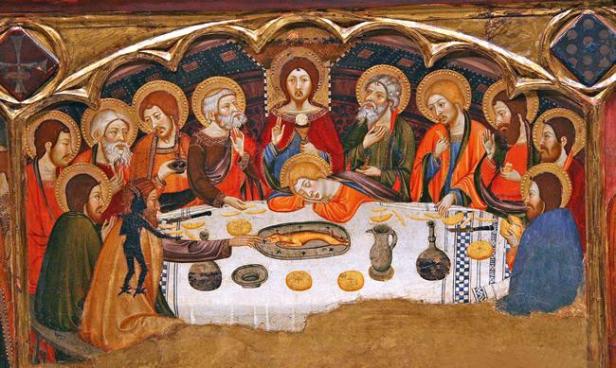
This is everywhere evident in the Gospels, though John’s Gospel puts it the most clearly. Where the other gospels have Jesus speaking the words of institution at the last supper (“This is my body. This is my blood. Do this in memory of me.”) John has Jesus washing the disciples feet. But, for John, this gesture replaces the words of institution. It specifies what the Eucharist is in fact meant to do, namely, to lead us out of church and into the humble service of others.
An old church hymn, often used to send people forth from church, puts it well:
Called from worship into service
Forth in His great name we go
To the child, the youth, the aged
Love in living deeds to show.
This wonderfully expresses what the Eucharist is meant to do. It is a call to move from worship to service, to take the nourishment, the embrace, the kiss, we have just received from God and the community and translate it immediately and directly into loving service of others. To take the Eucharist seriously is to begin to wash the feet of others, especially the feet of the poor. The Eucharist is both an invitation which invites us and a grace which empowers us to service. And what it invites us to do is to replace distrust with hospitality, pride with humility, and self-interest with self-effacement so as to reverse the world’s order of things – wherein the rich get served by the poor and where the first priority is always to keep one’s pride intact and one’s self-interest protected. The Eucharist invites us to step down from pride, away from self-interest, to turn the mantel of privilege into the apron of service, so as to help reverse the world’s order of things wherein pride, status, and self-interest are forever the straws that stir the drink.
It is no accident that, among all the potential scripture texts it might have picked for liturgy on Holy Thursday, the feast that marks the institution of the Eucharist, the church has chosen to use John’s account of Jesus washing the feet of disciples. A splendid choice. Indeed, nothing better expresses the meaning of the Eucharist than does that gesture.
April 1, 2001
By kind permission of the author.
Oblate Father Ron Rolheiser is a Professor of Spirituality at Oblate School of Theology and award-winning author.
He can be contacted through his website www.ronrolheiser.com.
Follow on Facebook www.facebook.com/ronrolheiser
