Leo’s Journey to Algeria, Cameroon, Angola, and Equatorial Guinea (April 13–23) becomes the first act of his pontificate that intends to speak to the world
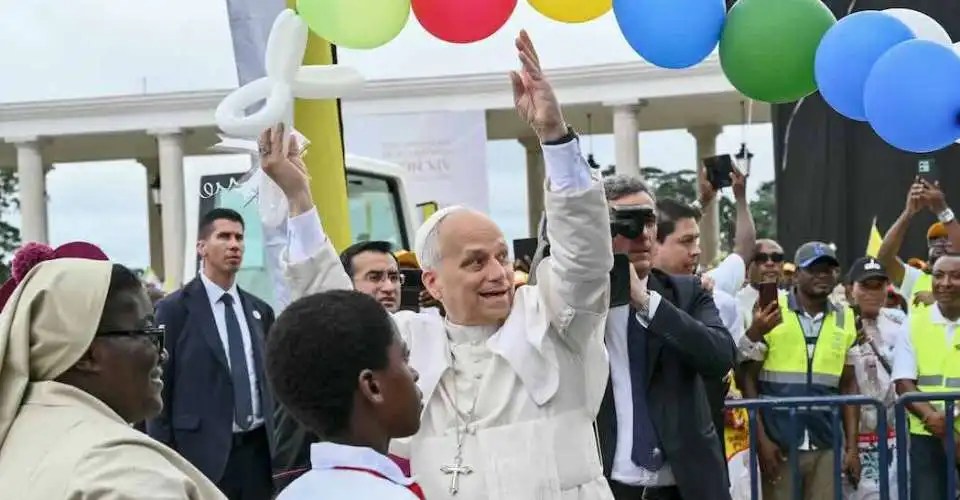
Pope Leo XIV receives balloons from children as he arrives to lead a Holy Mass at the Basilica of the Immaculate Conception in Mongomo on the tenth day of an 11-day apostolic journey to Africa, on April 22, 2026. (Photo by Alberto PIZZOLI / AFP)
By Antonio Spadaro, SJ
Published: April 24, 2026
https://www.ucanews.com
The first major apostolic journey of Pope Leo XIV — eleven days, four countries, an entire continent as horizon — was far more than a pastoral pilgrimage.
From his landing in Algiers on April 13 to his departure from Malabo on April 23, Leo XIV constructed an organic, carefully articulated discourse on the state of the contemporary world, a discourse in which Africa is the protagonist, the vantage point from which to judge the pathologies of international politics.
Peace, war, tyranny, corruption, neo-colonialism, extractivism, exclusion, fundamentalism: each of these themes was addressed by the Pope with a candor and a coherence that reveal a pastoral project of sweeping ambition.Trending NewsVatican News
Algeria: The Pilgrim of Peace in the Land of Augustine
Leo XIV wanted Africa to be the destination of his first international journey. And he wanted that journey to begin in Algeria, the homeland of his spiritual father, Saint Augustine, where he had already traveled twice — in 2004 and 2013 — as an Augustinian religious.
At the Djamaa el Djazair Conference Center in Algiers, dressing the president, government authorities, and the diplomatic corps, the pope introduced himself as a “pilgrim of peace,” affirming that in a world full of conflicts and misunderstandings, the simple act of recognizing ourselves as one family is the key that opens many locked doors. This programmatic simplicity — the primacy of encounter over strategy — is the hallmark of his magisterium.
But the Algerian address did not stop at the rhetoric of fraternity. Leo XIV confronted the question of global power imbalances head-on, speaking from a country whose colonial and post-colonial history affords it a particularly acute perspective on international dynamics.
He spoke of “continuous violations of international law” and of “neo-colonial temptations,” calling on Algeria to become a protagonist in a new chapter of history, founded on respect for the dignity of every person and on solidarity with the sufferings of peoples near and far.
He cited Benedict XVI on globalization, which, when poorly oriented, generates poverty and inequality, and Pope Francis on the need to include popular movements in governance.
The message was clear: international politics cannot be decided solely in the centers of power; the world’s peripheries — and Africa is the first among them — have something to say and to teach.
At the monument to Algeria’s martyrs, the Maqam Echahid, Leo XIV delivered a dense reflection on freedom and peace. He affirmed that God desires peace for every nation — not the mere absence of conflict, but a peace that is the expression of justice and dignity.
And he added that such a peace is possible only through forgiveness, acknowledging how difficult it is to forgive, yet insisting that the future belongs to men and women of peace, and that justice will ultimately prevail over injustice, while violence — despite appearances — will never have the last word.
These were words directed, self-evidently, not only at Algeria’s historical memory but at every conflict raging in the world today.
The visit to the Grand Mosque of Algiers then confirmed the centrality of interreligious dialogue in the Leonine pontificate. The pope linked the search for God to the search for the dignity of every human being, praying for the peace and justice of the Kingdom of God among all the peoples of the earth.
Cameroon: Disarmed Peace and the Denunciation of the Warlords
The Cameroonian leg of the journey was its political heart. In Yaoundé, at the Presidential Palace, Leo delivered an address that amounts to a genuine manifesto on peace and good governance.
He described Cameroon as “Africa in miniature” for its rich cultures and languages, but immediately made clear that this variety “is not a fragility: it is a treasure” and that “it constitutes a promise of fraternity and a solid foundation for building a lasting peace.”
The pope did not hesitate to denounce the country’s dire situations — the tensions and violence in the Northwest, the Southwest, and the Far North — and their consequences: lives lost, families displaced, children deprived of school, young people with no future.
He invoked a peace that is “disarmed” — that is, not founded on fear, threats, or armaments — and “disarming” — that is, capable of resolving conflicts, opening hearts, and generating trust and empathy.
He repeated the cry he had launched in October 2025 at the World Meeting for Peace: enough wars, with their agonizing accumulations of dead, destruction, and exiles.
But the Yaoundé address also contains a formidable lesson on power and corruption, inspired by Augustine. Leo XIV quoted the passage from the De civitate Dei in which Augustine declares that whoever commands is at the service of those who are apparently commanded, and that power is exercised not in the lust for domination but in the duty of provision, not in the pride of imposing oneself but in the compassion of caring.
He then called on those in government to break the chains of corruption, which disfigure authority by emptying it of all moral credibility, and to free the heart from the thirst for profit, which is “idolatry.” The true profit, he said, is integral human development.
This address also includes a highly significant passage on women: the pope underscored, with gratitude, their role as architects of peace and their commitment to education, mediation, and the reconstruction of the social fabric, describing it as capable of serving as a brake on corruption and abuses of power. For this reason, he said, their voice must be “fully recognized in decision-making processes.”
In Bamenda, at Saint Joseph’s Cathedral, the most intense moment of the trip: the encounter for peace with the community ravaged by the Anglophone crisis. Leo XIV delivered scorching words against the warlords, denouncing that “a single moment is enough to destroy, but often a lifetime is not enough to rebuild,” and that “billions of dollars are found to kill and devastate, but the resources needed to heal, to educate, to raise people up cannot be found.”
He described the perverse spiral of extractivism: those who plunder Africa’s resources invest a large share of their profits in weapons, fueling an endless spiral of destabilization and death. He concluded with a statement that resonates as a principle of political philosophy: “The world is destroyed by a handful of dominators and held together by a multitude of brothers and sisters in solidarity.”
The praise for collaboration between Christian and Muslim communities in Bamenda, who drew closer during the crisis and founded a Movement for Peace, was offered to the world as a model. The pope exclaimed that woe to those who bend religion and the very name of God to their own military, economic, or political ends, dragging what is holy into what is most foul and darkest.
At the Catholic University of Central Africa, finally, Leo XIV spoke to young people and the academic world, challenging them to become “pioneers of a new humanism in the context of the digital revolution” — a continent that knows well not only the seductive aspects of technology but also the dark side of the environmental and social devastation produced by the frantic search for raw materials and rare earths.
Angola: Joy and Hope as Political Virtues
The address to Angolan authorities in Luanda introduced an original concept: joy and hope as “political” virtues. Leo XIV defined Africa as “a reserve of joy and hope” for the entire world because its young people and its poor still dream and hope, refuse to settle for things as they are, and desire to rise again.
The wisdom of a people cannot be extinguished by any ideology, and the longing for the infinite that dwells in the human heart is a principle of social transformation more profound than any political or cultural program.
From this premise came the denunciation of the “extractive logic” that causes suffering, death, and social and environmental catastrophe, which imposes itself as the only possible model of development.
Leo XIV reprised Paul VI’s indictment, made sixty years ago, of the senile, entirely anachronistic character of a commercial, hedonistic, and materialistic civilization that presumes to pass itself off as the bearer of the future.
But the most radical passage in the Luanda address concerns tyranny. The pope described the mechanisms of despotism with a lucidity that evokes the finest tradition of Christian political thought: “Despots and tyrants of body and spirit seek to render souls passive and passions sorrowful, inclined to inertia, docile, and enslaved to power. In sadness, we are at the mercy of our fears and phantoms; we take refuge in fanaticism, in submission, in the media din, in the mirage of gold, in the myth of identity.”
He quoted Francis again on the strategy of those who dominate: “the best way to dominate without limits is to sow hopelessness and to foster constant distrust, even while it is disguised as the Défense of certain values.” Authentic joy — a gift of the Spirit, the fruit of relationship and solidarity — was presented as a force for liberation from political alienation.
In the homily at Saurimo, the tone shifted: Leo XIV spoke to the Angolan Church in its deepest heart, asking it to remain faithful to its Christian roots so as to continue contributing to the construction of justice and peace in Africa and throughout the world.
Equatorial Guinea: The City of God and the City of Peace
The final stop in Malabo gave Leo XIV the occasion for a sweeping theological-political reflection, grounded in Augustine’s two cities. The pope recalled that the earthly city is centered on the prideful love of self, on the craving for power and worldly glory that lead to destruction; the City of God, by contrast, is founded on unconditional love and the love of neighbor.
Addressing the authorities of a country that has just built a new capital called Ciudad de la Paz, Leo XIV asked that this name challenge every conscience to consider which city it wishes to serve.
The Malabo address is also the one in which Leo XIV launched his most precise denunciations of contemporary international politics.
He spoke of exclusion as “the new face of social injustice,” of the dramatic gap between the one percent of the population and the overwhelming majority, of the paradox whereby the lack of land, food, housing, and employment coexists with access to new technologies.
He denounced the speculation tied to the demand for raw materials, the neglect of the safeguarding of creation, the rights of local communities, and the dignity of labor. He stated bluntly that the proliferation of armed conflicts has among its principal motives the colonization of oil and mineral deposits, with no regard for international law and the self-determination of peoples.
Regarding new technologies, Leo XIV observed that they appear to be conceived and deployed primarily for military purposes and within frameworks of meaning that do not promise expanded opportunities for all.
He warned that without a course correction toward assuming political responsibility and respecting international institutions and agreements, the destiny of humanity risks being tragically compromised.
He concluded: “God does not want this. His holy Name must not be profaned by the will to dominate, by arrogance and discrimination: above all, it must never be invoked to justify choices and actions of death.”
At the Stadium of Bata on April 22nd, the pope met with young people and families, an event that became one of the most vibrant and emotionally charged of the entire journey. The setting itself was a declaration of intent: tens of thousands of young Equatoguineans, with their dances, costumes, and symbols — a fishing net, a statue of the Virgin Mary, a model boat, and a staff — bore witness to the living heritage of their cultures and to the joy of a faith that is not imported but incarnated.
Leo XIV seized on this energy to articulate a theology of youth and family that was at once pastoral and political. He told the young that the future belongs to them, but immediately grounded this affirmation in a demanding ethic: not the pursuit of easy success, but the culture of effort, discipline, and well-done work.
He praised the vocation of young men and women who give themselves entirely to God, urging those who feel called to the priesthood or consecrated life not to fear, and promising them — in the words of Christ — a hundredfold in return.
The address to families was equally pointed. Drawing on the testimonies of young couples preparing for marriage and the courageous words of an adolescent named Victor Antonio — whose account of the hardships of family life, in the pope’s words, “fell like boulders in our midst, not to destroy but to impel us to build a better world” — Leo XIV insisted that welcoming life requires love, commitment, and care, and that the family remains the fertile ground where the tree of human and Christian growth sinks its roots.
He quoted Pope Francis’s Amoris laetitia on the couple as the true living sculpture capable of manifesting the Creator God, and he called on the faithful to resist the judgments, prejudices, and stereotypes that attempt to diminish the value of the family.
The light of charity, cultivated in homes and lived in faith, he said, can truly transform the world, including its structures and institutions, so that every person may find respect and no one be forgotten.
The final public act of the journey was the Mass celebrated at the Stadium of Malabo on April 23rd, a homily of remarkable scriptural density.
Leo XIV chose the episode of the Ethiopian eunuch’s encounter with the deacon Philip (Acts 8:26–40) as the lens through which to read the entire African journey. The figure of the eunuch — rich yet enslaved, intelligent yet not fully free, his energies consumed by a power that controls and dominates him — became in the pope’s hands a parable of Africa itself: a continent of immense resources whose wealth serves others, whose labor benefits foreign masters.
Yet it is precisely this man, returning to his homeland, who is liberated by the proclamation of the Gospel. Leo XIV drew the parallel with striking force: through Baptism, the slave without descendants is reborn into a new and free life. The written text becomes a lived gesture; the reader becomes a protagonist.
The homily’s Eucharistic theology then expanded the political horizon into an eschatological one. Leo XIV connected the manna of Exodus — a test, a blessing, and a promise — to the Eucharist as the sacrament of the new and eternal covenant, the bread of One who descended from heaven to become our food.
He set this against what Francis had called the “individualistic sadness born of a comfortable and greedy heart,” warning that when the interior life closes in on its own interests, there is no longer room for the poor, the voice of God is no longer heard, and the sweet joy of his love is no longer savored.
The homily began, moreover, with a moment of striking pastoral candor: Leo XIV offered his condolences for the recent death of the Vicar General of Malabo, Monsignor Fortunato Nsue Esono. He then encouraged the Church in Equatorial Guinea to continue the mission of the first disciples of Jesus with joy, reading the Gospel together and announcing it with passion, so that the word of God might become “good bread for all.”
The Message to International Politics: A Synthesis
Read in its entirety, Leo XIV’s African journey delivers a powerful message to international politics. It should be recalled that the trip was marked by a dispute with American President Donald Trump, who on the eve of the pope’s departure had attacked him as “weak” and “terrible at foreign policy.”
Every word the pontiff spoke was read as a response to the White House. Leo XIV clarified, on the flight to Luanda, that the speeches had been prepared weeks in advance and that engaging in polemics with Trump “is not at all in my interest.”
Papal texts are, in fact, the product of a long editorial process that precedes departure. And yet, when the pope denounces “despots and tyrants” who render souls “passive and enslaved to power,” or the “colonization of oil and mineral deposits with no regard for international law,” these words cross every border.
Catholic Social Teaching speaks in universal terms but resonates in multiple directions. It would be reductive to say they have nothing to do with Trump; equally reductive to say they concern only him. Leo XIV does not name governments: he operates with the refinement of Vatican diplomacy. The African reference is direct; the global one, inescapable. No country is excluded.
A message built on five pillars
The first is the repudiation of war as a means of resolving conflicts, accompanied by the idea of peace that is not merely negative (the absence of conflict) but positive (justice, dignity, forgiveness). The pope called for a peace that is “disarmed and disarming,” capable of untying the knots of conflict rather than cutting them with violence.
The second is the denunciation of neo-colonialism and extractivism as contemporary forms of domination. Leo XIV spoke harshly of the powers and interests that continue to lay hands on the African continent to exploit and plunder it, using the profits to fuel arms production and destabilization.
The third is a critique of tyranny and corruption, addressed not as individual vices but as structural pathologies of power. The pope showed how despotism operates through sadness, fear, polarization, distrust, and the passivity of consciences. He set against this logic joy, hope, relationship, and solidarity as forces of liberation.
The fourth appeals to international law and multilateralism, rejecting the logic of might makes right. Leo XIV denounced violations of international law, the colonization of mineral deposits without regard for the self-determination of peoples, the military use of new technologies, and the absence of global political accountability.
The fifth is the affirmation of Africa as a political and cultural subject, not as an object of aid or exploitation. The pope presented the continent as the bearer of a wisdom and a joy that the dominant civilization has lost, and he asked its peoples not to resign themselves and not to be homogenized.
On the first anniversary of the death of Pope Francis — recalled during the flight to Malabo with deep emotion — Leo XIV demonstrated that he has gathered up and relaunched his predecessor’s legacy, grounding it in the Augustinian tradition and the Social Doctrine of the Church, while bringing it to bear on the specific challenges of 2026: artificial intelligence deployed for military purposes, speculation on rare earths, the climate crisis, digital exclusion, and global political polarization.
The journey to Africa was, in this sense, the first great act of a pontificate that intends to speak to the world.
