
5th Sunday of Easter (A)
John 14:1-12
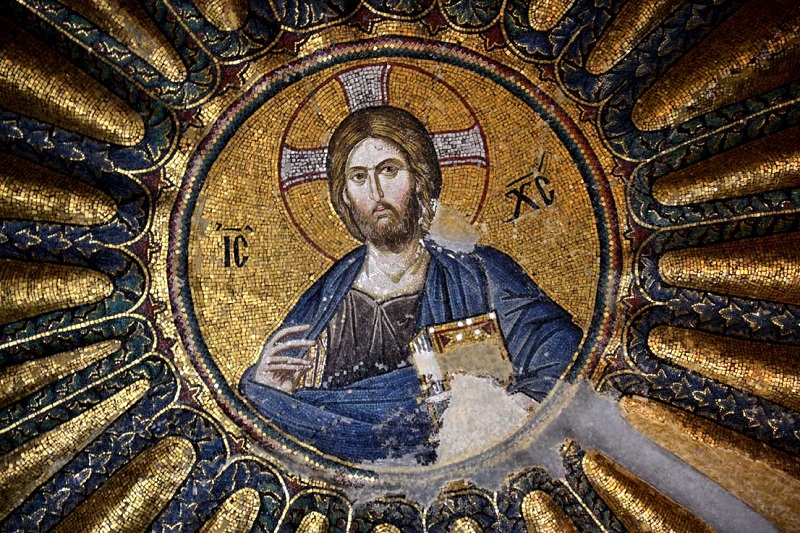
- First Reading: Acts of the Apostles 6:1-7
Brothers, select from among you seven reputable men, filled with the Spirit and wisdom, whom we shall appoint to this task, whereas we shall devote ourselves to prayer and to the ministry of the word.” - Second Reading: 1 Peter 2:4-9
You are “a chosen race, a royal priesthood, a holy nation, a people of his own, so that you may announce the praises” of him who called you out of darkness into his wonderful light. - Gospel Reading: John 14:1-12
Do not let your hearts be troubled. You have faith in God; have faith also in me…. I am the way and the truth and the life. No one comes to the Father except through me… Whoever has seen me has seen the Father… Believe me that I am in the Father and the Father is in me,
Background on the Gospel Reading
This fourth Sunday of the Easter season is sometimes called Good Shepherd Sunday because in each of the three lectionary cycles, the Gospel reading invites us to reflect on Jesus as the Good Shepherd. In each cycle the reading is from the tenth chapter of John’s Gospel. This chapter sets the framework for Jesus’ teaching about himself as the Good Shepherd.
Today’s reading falls between the stories of Jesus’ healing of the man born blind and the raising of Lazarus. Both of these stories were proclaimed in the Gospels found in this year’s season of Lent. Following the controversy that ensued when Jesus healed the man born blind, Jesus directs his allegory about the sheep and the shepherd toward the Jewish religious leaders of his time, the Pharisees.
Throughout John’s Gospel the Pharisees fail to accept Jesus’ ministry and teaching. They show themselves to be “robbers and thieves” because they try to lead the sheep without entering through the gate, Jesus. Through these metaphors, Jesus is telling his listeners that those who follow him and his way will find abundant life. He identifies himself both as the shepherd and the gate. The shepherds who are faithful to him are the ones whom the sheep (Jesus’ disciples) should follow.
The relationship between the sheep and their shepherd is based on familiarity. Sheep recognize their shepherd and will not follow a stranger. At the end of the day, shepherds lead their sheep from pastures to a common gated area called a sheepfold. There, one shepherd protects all of the sheep until the next day when each shepherd returns to lead his own sheep to pasture. As shepherds move among the sheep, the sheep follow only their shepherd.
Today’s Gospel also gives us the opportunity to reflect on Christian leadership. Jesus’ words suggest to us that those who will lead the Christian community will be known by their faithfulness to Jesus. The leaders will recognize that Jesus is the gate for all of the sheep and that having a good relationship with Jesus is the primary characteristic of a Christian leader. Jesus’ allegory also suggests that faithful Christian leadership requires a good relationship with the community: the shepherd knows his sheep, and they know him. Christian leaders follow the example of Jesus, the Good Shepherd, by being faithful to him and by being a good shepherd.
Praying is going with Jesus to the Father who will give us everything
Pope Francis
In this passage of the Gospel (see Jn 14:1-14), Jesus’s farewell discourse, Jesus says that He is going to the Father. And He says that He will be with the Father, and that also those who believe in Him “will do the works I have been doing, and they will do even greater things than these, because I am going to the Father. And I will do whatever you ask in my name, so that the Father may be glorified in the Son. You may ask me anything in my name, and I will do it” (vv. 12-14). We can say that this passage of the Gospel of John is the declaration of ascent to the Father.
The Father was always present in Jesus’s life , and Jesus spoke about Him. Jesus prayed to the Father. And many times, He spoke about the Father who cares for us, as He cares for the birds, the lilies of the field… the Father. And when the disciples asked to learn how to pray, Jesus taught them to pray to the Father: “Our Father” (Mt 6:9). He always addresses the Father. But in this passage it is very strong; it is also as if He opened the doors of the omnipotence of prayer. “Because I am with the Father: ask me and I will do anything. Because the Father will do it with me” (see Jn 14:11). This trust in the Father, trust in the Father who is capable of doing everything, This courage to pray, because it takes courage to pray! It takes the same courage, the same boldness it takes to preach: the same. Let us think of our father Abraham, when he – I think the right word is – “negotiated” with God to save Sodom (see Gen 18:20-33: “And if there were fewer? And fewer? And fewer…? He truly knew how to negotiate. But always with this courage: “Excuse me, Lord, but give me a discount: a bit less, a bit less…”. Always the courage of struggling in prayer, because praying is struggling: struggling with God. And then, Moses: the two occasions that the Lord wanted to destroy the people (see Ex 32:1-35 and Nm 11:1-3), and to make him the leader of another people, Moses said “No!”. And he said “No” to the Father! With courage! But if you go and pray like this [whispers a timid prayer] – this is a lack of respect! Praying is going with Jesus to the Father who will give you everything. Courage in prayer, boldness in prayer. The same that it takes to preach.
And we have heard in the first Reading about that conflict in the early times of the Church (see Acts 6:1-7), because the Christians of Greek origin were grumbling, complaining – they were already doing it back then: it is obvious that it is one of the Church’s habits – they were complaining that their widows, their orphans were not well cared for; the apostles did not have the time to do many things. And Peter [with the apostles], enlightened by the Holy Spirit, “invented”, let’s put it that way, the deacons. “Let’s do something: let’s look for seven people who are good and these men can take care of the service” (see Acts 6:2-4). The deacon is the one who takes care of service, in the Church. “And so these people, who are right to complain, have their needs taken care of, and we”, Peter says, we heard him, “and we can devote ourselves to prayer and the proclamation of the Word” (see v. 5). This is the bishop’s task: praying and preaching. With this power that we heard in the Gospel: the bishop is the first who goes to the Father, with the trust that Jesus gave him, with courage, with parrhesia, to fight for his people. The first task of a bishop is to pray. Peter said so: “And to us, prayer and the proclamation of the Gospel”.
I knew a priest, a holy parish priest, good, who when he found a bishop, greeted him well, very amiably, and always asked the question: “Your Excellency, how many hours a day do you pray?”, and he always said, “Because your first task is to pray”. Because it is the prayer of the head of the community, interceding to the Father so that He may safeguard the people.
The prayer of the bishop, the first task: to pray. And the people, seeing the bishop pray, learn to pray. Because the Holy Spirit teaches us that it is God who does things. We do very little but it is He who “does things” in the Church, and prayer is what makes the Church progress. And therefore the heads of the Church, so to speak, the bishops, must persevere in prayer.
Peter’s word in this case is prophetic: “May the deacons do all this, so that the people are taken care of well, their problems are solved and their needs met. But to us, bishops, prayer and the proclamation of the Word”.
It is sad to see good bishops, good people, but busy with many things, the finances, with this, that and the other… Prayer must take first place. Then the other things. But when the other things take away space from prayer, then something is not right. And prayer is strong because of what we have heard in the Gospel of Jesus. It is “because I am going to the Father. And I will do whatever you ask in my name, so that the Father may be glorified in the Son” (Jn 14:12-13). Thus the Church progresses in prayer, in the courage of prayer because the Church knows that without this ascent to the Father, she cannot survive.
Sunday, 10 May 2020
From fear to courageous proclamation of the Risen Christ
Romeo Ballan mccj
The words of the Gospel are like the dictation of a will, which Jesus entrusts to His disciples during the long farewell discourse following the Last Supper (Jn.13:31-17:26). It is an inheritance that Jesus leaves to his disciples as a precious teaching, only hours before he enters his way (v. 4,6): the way of the Cross-Death-Resurrection. A will and an inheritance which, as in everyone’s life, do not become effective until the death of the one who makes them. In the case of Jesus, there is a difference: it is not the will of a dead person, but of a living one. That is why the liturgy reveals this ‘last will and testament’ to us on Sundays after the Pasch of Jesus, letting us taste them as the living word of the Risen One. In the first place, it is a message of comfort and of hope to the community of the faithful, so that they are not troubled, but strong in faith (v. 1) and ready to follow in the steps of the Master on his way: the journey towards Easter, towards the Father’s House. However, the Father’s House is not Paradise at once; first of all it is the community of believers, where there are “many rooms”; to where Jesus has gone ahead of us, to prepare a place for us (v. 2-3); where the places, the tasks and the services to undertake are numerous; where the best place is the one that enables us to serve others more and better.
It means brother helping brother, washing each other’s feet (Jn.13:14), without titles of class, honour or prestige… That was the ideal and the powerful witness of the first Christian community, in which the only difference, recognised by all, right from the beginning, is the difference of service (or ministry) required and offered in the community. It is an exciting missionary theme. The message of the Gospel this Sunday and the experiences of the first Christian community (1st and 2nd Reading) shed a precious light on the mission of the Church. The book of Acts (1st Reading) presents a picture of missionary difficulties that are concrete and frequent: they regard the growth in numbers, the cultural differences within the community (v.1 brings up the conflict between Hebrews and Hellenists, with social and economical undercurrents), the organisation of assistance to those in need… The solution comes from criteria that are fundamental for the carrying out of mission: wide consultation within the group (v. 2), looking for people full of the Spirit and of wisdom (v. 3,5), the definition of the ministries (v. 3,4,6) of deacons (service at the tables) and of the Twelve Apostles (preaching and service of the Word).
Nowadays we would say that the solution has been found thanks to a joint and plural exercise of authority: in a way that is both collegial and ministerial, thus allowing action that is culturally pluralistic and also decentralised. The Church of Jerusalem came out of that episode more mature, enriched with new energy for apostolate, more open to the cultural needs of the various groups. It was an exemplary solution that had an immediate effect in the spreading of missionary activity; “the word of the Lord continued to spread, the number of disciples was greatly increased.” (v. 7)
Solutions of that type are truly fitting for a people that St. Peter (2nd Reading) calls royal, holy, chosen by God (v. 9), called to set themselves close to “the Lord, the living stone”, thus becoming a people made up of “living stones” (v. 4-5). Here we return to the topic of the roles and services in the house of God: it is not important whether they are stones on the façade or stones hidden in the foundations. St. Daniel Comboni urged this on his missionaries: “a missionary works in an undertaking that is of the highest worth, but extremely arduous and laborious, to be a stone hidden underground, that will perhaps never come to light, but which forms part of the foundations of a new and colossal edifice, that only future generations will see peeping out of the ground (Rules, 1871: cf. Writings 2701). What is important is to be part of the community of the disciples and be active in the service of the mission of Christ the Saviour, welcoming and showing solidarity with people who are far away, strangers, alone…
Jesus did not come to take suffering away from us, but to give us the strength to face the deep fear of sickness, of the future, of solitude, of death… “God did not come to explain suffering; he came to fill it with his presence” (Paul Claudel). In his words to his disciples (Gospel) Jesus tells them not to be troubled by fears (v. 1). He urges them to believe in Him, who is “the way, the truth and the life” (v. 6). He speaks about his unity with the Father, to the point that the one who has seen Him has seen the Father (v. 9). Jesus is the first missionary of the Father: he has proclaimed Him and revealed Him by word and deed (v. 11). Here arises the fundamental question for the mission in every age: whose task is it to reveal the Father and reveal Jesus, whom the Father sent to be the Saviour of the world? The permanent challenge for a Christian is to be able to say: whoever sees my life and listens to my words sees the Father, sees Christ! The roots and the scope of the missionary character of every baptised person lie here.
ONLY ONE LIFE BUT SO MANY WAYS TO OFFER IT
Fernando Armellini
Introduction
One of the primitive community characteristics described in the Apostles Acts is the absence of classes, titles, honorifics, prestige, or any recognized dignity of eminent members. All believers are considered with equality. No one would be called rabbi because there was only one Master, and they were only disciples. They felt themselves brothers and sisters, and no one claimed the title of father. They knew they had one Father in heaven (Mt 23:8-10).
Nor did they have degrees of holiness. ‘Saints’ was a collective title which they were fond of to refer to themselves. Paul addresses his letter “to the saints in Philippi …” (Phil 1:1), “to the saints in Ephesus” (Eph 1:1) “to all of you, the beloved of God in Rome, called to be holy” (Rom 1:7). Yet one distinction was recognized and held in high esteem: that of the ministry of service that each was called to perform in favor of their brothers and sisters.
The only Spirit—Paul reminds the Corinthians—enriches the community with diverse and complementary gifts: “to one he gives the language of science, to another that of wisdom, to another faith, to another the gift of healing. Another works miracles, another speaks in tongues and still, another interprets”, all for the common good (1 Cor 12:7-11).
Peter recommends to “serve one another with the gifts each of you received thus becoming good managers of the varied graces of God” (1 P 4:10). Our current communities are called to confront themselves with this ministerial Church, “whose cornerstone is Christ and whose foundations are the apostles” (Ephesians 2:20).
First Reading: Acts 6:1-6
The passages of the Acts of the Apostles evoke an enchanting feeling. In it, Luke tells the memorable story of the first community of Jerusalem. The disciples were of one heart and mind. They participated daily in the catechesis of the apostles, shared goods, prayed together, celebrated the Eucharist weekly, and displayed extraordinary signs through the power of the Spirit. Perfect harmony reigned among them, and they enjoyed the esteem of all the people.
Was everything really going well in Jerusalem? Has the author of the Acts of the Apostles been lulled into a dream? Has he not confused his ideal with reality? The answer is easy and definite: he has transformed, idealized it without a shade of doubt. Actual events inspired him—the exceptional generosity of Barnabas (Acts 4:36-37), the radical change of feelings and relationships within the group of disciples after the resurrection of Christ—and generalized them to outline the image of a model Christian community.
The ecclesial reality, even in Jerusalem, was not so idyllic. Problems existed as in our communities. At one point, they came to the surface, even dramatically. That is the story that we find in today’s reading. The community was initially composed only of Jews, but they belonged to two distinct groups: Hebrews and the Hellenists. The former were born and raised in Palestine. They spoke Aramaic and frequented the synagogues where the Bible was read in Hebrew. They were strongly attached to the traditions of their fathers and the Law of Moses. They accepted and considered indisputable all the teachings and interpretations given by the rabbis.
The Hellenists were born and raised abroad. They also adopted lifestyles that their coreligionists considered misleading and corrupt through contact with other peoples they had known and appreciated. They felt free about the traditions and rules of the rabbis. They did not understand Hebrew, spoke in Greek (the language then used throughout the empire). In their synagogues, they read the Bible in the Greek translation.
This diversity of origin, language and mentality was the cause of tension between the two groups. One day the conflict erupted. The occasion was the manner of distribution of the community’s goods. The Hellenists, who were in the minority, began to complain that the Jews were favoring their own widows to the neglect of others. The situation became explosive. The great sympathy that the disciples enjoyed in front of all the people risked being marred.
The problem had to be solved. The apostles gathered and pointed to a possible solution: choose—they said—among you men who enjoy the esteem and confidence of all; they will be entrusted with the task of distributing goods to the poor, while we will devote ourselves to prayer and the proclamation of the Gospel. The proposal was accepted, and the matter was resolved to everyone’s satisfaction. Luke used the incident in the Book of Acts to cast light on the problems of his community where dissension, tension, disagreement, and lack of dialogue existed alongside the many signs of new life.
As always, Luke reveals himself as intelligent, optimistic, and balanced. His story is an invitation to evaluate the actual situation of each community with realism, wisdom, and patience. He wants to tell us that the Church is not made up of angels but people with particular mentalities, cultures, and ideologies, vastly different characters with many limitations. It is unfortunate and painful that prejudice, sectarianism, envy, jealousy, and misunderstanding emerge, but it is normal.
It even happened in the community of Jerusalem where exceptional people, the apostles, and Mary, the mother of the Lord, were present. The community of Jerusalem worked through this ‘incident’ maturely. It grew up, learned to solve its problems, and found a way to respond to its growing needs. It became ministerial. The apostles were not the only ones to carry out all duties. Other capable people assumed responsibilities that were not within the specific competence of the apostles.
Thus began what is now called the ministerial community. It is the community in which all members have equal dignity. The only honorific title is that of ‘servant.’Everyone “according to the grace received” puts himself in service of others (1 P 4:10). “Those who have the gift of prophecy give the insight of faith, the minister fulfills his office, and the teachers teach, the one who encourages, convinces, who presides is dedicated and who does works of charity is cheerful” (Rom 12:6-8).
Second Reading: 1 Peter 2:4-9
Peter likens the Church to a spiritual building whose builder is God and whose living stones are people. The construction began with a solid rock as the foundation for the whole building: Christ on whom God has also placed other stones, those who believed in him, those newly baptized in the Easter Vigil as spoken about by the author. United with Jesus, they form a new, stunning temple (vv. 4-5). The Old Testament (Ps 118:22) announced that one day God would take the stone which the builders rejected and put it at the base of a new house (v. 6). The prophecy is fulfilled on the day of Passover. God chose Jesus, rejected by his people’s political and religious leaders, and placed him as the foundation of the new sanctuary.
The ancient temple of Jerusalem was built with material stones. It was a place where the sacrifice of lambs and bulls was offered. A new temple replaced this wherein each one, together with Christ, immolates spiritual holocausts pleasing to God: holy, blameless, and a life filled with love works. By offering these sacrifices, every disciple becomes a priest in baptism.
In front of the neophytes, distinguished with a sublime dignity, the preacher is moved and exclaims: “Honor to you who believe!”; you have become “a chosen race, a royal priesthood, a holy nation, a people of God”; you are entrusted with the task of proclaiming through your life the wonderful works of him who called you out of darkness into his marvelous light. Then his face is sad. He thinks of those who refused the gift of God and have chosen to continue living like pagans. For them, the stone was not a source of salvation but an occasion for stumbling. The conflict foretold by Simeon is verified: “He is established for the falling and rising of many, a sign of contradiction so that, out of many hearts, thoughts may be revealed” (Lk 2:34-35).
Gospel: John 14:1-12
The passage in today’s Gospel is taken from the first of three farewell speeches pronounced by Jesus at the Last Supper after Judas went out to carry out his treason. They are called so because, in them, Jesus seems to dictate his last will before facing his passion and death. The liturgy invites them to ponder further for a very simple reason: a testament opens and acquires its meaning only after the death of the person who dictated it. The words spoken by Jesus at the Last Supper were not restricted to the apostles in the upper room but addressed to the disciples of all times. Easter is the most suitable time to understand and meditate on them.
The passage today begins with a phrase that could be misunderstood: “In my Father’shouse there are many rooms; otherwise, I would not have told you that I go to prepare a place for you. After I have gone and prepared a place for you, I shall come again and take you to me. Yet you know the way where I am going” (vv. 2-4).
Jesus seems to be saying that the time for him to go to heaven has come. He promises that there he will prepare a place for his disciples. This explanation is unsatisfactory because we believe that everything is already set in heaven. Then the idea of the numbered seat, corresponding to the various degrees of reward, with the danger that someone may not have a place to stay emerges, which does not enthuse at all.
The meaning of the sentence is different. It is much more concrete and relevant for us and the life of our communities. Jesus says he must go down a difficult ‘path.’ He adds that his disciples would have to know that ‘way’ extremely well because he often spoke of it.Thomas replies on behalf of all: we do not know this ‘way,’ and we cannot guess where you want to go. Jesus explains: he will be the first to run the ‘way.’ Once his mission is accomplished, he will be back and take the disciples with him. He will infuse them with his courage and strength, so they will be enabled to follow in his footsteps.
What the ‘way’ is, is now clear: It is the difficult path toward Easter. It demands the sacrifice of life. Jesus talked about it many times, but the disciples were always reluctant to understand. When he insisted on the ‘gift of life,’ they preferred to be distracted, thinking about something else.
In this perspective, the question about ‘the seats in the Father’s house’ becomes apparent. Whoever has agreed to follow the ‘way’ and traveled alongside Jesus finds himself immediately in the Kingdom of God, in the Father’s house. This house is not paradise but the Christian community. There are many places, that is, many services, many tasks to be performed in it. There are many ways in which the gift of life takes form. The ‘many places’ are nothing but the ‘various ministries,’ the different situations in which everyone is required to make available to the brethren their capacity, the many gifts received from God.
Until the Second Vatican Council, the laity was not considered an active member of the Church. They did not participate but ‘assisted’ in the Eucharist; they did not celebrate reconciliation; they went to ‘receive’ the absolution. They were often idle spectators at what the priests were doing. Today we understand that every Christian should be active, not because of a shortage of priests, but because everyone has work to do within the community.
Jesus says that during the ministry, there can be no motives for envy or jealousy. The ‘places,’ that is, the services to be rendered to the brethren, are many. The only ones who can remain idle are those not yet shaken by the newness of life, communicated by faith in the Risen Lord. Civil society is assessed based on power, the social prestige that confers the money it is paid for. The question: ‘What do you do?’ is equivalent to ‘How much do you earn?’ The place prepared by Jesus and each one is instead evaluated based on service: the better ‘place’ is to serve more and better the community.
The passage is a call for verification of community life: what is the percentage of active members? Are there commitments that no one wants to take? Are there competitions to grab responsibility for any assignment? Of the many ‘jobs’ prepared by Jesus, are there still many undiscovered ones? Are there ‘unemployed’ people? Why?
The second part of today’s Gospel (vv. 8-12) is centered on the question of Philip: “Lord, show us the Father and that is enough.” “Let me see your glory,” Moses asked the Lord, and God answered him: “You cannot see my face because man cannot see me and live” (Ex 33:18,20).
While conscious of this inability to contemplate the Lord, the pious Israelites continued to implore: “I seek your face, O Lord. Do not hide your face from me” (Ps 27:8-9); “My soul thirsts for God, the living God. When shall I go and see the face of God?” (Ps 42:3).
Philip seems to be an interpreter of this intimate yearning of the human heart. He knows that “no one has ever seen God” (John 1:18), because “he lives in unapproachable light and whom no one has seen or can see” (1 Timothy 6:16); but also recalls the bliss reserved for the pure in heart: “for they shall see God” (Matthew 5:8) and thinks that Jesus can satisfy his secret aspiration. He presents a demand that seems to echo sentiments expressed by Moses and by the psalmists.
In his response, Jesus shows the way to see God. We need to look at him. He is the human face that God has taken to manifest himself, to establish a relationship of intimacy, friendship, and the communion of life with people. He is “the image of the invisible God” (Col 1:15), “the radiance of God’s glory and bears the stamp of God’s hidden being” (Heb 1:3). To know the Father does not require argument or reasoning. It is not worth getting lost in inadequate philosophical investigations. It is sufficient to contemplate Jesus, to observe what he does, says, teaches about how to behave, and how he loves those whom he prefers, attends to and caresses, and by whom he allows himself be caressed, with whom he dines, chooses, defends … because the Father does so. The work that Jesus fulfills is that of the Father (v.10).
There is a time when the Father fully reveals his face: on the cross. There he reveals his supreme love for people. The “radiance of his glory” (Hebrews 1:3) fully appears. There, his “light shines” (2 Cor 4:6) in its fullness. “Whoever has seen me has seen the Father,” Jesus affirms (v. 9). But this seeing is not confined to the gaze of witnesses to events or his concrete gestures. It is a gaze of faith that is required, a look that can go beyond appearances, beyond purely material data, a look that captures the revelation of God in the works of Jesus.
This seeing is equivalent to believing. Whoever sees the Father in him, who grants him complete confidence and is prepared to risk their lives for his proposed values, will do the same work and even greater work. It is not about miracles but the total gift of self for love.The Father will continue to realize in the disciples the works of love he has accomplished in Jesus.
READ: The specific call and commissioning of the deacons. The familiar call of all Christians to become living stones—spiritual temples—of God. Those who are called will do the same works as Jesus did.
REFLECT: Christian vocation is different from other worldly vocations in form and matter: for a Christian is called by God and commissioned. And the works are being done through them—the agency for the call and the task remains with the one who calls. “The Father who dwells in me is doing his own work,” says Jesus. Are we brave and open enough to let God do his work in and through us?
PRAY: Let us be convinced of our worth as God’s chosen ones. With dignity, let us dispel all doubts and disbelief so that we may be a channel of the Lord’s redemptive work.
ACT: Consecrate this day to God and ask him to use you as he wills. Observe what happens today.
