Fr. Manuel João, Comboni Missionary
Sunday Reflection
from the womb of my whale, ALS
Our cross is the pulpit of the Word
28th Sunday in Ordinary Time (B)
Mark 10:17-30: “You lack only one thing!”
THE GOSPEL OF GAZES
This Sunday’s gospel narrates the episode of the so-called rich young man, which we all know well. After the theme of marriage, the Word of God invites us today to address another sensitive topic: that of wealth.
The passage is structured in three moments. First, the encounter between Jesus and a rich man who asks Him: “Good Teacher, what must I do to inherit eternal life?”. Then, the famous comment by Jesus on the danger of attachment to wealth: “It is easier for a camel to pass through the eye of a needle than for a rich man to enter the kingdom of God,” shortly after that, at Jesus’ proposal, the young man “darkened his face and went away sorrowful.” “For he had many possessions,” adds the evangelist. Finally, the promise of a hundredfold to those who leave everything “for His sake and the Gospel’s sake.”
Three gazes from Jesus punctuate this gospel: the gaze of sympathy and love toward the rich young man; the sad and reflective gaze toward those around Him, after the young man’s departure; and finally, the deep and reassuring gaze toward His closest followers, the twelve. Today, Jesus’ gaze is directed at us. Listening to this gospel must be done with the eyes of the heart.
The text begins with the account of Jesus’ encounter with “a man,” unnamed, wealthy, a young man according to Matthew (19:16-29), and a ruler according to Luke (18:18-30). This person could be each one of us. We are all rich, for the Lord “though He was rich, became poor for us, so that we might become rich through His poverty” (2 Corinthians 8:9). At the same time, we are all poor, poor in love, generosity, and courage. This gospel reveals our deep reality, exposing our false riches and securities. “You say: I am rich, I have become wealthy, I need nothing. But you do not realize that you are wretched, miserable, poor, blind, and naked” (Revelation 3:17).
“Jesus looked at him and loved him.” This is undoubtedly the most beautiful, profound, and unique gaze of Jesus. Yet, we find many references to Jesus’ gaze in the gospels. His gaze is never indifferent, apathetic, or cold. It is a clear, bright, and warm gaze, engaging with reality and people. It is a curious gaze that moves around, observes, and questions. A gaze that reveals the deep feelings of His heart. A gaze that feels compassion for the crowds and intuits their needs. A gaze attentive to every single person He encounters along the way. A gaze that evokes miracles, as in the case of the widow of Nain. A gaze that nourishes deep feelings of friendship and tenderness, even to the point of making Him weep for His friend Lazarus and for the holy city of Jerusalem, the apple of every Israelite’s eye.
His is also a penetrating gaze, like His word, “sharper than any double-edged sword”. “Everything is naked and laid bare” to His eyes, as the second reading says (Hebrews 4:12-13). His is also a flaming gaze (Revelation 2:18), which becomes angry in the face of hardness of heart, neglect toward the little ones, and injustice toward the poor.
Jesus’ eyes are the protagonists, the forerunners of His words and actions. We usually consider the gospel as a narrative of Jesus’ words and actions. However, we could say that there is also a gospel of Jesus’ gazes. It is especially the artists who tell it.
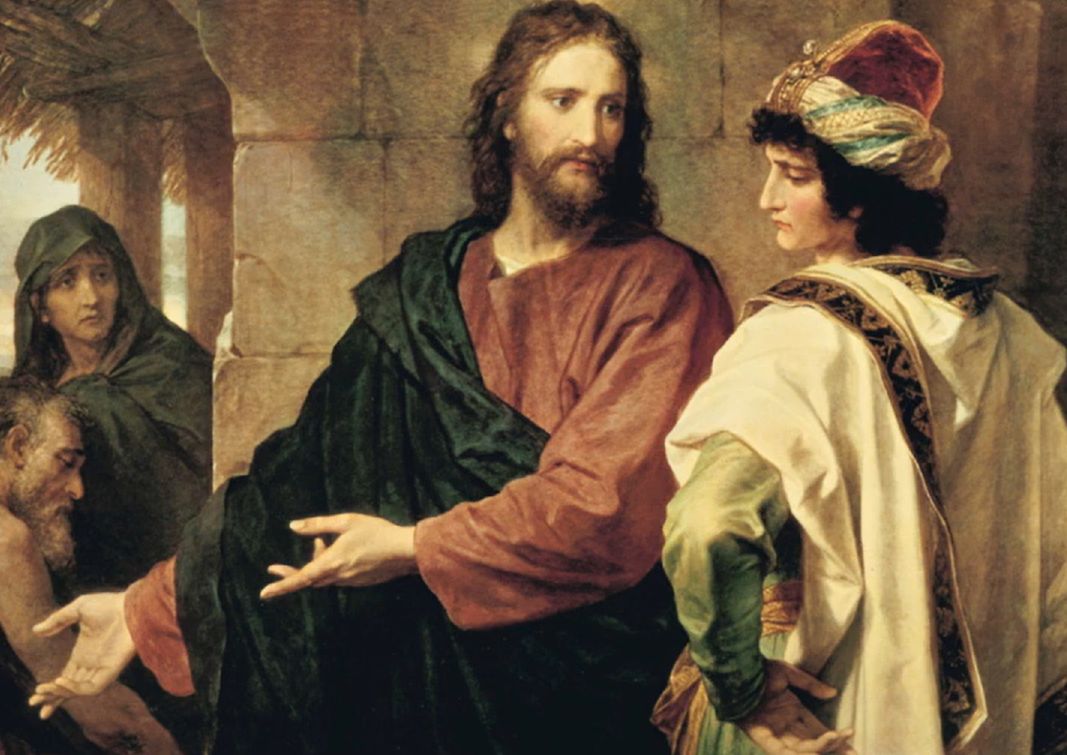
The most famous painting depicting Jesus’ gaze directed at the rich young man is probably that of “Christ and the Rich Young Ruler” by the German painter Heinrich Hofmann (1889). Jesus’ deep and intense gaze is directed toward the young man, while His hands are extended toward the sad and languid gaze of the poor. The young man has a lost, uncertain, and evasive gaze, directed downward, toward the earth. It is an iconic representation of the missed vocation of the “thirteenth apostle,” we could say. In contrast, the painting illustrates well the Christian vocation: to welcome Christ’s gaze and then direct it toward the poor. Without uniting these two gazes, there is no faith, only alienating religiosity.
“One thing you lack!” What is it? To welcome Jesus’ gaze upon you, whatever it may be, and let it penetrate deep into your heart and transform it. Then, we will discover, with wonder, joy, and gratitude, that truly “everything is possible with God!”
Fr. Manuel João Pereira Correia, mccj