24th Sunday in Ordinary Time – Year B
Mark 8: 27-35
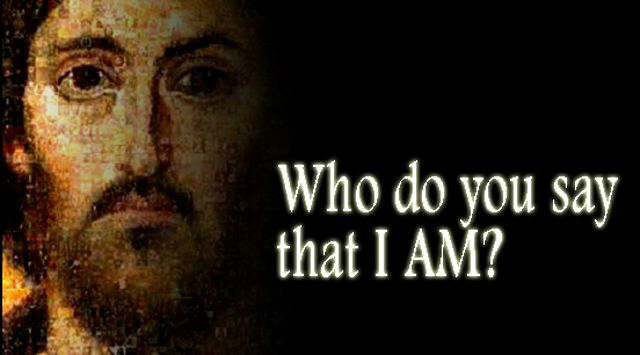
Jesus and his disciples set out for the villages of Caesarea Philippi. Along the way he asked his disciples, “Who do people say that I am?” They said in reply, “John the Baptist, others Elijah, still others one of the prophets.” And he asked them, “But who do you say that I am?” Peter said to him in reply, “You are the Christ.” Then he warned them not to tell anyone about him.
He began to teach them that the Son of Man must suffer greatly and be rejected by the elders, the chief priests, and the scribes, and be killed, and rise after three days. He spoke this openly.
Then Peter took him aside and began to rebuke him. At this he turned around and, looking at his disciples, rebuked Peter and said, “Get behind me, Satan. You are thinking not as God does, but as human beings do.”
He summoned the crowd with his disciples and said to them, “Whoever wishes to come after me must deny himself, take up his cross, and follow me. For whoever wishes to save his life will lose it, but whoever loses his life for my sake and that of the gospel will save it.”
Who Do You Say That I Am?
Raniero Cantalamessa
The three synoptic Gospels refer to the episode of Jesus when, in Caesarea Philippi he asked his apostles what people thought of him. The common fact in the three Gospels is Peter’s response: “You are the Christ.” Matthew adds: “the Son of the living God” (Matthew 16:16) which could, however, be a manifestation due to the faith of the Church after Easter. Soon the title “Christ” became Jesus’ second name. It is mentioned more than 500 times in the New Testament, almost always in the composite form “Jesus Christ” or “Our Lord Jesus Christ.”
However, it was not so in the beginning. Between Jesus and Christ a verb was understood: “Jesus is the Christ.” To say “Christ” was not to call Jesus by his name, but to make an affirmation about him. Christ, we know, is the Greek translation of the Hebrew Mashiah, or Messiah, and both mean “anointed.” The term derives from the fact that in the Old Testament kings, prophets and priests, at the moment of their election, were consecrated through an anointing with perfumed oil.
But increasingly in the Bible there clearly is talk of a special anointed or consecrated one who will come in the end times to fulfill God’s promises of salvation to his people. It is the so-called biblical messianism, which takes on different hues according to how the Messiah is seen as a future king (royal messianism) or as Daniel’s son of man (apocalyptic messianism).
The whole primitive tradition of the Church is unanimous in proclaiming that Jesus of Nazareth is the awaited Messiah. He himself, according to Mark, will proclaim himself such before the Sanhedrin. To the question of the High Priest: “Are you the Christ, the Son of the Blessed?” He replies: “I am” (Mark 14:61 ff.). So much more disconcerting, therefore, is the continuation of Jesus’ dialogue with the disciples in Caesarea Philippi: “And he commanded them energetically not to speak about him to any one.”
However, the motive is clear. Jesus accepts being identified with the awaited Messiah, but not with the idea that Judaism had made for itself of the Messiah. In the prevailing opinion, the Messiah was seen as a political and military leader who would liberate Israel from pagan dominion and establish the kingdom of God on earth by force. Jesus had to profoundly correct this idea, shared by his own apostles, before allowing them to talk of him as the Messiah. To this end is oriented the discourse that follows immediately: “And he began to teach them that the Son of Man must suffer many things.”
The harsh word addressed to Peter, which seeks to dissuade him from such thoughts: “Get behind me, Satan!” is identical with that addressed to the tempter of the desert. In both cases, in fact, it is about the same attempt to deflect him from the path that the Father has indicated to him — that of the suffering servant of Yahweh — to another which is “according to men, not according to God.”
Salvation will come from the sacrifice of himself, from “giving his life in ransom for many,” not from the elimination of the enemy. In this way, from a temporal salvation one passes to an eternal salvation, from a particular salvation — destined for only one people — one passes to a universal salvation.
Regrettably we must state that Peter’s error has been repeated in history. Also certain men of the Church, and even Successors of Peter, have behaved at certain times as if the Kingdom of God was of this world and should be affirmed with the victory (if necessary also with arms) over enemies, instead of doing so with suffering and martyrdom.
All the words of the Gospel are timely, but the dialogue of Caesarea Philippi is so in an altogether special way. The situation has not changed. Also today, people have very diverse opinions on Jesus: a prophet, a great teacher, a great personality. It has become fashionable to present Jesus in shows and novels, in customs and in the strangest messages. The “Da Vinci Code” is only the latest in a long series.
In the Gospel, Jesus does not seem to be surprised by people’s opinions, nor does he take time to deny them. He only poses a question to his disciples, and he does so also today: “For you, who am I for you?” A leap must be taken that does not come from the flesh or from blood, but is a gift of God which must be accepted through the docility of an interior light from which faith is born. Every day there are men and women who take this leap.
Sometimes it is famous people — actors, actresses, men of culture — and then they make news. But infinitely more numerous are the unknown believers. At times nonbelievers interpret these conversions as weakness, sentimental crises or a search for popularity, and it might be that in some cases it is so. But it would be a lack of respect of the conscience of the rest to cast discredit on every story of conversion.
One thing is certain: Those who have taken this leap will not go back for anything in the world, and more than that, they are surprised to have been able to live for so long without the light and strength that comes from faith in Christ. Like St. Hillary of Poitiers, who converted when he was an adult, they are willing to exclaim: “Before knowing you, I did not exist.”
Translated by Zenit
To dare! To save one’s life by proclaiming the Gospel
Romeo Ballan, mccj
At the heart of Mark’s Gospel (today we are exactly half way through), the fundamental theme of the identity of “Jesus Christ, Son of God” (1:1; cf 15:39) comes at the forefront again. Christ has a rich and mysterious identity, which, from beginning to end, the evangelist Mark wishes to gradually reveal to his readers. Today’s text, in chapter 8, holds the passionate answer of Peter that differs from the current views of his contemporaries: the great religious figures of the past have become superseded, is Jesus of Nazareth now the Messiah, the Christ. The parallel text in Matthew (16:13-20) develops at greater length this dialogue between Jesus and Peter, with the addition of the theme of the rock, the Church, the keys… Mark, instead, in his brevity sums up Christ’s revelation in the words of Peter: “You are the Christ” (v. 29). Peter’s declaration is correct in its theological formulation, but he has, nevertheless, an inadequate and distorted understanding of it, as we can see from Christ’s reproach that immediately follows (v. 33).
At this point of Mark’s Gospel, Jesus has entered a new stage: he leaves the crowds of Galilee; he wishes to give more time to his disciples’ formation and begins with the revelation of his dual identity as Messiah and suffering Servant, two realities that cannot be understood by human mind alone. Peter, with difficulty, manages to grasp the truth about Jesus as the Messiah-Christ, but he stumbles completely on the reality of the Messiah-Servant, who “was destined to suffer grievously… to be put to death and to rise again” (v. 31). Peter even appears as if he were giving a lesson to Jesus, as he reproaches him for that kind of talk (v. 32); so much so that Jesus harshly admonishes him and invites him to keep his place behind Jesus: The disciple walks behind the Master, he follows his footsteps. Regarding the theme of the cross and of suffering, Peter does not differ from the current belief, as he thinks “man’s way”. Only much later, with the coming of the Spirit, he will be able to reason in the way of God (v. 33).
“The way you think is not God’s way but man’s”: is the severe warning of Jesus not only to Peter but to the disciples of his own time and of all times. A warning that freezes all forms of comfortable and rhetorical religiosity. An incredible invitation to follow the narrow path of humility and austerity: to stop thinking only about ourselves, but to make us available to others and to follow the path that Jesus has chosen out of love, even to the acceptance of death, so that all may have life in all its fullness (Jn 10:10). An invitation to all the baptised (whether they are ordinary faithful or people with responsibility in the community, at all levels) to collaborate, so that the Church – of which we are all equally part – may be ever more of a disciple in learning and acting according to Christ’s style; more humble, poor and sober in its exterior signs; more courageous and efficient in its choices on behalf of the weak and the least; in a word, ever more consistent with its Master and following his ways. This is how a Church that is disciple and missionary has to be, its unique boast.
To take up one’s cross and to follow Christ (v. 34), to accept the evangelical wisdom and the fruitfulness of the cross only through a grace that the liturgy makes us pray for, so that we may understand that we are certain to save our life “only when we have the courage to lose it” (introductory prayer), by offering it together with that of Christ for the life of the world. It is the certainty that was sustaining the suffering Servant(1st reading): “For the Lord Yahweh will help me; therefore I have not been confounded” (v. 7).
The values of fraternity and service to the needy are inseparable from the following of Christ, as St. James (2nd reading) teaches when he warns about hypocritical and empty talks, which do not warm those who are cold or feed the hungry (v. 15-16). The authenticity of the following of Christ is proven by acts of charity. A number of saints we remember this month bears witness to this: Bl. Mother Teresa of Calcutta (5/9), St. Peter Claver (9/9), St. Padre Pio from Pietrelcina (23/9), St. Vincent de Paul (27/9)… Since they dared loose their life by serving the poor, for the sake of Christ and the sake of the Gospel, they have saved it (Mark 8:35). Their witness, therefore, is a clear and encouraging example to all who work in the mission today, here and anywhere else.
Who am I for you?
Pope Francis
Today’s Gospel passage (cf. Mk 8:27-35) turns to the question that permeates the whole Gospel of Mark: who is Jesus? But this time Jesus himself poses it to his disciples, helping them to gradually address the question of his identity. Before asking them, the Twelve, directly, Jesus wants to hear from them what the people think about him, and he is well aware that the disciples are very sensitive to the Teacher’s renown! Therefore, he asks: “Who do men say that I am?” (v. 27). It comes to light that Jesus is considered by the people as a great prophet. But, in reality, he is not interested in the opinions and gossip of the people. He also does not agree that his disciples should answer the questions with pre-packaged formulas, quoting well-known individuals from Sacred Scripture, because a faith that is reduced to formulas is a short-sighted faith.
The Lord wants his disciples of yesterday and today to establish a personal relationship with him, and thus to embrace him at the centre of their life. For this reason he spurs them to face themselves honestly, and he asks: “But who do you say that I am?” (v. 29). Today, Jesus addresses this very direct and confidential question to each of us: “You, who do you say that I am? All of you, who do you say that I am? Who am I for you?”. Each person is called to respond, in his or her heart, allowing each one to be illuminated by the light that the Father gives us in order to know his Son Jesus. And it can also happen to us, as it did to Peter, that we passionately affirm: “You are the Christ”. However, when Jesus tells us clearly what he told the disciples, that is, that his mission is fulfilled not on the wide road to success, but on the arduous path of the suffering, humiliated, rejected and crucified Servant, then it can also happen that we, like Peter, might protest and rebel because this contrasts with our expectations, with worldly expectations. In those moments, we too deserve Jesus’ healthy rebuke: “Get behind me, Satan! For you are not on the side of God, but of men” (v. 33).
Brothers and sisters, the profession of faith in Jesus Christ cannot stop at words, but calls to be authenticated by practical choices and gestures, by a life characterized by God’s love; it calls for a great life, a life with an abundance of love for neighbour. Jesus tells us that to follow him, to be his disciples, we must deny ourselves (cf. v. 34), that is, the demands of our own selfish pride, and take up our own cross. Then he gives everyone a fundamental rule. And what is this rule? “For whoever would save his life will lose it” (v. 35). Often in life, for many reasons, we go astray, looking for happiness only in things, or in people whom we treat as things. But we find happiness only when love, true love, encounters us, surprises us, changes us. Love changes everything! And love can also change us, each one of us. The witnesses of Saints proves it.
May the Virgin Mary, who lived her faith by faithfully following her Son Jesus, help us too to walk on his path, generously spending our life for him and for our brothers and sisters.
Angelus, 16/09/2018
Peter Followed Jesus but had Misunderstood the Goal
Fernando Armellini
The question we now turn to whoever asks us to follow him is: “Where do you want to lead me?”
The disciples forgot to put it to Jesus when, along the shore of the Sea of Galilee, they heard his call, “Follow me!” (Mk 1:17). Fascinated by his word and by his look, they immediately left their nets and their father, the hired servants, and went with him, without objections, without asking questions, and were involved in a misunderstanding. Convinced that they had chosen a successful man as guide, they found themselves in front of an executed man, unable to come down from the cross.
The decision to accept the offer of a trip depends on the goal which is proposed, on the strength that we feel we have, from the budget we can count on, the interest that we are fond of. It is a test that should be done and even Jesus suggests it to those who want to go with him, “Do you build a house without first sitting down to count the cost to see whether you have enough to complete it?” (Lk 14:28).
On the Way to Rome, where he was thrown into the arena and would shed his blood to bear witness to his faith, Ignatius of Antioch, in A.D. 110, wrote to the Christians in the capital of the empire, “Now I begin to be a disciple.” He devoted many years of his life animating, as a bishop, the churches of Syria, and yet, only at that time, along the road that led him to martyrdom, he began to feel himself a disciple. He was sure not to be mistaken: he was going with the Master, towards Easter.
Gospel reflection
In the Gospel of Mark, Jesus is always on the move and his disciples walking behind him. From the very start, they were aware of following an extraordinary character. They always paid much attention to what people said about him. They were sensitive to the praises; they were pleased with the approvals gathered because his success involved them too. Yet, even after months of communion of life with the Master, they failed to grasp his true identity.
Several times in the first chapters of this Gospel, we read that the crowds and the disciples have put themselves the question: “Who is this?” He has the power to cast out demons (Mk 1:27), performs miracles, commands even the waves of the sea, and they obey him (Mk 4:41) … Who will he be?
With today’s passage the central part of the Gospel of Mark begins, in which Jesus reveals the mystery, answers the question on everyone’s mind and shows his true face.
The episode is set in the vicinity of Caesarea Philippi (vv. 27-30), the city that Philip, a son of Herod the Great, founded at the far north of Israel and erected as the capital of his kingdom. It is inhabited mostly by pagans and this is perhaps the reason that pushes Jesus to leave the towns and villages along the Sea of Galilee and begin a journey towards that region. He shows the desire to bring salvation to all the children of his people, even to the most distant.
We are in the middle of the gospel, and so we can also think that Jesus has reached halfway the formation he is giving to his disciples.
Along the way he addressed to them two questions; simple enough, the first one: Who do people say I am?; the second is more challenging: Who do you say I am?
The list of popular opinions circulating among the people has already been reported by Mark at greater length: “King Herod heard about Jesus, because now his name had become known. He said, ‘John the Baptist has been raised from the dead, and that is why miraculous powers are at work in him.’ Others thought, ‘He is Elijah’; and others, ‘He is a prophet, like the prophets of times past’. When Herod was told of this, he thought, ‘I had John beheaded, yet he has risen from the dead!’” (Mk 6:14-16).
These were the opinions of the people, but Jesus wanted to know what the disciples have understood. Had they caught a glimpse of something more or cultivated the beliefs of all?
A few days before had given them a severe rebuke: “Do you not see and understand? Are your minds closed? Have you eyes and don’t see and ears that don’t hear?” (Mk 8:17-18). They were unable to grasp his identity.
Now here’s the surprise: after reporting what people were saying, Peter shows to have understood everything and, on behalf of the others, proclaims: “You are the Messiah,” the Christ, the savior spoken of by the prophets, and that all the people are waiting.
It’s hard to find a more appropriate response.
In the Gospel of Matthew the pleasing reply of the Master is also remembered: “It is well for you, Simon Bar-jona, for it is not flesh or blood that has revealed this to you, but my Father in heaven” (Mt 16:17).
To Peter’s response follows the strict imposition of silence. Jesus does not want the news about his messianic identity spread around (vv. 27-30) and the reason for keeping the secret is clear: Peter gave a precise definition only in form, in fact, the idea he has in mind is totally distorted. He continues to be convinced that the Master will soon begin the kingdom of God on earth and thinks that this will be implemented by an ostentation of power, through signs and wonders that will require the attention of all. He is certain that Jesus will get a resounding success and this is also the opinion of the other disciples who, despite, having understood something more than the crowds, are drawn into the mentality that evaluates the outcome of a life based on success gained. They have not yet realized that, from the beginning, the Master has considered diabolic the proposal to take power and to present himself as a ruler of this world (Mt 4:8- 10).
The misconception is total and for Jesus the time to correct this dangerous mistake has arrived. He should make very clear what is the goal of his journey, explaining how the Father will fulfill in him his work of salvation.
Mark wrote his Gospel for the Christians of Rome, to invite them to do a check of the reasons which led them to believe in Christ. The misconception in which Peter and the other eleven fell, in fact, is always looming over all Christian communities. The professions of faith can be impeccable, but the question remains: what image of God and what concept of life lie behind these so accurate formulas?
In the second part of the passage (vv. 31-33), Jesus begins to teach his disciples that the Son of Man must suffer many things. He is not bound to succeed, but to fail; that he will not triumph over those who oppose his plan but that he will be defeated. He does not go to Jerusalem to scare off his enemies, but to give them his life.
He began to teach. This statement of the evangelist reveals some embarrassment, some disappointment of the teacher who, in the middle of the school year, after having repeatedly explained a lesson, is aware of having to start from scratch because the students are not really able to assimilate it.
The disciples can neither understand nor accept the prospect of the gift of life. It’s not for this that they left the house, the boat, the family to follow the Master. Where does he want to lead them, to ruin, to defeat?
Jesus does not withdraw a word, in fact, two more times he repeats to them, “The Son of Man will be delivered into the hands of men. They will kill him.” (Mk 9:31); “You see we are going up to Jerusalem, and the Son of Man will be condemned to death. They will make fun of him, spit on him, scourge him, and finally kill him” (Mk 10:33-34). This latest announcement is particularly dramatic because it lists, in detail, almost pedantic, the six works that make up the human response to God who comes to meet him to offer him salvation. A seventh will follow: “Three days later he will rise” (Mk 10:34), but this will be the work of God.
Human logic cannot but be upset in front of such a prospect. In fact Peter, on behalf of all, reacts (vv. 32-33), not for fear of sacrifices, we know that he would be willing to risk his life if necessary (Jn 18:10), but to win, not to lose. He does not feel like committing himself in an absurd project. He cannot accept to walk a road that leads to failure, that is why he tries to make the Master change his mind.
Jesus’ response to Peter, who wants to turn him from his way is tough, “Get behind me, Satan!” (v. 33). He does not intend to turn Peter away from him, but to bring him back to the right path. His words do not mean “Go away!” but “Come behind me,” “Stay with me while I give my life.”
Peter made the mistake of by putting himself ahead of the Master. Moved by his religious beliefs, he felt compelled to show him the way. Jesus invites him to return to his place—behind—and to follow in his footsteps. He calls him “Satan” because, having absorbed the thoughts of men, which makes him blind and unable to understand the will of God (Wis 2:21-22), he suggested to the Master, without even realizing it, choices opposite to those of the Lord.
After having rebuked Peter, Jesus calls the crowd (vv. 34-35). It is surprising that, on the road leading to Caesarea Philippi, there appeared, unexpectedly, a multitude which, previously, was not mentioned at all. Mark brings it on stage for a theological reason: He sees in this crowd the multitude of Christians of his community personified. He wants to put them in front of the strict conditions set by Jesus to anyone who wishes to follow him. They are the demands that cannot be mitigated or made more acceptable. They can only be accepted or rejected, but cannot be negotiated.
The radical nature of this choice, that does not allow discounts, hesitation or second thoughts, is invoked with three imperatives: “Deny yourself, take up your cross, follow me.”
“Deny yourself” is to say, “stop thinking about yourself!”
It is the reversal of the logic of this world. Man has rooted deep in his heart a tendency to “think of himself,” to be at the center of interest, to seek in everything his own advantage and to ignore the others. One who chooses to follow Christ is called first of all to reject this egoistic withdrawal, to give up making choices, the view of his own advantage.
The disciple who has “stopped thinking about oneself” does not even take minimally in consideration the positive impact that he has on the person of the good deeds he performs. He does not think even of the glory that will be reserved for him in heaven. He loves gratuitously, in pure loss, as God does.
The second imperative, “take up your cross,” does not refer to the need to patiently endure the tribulations of life, small or big, nor, even less, an exaltation of pain as a means to please God. The Christian does not seek suffering, but love.
The cross was the punishment reserved for slaves, to those who did not belong to themselves, but to another. To embrace it means making the choice to become the servants of others. Jesus has become one, as we sing in the famous hymn of the Letter to the Philippians: “He emptied himself, taking the nature of a servant; he humbled himself by being obedient to death, death on the cross” (Phil 2:7-8).
In Jesus, God has shown he does not belong to himself, but to be the slave of people.
The cross is the sign of God’s love and the ultimate gift of self. To carry it behind Jesus means to join him in making oneself available to others, even to martyrdom.
The third imperative, “follow me,” does not mean “take me as a model,” but share my choice, make my project yours, risk your life for love of people, along with me. You’re going to encounter misunderstanding and rejection; you will see your dreams dissolve and all human projects called into question; you will feel like dying, but your destiny will not be the ruin; I do not want to lead you to death, but to true life. However, to reach it, it is necessary that you pass through death (v. 31).
In the last part of the passage (v. 35) Jesus develops, resorting to sapiential argument, his proposal.
What does it profit a man to gain control of all the kingdoms of this world, succeed in the fields of knowledge, money, power, glory, pleasures, injures himself and spoils his life? All of his achievements, all his successes are ephemeral; they have no consistency because death is imminent on them: “Even those who have given their name to the land… leaving to others their fortunes and wealth” (Ps 49:11-12).
Only those who make their lives a gift builds lasting work.
When God, in the final judgment, will consider the lives of everyone who will not be united to Christ, embracing the Cross, and the fate, will be forced to register their failure, to verify that they have wasted a unique opportunity that was offered.
The debates about the identity of Jesus continue to this day. No one denies that, more than any other man, he has marked the history of the world. But not enough to cultivate this belief to be regarded as his disciples. To admire Christ is not to be his disciples.
The apostles received from Jesus the strict injunction not to disclose his identity. If we do not verify, in the light of the words in today’s Gospel, the reasons why we proclaim ourselves Christians, he could also strictly impose silence to many of us.
