Solemnity of Corpus Domini (A)
John 6:51-58
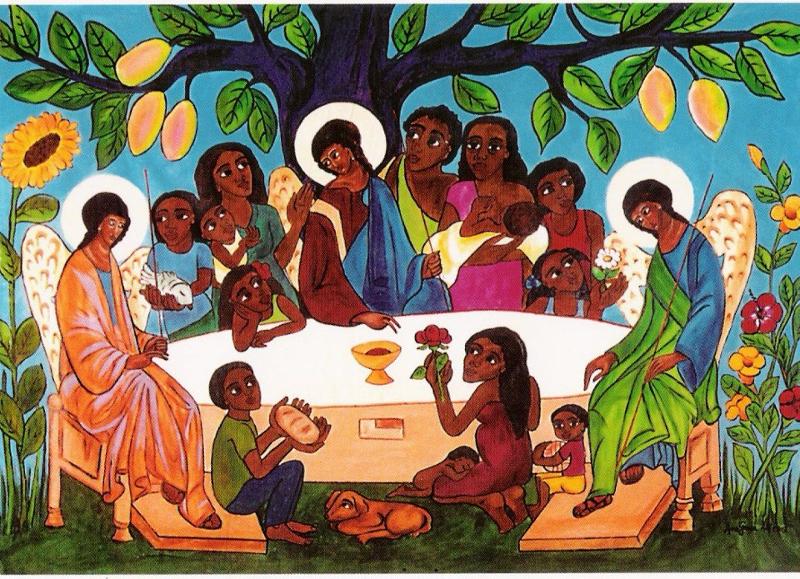
- First reading -Deuteronomy 8:2-3,14-16
He fed you with manna, which neither you nor your fathers had known - Second reading – 1 Corinthians 10:16-17
That there is only one loaf means that, though we are many, we form one body - Gospel John 6:51-58
My flesh is real food and my blood is real drink
Background on the Gospel Reading
This Sunday we celebrate a second solemnity during this period of Ordinary Time in the liturgical calendar. Today is the Solemnity of the Most Holy Body and Blood of Christ. This day was once called Corpus Christi, which is Latin for “Body of Christ.” In the revised Lectionary the name for this day is expanded to reflect more completely our Eucharistic theology.
Today’s Gospel is taken from the Gospel according to John. The reading is part of a discourse between Jesus and a crowd of Jews. The discourse comes shortly after the miracle of Jesus’ multiplication of the loaves and fishes. In John’s Gospel, miracles such as this are identified as “signs” through which people come to believe that Jesus is the Son of God. These signs are followed by dialogue, or discourse that interprets and explains the miracle. In John’s Gospel, Jesus’ multiplication of the loaves is said to have occurred near Passover, thus linking it to the Exodus story and God’s saving action toward the Israelites.
Having seen Jesus multiply the loaves and fishes, the crowd pursues him, perhaps seeking more food but also looking for another sign. Jesus tells the crowd that he is the bread of life. He explains that just as God gave the Israelites manna to sustain them in the desert, so now God has sent new manna that will give eternal life. It is in this context that Jesus repeats those words in today’s Gospel and tells them again that he is the living bread that came down from heaven.
Jesus’ words are not well understood by the crowd; they argue that Jesus is not from heaven but born of Mary and Joseph. The crowd also has trouble understanding how Jesus could give them his flesh to eat. Jesus tells them that when they eat his flesh and drink his blood, they will remain forever connected to him. These are difficult words, but they are important because they seek to show us our intimate connection with Jesus.
This is the mystery that is at the heart of our Eucharistic theology. In the elements of bread and wine, Jesus’ Body and Blood are truly present. When we share in the Body and Blood of Christ, Jesus himself comes to dwell within us. This communion with the Lord makes us one body, brings us eternal life, and sends us forth to be Christ’s Body in the world.
The Sacrament of Memory
Pope Francis
On this Solemnity of Corpus Domini, the idea of memory comes up again and again. Moses says to the people: “You shall remember all the way which the Lord your God has led you…. Lest… you forget the Lord your God, who fed you in the wilderness with manna” (Dt 8:2, 14, 16). Jesus will tell us: “Do this in memory of me” (1 Cor 11:24). Saint Paul will tell his disciple: “Remember Jesus Christ” (2 Tim 2:8). The “living bread, come down from heaven” (Jn 6:51) is the sacrament of memory, reminding us, in a real and tangible way, of the story of God’s love for us.
Today, to each of us, the word of God says, Remember! Remembrance of the Lord’s deeds guided and strengthened his people’s journey through the desert; remembering all that the Lord has done for us is the foundation of our own personal history of salvation. Remembrance is essential for faith, as water is for a plant. A plant without water cannot stay alive and bear fruit. Nor can faith, unless it drinks deeply of the memory of all that the Lord has done for us. “Remember Jesus Christ”.
Remember. Memory is important, because it allows us to dwell in love, to be mind-ful, never forgetting who it is who loves us and whom we are called to love in return. Yet nowadays, this singular ability that the Lord has given us is considerably weakened. Amid so much frantic activity, many people and events seem to pass in a whirl. We quickly turn the page, looking for novelty while unable to retain memories. Leaving our memories behind and living only for the moment, we risk remaining ever on the surface of things, constantly in flux, without going deeper, without the broader vision that reminds us who we are and where we are going. In this way, our life grows fragmented, and dulled within.
Yet today’s Solemnity reminds us that in our fragmented lives, the Lord comes to meet us with a loving “fragility”, which is the Eucharist. In the Bread of Life, the Lord comes to us, making himself a humble meal that lovingly heals our memory, wounded by life’s frantic pace of life. The Eucharist is the memorial of God’s love. There, “[Christ’s] sufferings are remembered” (II Vespers, antiphon for the Magnificat) and we recall God’s love for us, which gives us strength and support on our journey. This is why the Eucharistic commemoration does us so much good: it is not an abstract, cold and superficial memory, but a living remembrance that comforts us with God’s love. A memory that is both recollection and imitation. The Eucharist is flavoured with Jesus’ words and deeds, the taste of his Passion, the fragrance of his Spirit. When we receive it, our hearts are overcome with the certainty of Jesus’ love.
The Eucharist gives us a grateful memory, because it makes us see that we are the Father’s children, whom he loves and nourishes. It gives us a free memory, because Jesus’ love and forgiveness heal the wounds of the past, soothe our remembrance of wrongs experienced and inflicted. It gives us a patient memory, because amid all our troubles we know that the Spirit of Jesus remains in us. The Eucharist encourages us: even on the roughest road, we are not alone; the Lord does not forget us and whenever we turn to him, he restores us with his love.
The Eucharist also reminds us that we are not isolated individuals, but one body. As the people in the desert gathered the manna that fell from heaven and shared it in their families (cf. Ex 16), so Jesus, the Bread come down from Heaven, calls us together to receive him and to share him with one another. The Eucharist is not a sacrament “for me”; it is the sacrament of the many, who form one body, God’s holy and faithful people. Saint Paul reminded us of this: “Because there is one bread, we who are many are one body, for we all partake of the one bread” (1 Cor 10:17). The Eucharist is the sacrament of unity. Whoever receives it cannot fail to be a builder of unity, because building unity has become part of his or her “spiritual DNA”. May this Bread of unity heal our ambition to lord it over others, to greedily hoard things for ourselves, to foment discord and criticism. May it awaken in us the joy of living in love, without rivalry, jealousy or mean-spirited gossip.
Now, in experiencing this Eucharist, let us adore and thank the Lord for this greatest of gifts: the living memorial of his love, that makes us one body and leads us to unity.
THERE IS BREAD FOR TODAY AND FOOD FOR ETERNAL LIFE
Fernando Armellini
Introduction
When we enter a building, we immediately realize what function it is assigned to. A classroom is decorated differently from an infirmary, a discotheque, an office. It is easy to recognize a church: the altar and the tabernacle to house the Eucharist, the paintings and the statues of saints and the baptistery. The sacred vessels allow us to identify immediately the environment dedicated to prayer, worship, and devotional practices.
However, the architecture and excessive decor of some of our churches do not always suggest the idea of the place where the community is called to be fed at the double table of the word and of the bread.Whoever enters the chapels used in the African forests immediately captures this message. The chapels are bare and unadorned huts built with mud and straw. I recall them with nostalgia.
The stakes that serve as seats are arranged in a circle to promote the unity of the assembly and to ensure that the participants face each other and not turn their backs against each other. The altar is at the center. It is a table, certainly the best in the village, but simple and poor. A lectern, with the lectionary, opened on the day’s reading, is on the altar. Nothing else.
Here they have clearly marked: the two loaves or if we like, the only bread in two forms or the double table. These are the signs: the altar of the Eucharist, the lectionary of the Word.
The Second Vatican Council has recalled it: “The Church has never failed to take the bread of life, taking it from the table both of the Word of God and the body of Christ and offer it to the faithful” (DV 21).
First Reading: Deuteronomy 8:2-3,14b-16a
Deuteronomy presents itself as a collection of speeches by Moses on Mount Nebo before he died. It was written many centuries later, in the years immediately before the end of the monarchy and the destruction of Jerusalem. It reflects the events of the Exodus, which aims to shed light on the dramatic situation in which Israel is living: It is surrounded by enemies and coming close to ruin. What to do in such a difficult time?
In the book of Deuteronomy, a heartfelt invitation is repeatedly addressed to the people: remember, do not forget. Look at your past, consider what God has done, keep in mind the wonders he accomplished in your favor, always remember his works of salvation: “Remember that you were once enslaved in the land of Egypt, from where Yahweh, your God, brought you out with his powerful hand and outstretched arm” (Deut 5:15). “Recall the days of old, think of the years gone by; your father will teach you about them, your elders will enlighten you” (Deut 32:7).
This recommendation is repeated insistently in today’s reading. The memory of the severe hardships faced in the desert and the providential intervention of God is intended to instill confidence and hope in the present moment. The description of the difficulty is particularly alive: the desert, which opened wide before the Israelites, was “great and terrible, full of fiery serpents and scorpions, and arid land where there is no water” (v. 15). If they had to rely only on their own strength and ability, they would undoubtedly have perished. From where did salvation come?
The reading provides an answer: from “that which comes from the mouth of the Lord”(v. 13). The expression, a bit enigmatic for us, was relatively well-known in Egypt, where it showed the power of the Word of God to create utterly new nourishment. The bread was known, but the manna was a mysterious, unknown, and unexpected food. It miraculously appeared in the wilderness. The Israelites had seen this as a gift ‘coming from the mouth of the Lord.’
With this amazing food, he wanted to humiliate and test his people (vv. 2-3). As was promised, Israel had settled in a fertile country, “a land of streams and rivers, of subterranean waters that gush forth in the valleys and mountains, a land of wheat and barley, of grapes and figs, of pomegranates and olives, a land of oil and honey” (Deut 8:7-8). Instead of being grateful and blessing the Lord, Israel had forgotten him. After “having built comfortable homes and live in them, when your livestock have multiplied, when you have silver and gold in abundance and an increase in good things of every kind, your heart became proud and forgot God” (Deut 8:13-14).
Progress, prosperity, beautiful and cozy houses, and a pleasant life are judged positively in this text. Still, the danger of wealth and well-being is denounced because they obscure his presence instead of leading to God. That is the reason for the invitation to remember, to consider the experience of the desert. There God taught his people simplicity and the bare essentials. He understood the basic needs and what stems from avarice, greed,or the craving for possession and accumulation. The confusion of want with need leads to a desire for the superfluous, the lazy, and a life of pleasure that moves people away from God.
“All these things—says Paul—were written as a warning for us” (1 Cor 10:11). The invitation to remember and not to forget is also being addressed to us. According to the biblical symbolism, the 40 years spent by the people of Israel in the desert represent an entire generation and, therefore, our whole life. During our ‘exodus’ to the “heavenly dwelling that lasts forever” (2 Cor 5:1), the Lord also offers to us an entirely new food, not just one that human beings have always known and experienced, a food ‘coming from the mouth of the Lord,’ coming from heaven like manna: his Word becomes bread.
Second Reading: 1 Corinthians 10:16-17
It is difficult for complete agreement and perfect harmony to reign always in the Christian communities. It is inevitable that, even in the unity of faith, diverse views will emerge. It is especially true when it comes to theological interpretation and moral choice. It also happened in Corinth, where the issue of meat sacrificed to idols was much debated. The community was made up of converted pagans whose family members and friends continued to offer sacrifices to idols. The question was whether they could participate in these ceremonies in order not to be considered anti-social and not to be marginalized. There was a discussion on the legality of buying meat sacrificed to the gods from the market.
In Corinth, the Christians not only had different opinions, but they also took offense easily. Consequently, some were cursed, and others excommunicated. The situation had become so hot that Paul had to intervene and face the dilemma of convincing the Corinthians to maintain unity and respect for each other despite their diversity of opinion. The apostle calls up the most decisive argument at his disposal: the celebration of the Eucharist. It is from this one bread, shared by the brothers and sisters, that the community’s need for unity is born: “The bread is one, and so we, though many, form one body, sharing the one bread” (v. 17).
The Eucharist is not bread that can be eaten alone. It is bread broken and shared with the community, and this assumes that all should strive to be genuinely “one heart and one soul” (Acts 4:32). Note well: it is the bread broken that creates unity. While it holds the community in one body, it is also a sign of distinction and a call to respect and value diversity.
Further on in the same letter, Paul will invite the Corinthians to consider as a sign of God’s benevolence and the gift of the Spirit the manifestation in the community of different charisms, ministries, and services. The diversity serves the common cause and should lead to unity: “As the body is one, having many members, and all the memberswhile being many, form one body, so it is with Christ” (1 Cor 12:4-12).
Gospel Reflection
This passage is the concluding part of the so-called discourse on the bread of life, taught by Jesus in the synagogue of Capernaum, after the multiplication of the loaves and fishes.
The miracle aroused great wonder, which resulted in an uncontrollable enthusiasm and dangerous collective exaltation: the people saw the sign; they decided to take him by force to make him king (Jn 6:14-15).
Why do these amazed and admiring crowds seek Jesus? One might answer: because they understood that the power of God acts in him. They therefore believe in him. In reality, they are victims of a dangerous misconception. They are moved by an immature faith. They are interested in Jesus just because they think he is able to satisfy, through miracles, their material needs.
Mature faith is something else. It is the faith of those who understand that Jesus does not perform miracles to impress but to introduce a deeper reality. In the healing of the man born blind, the true believer realizes that Jesus is presented as the light of the world; in the water turned into wine, he discovers the gift of the Spirit, the source of joy; in the resuscitation of Lazarus, he understands that Jesus is the Lord of life; in the bread distributed to the hungry people, he beholds Jesus, the nourishment that satisfies.
Instead, in Capernaum, the crowd does not understand. It stops at the outward appearance, the surface of the event. It needs to be helped to move from the search of the “food that perishes” to what “lasts for eternal life” (Jn 6:27). A difficult task, but Jesus attempts it.
He starts presenting himself as the bread of life which comes from heaven (Jn 6:33-35). He declares that whoever listens to him, assimilates his message, his Gospel, feeds himself of the words of life. Whoever feeds on other words—even if enjoyable and captivating—ingests poisons of death.
His statement is not listened to. For the Jews, the bread that came down from heaven is the manna (Ps 78:24) and the food that nourishes is the Word of God (Is 55:1-3). How can “the son of Joseph claim such right?”—they ask indignantly. Who does he want to be? (Jn 6:42). Even the Samaritan woman had reacted in a similar way: “Are you greater than our ancestor Jacob?” (Jn 4:12).
Instead of mitigating his claim, Jesus makes an even more surprising statement. The bread to eat is not only his doctrine but his own flesh. “The bread I shall give is my flesh, and I will give it for the life of the world.”These are the opening words of today’s passage (v. 51).
To avoid misconception (not to be led to imagine a cannibalistic act), it should be noted that when the Bible says that “man is flesh” (Gen 6:3), there is no reference to the fact that he is covered with muscles, but that he is weak, fragile, precarious, subject to death. For example, in the face of the Israelites’ moral misery, God—says the Psalmist with bold anthropomorphism—appeases his wrath and restrains his fury because “he remembers that they were but flesh, a breeze that passes and never returns” (Ps 78:39). When, in the prologue of his Gospel, John says that “the word was made flesh” (Jn 1:14) he refers to the lowering of the Son of God, his descent to the lowest level. He underlines his acceptance of the most fleeting aspects of the human condition.
Eating this God made flesh means recognizing that the revelation of God comes into the world through “the carpenter’s son” and to welcome this wisdom coming from heaven.
Even after this clarification, however, the scandalous aspect of the proposal of Jesus remains. How can one “eat his person”? The shocked reaction of the listeners is understandable and justified. “How can this man give us his flesh to eat?” (v. 52). They understand that he is not only referring to the spiritual assimilation of God’s revelation, but also to a real “eating.” What does he mean?
Jesus does not care about their embarrassment. He reaffirms what he has already said, adding an even more provocative demand: it is necessary to drink his blood (vv. 52-56). Many biblical texts strictly prohibit the practice of drinking blood “for the life of the flesh is in the blood” (Lev 17:10-11), and life does not belong to man, but to God. It is therefore about assimilating his life.
It is at this point that the discourse on the Eucharist is inserted.
Before explaining the meaning that, in his speech, Jesus gives to this sacrament “fount and summit of all Christian life,” I would warn the readers of some reductive and even misleading interpretations. These are derived from a certain devotional and intimate catechesis, not supported by biblical foundations. I refer to the eucharistic spirituality that spoke of the “divine prisoner,” that exhorted people to go to church to “keep company, to console Jesus.” The Eucharist is not intended to capture Jesus to keep him closer, to have a chance to convince him to grant graces, to take advantage of the fact that “he came to visit us,” that “he came in our hearts.” It was established as food to eat and even when it is exposed for adoration (preferably in the pyx in which it was consecrated than in the monstrance), it is to be consummated as food. Only in this way does it retain its authentic meaning.
If we start from the observation that, to attain union of life with Christ, faith in his word is sufficient, then we rightly ask: why is it necessary to receive the sacrament? Why has Jesus added a rather difficult to understand request: to eat his flesh and drink his blood in the signs of bread and wine?
We know that, for lack of priests, on Sunday many Christian communities do not gather around the table of the bread of the Eucharist, but around the Word of God. We are confident that they receive an abundance of life from this unique food available to them.
It is important that, in verse 54, Jesus says that whoever eats his flesh and drinks his blood has eternal life, just as verse 47 states that the same result is achieved by those who believe in his word. Why then the Eucharist?
First of all, it must be emphasized that this sacrament—that really makes the Risen Christ present—does not substitute the faith in the Word of Christ. Receiving Holy Communion is not equivalent to performing a magic ritual. The host is not some kind of pill that works automatically and heals the sick, even if asleep or unconscious.
It is not enough to make many communions to receive the grace of the Lord. Jesus did not say to make many communions, but to “eat his flesh and drink his blood.”
That’s the reason why, before receiving the Eucharistic bread, it is necessary to listen to and meditate on a Gospel passage. The reading of the Word of God is the essential premise.
When one signs a contract, enters into an alliance, one must first know and carefully evaluate all the clauses. Whoever agrees to become one person with Christ in the sacrament, must be aware of the proposal made to him, and take a firm decision to accept it. It is the meaning of the heartfelt recommendation of Paul: “Let each one, then, examine himself before eating of the bread and drinking from the cup. Otherwise, he eats and drinks his own condemnation” (1 Cor 11:28-29).
The gesture to reach out to receive the consecrated bread is the sign of the interior disposition to accept Christ and to ensure that his thoughts become our thoughts, his words our words, his choices our choices. In the sign of the Eucharist, his person is assimilated, as is the case with the bread.
The change, the metamorphosis will take place very slowly. The process will be marked by successes and failures, but the humble listening to the Word and communion with the Body of Christ will accomplish the miracle. One day, the disciple will relish the transformation performed in him by the Spirit at work in the sacrament and he will exclaim, like Paul: Now “it is no longer me; Christ lives in me” (Gal 2:20).
READ: “I am the living bread which has come from heaven; whoever eats of this bread will live forever.”
REFLECT: Jesus gives himself to us totally, not only to sustain us day-to-day, but for us to attain the fullness of life.
PRAY: Pray to grow in understanding and appreciation of the presence of Jesus in the Eucharist. Pray for people who find this a hard saying.
ACT: Recall an event of God’s intervention in your life and make an act of thanksgiving.
Fernando Armellini
https://sundaycommentaries.wordpress.com
The Eucharist:
nourishment for Mission in the desert of the world
Romeo Ballan, MCCJ
Jesus Christ in the Eucharist is the Bread of Life (Gospel) in the desert of the world (1st Reading) so that the Church may bring about, experience and proclaim communion and fraternity (2nd Reading). The language of Jesus in the synagogue of Capernaum is realistic and insistent: the Body and Blood of Christ are not just ‘holy things’, but Christ Himself. He is the Bread of Life, to be welcomed and received with a radical faith, to be lived in this life and the next. He who has the words of eternal life guarantees it (cf. Jn.6:68).
As soon as they were freed from the slavery of Egypt, the people had to face the desert (1stReading), “a vast and dreadful wilderness, a land of fiery snakes, scorpions and thirst, a waterless space” (v. 15). On the difficult journey towards liberation, the Lord accompanied the people with his gifts, his word and his interventions: in particular the gift of water from the hardest rock and the gift of manna (v. 16). They are gifts to be remembered, not to be forgotten! (v. 2.14)
Jesus promises a gift greater than the manna (Gospel, v. 58). A gift to be discovered, proposed and shared with others: “If you only knew the gift of God!” Jesus said to the Samaritan woman (Jn 4:10). The Eucharist is the new and definitive gift that Christ entrusts to the Church, which is both pilgrim and missionary in the desert of the world. It is much more than just remembrance of a beautiful event of the past: it is an event of today, the gift of the Living! “The biblical memorial introduces again the believer to the salvific event, making present today the events of the past. This is the precise meaning of the word memorial which the New Testament also applies to the Eucharist… The Eucharist is a remembrance of the Death and Resurrection of Christ, but it is the certainty of his continued presence as the food of pilgrim humanity, while waiting for His coming” (G. Ravasi).
The Eucharist is the source and the seal of unity (2ndReading): as it is a communion with the Body and Blood of Christ, it must lead all those who partake of the one bread to live in communion. From the Eucharist comes, necessarily, a generous and creative urge towards ecumenical encounter and missionary activity, “so that we may come to walk in the light of one faith and in one communion of love” (Preface). The believer and the community who make a lively experience of Christ in the Eucharist are motivated to share with others the gift received in the Word and the Sacrament: mission is borne of the Eucharist and leads to it… The missionary takes into the desert of the world the only true valid answer, that is Christ, the good news for all peoples.
The Eucharist teaches us and gives us the strength to break down the barriers that hinder or suffocate the development of life: to defend the life of every person, in the absolute conviction that ‘nobody is redundant’ in the global village of humanity; to overcome the spiral of violence through dialogue, forgiveness and self-sacrifice; to break the chains of the hoarding of goods by encouraging everywhere sharing and solidarity.
The ‘global village’ can have only one global banquet, in which all peoples have a right to partake, and from which nobody, for any reason, must be excluded or put aside. This, and only this, has been the eternal project of the common Father of all the human family (cf. Is 25:6-9). This is the dream that He entrusts, so as to be carried to its completion, to the community of believers.
