Easter Sunday
John 20:1-9
Resurrection of the Lord
This Sunday’s Readings
First Reading
Acts of the Apostles 10:34a,37-43
Peter preaches about Jesus’ life, death, and resurrection.
Responsorial Psalm
Psalm 118:1-2,16-17,22-23
Rejoice in this day of the Lord.
Second Reading
Colossians 3:1-4 or 1 Corinthians 5:6b-8
Colossians: Having been raised by Christ, be concerned with what is above.
1 Corinthians: Let us celebrate this feast with new yeast.
Gospel Reading
John 20:1-9
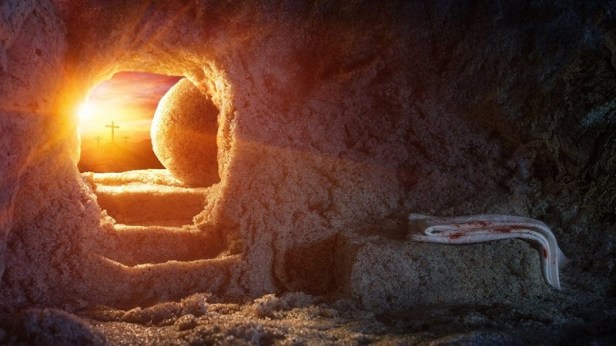
Mary of Magdala finds that the stone has been removed from Jesus’ tomb.
Background on the Gospel Reading
Today we begin the Easter Season, our 50-day meditation on the mystery of Christ’s Resurrection. Our Gospel today tells us about the disciples’ discovery of the empty tomb. It concludes by telling us that they did not yet understand that Jesus had risen from the dead. Thus, the details provided are not necessarily meant to offer proof of the Resurrection. The details invite us to reflect upon a most amazing gift, that is faith in Jesus and his Resurrection.
Each of the four Gospels tells us that Jesus’ empty tomb was first discovered by women. This is notable because in first-century Jewish society women could not serve as legal witnesses. In the case of John’s Gospel, the only woman attending the tomb is Mary of Magdala. Unlike the Synoptic accounts, John’s Gospel does not describe an appearance of angels at the tomb. Instead, Mary is simply said to have observed that the stone that had sealed the tomb had been moved, and she runs to alert Simon Peter and the beloved disciple. Her statement to them is telling. She assumes that Jesus’ body has been removed, perhaps stolen. She does not consider that Jesus has been raised from the dead.
Simon Peter and the beloved disciple race to the tomb, presumably to verify Mary’s report. The beloved disciple arrives first but does not enter the tomb until after Simon Peter. This detail paints a vivid picture, as does the detail provided about the burial cloths. Some scholars believe that the presence of the burial cloths in the tomb offers evidence to the listener that Jesus’ body had not been stolen (it is understood that grave robbers would have taken the burial cloths together with the body).
The Gospel passage concludes, however, that even having seen the empty tomb and the burial cloths, the disciples do not yet understand about the Resurrection. In the passage that follows, Mary of Magdala meets Jesus but mistakes him for the gardener. In the weeks ahead, the Gospel readings from our liturgy will show us how the disciples came to believe in Jesus’ Resurrection through his appearances to them. Our Easter faith is based on their witness to both the empty tomb and their continuing relationship with Jesus—in his appearances and in his gift of the Holy Spirit.
Witness is one who “saw” the Lord
Fernando Armellini
Introduction
The words with which John begins his letter are moving: “What we have heard and what we have seen with our own eyes, what we have looked at and touched with our hands, I mean the Word who is Life… we proclaim also to you” (1 Jn 1:1-3). His is an enviable experience, but unrepeatable. However, to become “witnesses” of Christ, it is not necessary to have walked with Jesus of Nazareth on the roads of Palestine.
Paul—who also did not know Jesus personally—is constituted a witness of the things he saw (Acts 26:16) and receives this task from the Lord: “As you have born witness to me here in Jerusalem, so must you do in Rome” (Acts 23:11). To be a witness, it’s enough to have seen the Lord really alive, beyond death.
Witnessing is not to give a good example. This is certainly useful, but the testimony is something else. This can only be given by one who passed from death to life; one who can confirm that his existence is changed and acquired meaning when it was illuminated by the light of Easter; one who has made the experience that faith in Christ gives meaning to the joys and sorrows and illuminates the joyful and sad moments.
Let’s ask ourselves: is Christ’s resurrection a constant point of reference in all the projects we do, when we buy, sell, dialogue, divide an inheritance, choose to have another child … or do we believe that the reality of this world has nothing to do with Easter?
Anyone who has seen the Lord will do nothing more without him.
First Reading: Acts 10:34,37-43
This reading is taken from the fifth of the eight speeches delivered by Peter in the Acts of the Apostles. The scene takes place in Caesarea, in Cornelius’ house. It is there that he joins a group of pagans who are to be baptized.
This passage is a valuable piece because, in short, it presents the preaching done in the early Christian communities. Placing it on the mouth of Peter, the author intends to confer it the authority and guarantee of officialdom. Let us see what are the main points of this preaching.
Foremost, it refers to the life of Jesus. “He went about doing good and healing all who were under the devil’s power, because God was with him” (vv. 37-38). It also indicated the place and the time when his activity began. It all began in Galilee after the baptism which John preached. That which happened before—his childhood and youth spent in Nazareth—spurs our curiosity on, but does not constitute a point of reference for our faith.
Peter emphasizes concrete, verifiable, known to all facts, because the Christian faith is not based on esoteric ruminations or on a mythological character, but makes reference to a concrete person, who lived in a place and at a precise time. We would expect Peter to at least give a hint also on proclaiming the Good News. Instead, he merely highlights the concrete transformation of the world made by Jesus. It is enough to prove that a new reality has started.
The second point of the preaching is what people have done: They have not recognized in Jesus the messenger of God. They killed him, nailing him to the cross (v. 39).
And how did God react? Peter said: He could not abandon his “faithful servant” prisoner of death. For this, God raised him to life. His work is opposed to that of men, which gives the death, leading to the tomb.
God is the one who uplifts and leads to life. This is the fundamental article of our faith (v. 40).
Finally, the mission of the disciples is given: they are witnesses of these things (vv. 39,41) and are sent to proclaim and testify that Jesus is the one appointed by God to judge the living and the dead (v. 42). This truth is part of the “Creed” and is not a threat, but a happy message. The apostles must tell everyone that Jesus is not a judge who condemns, but the model with which God compares the life of every man, declaring the success or failure. There is not a higher authority. The Jews cannot invoke their faith in God or the observance of the law. The point of reference established by God are not the law, traditions, nor any other human standard, but Jesus and only Jesus.
The apostles are his witnesses because they were with him. They ate and drank with him; they heard his teachings and saw the signs he made . There are no witnesses for their exemplary life, but they made a unique experience that they can relate to anyone who will listen to them with honesty and purity of heart.
Second Reading: Colossians 3:1-4
Writing to the Christians of Colossae, Paul reminds them that, on the day of baptism, they were born to a new life, a life which has its fulfillment not in this world but in the world of God. Faith in this new life is what differentiates the believers from the atheists, who are convinced that man, relying only on one’s own strength, manages to attain salvation in this world.
It is not difficult to realize that, even if all the material problems are solved, there would be food for all, pain and disease would be overcome, yet there will still be unresolved questions remaining in the depths of the human heart: why do I live and why do I die? Where do I come from and where am I going? Only Christ who died and rose from the dead can give a satisfactory answer to these questions.
Paul does not say that Christians should not concern themselves with the reality of this world. They work and are committed as the others. However, they are not convinced that the fullness of life cannot be reached here (v. 2).
Good works are not wanting—says the reading. They are a manifestation of the new life. They are signs of his presence. They are like fruits that can sprout and grow only on a living and thriving tree.
Gospel: John 20:1-9
“Now, on the first day after the Sabbath, Mary of Magdala came to the tomb early in the morning while it was still dark …” (v. 1). In these first words of the Gospel of Easter day, we can sense, almost breathe the signs of death’s victory. On earth, it’s all silence, immobility and quiet. A woman, alone and frightened, moves in the darkness of the night. Death seems to dominate unchallenged while silence and darkness celebrate the triumph. Power, the principle of force, discrimination, injustice and the yeast of cunning seem to have decisively bettered the forces of life.
Let’s see what happens when Mary sees the empty tomb: the scene changes as it by magic. Caught in a sudden thrill, all the characters are shaken from their slumber and move quickly. “Mary of Magdala runs to Simon Peter … who rushes out with the other disciple … They run together, but the other disciple, outrun him …” (vv. 2-4). Taking everyone by surprise, the day after the Sabbath, life explodes in all its force. God intervened and opened the tomb, but Mary of Magdala does not know that. She thinks that the corpse was stolen. It’s a natural and spontaneous reaction. It is the first thought that would cross the mind of anyone running into an empty tomb.
We can stop at this first finding or continue searching for the meaning of what we observe. In the face of death, we can be resigned, cry, or open our hearts to the light from above.
Magdalene exits the scene momentarily, as if passing the baton in the race toward the faith to two other disciples. One is well-known, Peter, the other has no name. It is generally believed to be the Evangelist, John. But this was identified much later, about a hundred years after the apostle had died. It may have been him, the disciple that Jesus loved. However, in the Gospel of John, this figure certainly has a symbolic character who should be dwelt upon.
This unnamed disciple is always connected in some way to Peter:
– He enters the scene next to Andrew. One day the two see Jesus passing by. They ask him where he lives. They follow and stay with him all night. What about Peter? He enters because the nameless disciple reaches Jesus before him (Jn 1:35-40).
– This disciple is not spoken about again until the last supper when Jesus declares that among the twelve there is also a traitor. Who finds him out? Those who can recognize who is on the side of Jesus and who instead is against him? It’s not Peter, but the unnamed disciple who reclines his head on the breast of the Lord (Jn 13:23-26).
– During the passion, Peter stalls and denies the Master. The unnamed disciple has the courage to follow him into the house of the high priest and is close to Jesus during the process (Jn 18:15-27).
– Peter is not on Calvary. He escaped. The disciple whom Jesus loves is instead with the Master. He is at the foot of the cross with His mother (Jn 19:25-27).
– Then comes the passage in which Peter is again beaten both in the physical race and in the spiritual one—as we shall see shortly (Jn 20:3-10).
– On the sea of Tiberias, it is still this disciple who recognizes the risen Christ in the man on the shore. Peter recognizes him only later (Jn 21:7).
– Finally, when he is invited by Jesus to follow him, Peter does not have the courage to do it alone. He feels the need to have at his side “the disciple whom Jesus loved” (Jn 21:20-25).
Who is he then? Why has he no name?
He represents the authentic disciple, the one that just meets Jesus and does not hesitate. He immediately follows him and wants to know him. He even forgets to sleep just to be with him. Do you know him enough to immediately know who are his friends and enemies? He also follows him when it is necessary to offer his life. He has no name, because everyone is invited to name themselves.
We see this pair of disciples run to the tomb. The unnamed disciple arrives first, bends, sees the linen cloths lying there, but does not enter. Simon Peter also arrives, enters and sees the linen cloths lying flat, and the napkin that was placed on Jesus’ head, not lying with the linen cloths, but rolled up in a place by itself.
Nothing miraculous! There is no appearance of angels; everywhere one only the signs of death. Perhaps the two disciples have an intuition, the one formulated by John Chrysostom: “Whoever had taken the body, would not have stripped it before nor would have taken the trouble to remove and roll the napkin and leave it in a place by itself.” His body has therefore not been stolen.
Peter stops, astonished and amazed. He observes but cannot go further. His thoughts are frozen before the evidence of death. The unnamed disciple instead takes a step forward: he sees and begins to believe (v. 8). It is the climactic moment of his journey of faith in the risen Lord. In front of the signs of death (the grave, the bandages, the shroud…), he begins to sense the victory of life.
The following annotation unites the two disciples: “Scripture clearly said that Jesus must rise from the dead, but they had not yet understood that” (v. 9). It seems illogical, at least as regards the disciple without a name. But, at this point, the evangelist John is not compiling a cold chronicle of events, but is pointing the Christians of his community to the route through which to come to faith. It starts from the signs—those documented in the Gospels (Jn 20:30-31). However, they remain mysterious and incomprehensible unless guided by the Word of God contained in the holy Scriptures. These are words that open the mind and the heart and give the interior light that reveals the Risen One. The true disciple does not need further testing; he does not need the verification that Thomas will require.
Jesus said to his disciples: “Unless a grain of wheat falls into the earth and dies, it remains alone, but if it dies, it produces much fruit.” Whoever does not believe considers even the free-gift of life an absurdity, a madness, because behind this gift they only see signs of death. But in the light of Easter, the authentic disciple “begins to understand” that the life given for the brothers and sisters introduces one to the bliss of God.
The concluding verse of the episode: The two disciples “went back home again” (v. 10). It almost gives the impression that everything returns as before. But it is not so. The two have known Jesus; they have witnessed the same events and seen the same signs. By simply resuming their daily lives, they would continue to be discouraged and disappointed, but their new lives are guided by a new light and supported by a new hope.
Fr. Fernando Armellini
Italian missionary and biblical scholar
https://sundaycommentaries.wordpress.com
CHRIST IS RISEN
Pope Francis
Today the Church repeats, sings, shouts: “Jesus is Risen!”. But why is this? Peter, John, the women went to the Sepulchre and it was empty. He was not there. They went away with their hearts closed in sadness, the sadness of defeat: the Teacher, their Teacher, the One whom they loved so much had been put to death; He is dead. And there is no return from death. This is the defeat. This is the path of defeat, the path towards the sepulchre. But the Angel says to them, “He is not here, He is Risen”.
It is the first announcement: “He is Risen”. And then the confusion, the closed hearts, the apparitions. But the disciples stayed locked in the Upper Room the entire day because they were afraid that what happened to Jesus would happen to them. The Church does not cease to say before our losses, our closed and fearful hearts: “Stop, the Lord is Risen”. But if the Lord is Risen, why is it that these things happen? Why is it that there is so much adversity: illness, human trafficking, human slavery, war, destruction, mutilation, vengeance, hatred? Where is the Lord then?
Yesterday I phoned a young man with a grave illness, an educated young man, an engineer, and while talking to him, to give him a sign of faith, I said: “There are no explanations for what is happening to you. Look at Jesus on the Cross. God did this to his Son, and there is no other explanation”. And he answered: “Yes, but He asked His Son and the Son said ‘yes’. I was not asked if I wanted this”. This moves us. None of us is asked: “Are you happy with what is happening in the world? Are you willing to carry this cross further?”. And the Cross goes forth and faith in Jesus comes down from it. Today, the Church continues to say: “Stop. Jesus is Risen”. And this is not a fantasy. The Resurrection of Christ is not a celebration with many flowers. This is beautiful, but this is not it. It is something more. It is the mystery of the discarded stone which becomes the foundation of our existence. Christ is Risen. This is what it means.
In this throwaway culture where what is not needed is just used and disposed of, where what is not needed is thrown away, that stone — Jesus — the source of life, is discarded. And with faith in the Risen Christ, we too, pebbles on this earth of pain, tragedy, acquire meaning amid so many calamities. The sense to look beyond, the sense to say: “Look, there is no wall; there is a horizon, there is life, there is joy, there is the cross with this ambivalence. Look ahead, do not close within yourself. You pebble, acquire meaning in life because you are a pebble near that rock, that stone which the evil of sin discarded”. What does the Church tell us today before so many tragedies? Simply this: the discarded stone is not really discarded. The pebbles which believe and stick to that stone are not discarded. They have meaning and it is with this sentiment that the Church repeats from the bottom of Her heart: “Christ is Risen”.
Let us think for a while, each of us, think about the daily problems, the illnesses we have been through or of one that a relative has; let us think about wars, human tragedies and with simplicity, with a humble voice, without flowers, alone, before God, before us, let us say, “I do not know how this is, but I am certain that Christ is Risen and I have put a wager on it”. Brothers and sisters, this is what I wanted to say to you. Go home today repeating in your hearts: “Christ is Risen”.
Pope Francis
Easter 2017
“The Risen Lord”:
the good news that changes man and his history
Romeo Ballan, MCCJ
“The first day of the week” (Gospel, v. 1), Jesus is risen! An explosion of life, the beginning of a new history for mankind, nothing is as before, everything has a new, positive and final meaning. The proclamation of that historical event – the amazing wonder on which is grounded the community of believers – ricochets from house to house, from church to church, at all latitudes, in all corners of the world; it becomes a ‘gospel = good news’ for all peoples. “The empty tomb has become the cradle of Christianity” (St. Jerome). The empty tomb has marked the decisive step of faith for John: he ran to the tomb, “he bent down and saw the linen cloths lying on the ground, but did not enter,” then he entered together with Peter, “and he saw and he believed” (v. 4.5. 8). It was the beginning of faith in the risen Jesus, which later was strengthened when they saw him alive. “The main event in the history of Christianity consists in a number of people who claim to have seen the Risen Lord” (Sinclair Lewis).
As always, the missionary Church begins new communities of believers by proclaiming that Jesus Christ is the Son of God, crucified and risen. He is the fundamental reason and the foundation of the mission. The historical fact of Christ’s resurrection, which occurred around the year 30 of our era, is right at the heart of the Christian message, while the catechesis enriches its content and transmits it with an appropriate methodology. Mission is to spread this message of life, that is, Christ himself: the One Who is Alive on account of his resurrection, following his passion and death. This is the kerygma, the essential announcement for those who are not yet Christians, and the fundamental proclamation to also awaken and purify the faith of those who dwell almost exclusively on the first part of the paschal mystery. There are Christians, in fact, who focus almost exclusively on the suffering Christ in his passion, and who barely make the leap of faith in the risen Christ. It seems easier and more comforting for them to identify with the dead Christ, especially when they live in situations of distress, depression, poverty, humiliation, grief… Indeed, this would only appear to be comforting, but true consolation acquires strength through faith and life in the Risen Lord. The mission is an eminently Easter event, because its origins and contents are rooted in the Resurrection of Christ.
Faith is gradual: Mary Magdalene, Peter and John ran to the grave with the intention to recover a corpse that had disappeared. They were unprepared for an event beyond their reckoning, and only later they arrived to believe in the Risen Lord and to even become its brave witnesses and heralds (I Reading): “We are witnesses… witnesses chosen by God… And He has ordered us to proclaim and bear witness to the people…” (v. 39:41.42). Since then, the normal path of transmission of the Christian faith is the testimony of people who believed before us. For this reason we profess that faith is apostolic, because it is rooted in the faith of the Apostles and their testimony.
The testimony, which brings together proclamation and coherence of life, is the first form of mission (cf. AG 11-12, EN 21; RMi 42-44). The true witnesses of the Risen Lord are ‘contagious’ people. People transformed by the Gospel of the risen Jesus, who put into practice the higher values of the spirit (II Reading), are the only ones capable of influencing other people and of making them become interested in their same values: such as acceptance and serenity in suffering, hope in the face of death, prayer as abandonment into the hands of the Father, joy in the service of others, well-tried honesty, humility and self-control, promotion of the good of others, attention to the needs of the least, witnessing the Invisible… Mission spreads and is accomplished widely in this way, even before and better than through just structures and hierarchies. “Only those who know how to love and forgive with a heart as big as the world, without enemies and without rancour, can celebrate Easter with Christ”, as Bishop Oscar Arnulfo Romero, shortly before he was killed in San Salvador on March 24, 1980, taught in a catechesis. This is the good news that the world needs, the Gospel that everyone has the right to know and which the missionary Church has to bring to all peoples without delay.
