4th Sunday of Lent (A)
John 9:1-41
This Sunday’s Readings
First Reading
1 Samuel 16:1b,6-7,10-13a
Samuel is sent to anoint David as king.
Responsorial Psalm
Psalm 23:1-6
The Lord is our shepherd.
Second Reading
Ephesians 5:8-14
The Ephesians are told to live as children of light.
Gospel Reading
John 9:1-41 (shorter form: John 9:1,6-9,13-17,34-38)
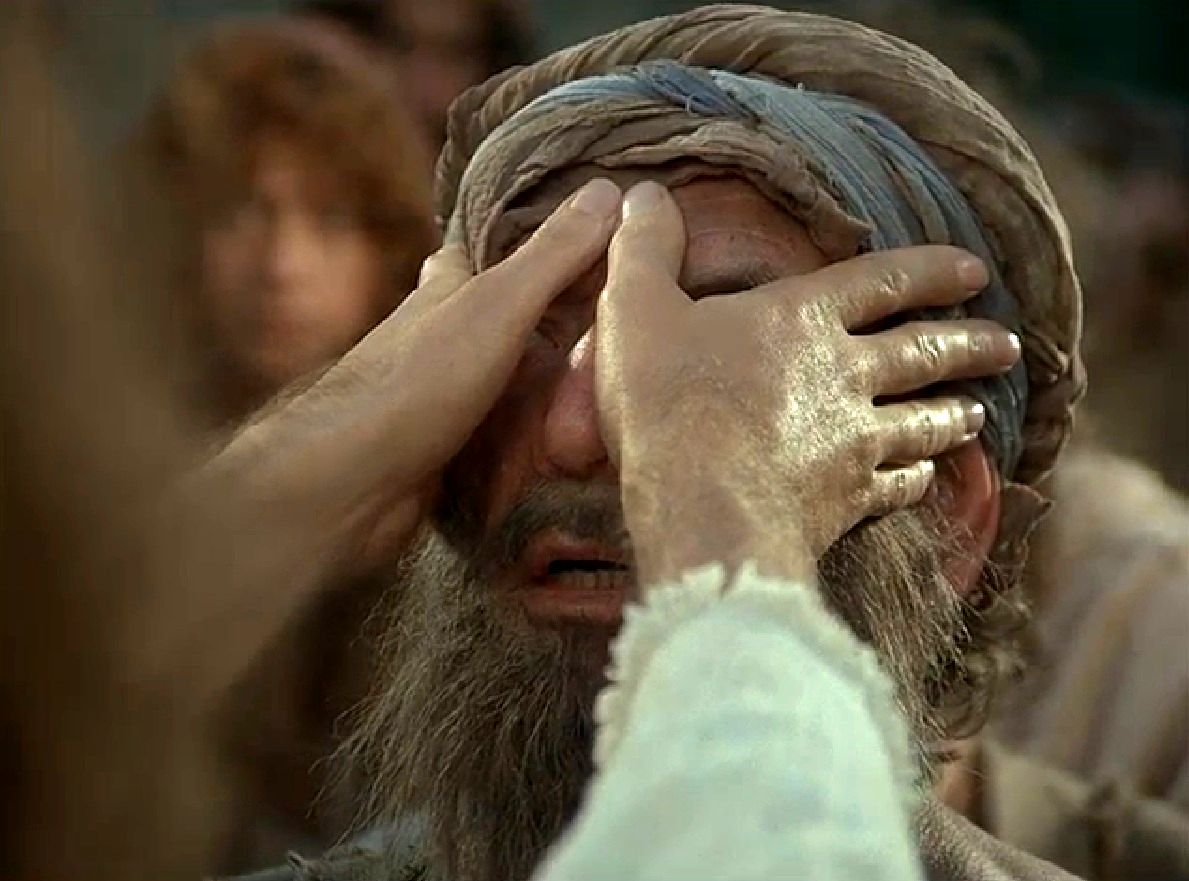
Jesus heals the man born blind and reveals himself to him as the Son of Man.
Background on the Gospel Reading
As we did last week, we are reading today from the Gospel of John. In today’s Gospel, the healing of the man born blind invites us to focus on the physical and spiritual aspects of sight and light. In the first part of today’s Gospel, we hear Jesus’ response to a prevalent belief of his time: that misfortune and disability were the result of sin. That belief is why Jesus is asked the question of whose sin caused the man’s blindness—his own or his parents’. Jesus does not answer directly, but instead gives the question an entirely different dimension—through this man’s disability, God’s power will be made manifest. Jesus then heals the man.
The healing is controversial because Jesus heals on the Sabbath. The Pharisees, the religious authorities of Jesus’ time, understood that the law of Moses forbade work (including healing) on the Sabbath. They also have trouble believing that Jesus performed a miracle. To determine whether the man was really born blind, the Pharisees question him and his parents. The man challenges the leaders of the synagogue about their assessment of the good that Jesus has done. In turn, they expel the man for questioning their judgment.
The final revelation and moment of enlightenment comes when the man born blind encounters Jesus again. Having heard the news of his expulsion, Jesus seeks out the man born blind and reveals himself to him as the Son of Man. In this moment, the man born blind shows himself to be a man of faith and worships Jesus. Jesus replies by identifying the irony of the experience of many who encounter Jesus: Those who are blind will now see, and those who think they now see will be found to be blind.
As in last week’s Gospel about Jesus’ encounter with the Samaritan woman, today’s reading has many allusions to Baptism. The washing of the man in the pool of Siloam is a prototype for Christian Baptism. Through the man’s encounter with Jesus, the man born blind is healed, his sight is restored, and his conversion to discipleship begins. The man born blind gradually comes to a greater understanding about who Jesus is and what it means to be his disciple, while the Pharisees (those who should see) are the ones who remain blind.
Opening the Eyes of Faith
Raniero Cantalamessa
The healing of the man blind from birth hits close to home, because in a certain sense all of us are blind from birth.
The very world was born blind. According to what science tells us today, during millions of years there was life on earth, but it was life in a blind state. The eye for seeing did not exist yet, sight itself did not exist. The eye, in its complexity and perfection, is one of the functions formed more slowly.
This situation is reproduced in part in the life of every man. A child is born, though not precisely blind, at least incapable of distinguishing things clearly. Only after weeks he begins to focus. If the child could express what he experiences when he begins to see clearly the face of his mother, of people, of things, of colors — how many “oh’s” of awe would be heard! What a hymn to light and sight.
To see is a miracle, only we don’t pay attention to it because we are too accustomed to it and we take it for granted. It is here that God sometimes acts in a sudden and extraordinary way, aiming to take us out of drowsiness and make us alert. That is what he did with the healing of the man blind from birth and of other blind people in the Gospel.
But is this the only reason that Jesus healed the man blind from birth? There is another sense in which we were born blind. There are other eyes — besides the physical ones — that should open themselves to the world: the eyes of faith! They allow a glimpse of another world beyond that which we see with the eyes of the body: the world of God, of eternal life, the world of the Gospel, the world that does not end — not even with the end of the world.
This is what Jesus wanted to remind us of with the healing of the man blind from birth. Before anything else, he sent the young blind man to the pool of Siloam. With this, Jesus wanted to signify that these different eyes, those of faith, begin to open up in baptism, precisely when we receive the gift of faith. That’s why in ancient times baptism was also called “illumination,” and being baptized meant “having been illuminated.”
In our case, it’s not about believing generically in God, but believing in Christ. The Evangelist avails of the episode to show us how to arrive to a full and mature faith in the Son of God. The blind man’s recovery of his sight happens, in fact, at the same time that he discovers who Jesus is. In the beginning, for the blind man, Jesus is no more than a man. “The man called Jesus made clay …”
Later, he was asked, “What do you have to say about him, since he opened your eyes?” He responded, “He is a prophet.” He has taken a step forward; he has understood that Jesus is sent form God, which he speaks and acts in his name.
Finally, finding Jesus again, he exclaims, “I do believe Lord,” and he bows before him to worship him, thus openly recognizing him as his Lord and God.
In describing all of this with so much detail, it is as if John the Evangelist very discreetly invites us to ask ourselves the question: “And me? In what point am I on this path? Who is Jesus of Nazareth for me?”
That Jesus is a man, no one denies. That he is a prophet, one sent from God, is also admitted almost universally. Many stay at that point. But it is not enough. A Muslim, if he is coherent with what is found written in the Koran, also recognizes that Jesus is a prophet. But not for that is one considered a Christian.
The leap by which one passes to be a Christian in the true sense is when he proclaims, like the man blind from birth, that Jesus is “Lord” and adores him as God. Christian faith is not primarily to believe in something — that God exists, that there is something beyond — but to believe in someone. Jesus in the Gospel does not give us a list of things to believe; he says, “Believe in God; believe also in me” (John 14:1).
For Christians, to believe is to believe in Jesus Christ.
Fr. Raniero Cantalamessa
http://www.zenit.org
NEW EYES
José Antonio Pagola
The story of the blind man of Siloam is structured around a strong contrast. The Pharisees believe that they know everything. They have no doubts. They impose their truth. They even end up expelling a poor blind man from the synagogue. «We know that God spoke to Moses». «We know that that man who has healed you doesn’t keep the Sabbath». «We know that he is a sinner».
On the other hand, the beggar who is healed by Jesus knows nothing. He only tells of his experience to whoever would want to listen to him: «I only know that I was blind and now I see». «That man did something to my eyes, and I began to see». The story concludes with this last warning from Jesus: «I have come into this world, so that those without sight may see and those with sight may become blind».
Jesus fears a religion defended by secure arrogant scribes, who authoritatively manage God’s Word in order to impose it, utilize it as a weapon, and even excommunicate those who think differently. He fears doctors of the law who are more worried about «keeping the Sabbath» than about «healing» sick beggars. For Jesus it seems to be a tragedy to have a religion of «blind guides» and he says it openly: «If a blind man leads another blind man, they both fall into the pit».
Theologians, preachers, catechists, and teachers, who pretend to «guide» others without perhaps having allowed themselves to be enlightened by Jesus: don’t we need to hear his questioning? Are we going to keep repeating endlessly our doctrines without living a personal experience of encounter with Jesus that opens our eyes and our hearts?
Our Church today doesn’t need preachers who fill the Churches with words, but witnesses who spread, albeit in a humble manner, their small experience of the Gospel. We don’t need fanatics who defend «truths» in an authoritative manner and with empty language, woven together of clichés and stock phrases. We need believers of the truth, attentive to life and sensitive to the problems people have, seekers of God who are capable of listening and accompanying respectfully the great number of men and women who are suffering, who seek and don’t find a way to live that is more human and more believing.
The blind man: has his sight restored, believes and announces
Romeo Ballan, mccj
The journey towards Easter is marked by great catechetical-baptismal themes: the tempter to be overcome, the face of Christ to be contemplated, the symbols of water, light and life. In the Gospel of this Sunday, the figure of Jesus-the light is central: it is he who seeks out and meets the blind man, who smears mud on his eyes and sends him to wash at the Pool of Siloam (a name that means sent). The blind man goes off, washes himself and comes away with his sight restored (v. 1:6-7). The sign is clear, but only for those who are able to see it. That very miracle of Jesus, which is so obvious, becomes a sign of contradiction: from the same event we have two opposite reactions (that of the blind man and that of the Pharisees).
The blind man moves gradually towards the discovery of the face-identity of Jesus: from just an ordinary man, to a prophet, to a man of God, to the Lord… to the point of worshipping him with faith: “Lord, I believe” (v. 38). Now the blind man is converted: filled with light in body and spirit. As the man advances in the discovery of Jesus, the Pharisees, on the other hand, gradually close themselves to the light, do not believe in the testimony of the healed blind man, hush him up and drive him away (v. 34). The stubbornness of the heart leads to interior blindness. Unfortunately, faith can even be lost! Only those who accept that truth can change their lives, will not be afraid of light, love, service… In this respect, it is worth remembering the aspiration of St. Augustine which is beautiful, as always, in the Latin text as well: “Servum te faciat caritas, quia liberum te fecit veritas” (may charity make you a slave, since truth has made you free).
“More light!” were the last words of Johann W. Goethe. Jesus, by word and sign, brings a new light which sheds light even on the reality of sin in the world. Sin is that vast dark area where people, not yet enlightened by the Gospel, live. In that dark zone there is also the non-comprehension of the significance of illness, pain and misfortune, which are evils that are often linked, erroneously, to personal sins. Emblematic in this regard is the story of Job. The apostles themselves are an example of this way of thinking. When they see the man born blind, they ask the Master: “Who sinned, this man or his parents?” (v. 2). This is a typical pre-Christian setting of the problem of suffering, which identifies the cause of pain or disease with sin, with the evil eye or witchcraft or curse on other people… It is a widespread mentality, even in Christian circles, typical of people not properly evangelised. Going back to my years of missionary work in Congo, where the problems and fears of the ndoki (the evil eye and the likes in Lingala) were everyday’s happenings: so many Christians (including some catechists and religious), were not inwardly free. I have seen similar situations even in Latin America and Europe. One can experience first hand that paganism (and its varieties) is synonymous with darkness, fear, revenge and sinister manoeuvres… which spread even among Christians everywhere. The human heart is never completely converted. Therefore the Church’s missionary work is not content with superficial evangelisation, but must aim at the heart of the people and at the values of cultures, as Paul VI teaches very well.
One can get out of this pagan mentality only by making a journey of ongoing conversion, accepting inwardly and totally Christ who said: “I am the light of the world” (v. 5), “the truth will make you free” (Jn 8:32 ). It is the clear admonition of Paul (II Reading) to behave like children of light (v. 8; see Mt 5:14), not to take part in the futile and shameful works of darkness (v. 11-12), but to look at Christ: “Wake up… and Christ will shine on you” (v. 14). Christ is the light, the Messenger (v. 7) of the Father, the water into which to be immersed by baptism. The light of faith that we receive in baptism is a gift for each of us, but to be shared with the others.
The light of Christ helps us to understand the meaning of illness and pain, as we learn from the silent and patient witness of so many people who are sick but inwardly serene. Faith is a new light that allows us to grasp the message of life present in suffering, the opportunity of purification and salvation for self and for others. Faith leads us to trust God, the Shepherd who guides us even in the valley of darkness (Responsorial Psalm). He has ways and criteria that are different from ours (I Reading): “The Lord looks at the heart” (v. 7) of the people, as it appears from his choice of David. He was the youngest, a shepherd (cf Lk 2:8), but God makes him a king. God’s criteria are amazing: Jesus heals a blind man, a beggar (v. 8), one who had been driven away (v. 34; Jesus will also be rejected), and Jesus reveals himself to him, makes of him a believer, a witness, a convinced announcer (v. 30-33), just as he did for the Samaritan woman (see last Sunday). God surprises us: He chooses the least to announce and make his Kingdom grow in the world.
THERE’S A LIGHT THAT NEVER SETS
Fernando Armellini
Introduction
We can see some things; others elude us. The scientific knowledge that allows us to examine, monitor, and quantify everything that is material is growing at a breakneck pace. It makes us curious, thrilled and feel proud to the point of inducing some to believe that only what can be seen with the eye, observed with the senses, or checked in the laboratory is true. But the presumption of control over all reality stems from a lack of vision, from a blurring of the interior and spiritual vision that allows us a glimpse into the mysteries of God, the meaning of life and death, and the ultimate fate of human history.
There is also another kind of blindness: those who are convinced that they have the light and ability to give the correct value to everything: money, success, career, sexuality, health and sickness, youth and old age, family and children. However, they draw their confidence from the scale of values of this world. Perhaps without realizing it, they have deduced only through the instinct and emotion of the moment. They make their calculations from ideologies and economic systems contaminated by sin and gossip, which produce false light, unreliable sparkle, and wisp that create a misleading glow.
“The true light that enlightens everyone came into the world” (Jn 1:9). Christ came to dispel our darkness, to illuminate our nights, to usher in the family of the “children of light and children of the day” (1 Thes 5:5).
First Reading: 1 Samuel 16:1b,4a,6-7,10-13a
The Lord said to Samuel: “Fill your horn with oil, and be on your way. I am sending you to Jesse of Bethlehem, for I have chosen my king from among his sons.”
As Jesse and his sons came to the sacrifice, Samuel looked at Eliab and thought, “Surely the Lord’s anointed is here before him.” But the Lord said to Samuel: “Do not judge from his appearance or from his lofty stature, because I have rejected him. Not as man sees does God see, because man sees the appearance but the Lord looks into the heart.” In the same way Jesse presented seven sons before Samuel, but Samuel said to Jesse, “The Lord has not chosen any one of these.” Then Samuel asked Jesse,“Are these all the sons you have?” Jesse replied, “There is still the youngest, who is tending the sheep.” Samuel said to Jesse, “Send for him; we will not begin the sacrificial banquet until he arrives here.” Jesse sent and had the young man brought to them. He was ruddy, a youth handsome to behold and making a splendid appearance.The Lord said, “There—anoint him, for this is the one!” Then Samuel, with the horn of oil in hand, anointed David in the presence of his brothers; and from that day on, the spirit of the Lord rushed upon David.
“The reasoning of mortals is worthless and our thoughts uncertain because a perishable body weighs down the soul” (Wis 9:14). So the author of the Book of Wisdom warns against the danger of giving value to excess through a naive trust in the human judgment criteria. Will the Prophet, to whom the Lord entrusts his projects and reveals his mysteries, be free from petty constraint? Not at all: He remains a man. It is difficult for him to tune his thoughts to those of God. He, too, needs to purify his eyes if he wants to contemplate reality through the eyes of the Lord. It is what happened to Samuel, the man of God sent to Bethlehem to anoint the one whom the Lord had chosen as king.
We are in 1020 B.C., and the people of Israel are going through a difficult time because the Philistines are pressing upon them from every side. A brave, skillful and clever man could probably contain the arrogance of such powerful enemies, but where to find him?
One day, the Lord clarifies to Samuel that he had chosen the right man: a young man of Bethlehem, a son of Jesse. The prophet sets off towards that town. He looks for the house of Jesse. He enters and tells what the Lord has revealed. Jesse is enlightened, is beaming because God has chosen one of his sons as king of Israel. But who among them? He asks himself. He has many sons. After a moment’s hesitation, he thinks. Indeed, the chosen one is Eliab, the firstborn. He is tall, proud, and handsome. It cannot be him! Even Samuel is struck by the appearance of the young man, by the imposing stature, but in his interior, the voice of the Lord tells him: “No, it is not him.”
A little disappointed, Jesse presents to the Prophet, one after another, all of his seven beautiful, vigorous, intelligent children, and yet none of them is chosen. Samuel also looks puzzled and bewildered. He then asks Jesse: “Don’t you have other children?” “Yes—he answers—I have one more, but he’s a teenager. It is absurd that God would choose him for a mission so challenging when he can rely on far more capable people.” The prophet now begins to see reality with new eyes, those of God. He says, “Go, take him because he is the chosen one.”
The choice of God is strange, even illogical. His behavior is not easy to understand. It is not the first time that he acts in a way contrary to human criteria. From the very beginning of the Bible, he shows a preference for Abel over Cain. The sacred text does not explain the reason (it does not say that Abel was good and Cain bad). The reason is other: Hebel (Abel) in Hebrew means ‘vanity,’ without consistency; therefore, it indicates one that does not count. Abel is Hebel and the weakest and the smallest: he has everything that attracts God’s eye. In the Bible, this is the first manifestation of the preference of the Lord for those who have no value.
Later he will choose a people. He will observe the Egyptians: deeply religious, builders of pyramids, and knowers of scientific secrets. He will consider the Babylonians: rich, powerful, and advanced in every field of knowledge but will not choose them. He will prefer Israel because she was the smallest (Deut 7:7-8). To free his people from the Midianites, he will call Gideon, who unbelievingly say, “Pardon me, Lord, but how can I save Israel? My family is the lowliest in my tribe, and I am the least in the family of my father” (Jdg 6:15). Jesus will behave in the same way. He will prioritize the small ones, the sinners, the poor, the shepherds, and the despised people and make them the first guests at the banquet of the Kingdom.
How can these predilections of God be explained? The answer lies in the central part of the reading. He does not see people as we see them. Our gaze contemplates the external and does not go beyond the surface. It often focuses on the temporary while his goes to the heart. Even Samuel, the man of God, the prophet of the Lord, hesitated for a moment and was dazzled by appearances. It is, therefore, easy for this to happen. Without even realizing it, we express superficial and unjust judgments about people. The First Reading invites us to take note and re-examine them in the light of God’s judgment and gaze.
Second Reading: Ephesians 5:8-14
Brothers and sisters: You were once darkness, but now you are light in the Lord. Live as children of light, for light produces every kind of goodness and righteousnessand truth. Try to learn what is pleasing to the Lord. Take no part in the fruitless works of darkness; rather expose them, for it is shameful even to mention the things done by them in secret; but everything exposed by the light becomes visible, for everything that becomes visible is light. Therefore, it says: “Awake, O sleeper, and rise from the dead, and Christ will give you light.”
In the Bible, the struggle between good and evil is often presented as light and dark. “Light cannot coexist with darkness,” says Paul to the Corinthians (2 Cor 6:14). The drama lies in the fact that man can choose darkness and move away from God, who is light (1 Jn 1:5,7).
For the Semites—who had assimilated many aspects of Persian dualistic conception—the east, where the sun rises, was the symbol of God, while the west recalled the evil one. In one of his famous baptismal catechesis, Cyril of Jerusalem (fourth century) reminded his followers: ‘Turning away from the west, you have stretched your hands and you have renounced Satan because the west is the place of the thick darkness and the empire of Satan is in the darkness.’ The exhortations contained in the reading must be placed in the context of this mentality.
Christians are reminded that through baptism, they have passed from darkness to light, so the work of the light is expected from them. Paul sums this up as every kind of goodness, justice, and truth. As for the works of darkness—he continues—they are so shameful that those who do them hide, afraid of the light and instinctively seeking the darkness.
The apostle finally suggests countering evil deeds: open and determined denouncement (v. 13). The shameful acts must be condemned firmly. Children of the light must not try to justify, excuse, or make them somehow acceptable. The mere fact of calling them by their name and not by any equivocal circumlocution means putting them into the open. It is like projecting a beam of light that deprives them of their most valuable protection. When there is no darkness, evil works are out of their living environment. It is a reference to the duty of every Christian to denounce disorder courageously. The danger of becoming entangled in false reasoning leads to calling “good evil and evil good” (Is 5:20), always a threat to Christians.
Gospel: John 9:1-41
As Jesus passed by he saw a man blind from birth. His disciples asked him, “Rabbi, who sinned, this man or his parents, that he was born blind?” Jesus answered,“Neither he nor his parents sinned; it is so that the works of God might be made visible through him. We have to do the works of the one who sent me while it is day. Night is coming when no one can work. While I am in the world, I am the light of the world.” When he had said this, he spat on the ground and made clay with the saliva, and smeared the clay on his eyes, and said to him, “Go wash in the Pool of Siloam”—which means Sent. So he went and washed, and came back able to see.
His neighbors and those who had seen him earlier as a beggar said, “Isn’t this the one who used to sit and beg?” Some said, “It is,” but others said, “No, he just lookslike him.” He said, “I am.” So they said to him, “How were your eyes opened?” He replied, “The man called Jesus made clay and anointed my eyes and told me, ‘Go to Siloam and wash.’ So I went there and washed and was able to see.” And they said to him, “Where is he?” He said, “I don’t know.”
They brought the one who was once blind to the Pharisees. Now Jesus had made clay and opened his eyes on a sabbath. So then the Pharisees also asked him how hewas able to see. He said to them, “He put clay on my eyes, and I washed, and now I can see.” So some of the Pharisees said, “This man is not from God, because he does not keep the sabbath.” But others said, “How can a sinful man do such signs?” And there was a division among them. So they said to the blind man again, “What do you have to say about him, since he opened your eyes?” He said, “He is a prophet.”
Now the Jews did not believe that he had been blind and gained his sight until they summoned the parents of the one who had gained his sight. They asked them, “Isthis your son, who you say was born blind? How does he now see?” His parents answered and said, “We know that this is our son and that he was born blind. We do not know how he sees now, nor do we know who opened his eyes. Ask him, he is of age; he can speak for himself.” His parents said this because they were afraid of the Jews, for the Jews had already agreed that if anyone acknowledged him as the Christ, he would be expelled from the synagogue. For this reason his parents said, “He is of age; question him.”
So a second time they called the man who had been blind and said to him, “Give God the praise! We know that this man is a sinner.” He replied, “If he is a sinner, I do not know. One thing I do know is that I was blind and now I see.” So they said to him, “What did he do to you? How did he open your eyes?” He answered them, “I told youalready and you did not listen. Why do you want to hear it again? Do you want to become his disciples, too?” They ridiculed him and said, “You are that man’s disciple; we are disciples of Moses! We know that God spoke to Moses, but we do not know where this one is from.” The man answered and said to them, “This is what is so amazing, that you do not know where he is from, yet he opened my eyes. We know that God does not listen to sinners, but if one is devout and does his will, he listens to him. It is unheard of that anyone ever opened the eyes of a person born blind. If this man were not from God, he would not be able to do anything.” They answered and said to him, “You were born totally in sin, and are you trying to teach us?” Then they threw him out.
When Jesus heard that they had thrown him out, he found him and said, “Do you believe in the Son of Man?” He answered and said, “Who is he, sir, that I may believein him?” Jesus said to him, “You have seen him, and the one speaking with you is he.” He said, “I do believe, Lord,” and he worshiped him. Then Jesus said, “I came into this world for judgment, so that those who do not see might see, and those who do see might become blind.” Some of the Pharisees who were with him heard this and said to him,” “Surely we are not also blind, are we?” Jesus said to them, “If you were blind, you would have no sin; but now you are saying, ‘We see,’ so your sin remains.”
From the early days of the Church, the story of the man born blind is proposed in Lent. The reason is easy to understand. In the story of the man born blind, every Christian can easily recognize his own story. Before meeting Christ, he was blind; then, the Master gave him his sight. He enlightened him in the water of the baptismal font. After Constantine began to build the first baptismal fonts, they were given the name of ‘photisteria’: places of enlightenment.
In today’s passage, John is inspired by an episode in the life of Jesus. He uses it to develop the central theme of the Christian message: the salvation given by Christ. He uses a biblical language: the dark–light contrast. In the Bible, darkness always has a negative connotation. It is the symbol of the dark power of evil, death, and destruction. Light represents an orientation towards God, the choice of good and life. The healing of the man born blind is placed in the context of the Feast of Tabernacles (Jn 7:2). It is the most popular of all the Jewish feasts, simply called ‘the feast.’ It was celebrated for a week and characterized by an explosion of joy and liturgies of light and water.
On the esplanade of the temple, lit every night with large torches, there was a well from which they drew water for libation. It referred to the prophecy of Isaiah: “You will draw water with joy from the very fountain of salvation” (Is 12:3). On the second day of the feast, the rite of the ‘joy of the well’ was celebrated with dancing and singing. Jesus waited for ‘the last day, the most solemn feast’ to stand and cry out in a loud voice: “Let anyone who is thirsty come to me, and let the one who believes in me drink” (Jn 7:37). It was during this festival of light that he also proclaimed: “I am the light of the world; the one who follows me will not walk in darkness but will have light and life” (Jn 8:12).
To grasp the significance of the message of today’s Gospel, this festive context and the references to light and water should be noted. The blind will come to see the light only after washing in the water of the Sent One. We will divide the passage into seven parts as if they were seven scenes of theatrical work.
The first scene (vv. 1-5) opens with a dialogue between Jesus and his disciples. Their intervention is a literary device by which Jesus offers the opportunity to give the key to reading about the episode. If the passage is reduced to a journalistic report, the symbolism of the healing of the man born blind would not be grasped. The central message is lost: Jesus “is the light of the world” (vv. 4-5).
The question of the disciples is perhaps also ours: “Why is this man born blind? Who sinned: he or his parents?” (v. 2). At the time of Jesus, it was believed that God would reward the good in his infinite justice and punish the wicked in this world in proportion to their good or evil deeds. Misfortune, disease, and suffering were considered punishments for sin.
This theology—dictated by logic and human criteria—has never been easy to defend. Job mocked it: “Why do the wicked live, increase in age and power? Their descendants flourish in their sight, their kinsfolk and their offspring. They live out their days in happiness and go down to Sheol in peace” (Job 21:7-8,13), and to those who challenged him, he answered: “His children will pay for his sin. What does he care about his family when he dies, when his months have been cut off?” (Job 21:19-21). Despite this compelling rationale, the theology of ‘just compensation’ was accepted by all. To explain the birth of a disabled person, it even came to the supposition that he had sinned in the mother’s womb.
The position that Jesus takes on the subject is clear and enlightening. “Neither was it for his own sin nor for his parents’ sin” (v. 3). It is a blasphemy to speak of God’s punishments. It is a pagan way to imagine it. When the Bible tells of ‘God’s punishment,’ it employs an archaic language that is not ours. It intends to denounce disasters as caused by sin, not by God. Today it is incorrect and misleading to use the metaphor of ‘God’s punishment’ without immediately clarifying the meaning.
It does not make sense to ask who is guilty in front of evil. The only thing to do is to eliminate it, as Jesus did. Speaking of the blind man, Jesus says: “He was born blind so that God’s power might be shown in him” (v. 3). Each event is ambivalent. We have cataloged the events into good and bad, but each of them can be good or bad. How a person lives determines salvation or defeat.
The blind man is not guilty of being born so. The Johannine symbolism appears here: blindness is the condition in which man is born. It is not his fault nor of others. He is blind and has not even the faintest idea of what light is. So it is true that he never thinks of asking to be healed by Jesus. Jesus takes the initiative to heal him, and with his gesture, he shows that his salvation (his light) is an entirely free gift. Where Jesus is, there is light; it is day. Where he is absent, it is night (v. 5).
In the second scene (vv. 6-7), the healing of the blind man is referred to in a few words. The method used is rather strange: the mud and the saliva. Jesus adapts to the mentality of the people of his time who believed that saliva is a concentration of breath, the spirit, and the strength of a person. In this gesture—sometimes accomplished by Jesus (Mk 7:33,8,23)—there is perhaps a reference to the creation of man told in the book of Genesis (2:7). The evangelist wants to insinuate the idea that the new and enlightened man is born by the breath, the Spirit of Jesus.
The blind man does not recover immediately. He must go and wash in the water of Siloam. John notes that this name means Sent. The reference to Jesus—the One sent by the Father—is explicit. He is God’s water, that which was promised to the Samaritan woman, who cures the man’s blindness.
The third scene introduces the first of the interrogations of the blind (vv. 8-12).
Enlightened by Jesus, he becomes unrecognizable and is completely changed. Even the neighbors, who for years have lived next door, ask themselves: “Is this the beggar who used to sit here or not?” It is the image of the man who, from the day he became a disciple, is transformed to such an extent as not to seem any longer the same person. Before, he led a corrupt life, intractable, selfish, greedy, grumpy, but now not anymore. His way of thinking, speaking, judging, evaluating people and events, tackling problems, reacting to provocation is changed. The water, which is the word of Christ, has opened his eyes. It makes him discover how the life he led was meaningless. It created a new and enlightened man.
The path of the disciple towards the fullness of light is long and tiring. The evangelist presents it with the image of the blind man who began his journey when he met the man Jesus. “The man called Jesus made a mud paste,” and they ask him: “Where is he?” He answers: “I don’t know.” He confesses his ignorance; he recognizes not knowing anything about him. The starting point of the spiritual journey of the disciple is the awareness of not knowing Christ and feeling the need to know something more.
In the fourth scene (vv. 13-17), the religious authorities intervened and submitted the blind man to a second interrogation. They do not bother to check what happened. They have already decided that they must condemn Jesus because he does not correspond to the idea of the religious man they have in mind. Claiming the right to speak in the name of God, they classify him among the wicked, the enemies of the Lord according to the rules and criteria established by them.
This conviction of being right and not needing any other light, the refusal to call into question their theological certainties, lead them to say arrogantly, “That man is not from God” (v. 16). They are blind but convinced that they can see. The position taken by these Pharisees is a reminder of the danger of anyone who starts to know Christ. He clings to his own securities and convictions. He stubbornly refuses any change and will remain a slave to the darkness.
However, the blind man who is conscious of ‘not knowing’ takes a second step. When the Pharisees ask him: “What do you think of this man? he replies: “He is a prophet” (v. 17). At first, he thought he was a simple man; now he realizes that he is something more; he is a step higher: he is a prophet.
The fifth scene (vv. 18-23) tells of a new interrogation. This time the authorities call into question the blind man’s parents. They hold the power, and they cannot tolerate someone questioning their beliefs and their prestige. Who dares to oppose them must be taken away. They are so powerful that even the parents are afraid to take a stand in favor of their son.
It is the story of anyone enlightened by Christ. He is no longer understood, is abandoned, and sometimes even betrayed by the people most dear to him, even those from whom they would expect encouragement and support. It is always difficult and risky to take the side of the truth: the fear of alienating the friendship of the people that matter or the sympathies of those in power often leads to failure to intervene, thus causing reticence and guilty silence.
In the sixth scene (vv. 24-34), the religious authorities call the blind man back for more questioning. In his replies and attitude, we can grasp the characteristics that distinguish those enlightened by Christ.
– He is first of all free: he sells his head to no one; he says what he thinks. “He is a prophet,” he says, referring to Jesus. When they argue: “We know that this man is a sinner,” he even allows himself the liberty of irony: “I do not know whether he is a sinner or not; I only know that I was blind and now I see” and, soon after, he is even more scathing, he adds: “It is amazing that you do not know where the man comes from….”
– He is brave: he rejects any form of subservience, not intimidated by those abusing their power, insulting, threatening, and resorting to violence (vv. 24ff).
He is sincere: he does not shrink from telling the truth even when uncomfortable or not welcomed by those at the top, those used to approval and applause from flattering sycophants.
– He is simple as a dove but also cautious. The authorities are trying to trap him, forcing him to admit that he is on the side of the one who ‘does not keep the Sabbath.’ With ability, he escapes the trap: “I have told you already, why do you want to hear it again?” He lodges a new ironic jab: “Do you also want to become his disciples?” (v. 27).
– He keeps a constant research attitude: he knows he has glimpsed something, grasped part of the truth, but he is aware that many things still escape him. The authorities are convinced they see clearly. They think they know it all: “We know that this man is not from God” (v. 16); “we know that he is a sinner” (v. 24); “we know that God spoke to Moses” (v. 29). He who was blind, however, has consistently recognized his limits: “Where is this man, I do not know” (v. 12); “I do not know whether he is a sinner or not” (v. 25). When Jesus asks him if he believes in the Son of man, he will answer: “Who is he?” recognizing, once again, his ignorance (v. 36).
– Finally, he resists pressure and fear. He suffers violence but does not give up the light received. Rather than going against his conscience, he prefers to be kicked out of the institution (v. 34).
In the last scene (vv. 35-41), Jesus reappears. Everything is turned around as if he does not exist. He does not intervene any longer. He lets the blind man juggle alone amid difficulty and conflict. The enlightened disciple does not need the physical presence of the Master. The strength of his light is enough to remain firm in the faith and make consistent choices.
In the end, Jesus intervenes and pronounces his judgment, the only one that matters when it comes to deciding on the success or failure of a man’s life. He says: at the beginning, there was a blind man, and many saw him. Now the situation is reversed: those who were convinced of seeing, in reality, are those with incurable blindness. And the man who was conscious of his blindness can now see.
In the story, how Jesus is called must be noted: for the authorities—for those who can see—he is ‘such man,’ ‘that man,’ ‘he’; they don’t deign to call him by his name. They have eyes, but they don’t want to see who he is.
The blind man journeys a path of faith that corresponds to that of every disciple. In the beginning, Jesus is for him a simple “man” (v. 11), then he becomes a “prophet” (v. 17), and then a “man of God” (vv. 32-33), and at the end, the “Lord” (v. 38). The last title is the most important. It is that title with which Christians proclaimed their faith. Before coming to be immersed in the water of the ‘photisterion,’ during the solemn ceremony of the Easter Vigil, each catechumen declares in front of the whole community: ‘I believe that Jesus is the Lord.’ From that moment, he is welcomed among ‘the enlightened.’
READ: Jesus cures a blind man, and this stirs up controversy. The religious leaders are the ones who are blind, and the one who was born blind see. The reference to the expulsion from the synagogue probably comes from the time of the Johannine community.
REFLECT: Who is blind today in the Church and society? Are you blind to others? What do you not want to see? Compare the words of the blind man with the words of religious leaders. Who do the religious leaders refuse to see? Do you accuse others rather than examine your motives?
PRAY: Everyone has blind spots. Pray to recognize those times when you do not want to see what is obvious. Pray that you may not accuse others before examining your motives.
ACT: Be sensitive to anyone who is disabled. Never treat such as person as being inferior and unable to function without your help.
