ON THE LIMIT
Pastoral Letter 2025
by
DOMENICO POMPILI
Bishop of Verona
3. The Limit as a Place of Blessing
3.1 A Mysterious Adversary: the Hidden Master
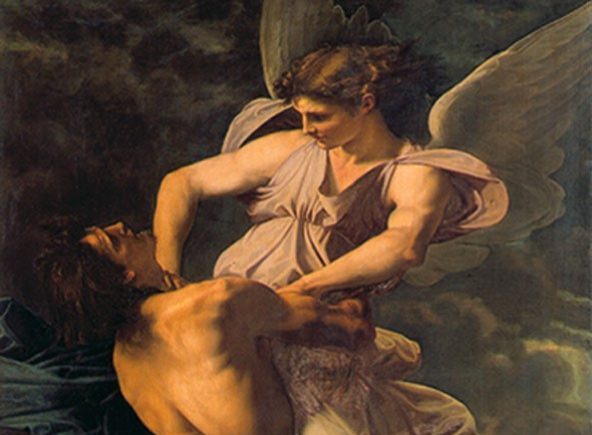
At the ford of the River Jabbok, on the darkest night of his life, Jacob remains alone. He has sent across his family, his servants, and his flocks. It is the moment of truth, the moment when one can no longer hide behind excuses, deceit, or protection. And it is precisely then that “a man wrestled with him until the break of dawn” (Gen 32:25).
Who is this adversary emerging from the darkness? Scripture preserves the mystery. It could be everything Jacob had tried to escape for twenty years: remorse, fear, the face of the brother he betrayed. Or perhaps it is something greater: life itself coming to call him to account, destiny catching up with him, an angel, God who becomes struggle.
In this mysterious adversary we recognise all those “limit situations” that sooner or later knock at the door of every life: when illness erupts and changes every plan; when an economic crisis sweeps away the certainties built through years of work; when bereavement tears apart the fabric of our relationships; when an important relationship breaks and we find ourselves having to learn again how to live in solitude.
The adversary has something enigmatic about him: he does not come to destroy, yet neither does he come to console. He comes to transform. He is the most demanding master we could encounter, the one who refuses our masks and forces us to face who we truly are.
The struggle lasts the whole night. There is neither victory nor defeat. No easy solution. There is only the long time of endurance, of passage, of transformation that takes place drop by drop, like water that wears away the stone.
3.2 The New Name: When Identity is Transfigured
There is something deeply paradoxical in the fact that Jacob receives a new name precisely when he is about to return home. After years of flight, deception, and life elsewhere, at the moment when he must face the brother he betrayed, he finds himself in the darkest night wrestling with a mysterious being. It is a hand-to-hand struggle, relentless, lasting until dawn.
And when everything seems finished—when Jacob’s hip has been dislocated and he can no longer flee—his adversary gives him a new name:
“Israel, because you have struggled with God and with men and have prevailed” (Gen 32:29).
It is as though, in order to rediscover the road home, he must first wrestle to exhaustion with the very mystery of life.
The new name is not a free gift. It is the recognition of a struggle endured, of a confrontation that Jacob did not avoid. The deceiver has become the wrestler, the one who has the courage to measure himself against what he does not understand, what he cannot control, what frightens him.
It is precisely this radical transformation—so intimate that it touches his very identity, so demanding that it leaves a permanent scar—that enables him to cross the ford and return to the land of his fathers.
He is no longer the deceiver who fled, yet neither has he become someone else. He is Jacob-who-has-become-Israel through the struggle, and only thus can he face Esau; only thus can he receive the embrace he did not deserve; only thus can he welcome the tears he had caused.
Jacob’s story becomes the mirror of every human life, because every existence knows changes so deep that they seem to take away our identity and yet—mysteriously—bring us home again.
But such changes are not gentle, gradual, or painless. They are struggles. They are those nocturnal confrontations with reality that we would rather never face, those battles that leave us marked for ever.
The illness that forces us to wrestle with the fragility of the body; the loss that obliges us to confront the pain of love; the crisis that places us face to face with the fragility of our certainties; age itself that compels us to wrestle with the end of our dreams.
Moments when we wake in the night no longer knowing who we are, moments when we must wrestle to exhaustion with what frightens us most.
Yet there is also another form of limit: the one we impose upon ourselves out of fear of leaving our securities. The short film The Butterfly Circus by Joshua Weigel (2009) offers a striking example. Will, a man without arms or legs, has resigned himself to living as a sideshow curiosity, convinced of his own uselessness.
When Mr Mendez, the circus director, seems almost to mock him by reminding him how different he is, Will reacts:
“Why do you say these things to me?”
The answer is illuminating:
“Because you believe it!”
Often the most insurmountable limit lies hidden within our own convictions.
Mendez challenges him:
“If only you could see the beauty that can arise from the ashes… The greater the struggle, the more glorious the triumph.”
Will must learn to fall and rise again by himself until he discovers that he can swim:
“Stop! Stop! Look! I can swim!”
In that moment of joyful astonishment, the curse becomes a blessing. He is no longer “the freak”, but “a brave soul”.
The limit is transfigured into a gift when we accept to change the way we look at ourselves.
It is precisely in these agonising passages that something essential comes to light. Like a diamond formed from coal under pressure, like a spring that bursts forth where everything seemed dry, our truest identity emerges not despite the struggles, but through them.
We do not erase what we once were; rather, we integrate it into a broader, wiser story, one more capable of embracing the complexity of life—just as Jacob does, who does not cease to be Jacob but becomes Israel: the name of a man, yet also of a people.
3.3 The Wound and the Dance
Beyond the change of name, the struggle leaves another indelible sign: Jacob will limp for the rest of his life. Yet this lameness is not a punishment but a seal—a bodily reminder of that transforming encounter that marked the passage from flight to blessing.
From that moment onwards, every step of the patriarch will carry the memory of that night, that struggle, that grace received.
There is a profound wisdom in this limping that speaks directly to the human condition. Lameness imposes a different rhythm: slower, more attentive. It is no longer possible to flee as Jacob had done for twenty years. One must pause, lean for support, sometimes ask for help.
Thus the wound becomes a teacher of authentic humanity, educating us in that vulnerability which opens the way to genuine encounter with others.
This is evident in people who have passed through great trials: they all carry some form of limp—visible or hidden, physical, psychological, or spiritual. Yet precisely that wound has made them more real, more compassionate, more attentive to the suffering of others.
“I have seen your face as one sees the face of God,” Jacob says to Esau (Gen 33:10).
After twenty years of separation, after all the harm done and suffered, the two brothers meet again. And instead of the vengeance that had been feared, there is an embrace, shared tears, forgiveness.
The most precious gift for those who have passed through the night of limitation is the ability to see beyond appearances, to recognise a glimmer where others see only shadows.
Lameness is thus transformed into a new dance. Not the dance of those who pretend that everything proceeds without difficulty, but the dance of those who have learned to move with grace within their own limits.
At sunrise, Jacob limps towards the future. Yet in that limp there is more strength than in a thousand confident steps. For it is the limp of one who has wrestled with the mystery and bears its marks; of one who has been wounded and blessed; of one who has discovered that limits are not the place where God stops, but where he chooses to meet us.
Like Jacob who becomes Israel, we too may discover that a new name awaits us beyond the night of struggle—a name that does not erase who we have been but gathers everything into a greater story. A name that only the passage through limitation can reveal.
