ON THE LIMIT
Pastoral Letter 2025
by
DOMENICO POMPILI
Bishop of Verona
Always dear to me was this lonely hill,
and this hedge, which from so great a part
of the furthest horizon hides the view.
But sitting and gazing, boundless
spaces beyond it, and superhuman
silences, and deepest stillness
I fashion in my mind; where, for a moment,
the heart is almost afraid. And as the wind
I hear rustle through these plants, I that
infinite silence to this voice
go comparing: and the eternal comes to mind,
and the dead seasons, and the present,
living, and its sound. Thus in this
immensity my thought is drowned:
and shipwreck is sweet to me in this sea.
Giacomo Leopardi
From the hills of Recanati, on a summer evening in 1819, a remarkable young man, Giacomo Leopardi, questioned himself about this mystery. How can an obstacle become an opening? How can what confines become infinite? How can a barrier open our gaze to transcendence? The poet suggests an answer, seated in recollection before a hedge. That hedge prevents him from seeing beyond, yet it is not a mortifying wall. It is a threshold: the exact point where the real opens on to the possible. Where the eye stops, the imagination takes flight towards “boundless spaces”.
Each of us has our own “hedges”: the dependencies that condition us, the fears that paralyse us, the wounds that define us, the failures that isolate us, the crises that restrict us, the illnesses that slow us down, the ageing that weakens us. But if Leopardi is right, these very obstacles can be transformed from walls into doors, from barriers into thresholds.
The fact that the limit can be crossed does not entail fleeing the present. “Always dear,” says the poet, are precisely “this lonely hill” and “this hedge”: these, in their singular concreteness, in their unrepeatable uniqueness. Only, in that crossing-over, something else appears. The suspended world suddenly grows intense. Skirting the abyss of the infinite, the heart wavers; but when the wind makes itself felt among the branches’ leaves, a deeper contemplation is born. That murmur of nature carries with it eternity itself. It is then that the miracle of the “sweet shipwreck” occurs: not the frightening loss of self, but a trusting surrender to something greater.
Leopardi’s “sweet shipwreck” is a powerful antidote to the culture of performance. In a society that measures everything in terms of efficiency and results, learning the art of shipwreck becomes a skill for spiritual survival. Not giving up on goals, but discovering that failure can be a form of life that is deeper and freer from the inessential.
In a culture that promises everything at once and demands efficiency at any cost, such a discourse is far from easy. That is why today living with the limit, and not censoring it, is an almost revolutionary work. Perhaps our problem is not that we have too many limits, but that we no longer know how to recognise the ones that do us good. We have confused freedom with a totally open field, forgetting what art also teaches: a painter needs a canvas, a composer needs musical scales, a poet needs the rhythm of words, a dancer needs choreography. Leopardi’s insight, then, carries profound implications at the existential level.
This restlessness can serve as our compass. Let us move towards a sweet shipwreck in immensity, in search of a harmonious relationship – or at least a non-dominating one – with all things.
The limit, our finitude, is not a condemnation but a vocation: only by accepting that we are limited can we open ourselves to the infinity that dwells within us and that is fully compatible with human flesh. This truth finds a particular expression in the story of a man who had to learn to live within his limits through a long and tortuous path: the patriarch Jacob.
Part One
THE EXPERIENCE OF LIMIT
1. The limit as origin
1.1 The story of Jacob: the brother as the first limit
The story of the patriarch Jacob unfolds without interruption between chapter 25 and chapter 50 of Genesis. Like any of us, Jacob comes into the world in extreme vulnerability; he is formed within the body of a mother on whom he depends to survive; he did not choose the place, the time, the context of his being in the world. But there is more: he is formed in the womb together with his twin brother, Esau.
Rebecca’s pregnancy appears complicated: within her, the two children jostle one another continually. It is as though, already in her womb, a battle were being fought for space, for primacy, for the very existence of two peoples who will be eternal enemies. Why all this? Rebecca goes to ask God directly and receives, in return, a prophecy that immediately shifts her from what is happening within her to the history of her people. Two children formed at the same time in the same mother’s womb will become Israel and Edom, two nations with difficult relations, who will scatter and have an unpredictable destiny: the elder will serve the younger. This God, as we know, is not afraid to overturn what seems obvious and often binds himself to the weaker figures in order to open a new history.
Esau is not simply “the other”. He is the twin, the one who shares the same vital space, the same time of formation, the same origin. He is the first otherness Jacob encounters, even before coming to light. Esau represents everything Jacob is not: the first-born, the natural heir, the one who enjoys his father’s preference, the one destined for a role of power in the community. But he also represents everything Jacob could become, if only he accepted to inhabit relationship rather than suffer it: a man capable of fraternity. A brother – or a sister – is the mirror in which our inadequacy is reflected, but also the promise of a possible wholeness through encounter. When we refuse this fertile limit and reduce it to a sterile barrier, it becomes difficult to flourish as free subjects.
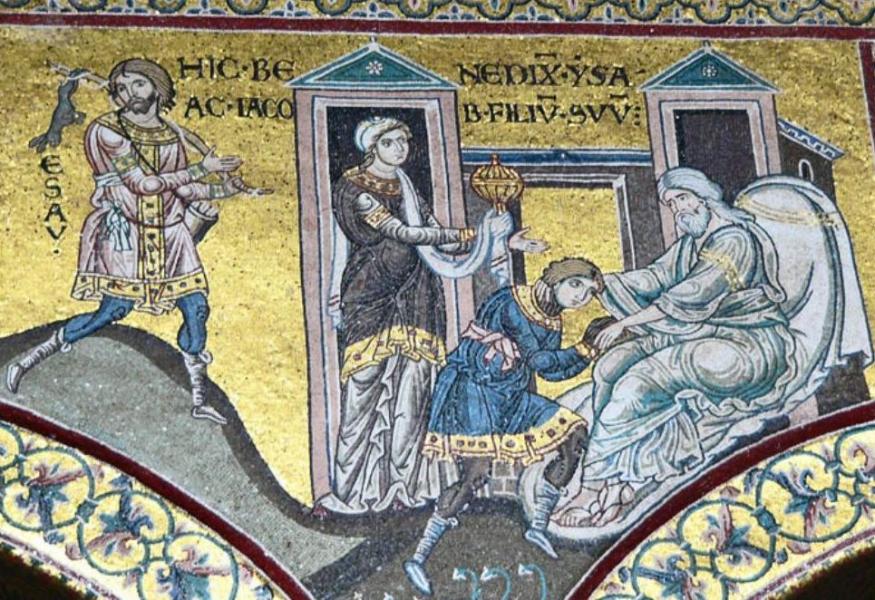
At the moment of birth, Jacob comes into the world holding Esau’s heel, as if he wanted to control him, as if he were already seized by the desire to enjoy a blessing that does not belong to him as the second-born. With his mother’s help and taking advantage of his father’s blindness, he fulfils his dream: he takes his brother’s place and receives the blessing reserved for the first-born. In this way he misses his first appointment with fraternity. Instead of recognising in Esau a companion on a shared journey, he perceives him as a competitor, an obstacle to his right to exist fully. The brother becomes the first limit-as-barrier of his life: not a presence that completes, but a boundary that prevents a serene image of himself.
1.2 The limit as a universal alibi, and the cost of deceit
Does this not sound familiar? How often do we too see in the other – brother, sister, colleague, relative, friend, manager, lover – a rival to compete with, a happy life to envy, an impediment to becoming what we would like to be? It is so easy to turn those who are beside us from gift into problem, from enriching presence into an obstacle that restricts and obstructs our desire.
It is at this point that the limit becomes something even more dangerous: it becomes an alibi. Jacob cannot bear the idea of being second, of having to wait, of not having immediate access to everything he desires. The presence of the older brother becomes the perfect justification for every strategy of domination: “I could do nothing else but use deceit,” he seems to say. Or: “Cunning was the only possible route. Everyone does this when it comes to surviving.”
The alibi of the limit turns necessity into virtue, competition into wisdom, deceit into legitimate self-defence. If the world is divided into winners and losers, if blessings are scarce and must be seized before others do, then every means becomes permissible. It is the perverse logic of a web of conflicts and suspicions that reduces existence to a zero-sum game in which the good of the other automatically coincides with my harm. This logic of the alibi runs through the centuries and continues to seduce our contemporary consciences. How often do we too turn our limits into justifications for behaviours that, deep down, we know to be inadequate and unjust? “That’s just how I am,” “I didn’t have the chance,” “Society forces me,” “If I don’t do it, someone else will”: these are the modern variations of Jacob’s deceit. The limit becomes the perfect excuse not to take responsibility for one’s own growth, and not to recognise in the other a possible ally on the path of becoming more fully human. Jacob chooses deceit as an escape route, convinced he can resolve everything through cleverness.
1.3 Exile
Reality, however, proves far more complex. The blessing obtained wrongly turns into a curse. Esau begins to plan his revenge, and Jacob, in danger of death, must flee. On his mother’s advice, he takes refuge in Haran with his uncle Laban. He will live for twenty years as an exile, paralysed by fear and guilt, with a blessing that has become useless, valid only as a reminder of the wrong he has done and its consequences. He will never see his mother again. The deceit that was meant to guarantee him a future has made him lose what he held most dear: home, family, peace.
Jacob’s exile in Haran represents the moment when time itself becomes an insurmountable limit. It is no longer the fertile time of growth or planning, but the suspended time of waiting without hope. It is no longer time to nourish roots in order to open tomorrow, but a sterile present, crushed between fear and regret. In exile, Jacob experiences the precariousness of one who no longer has a place in the world. He lacks everything: transparent bonds, the land of his fathers, the strength of a serene blessing, his mother’s presence, the certainty of an identity. He has become a man with no fixed abode, within and without himself. He is the wanderer who drags behind him the weight of choices that will for ever prevent a return to innocence.
For one reason or another, we too know what it feels like when the limit becomes hardness. If we have experienced illnesses that interrupt our plans, bereavements that drain the days of flavour, crises that dissolve every trust, or depression that turns every horizon grey, we know what it means to feel suspended between a past that cannot be repaired and a future that cannot find hospitality in the dreams that point the way. Faced with death, we feel particularly powerless, and that is why our culture removes it in every possible way. Death is the end of our time, our relationships, our possibilities. When it strikes someone we love, it is for us the end of a world, the end of that world in which we were together. Death can become the wall against which our very will to live is shattered, our desire to be present and to resist pain, injustice, and meaninglessness.
In such difficult times, even prayer can become impossible: words and breath are lacking, and each day offers itself as a desert where nothing can grow. It is the time when even God seems distant, absent, indifferent to our cries for help and to our communal practices of comfort. In this spiritual desert, the poet Rainer Maria Rilke offers us a liberating perspective:
“Be patient towards all that is unresolved in your heart and… try to love the questions themselves, like locked rooms and like books written in a foreign language. Do not now seek the answers that cannot be given you because you would not be able to live with them. And the point is to live everything. Live the questions now. Perhaps you will then gradually, without noticing it, live along some distant day into the answer.” (poem published posthumously in Letters to a Young Poet, 1929)
It is an invitation not to flee the condition of one who is still on the way, who does not have all the answers, who must learn to live with the unfinished.
1.4 The primordial suspicion
There is an even subtler and more dangerous aspect to this experience of the limit as obstacle: the suspicion that is born in the heart. It is what happens to Adam and Eve when their desire meets God’s limit: “You may eat of every tree of the garden; but of the tree of the knowledge of good and evil you shall not eat” (Gen 2:16–17). The divine command, however, was not meant to weaken them, but to safeguard their very desire: the limit is the necessary condition for reaching far more than what is immediately within reach. A perverse word, slithering in subtly, instead excites human desire by arousing a real suspicion about God’s goodness. God, according to the serpent, gave a prohibition so as not to have to share power with his creatures: eating that fruit meant opening one’s eyes and becoming strong like one’s Creator.
The limit placed upon desire is therefore perceived as a wall that blocks becoming, whereas it was a form of guardianship over the journey. Thus all bonds are perverted. Suspicion of God spills into our relationships, making them unjust: it happens between woman and man, who accuse one another and fall into the logic of domination; it happens between brothers, where conflict makes room for murder; it happens with all creation, put at risk by our claim to absolute control. It is a story that happens and happens again endlessly even today.
Jesus will come to illuminate this scene of suspicion. God is what we see in him: a presence of solidarity, with words and gestures that heal, free, awaken, regenerate. In his finitude there is hospitality for all the creatures of the world. The limit experienced in the flesh – to which God himself allows himself to be led back – is not a strategy to tyrannise the world, but the compass that directs desire towards authentic freedom.
When suspicion prevails, there is no true freedom. One responds in a linear way, one allows oneself to be positioned always and only face to face, and every thought goes into the concern of how to defend oneself against evil and the enemy. No creativity, no momentum, no trust in good transformations and good company.
And yet, precisely in this empty and apparently sterile time, something unexpected can happen. It is what Jacob will discover: the limit can be transformed from wall into door, from ending into beginning, from curse into blessing.
