Baptism of the Lord (A)
Matthew 3:13-17
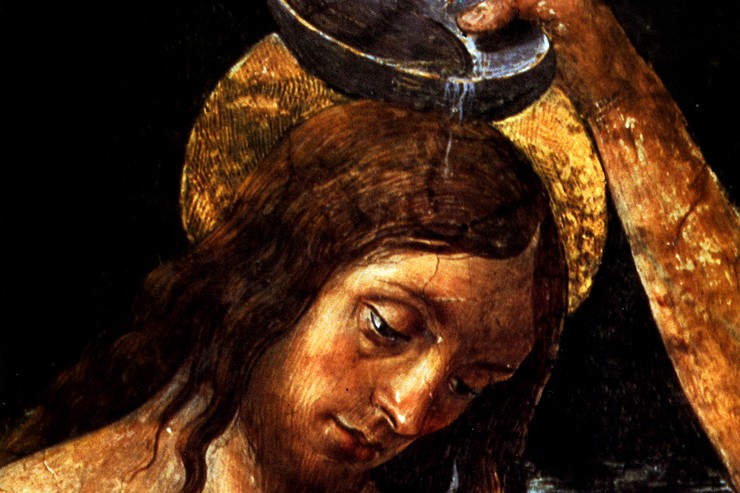
This Sunday’s Readings
First Reading
Isaiah 42:1-4,6-7
The servant of the Lord shall bring justice to all.
Responsorial Psalm
Psalm 29:1-2,3-4,9-10
The Lord will give peace to the people.
Second Reading
Acts of the Apostles 10:34-38
God anointed Jesus with the Holy Spirit.
Gospel Reading
Matthew 3:13-17
The Spirit of God comes upon Jesus as he is baptized by John.
Background on the Gospel Reading
The baptism of Jesus is attested to in the Gospels of Matthew, Mark, and Luke. The account that appears in Matthew is the only one to include the dialogue between Jesus and John, however. Another difference in Matthew’s presentation of this event is the announcement made by the voice from heaven, which says, “This is my beloved son . . .” In Mark and Luke, this voice addresses itself to Jesus: “You are my beloved son . . .”
The baptisms that John performs prefigure Christian Baptism. John baptizes for repentance from sin. In accepting this baptism, Jesus unites himself with all sinners even though he is sinless. In Matthew’s Gospel, John the Baptist distinguishes his practice of baptism from the Baptism that the Messiah brings: “I am baptizing you with water . . . He will baptize you with the holy Spirit and fire” (Matthew 3:11).
The baptism of Jesus is another manifestation of Christ, another epiphany. Christ’s baptism inaugurates his mission. In an analogous way, our Baptism inaugurates our mission as Christians.
This Sunday marks a transition from the Christmas season to Ordinary Time. In a way, today’s feast is the high point of the Christmas season. Before Jesus’ birth, angels announced to Mary and to Joseph who Jesus would be. At his birth, the shepherds and the Magi recognize Jesus as the Messiah. At his baptism, Jesus accepts that he is God’s son and inaugurates that mission.
PERSONAL EXPERIENCE
José Antonio Pagola
The meeting with John the Baptist was for Jesus an experience that turned his life around. After the baptism in the Jordan, Jesus doesn’t return again to his work in Nazareth, nor does he follow the Baptist’s movement. His life now centers on a single objective: to cry out to everyone the Good News of a God who wants to save humanity.
But what transforms Jesus’ path aren’t the words he hears from the lips of the Baptist nor the purifying rite of baptism. Jesus goes through something more profound. He feels himself inundated by the Spirit of the Father. He recognizes himself as the Son of God. His life will consist from then on in radiating and spreading that unfathomable love of a God who is Father.
This experience of Jesus also contains a meaning for us. Faith is a personal journey that each one of us must traverse. It’s very important, without doubt, that we have listened to our parents and teachers from childhood. It’s important that we heard priests and preachers. But in the end we always must ask ourselves one question: in whom do I believe? Do I believe in God or do I believe in those who speak to me about God?
We mustn’t forget that faith is always a personal experience that can’t be replaced by a blind obedience to what others tell us. From the outside they can direct us toward faith, but I myself am the one who must open myself to God confidently. That’s why faith never consists in just accepting a determined collection of formulas.
To be a believer doesn’t primarily depend on doctrinal content that gets put together in a catechism. All that is undoubtedly very important for configuring our Christian vision of existence. But before that and giving meaning to all that, is the interior dynamism that from within brings us to love, trust and hope always in the God revealed in Jesus Christ.
Nor is faith a capital that we receive in baptism and which we can later dispose of tranquilly. It’s not something acquired in ownership forever. To be a believer is to live permanently listening to God incarnate in Jesus, learning to live day by day more fully and more freely.
This faith isn’t made only of certitudes. Through our life, the believer lives all too often in obscurity. As was said by that great theologian that was Romano Guardini, «faith is having enough light to endure the obscurities». Faith is made up, above all, of trustworthiness. The true believer knows how to believe in the obscurity what she has seen in moments of light. At all times she keeps looking for that God who is beyond all our formulas, both clear and obscure. Henri de Lubac wrote that «the ideas that we make for ourselves about God are like the waves of the sea, over which the swimmer supports himself in order to overcome them». What’s decisive is faithfulness to the God who is shown to us in God’s Son Jesus Christ.
Missionaries by Baptism
Romeo Ballan, mccj
The Baptism of Jesus in the waters of the Jordan is one of the threeepiphanies or most significant manifestations that the Church’s liturgy sings on the solemnity of the Epiphany of the Lord, together with the manifestation to the Magi from the Orient and the miracle at the wedding of Cana. Also the baptism is a missionary presence and manifestation of Jesus. Liturgically speaking, we are celebrating today a feast that bridges the infancy of Jesus with his public life. But there is more: from the very beginning the Apostles’ missionary preaching of Christ’s life started “right from the time when John was baptising until the day when he was taken up from us” (Acts 1:22). The universal dimension of this epiphany emerges in particular from today’s readings.
This is confirmed by Peter (II Reading) in the house of the centurion Cornelius in Caesarea. After overcoming with some difficulty the initial resistance – his own and that of the community – Peter visits, welcomes Cornelius and defends his entrance into the Church by stating a fundamental truth forthemissionandthe theologyofsalvation, which is offered to all people even if not yet officially Christians: “God does not have favourites, but anybody of any nationality who fears God and does what is right is acceptable to him” (v. 34-35).
The event of the baptism of the Lord shines a great light on the identity and mission of Jesus (Gospel). In him the Holy Trinity is manifested: the Father proclaims him his Son, “the beloved” (v. 17), the Spirit descends upon Him (v. 16). The Father is the voice, the Son is the face, and the Spirit is the bond. The mission of Jesus is foreshadowedin the very firstsong ofthe Servantofthe Lord (I Reading), with a task that goes beyond the borders of Israel and reaches the nations (pagans) as light and salvation (v. 1.6). His is a mission that shuns the sensational and disruptive tones (v. 2); he will instead support, recover and enhance the weakest (v. 3.7); being always able to count on the strength of the One who has “taken him by the hand” (v. 6). It is anexciting program, able to fill the life of any person capable of loving and of generous ideals. Here we can recall the famous meditation on the Kingdom that St. Ignacio of Loyola placed at the beginning of the second week of his Spiritual exercises. In addition, it should be noted that the program of the Servant concerns the individuals as well as the community, or even then entire nation.
In the Gospel, Jesus, while making the mission of the Servant his own and feeling, at the same time, son and brother, getting in line with sinners, standing in a queue like everyone else, waits his turn to receive, he too, the innocent, the baptism of John the Baptists for the forgiveness of sins. Here, the total solidarity that Jesus felt with all the members of the human family, of which is a full member, is manifested. It is a solidarity to the point that “he openly calls them brothers” (Heb 2:11). Perceptive is the comment of St. Gregory Nazianzus when he describes the scene of baptism: “Jesus rises from the water and brings up with him the entire universe” (Office of the Readings). He is really the supportive and suffering Servant, the Lamb who carries upon himself the faults of all (see Is 53:4-5.12). Yet he is always the beloved Son, in whom the merciful Father is pleased!
The wonderful theological reflection of St. Gregory Nazianzus is also reflected in the geographical location where, presumably, the baptism of Jesus took place. The place could be Bet-Araba, at the same ford of the river by which Joshua made the people enter into the Promised Land (Gn 3:14ff). According to geologists, this would be the lowest point on earth: 400 meters below sea level. From the depth of that depression, Jesus emerges from of the river Jordan, rises up carrying on his shoulders the whole of humanity, the entire world. His prayer to the Father could have been that of the psalm that begins with the words De Profundis: “From the depths I call to you, o Lord… For it is with the Lord that mercy is to be found and a generous redemption” (Ps 130:1.7). The supportive proximity of such a Servant, Son and Brother, true God and true man, is the basis of the missionary commitment which for every Christian is based on and borne from Baptism, the sacrament that introduces us into the life of the Trinity and of the Church, to give life to the world.
He wanted to rise from the abyss
Fernando Armellini
Introduction
The biblical sites are often tied to a theological significance. The sea, the mountain, the desert, the Galilee of the Gentiles, Samaria, the Jordan river, the land beyond the lake of Genezareth are much more than simple geographical indications (often not entirely accurate).
Luke does not specify the place where the baptism of Jesus took place, but John alludes to it: “It happened in Bethany beyond the Jordan, where John was baptizing” (Jn 1:28). The tradition has correctly located the episode in Bethabara, the ford where the people of Israel, guided by Joshua, crossed the river and entered the Promised Land.
The gestures of Jesus present explicit references to the passage from slavery to freedom and to the beginning of a new exodus to the true Promised Land. Bethabara has also another recall, less obvious, but equally significant: the geologists ensure that this is the lowest point on earth (400m below sea level).
The decision to start from there the public life cannot be random. Jesus came from the heights of heaven to free people. He went down into a deeper abyss to show that he desires the salvation of every person. He wants to save even the most derelict, the one dragged by guilt and sin in an abyss no one imagines the possibility of getting out. God does not forget and does not abandon any of his children.
First reading: Isaiah 42:1-6,6-7
In the second part of the book of Isaiah, a mysterious character enters the scene. The author calls him: the “servant of the Lord.” His story is told in four passages (Is 42:1-7; 49:1-6; 50:4-9; 52:13–53:12). Who is he? Is he a concrete individual or a symbolic figure representing the whole people of Israel? Biblical scholars have not been able to give a definite answer and it’s not even so important to have it. What interests us is that in this Servant of the Lord the first Christians immediately recognized the image of Jesus (Acts 8:30-35). How did this identification happen? It all starts on that tragic Friday, April 7 in the year A.D. 30, the day on which Jesus was executed. The upset disciples wonder why the life of a good and just man has concluded in a failure. They seek a solution to the riddle in the scriptures. In the book of Isaiah, they find the story of this Servant who, after an unfair trial, is taken away by the very same people he wanted to liberate. They understand that God does not save by conceding victory, success, domination, a humiliation of enemies, but by the defeat, by the gift of life. What the prophet had said about the “servant of the Lord” was fully realized in Jesus of Nazareth. The reading today gives us the beginning of the story of this Servant.
His election is described first (v. 1). This word has not always a positive resonance in us: It refers to the preference towards someone and the exclusion of others. We do not like to hear others speak about “the chosen people or chosen lineage” because these expressions awaken memories of the tragic madness caused by the illusion of belonging to a “chosen race.”
The election of God has nothing to do with exclusivism, particularism, or separatism. When God chooses a person or a people, it is only to give a mission (always difficult, burdensome, unrewarding), to ask a favor in service of others. Sadly, it is easy, for one chosen by the Lord, to interpret the election according to human categories and to advance rights to honors and privileges. The reading speaks of a character that, from the outset, is identified not as a gentleman, but as a “servant,” in charge of completing a challenging job. Who will give him the strength?
The human is “flesh,” that is, beset with weakness. When the Lord asks someone to perform a task, he also gives him or her the ability to fulfill it. To his “servant,” the Lord communicates his Spirit, his irresistible force, as support.
It immediately also mentions the mission entrusted to this “chosen servant.” He is destined to bring justice to the nations (v. 1), to let “justice” triumph in the world. This is the “justice of God” which consists of his benevolence, his salvation.
In the following verses (vv. 2-5), how the Servant will fulfill his mission is described. He will behave in an unexpected way. He shall not impose himself by force, with the legal pressure, with threats of sanctions against those who oppose his provisions. He will not shout, raise his voice like the kings when they proclaim their programs or boast about their businesses in the squares. He will not be intolerant and intransigent with the weak. He will not convict anyone. He will bring back one who did wrong instead of annihilating or destroying him. He will rebuild with patience and respect one who was ruined. For him, there will be no lost cases, irrecoverable situations.
He will also be tempted by discouragement in the face of so much hard work. However, he will be firm and decisive in carrying it forward and will not withdraw in the face of any obstacle.
Using images, the last part of the reading (vv. 6-7) develops the mission of the Servant. He will be light to the nations, will open the eyes of the blind, and will free the captives and the slaves who walk in darkness.
An anonymous author composed the story about the Servant of the Lord. Then he placed it in the book of Isaiah about 500 years before the birth of Jesus. We do not know whom the prophet actually refers to. What is sure is the fact that Jesus fulfilled all that was written in the book of Isaiah. He was the faithful servant of God. Almost all the verses of this reading, in fact, are given and applied to Jesus in the gospels (cf. Mt 3:17; 12:18-21; 17:5).
Second reading: Acts 10:34-38
The reading shows a part of the speech given by Peter in the house of Cornelius in Caesarea. In the early church, a much-debated issue divided the community. Could baptism be granted to pagans? Peter, at first, was quite reluctant, influenced as he was by the deep-rooted prejudice in Israel, that other people were unclean.
One day, while he was praying in Jaffa, the Lord revealed to him that no creature of God is impure and profane. In front of God, all are equally pure and privileged. All are equally called to salvation because he is the Lord of all (Rom 10:12).
The expression “God shows no partiality”—employed in this passage—is repeated many times in the New Testament (Rom 2:11; Gal 2:6; 1 Pet 1:17) to denounce the temptation of dangerously projecting in God our discriminations and to warn against the illusion that the Lord treats people differently, according to the religious denomination they belong to. Peter’s speech goes on to present a brief summary of the life of Jesus (vv. 37-38). The expression “he went about doing good and healing all who were under the devil’s power” sums up his mission. He is committed against very form of evil, against everything that obstructs human life.
The work to be performed was difficult and challenging but Jesus was able to finish it because He was filled with the Spirit of the Lord and because God was with him.
The time and the place when salvation started to manifest are also noted. It started in Galilee when John began to baptize along the Jordan.
With these words, Peter defines the new period of Jesus’ life, which the faith of the believers must refer to: the public life “from the baptism of John until the day Jesus was taken away from us to heaven” (Acts 1:22).
Gospel: Matthew 3:13-17
At the time of Jesus many religious sects practiced baptism. The rite had many meanings, but one was especially important: the immersion indicated the death of an individual (his past life was wiped-out, almost swept away by the current) and with the emersion came the birth of a new person to whom, naturally, a new name was given.
John was doing this ceremony to welcome those who would be his disciples. He baptized whoever decided to change his life to prepare oneself for the coming of the Messiah, which was announced as imminent. The first condition for baptism was to recognize oneself a sinner. It is for this that the Pharisees and Sadducees, who thought themselves righteous and without sin, did not feel the need (Lk 7:30).
If that was the meaning of John’s baptism, the reason why Jesus received it is not well understood. He had no need to change his life and his actions could suggest the idea that John was superior to him. To clarify this difficulty, much felt among the early Christians, Matthew introduces in the episode the dialogue between the Baptist, who refused to baptize one superior to him, and Jesus who insists that “all righteousness” be fulfilled. John must adapt himself and collaborate in the implementation of the plan of salvation of God (and this is “justice”), even if it presents mysterious and incomprehensible aspects to him (vv. 14-15). Even a spiritually mature person like John the Baptist meets difficulties to accept the Messiah of God. He remains surprised when he sees the holy one, the righteous one close to those sinners who, according to human logic, should be annihilated.
It is the new and puzzling justice of God. It is the righteousness of one who desires “that all people should be saved” (1Tim 2:4). The author of the Letter to the Hebrews will call this consoling truth in poignant terms: Christ is not ashamed to call “brothers” the sinful men (Heb 2:11).
It is an invitation addressed to today’s Christian communities to change those attitudes which show arrogance, conceit, and self-satisfaction for one’s own righteousness; and correct the language that may lead to the idea of judging, condemning, and marginalizing those who make mistakes or are doing it.
After this original introduction, Matthew, like Mark and Luke, describes the next scene with three images: the opening of the heavens, the dove, and the voice from heaven. He is not recalling remarkable facts he personally witnessed. He uses images well known to his readers, and the meaning is not difficult for us to grasp.
Let’s start with “the heavens opened.”
This is not a matter of meteorological information. It is not that suddenly a luminous ray from the sun was filtered through the thick and dark clouds. If this were the case, Matthew would have reported to us a trivial detail that has of no interest to our faith. He is explicitly alluding to a text of the Old Testament, a passage from the prophet Isaiah that needs to be recalled.
In the last centuries before Christ, the people of Israel had the feeling that heaven was closed. Outraged by the sins and unfaithfulness of his people, God had withdrawn into his world. He had stopped sending prophets and seemed to have broken all dialogue with people. The pious Israelites were wondering: when will this distressing silence end? Will the Lord not speak to us again? Will He no longer show his serene face, as in ancient times? They called upon him thus: “O Lord, you are our Father. We are the clay and you are our potter; we are the work of your hands. Do not let your anger go too far or think of our sins forever; do not remember our iniquity forever. Oh, that you would rend the heavens and come down!” (Is 64:7-8; 63:19).
Affirming that with the beginning of the public life of Jesus, the heavens are torn, Matthew gives the readers a surprising piece of news. God has heard the prayer of his people. He has opened heaven and will never close it again. The enmity between heaven and earth is forever ended. The door of the house of the Father will remain eternally wide open to welcome every child who wishes to enter. No one will be excluded.
The second image is that of “the dove.”
Matthew does not say that a dove descended from heaven. This would also be a trivial and superfluous detail. He wrote that Jesus saw the Spirit of God descending from heaven “like a dove and rest upon him.”
The Baptist certainly remembers that from heaven it is not just the manna that came down, but also the destructive water of the flood (Gen 7:12), and the fire and brimstone that incinerated Sodom and Gomorrah (Gen 19:24). Probably one expects the coming of the Spirit as a consuming fire for the wicked. The Spirit, like a dove, rests upon Jesus: It is all tenderness, affection, and kindness. Moved by the Spirit, Jesus will approach sinners always with the sweetness and the amiability of the dove.
The dove was also the symbol of attachment to its nest. If the evangelist has this recall in mind, then he wants to tell us that the Spirit seeks Jesus as a dove seeks its nest. Jesus is the temple where the Spirit finds its permanent home.
The third image: “the voice from heaven.”
It was an expression often used by the rabbis when they wanted to attribute a statement to God. In our story, it is intended to define, in the name of God, the identity of Jesus.
The passage was composed after the events of Easter to respond to the questions raised among the disciples of the ignominious death of the Master. In their eyes, he seemed to be a loser, an outcast and abandoned by the Lord. His enemies, guardians, and guarantors of the purity of the faith of Israel had condemned him as a blasphemer. The disturbing question was: has God perhaps shared this judgment?
To the Christians of his community, Matthew reports the judgment of the Lord with a phrase that alludes to three Old Testament texts.
– This is my son. The reference is to Psalm 2:7. In the Semitic culture, the term ‘son’ did not indicate only the biological generation. It also implied the affirmation of a similarity. Presenting Jesus as his son, God guarantees to recognize him, in his words, in his works and especially in his supreme act of love: the gift of life. Who wants to know the Father has only to contemplate this child.
– The beloved. This refers to the trial Abraham was subjected to. He was asked to offer his only and well-beloved son, Isaac (Gen 22:2, 12, 16). By applying this title to Jesus, God invites us not to consider him a king or a prophet like the others. He, like Isaac, is the only, the beloved son.
– In whom I am well pleased. We have read this expression in the first verse of today’s reading (Is 42:1). God declares that Jesus is the servant of whom the prophet spoke. He is the one sent to establish the law and justice in the world. To fulfill this mission, he will offer his life.
The voice from heaven gives limelight to the judgment pronounced by people. It also denies the Messianic expectations of the people of Israel that could not think of a humiliated, beaten and executed messiah. In the house of the high priest, Peter swore of not knowing that man. He was basically telling the truth. He could not recognize in him the messiah. He did not correspond in any way to the expected savior. The way in which God has fulfilled his promises has been a surprise for everyone, including the Baptist.
Today’s passage, we find a new call to the parallelism Matthew made between Moses and Jesus. Moses received the Spirit of God when, along with all the people, came out of the waters of the Red Sea. That divine power enabled him to lead the Israelites through the wilderness to the Promised Land. Jesus also received the Spirit after getting out of the water, then with the people enslaved by evil, he undertook the path towards freedom.
