It could also be said that Luke, by presenting these stylised figures, wished to illustrate two forms of service in the Christian community: the “service at the tables” (diakonia) and the service of the Word (prophecy). Faced with both, the apostles must make a choice: “It is not right that we should neglect the Word of God in order to wait on tables” (Acts 6:2). The service of the Word would thus be superior to that of charity.

Three Gospel texts speak of Martha and Mary: Luke 10:38–42; John 11:1–46; and 12:1–8. We will focus mainly on Luke’s account.
According to the Fourth Gospel, the two sisters lived in Bethany, a village on the outskirts of Jerusalem. St John always mentions them together, along with their brother Lazarus. They seem to be a well-off family. They are friends of Jesus and welcome Him and His entourage (perhaps around thirty people?) when He comes to Jerusalem. There, Jesus can rest and “lay His head” (Matthew 8:20). Bethany is the “sanctuary” of friendship and hospitality.
Martha appears to be the elder and the mistress of the house. Her name probably means “lady” or “mistress of the house”. Among the Nabateans, the name is masculine, and in the rabbinic Talmud it can be either masculine or feminine. She is a dynamic, industrious woman.
Mary appears to be younger, more tender, and introverted. The etymology of her name is uncertain: “rebellious”, “beloved”, “exalted”…
According to Luke 10:38–42, Martha and Mary welcome Jesus into their home. While Martha is busy preparing food for the guests, Mary remains seated at Jesus’ feet, listening to Him. Irritated, Martha asks Jesus to tell her sister to help her. Jesus responds unexpectedly:
“Martha, Martha, you are worried and distracted by many things; there is need of only one thing. Mary has chosen the better part, which will not be taken away from her.”
This saying of Jesus has prompted countless interpretations—some biased or ideological. But it can help us reflect on our vocation as disciples of Jesus.
Submission or emancipation?
A REVOLUTIONARY VISION OF WOMANHOOD
Mary’s affectionate, devout, and silent attitude has often been idealised by a certain clerical and male-dominated tradition, advocating the submission of women to men.
Martha, on the other hand—a woman who dares to “speak up” and assert her own identity—has been seen as a symbol of female emancipation. In some medieval paintings, she is depicted as the female counterpart of St George or St Michael, with the peculiar detail that she does not slay the dragon but tames it, leading it on a leash like a household pet. It is a feminine way of overcoming evil—not by eliminating the adversary, but by rendering it harmless.
In truth, Mary’s figure is also revolutionary. To sit at someone’s feet meant to be their disciple. In Jesus’ time, study of the Torah was reserved for men. In Hebrew and Aramaic, the word “disciple” had no feminine form. So, by praising Mary’s behaviour, Jesus takes a bold stance, defying patriarchal norms. He even undermines, to some extent, the image of the “ideal woman” represented by Martha, who busies herself with household duties (see Proverbs 31:10ff).
Thus, both women represent forms of female empowerment: Martha, with her outgoing initiative, and Mary, with her silent introspection. They are models of an integrated humanity, where silence and speech, introversion and extroversion, live side by side.
Action or prayer?
MARRYING… BOTH SISTERS!
Tradition has seen Martha as the symbol of the active life, and Mary as the symbol of the spiritual or contemplative life—viewed as superior. Bodily service is inferior to spiritual service (St Basil). The active life ends with the present world, while the contemplative life continues in the world to come – says St Gregory the Great. But he adds that we must “marry” both, just as Jacob, though he preferred Rachel (more beautiful but barren), had to marry Leah first (less attractive but fertile).
At heart, the opposition between active and contemplative life is false, because one cannot exist without the other. They do not exclude but complement one another. They are two essential dimensions of the disciple’s vocation. Martha and Mary go hand in hand, as St John shows by always mentioning them together. Jesus loves them both (John 11:5). In fact, it is Martha who goes out to meet Jesus (while Mary stays at home) and who makes a moving profession of faith (John 11:20, 27). Martha and Mary are not opposites, but complementary. We are all called to embody both Martha and Mary—to serve and to listen to the Word.
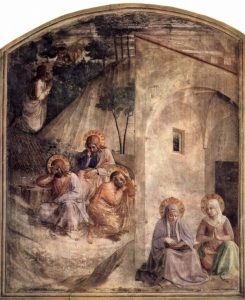
The sisters live in harmony. This is how the Dominican painter Fra Angelico portrays them in a fresco (in Florence). They both (spiritually) witness Jesus’ agony in the garden. While the three disciples sleep, they keep vigil, immersed in the mystery. Mary reads the Word, and Martha listens attentively and tenderly. The two “brides” dwell peacefully together.
Law or Gospel?
A CHURCH IN BRIDAL ROBES… AND AN APRON!
It could also be said that Luke, by presenting these stylised figures, wished to illustrate two forms of service in the Christian community: the “service at the tables” (diakonia) and the service of the Word (prophecy). Faced with both, the apostles must make a choice: “It is not right that we should neglect the Word of God in order to wait on tables” (Acts 6:2). The service of the Word would thus be superior to that of charity.
Others suggest that Martha and Mary represent two stages of discipleship. Martha, preoccupied with “doing many things”, symbolises the “first conversion” – purification through works. Mary, focused on “the one thing necessary”, embodies the “second conversion” – purification of the heart. In this reading, Martha represents the Old Testament (the Torah with its 613 commandments), and Mary the New (with the “Law of Love” that sums them up).
Ultimately, they represent two equally essential dimensions of the Bride (the Church), who identifies with her Bridegroom “who came to serve” (Mark 10:45). That is, the Christian community, resplendent in her bridal gown, “seated at the King’s right hand” (Psalm 45:9), yet also willing to set aside her robes, don an apron, and wash her children’s feet (John 13:4).
Doing or Being?
THE TWO-FOLD COMMANDMENT OF LOVE
The context of the Bethany episode is telling. On one side, it is preceded by the parable of the Good Samaritan, which ends with: “Go and DO likewise” (Luke 10:37). On the other, it is followed immediately by Jesus’ teaching on the Our Father and on prayer (Luke 11:1–10). It seems Luke wants to underline the unity between Doing (“becoming a neighbour” to others) and Listening (“drawing near” to God).
If the Good Samaritan is an icon of love of neighbour, Bethany is an icon of love for God. Martha “does”; Mary “loves”. The episode of the anointing at Bethany as told by St John confirms this reading. Jesus defends Mary against Judas, who appeals to charity for the poor in order to criticise her (John 12:8).
Conclusion?
CONVERSION AND DISCERNMENT
Martha and Mary always appear “at home”. The home and the village represent the time of normal life—the “domestic church”. This is the ordinary state of the Christian, the lay person. At the centre are the listening to the Word and service. It is a matter of making our homes into “Bethanys”—welcoming Christ our Friend. Hosting someone in one’s home changes our priorities and affects how we do things!
Both Martha and Mary love Jesus, but they differ in their priorities. Mary focuses entirely on Jesus and delights in His presence. Martha, anxious about the tasks, gives in to worry, impatience, and fatigue. And Jesus’ presence ends up becoming a burden to her. That is the issue.
Martha’s irritation prompts Jesus to call her gently (the repetition of the name “Martha, Martha” has a tender tone), to bring her back to what is essential: conversion to the “one thing necessary”, to the search for the Kingdom of God. All else will be given in addition (Luke 12:31).
Time is short, and the disciple cannot be distracted by “many things”. A multitude of activities does not necessarily mean true “service” as Jesus defines it. We must set priorities and assess what is urgent. In other words, we must discern. As Paul writes:
“This is my prayer: that your love may overflow more and more with knowledge and full insight, to help you determine what is best” (Philippians 1:9–10).
Fr Manuel João Pereira Correia, mccj
