3rd Sunday of Easter – Year C
First Reading
Acts of the Apostles 5:27-32,40b-41
The apostles are brought before the Sanhedrin and ordered to stop speaking in Jesus’ name.
Responsorial Psalm
Psalm 30:2,4,5-6,11-12,13
A song of praise to God who rescues us.
Second Reading
Revelation 5:11-14
John describes his vision of the praises that will be sung to the Lamb by every creature on heaven and earth.
Gospel Reading
John 21:1-19 (short form:John 21:1-14)
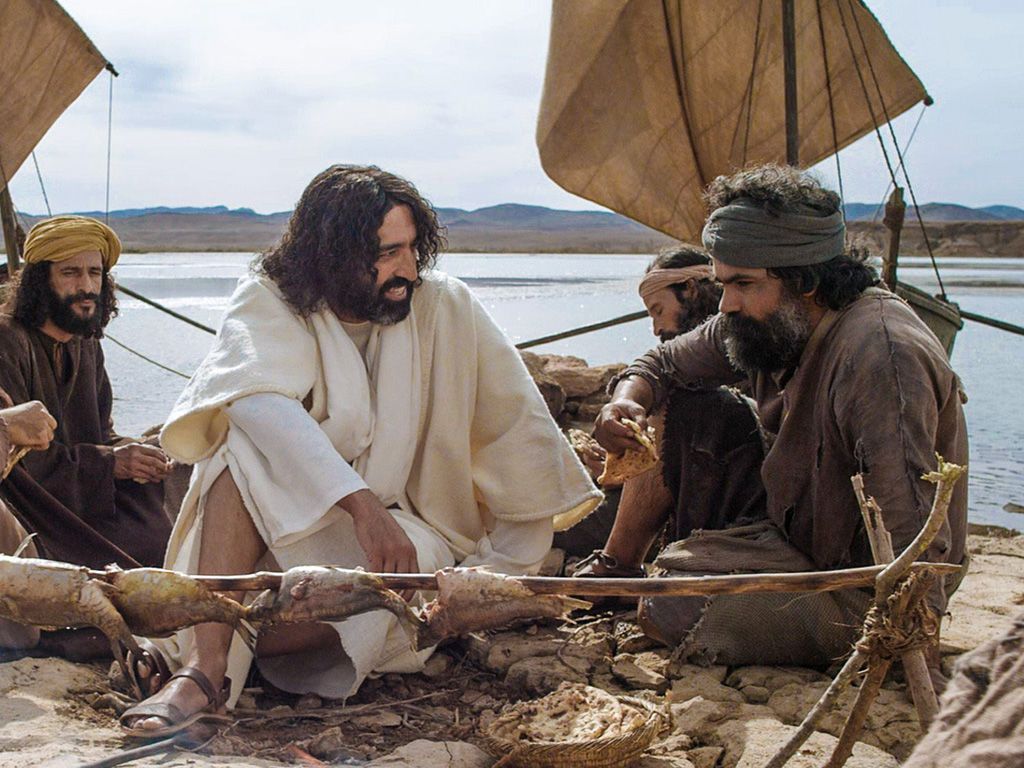
Jesus appears to the disciples for a third time after his Resurrection and shares a meal with them.
Background on the Gospel Reading
In Lectionary Cycle C, our Sunday Gospels are usually taken from the Gospel of Luke. The Gospels for the Easter Season, however, are taken from the Gospel of John. Today’s Gospel is one of the post-Resurrection appearances reported by John. Recall that in John’s Gospel, Jesus appears first to Mary of Magdala, second to all of the disciples except Thomas, and finally to Thomas and the disciples (which we heard last Sunday). After those appearances, John’s Gospel seems to conclude with a reference to other signs that Jesus gave after his Resurrection, which have not been recorded.
Because it follows this apparent conclusion, most scholars believe today’s Gospel passage (and all of John 21) to have been an addition to John’s original text. Because there are significant differences between this report and the other appearances described in John’s Gospel, it is quite likely that this story is from a different source. There are details in the story that recall Jesus’ call to Simon Peter and the other fishermen as well as the miraculous catch of fish (found in the Gospel of Luke, with parallels in the other Synoptic Gospels). The end of the chapter, where Jesus asks Peter three times whether he loves him, most likely is meant to represent the reconciliation that occurred between the community represented by John’s Gospel with the larger Christian community represented by Peter. This Gospel reading is a rich and textured story that speaks of Jesus’ presence in the Eucharist and our commission to serve others as Jesus did.
Last week we heard that Jesus appeared to the gathered disciples in a locked room, probably in Jerusalem. In today’s Gospel, the disciples are no longer in Jerusalem; they are in Galilee, returning to their work of fishing. Simon Peter is still presented in the role of leader: when he announces that he is going fishing, the other disciples follow. They spend the night fishing but are unsuccessful.
Jesus calls to them from the shore, but just as when Jesus first appeared to Mary of Magdala, the disciples do not recognize him immediately. Still, they follow the stranger’s instructions and bring in a large haul of fish. It is at this point that one of the disciples (the “disciple whom Jesus loved”) realizes that Jesus is appearing to them. Upon hearing this news, Simon Peter leads the way again, jumping from the boat and swimming to shore. The other disciples follow in the boat, dragging the fish.
The disciples have brought to shore a tremendous catch of fish that Jesus has directed them to find. But once on the shore, they see that Jesus has already prepared fish and bread on a charcoal fire. Jesus directs the disciples to bring their catch of fish as well. Jesus is host at the meal that follows, feeding the disciples the bread and fish. In this detail we see allusions to the miracle of the multiplication of the loaves and the fishes told in John 6.
There are also allusions in the Gospel to our gathering for the celebration of the Mass. In the Eucharist, we too are fed by Jesus in the bread and wine that have become his very Body and Blood. We also find in this story insight about the Presentation of the Gifts at Mass. The gifts we bring to the altar, bread and wine, are made from gifts that God gave first to us: grain and grapes, the fruit of the earth. God has no need of anything further. Yet God accepts the offering we bring—bread and wine, “the work of human hands”—and transforms our offering into the gift of his very presence.
After the meal, Jesus directs himself to Simon Peter. The community of John’s Gospel probably looked down on Peter because of his denial of Jesus. This dialogue with Simon Peter is a reversal of Peter’s three denials. Peter is forgiven. Having been restored to friendship with Jesus, Simon Peter is sent on a mission. “Feed my lambs . . . Tend my sheep . . . Feed my sheep.” These commands indicate that Peter is to be as Jesus, even unto sacrificing for the flock. As Jesus has fed Peter in this meal and as Jesus feeds us in the Eucharist, so he also sends us to follow him, asking that we offer our lives in service and sacrifice.
From the encounter with the Risen Lord to Mission
Romeo Ballan, mccj
We take in a breath of fresh air, a sense of universality, of mission to the world. The third encounter of the Risen Lord with a group of his disciples (Gospel) does not take place in the Cenacle of Jerusalem, with closed doors, but in the open, on the shore of the lake of Galilee, on a springtime morning. The event of that after-Easter miraculous catch and the mission which Christ entrusts to Peter are told in a language that resembles a mystical experience, rich in symbolism and expressing deep affection. In this way it is possible to pick out the message as a whole: the weekday going back to fishing, the number of seven fishermen, the sea, the action of fishing, the fruitless night, the dawn, the Lord on the shore, the abundant catch, the fire for breakfast, the meal; and then the mission entrusted to Peter with its surprising test on love, the threefold handing over of the flock, the commitment to follow him till death…
The mystical symbolism enriches the event and confers on it a fuller and universal understanding. For instance, if the sea symbolises unfavourable enemy forces to man, to fish and to be made fisher of men (Mc 1:17) means to become free from situations of death, and fishing becomes a symbol of apostolic mission. The success of such a mission, though perilous, can be seen in the “153 large fish” (v. 11). We may underline two of the many interpretations of this number: first of all the mathematical preciseness of an eyewitness; secondly the symbolism of “50×3+3”, where the number 50 is the symbol of the entirety of the people and 3 designates perfection. No fish escapes. The meal, to which the disciples are invited by Jesus, reminds us of the conclusion of salvation history, while in the threefold missionary handing over, Peter becomes the shepherd of the entire flock.
The various apparitions of the Risen Lord may be divided into two groups: apparitions of recognition, in which Jesus wishes above all to be acknowledged as ‘living’, and the apparitions of mission, in which Jesus gives clear orders of either immediate implementation (go to tell…) or of a far-ranging period (go to the peoples of all nations and make them my disciples…). In this way, the universal importance of the event of the ‘resurrection’ becomes gradually clear to the disciples: The Risen Lord (I Reading) is the “leader and saviour” of all peoples (Ac 5:31) and that this Good News has to be announced to all and everywhere, obeying God rather than people! (v. 29). The disciples begin straight away to bear witness to all the events (v. 32), with courage and “happy to have been considered worthy to suffer humiliation for the sake of Jesus” (v. 41). To Him, the Lamb that was sacrificed (II Reading), all creatures of heaven and earth are called to give honour and glory (Rev. 12-13).
The Risen Lord’s experience goes beyond the initial apparitions (Gospel): it extends to the ability of recognising the true and effective presence of the Lord in the ordinariness of day-to-day life. “Jesus is recognised through his gestures: one extraordinary (the miraculous catch) and the others very simple and familiar. He has prepared some bread and fish and lovingly invites them to eat. He takes the bread and gives it to them and does the same with the fish, as he had done so many times before. It seems that Jesus, instead of revealing all his glory, has desired to prepare the disciples to his mysterious presence, which after the resurrection is a universal presence: now Jesus is everywhere, in a divine manner, but also with his identical humanity… The Christians are invited to look for a divine glory that is not simply exterior; they are invited to recognise Jesus in their brothers and sisters… to recognise Jesus who is present in the poorest, in the most humble and needy: that’s where the Christians must recognise his glory, the hidden glory of their Lord and the power of his divine action that performs miracles through humble and simple means” (Albert Vanhoye).
Faith in the Risen Lord challenges us to experience the day-to-day life of risen people in the everyday concrete choices, made in faith and love. It is a full life that has a twofold kind of attitudes: gratefulness towards God and a missionary commitment towards others, sowing everywhere life, hope, mercy, reconciliation, joy… in various circumstances, areas, moments and way of expressing it.
Gospel reflection – John 21: 1-19
Fernando Armellini
If we consider this passage just as the record of a fact made by an eyewitness, there are surely some difficulties. The fact that, after so many manifestations of the Risen One, the disciples still did not recognize his surprises. It is already the third time they meet him (v. 14), and yet there is a strong feeling that they have never seen him before. Then, it is not clear why they marvel at the miraculous catch; Luke says that they had already witnessed a similar incident in the day when Jesus invited them to follow him to become fishers of men (Lk 5:1-11). Then again, why did Peter and the other apostles in Galilee resume their normal life as fishermen? After Easter, why were they not immediately and completely dedicated to the proclamation of the Gospel?
These difficulties are valuable because they make us suspicious about the literary genre of the text: we are not in front of a page of the news report, but in a piece of theology and the language used is biblical, not journalistic. It is therefore difficult to determine what really happened. The evangelist certainly wants to say that the apostles have had the experience of the Risen One, but primarily wants to give catechesis to the Christians of his community.
Last Sunday he told us two manifestations of the Lord: one which occurred on Easter Sunday, in the absence of Thomas, the other, eight days later, Thomas was present. This insistence on the “weekly” rhythm—we said—was the way John wanted the Christians to become aware that every time they gathered, on the Lord’s Day, to celebrate the Eucharist, the Risen Lord was in their midst.
Unlike the Gospel of last week, that of today does not put the appearance of Jesus on Sunday, but on a weekday, while the disciples are intent on their work. They have therefore returned to their everyday life. What do the disciples of Christ do during the week, what is the mission entrusted to them and how do they bring it to fruition? To these questions, the evangelist responds by telling an episode full of symbolism that now we will try to decode.
Let is start with the occupants of the boat. There are seven of them. This number represents perfection, completeness. Peter and the other six represent all the disciples who make up the entire Christian community. The symbolism could go even further to seize, in the identity of those disciples, an image of the various types of Christians who, despite their limitations and their faults, have still the right to citizenship in the Church: those who have difficulty to believe (Thomas), those a bit ‘fanatic’ (the two sons of Zebedee, who wanted to call down fire of heaven against the opponents; Lk 9:54), those who denied the Master (Peter), those tied to the traditions of the past, but honest and open to the signs of the times (Nathaniel), and also the anonymous Christians who are not known by anyone (the two unnamed disciples).
The sea, we have often noted, was, among the Israelites, the symbol of all the forces hostile to humanity.
If being under water means being at the mercy of evil, to fish, then, means to pull out of this condition of “non-life,” to free from the evil forces that keep people in death situations. Think of all the slavery that keep us from living with joy, from smiling: the greed of money, grudges, unruly passions, drugs, pornography, anxiety, haste, remorse, fear … .
Now it is clear what Jesus meant when he told his disciples: “Follow me, and I will make you fish for people” (Mark 1:17). In fact, here they are at work. Peter is back to do his job, his is material fishing, but—in the theological language of the evangelist—it indicates the apostolic mission of the Church committed to the liberation of people. In the Gospel of Matthew, “the kingdom of heaven is likened to a net cast into the sea, which collects fish of every kind, and when full it is dragged to shore” (Mt 13:47-48).
The night with darkness that accompanies it has also a negative meaning. “Those who walk at night stumble” (Jn 11:10), “the one who follows me will not walk in darkness” (Jn 8:12)—Jesus said. During the night no one can act or orient oneself (Jn 9:4). Without light, the “fishing” of the disciples cannot get any results.
Not only light is lacking, but also Jesus, indeed—according to the symbolism of the evangelist John—there is no light because there is no Jesus “the light of the world” (Jn 8:12). Peter and others are committed to the utmost in the mission that has been entrusted to them but do not conclude anything. They could guess the reason for their failure if they remembered the Master’s words: “Apart from me you can do nothing” (Jn 15:5).
They are alone, maybe they also feel abandoned in the midst of dangers and difficulties. They think they have to carry out their mission of “fishers of men” relying solely on their ability and their strength. They do not see Jesus; they do not perceive his presence because they look tarnished by the lack of faith. They cannot even recall his reassuring words: “I will not leave you, I am coming to you … . The world will see me no more but you will see me” (Jn 14:18-19).
The Lord is not in the boat—it is true—he is on the shore; he has already reached the mainland, that is, the final condition of the resurrected. Towards this land, the disciples tend to and will reach.
At last the dawn breaks (v.4) and with the new day even the light comes, the real light “that enlightens every person” (Jn 1:9), that which “comes from on high as a rising sun” (Lk 1:78). It is Jesus. He can be seen and recognized only with the eyes of faith because he is the Risen Lord. His voice is sharp and perceptible; his word comes from the shore and guides the activities of the disciples. As soon as these trust in his words, the miracle happens: against all human logic, against all reasonable expectation they get an amazing result.
John wants the Christians of his community to come to understand that Jesus, while being on the “shore,” that is, in the glory of the Father, is always beside them every day and continues to resonate his voice, calling, talking, and indicating what they should do.
The result of the mission of the Church is shown by the extraordinary amount of fish caught: 153. This number has a symbolic meaning. It follows from 50 x 3 + 3. To the Israelites the number fifty indicated all the people; the number 3 represents perfection and fullness. Not even a fish escapes!
The sense of this curious detail is as follows: the Christian community will accomplish with great success her mission of salvation. All the people, all humanity will be freed from the bonds of death that hold her captive, prisoner and bring her to ruin, as the rushing waters of the sea drag to the bottom even the most skilled swimmers. The disciples will succeed in this huge undertaking—today’s Gospel ensures—on condition that they always allow themselves to be guided by the voice of the Risen One.
Peter pulls the net with fish to shore. Jesus had said: “When I am lifted up from the earth, I will draw all to myself” (Jn 12:32). And now, he realizes, through his disciples, the promise. No one will escape the work of salvation carried out by his community. The net does not break, despite the large amount of fish. This seemingly trivial detail contains a significant message: Peter manages to hold firmly and fully the unity of believers despite their numbers and the consequent diversity of culture, of ideas, of language.
The banquet which closes the story of the miraculous catch of fish is the symbol of the conclusion of salvation history. Jesus expects his disciples on land, in heaven. He has fish (v. 9): it is the product of the work he has accomplished in this world. We remember for example the good thief that he brought with him to heaven (Lk 23:43).
Like the seven disciples at the Sea of Galilee, so also the entire Christian community is asked to present the fish, the fruit of the apostolic work. Bread instead is always offered for free by Jesus; it is not carried by people. It is the Eucharist! It is the bread that the Risen One breaks and wants all brothers and sisters to share until the day in which the sacramental sign will be made full by final and definitive union with him and with the Father.
The last part of the passage (vv.15-19) describes the mission of Peter. Throughout the story, this apostle has occupied a prominent position. It was he who took the initiative to go fishing. Then, despite having recognized the Lord after the “disciple whom Jesus loved,” he was still the one to take hold of the net full of large fish and, without breaking it, to drag it ashore.
The symbolic significance of these details is undeniable: the primacy within the Christian community—so to speak—of the “sensitivity” is up to the unnamed disciple, but that of presiding the apostolic work and the unity of the Church is undoubtedly Peter’s. Although Peter systematically arrives “late” and often earns the reproaches of Jesus, he remains the reference point of church life. He is asked to shepherd the Lord’s flock.
The image of the shepherd arouses not only positive resonances; being compared to the lambs, perhaps unable to think and to decide responsibly, he is not liked by everyone. But this is not the meaning of Jesus’ words. He has not conferred upon Peter the power to command, to give orders like a shepherd with sheep and, less still, to be a privileged caste and detached from the community of brothers and sisters. Peter—we remember him—was not immune to this temptation. He got to the point of rejecting the gesture of the Master who wanted to wash his feet because one day he hoped to be able to lord over the flock.
Asking him to look after the sheep, Jesus demands from him a complete conversion, a radical change in his way of thinking and acting. He wants him to manifest a capacity to love unconditionally, superior to that of all others. To look after means to feed the brothers and sisters with the food of the Word of life.
It will not be easy for Peter to understand and accept this proposal. For a long time yet he will keep on clinging to his beliefs, his dreams. Only with the passing of years, after much hesitation, he will arrive to full conversion. In today’s Gospel, the end of his journey in following the Master is pre-announced. During the passion, he did not have the courage to be with Jesus. But one day—he was told—he will be placed in a position to give his life; he will experience coercion, imprisonment [“another will put a belt around you, and lead you where you do not wish to go” (v. 18)] and finally he will die on a cross [“you will stretch out your hands” (v. 18)].
Fernando Armellini
Italian missionary and biblical scholar
https://sundaycommentaries.wordpress.com
