2nd Sunday of Easter – Year C
John 20: 19-31
First Reading
Acts of the Apostles 5:12-16
Peter and the apostles perform many signs and wonders.
Responsorial Psalm
Psalm 118:2-4,13-15,22-24
A song of praise to the Lord.
Second Reading
Revelation 1:9-11a,12-13,17-19
John describes the instruction he received to write down his vision.
Gospel Reading
John 20:19-31
Thomas believes because he sees Jesus.
Background on the Gospel Reading
Today’s reading, from the Gospel of John, is proclaimed on the second Sunday of Easter in each of the three Sunday Lectionary cycles. This should alert us to the significance of the encounters with the resurrected Jesus described in this reading. This Gospel combines two scenes: Jesus’ appearance to his disciples after his Resurrection and Jesus’ dialogue with Thomas, the disciple who doubted.
Part of the mystery of Jesus? Resurrection is that he appeared to his disciples not as a spirit but in bodily form. We do not know exactly what this form was like. Earlier in John?s Gospel, when Mary of Magdala first encountered the risen Jesus, she did not recognize the figure standing before her until Jesus spoke her. In Luke?s Gospel, the disciples walking on the road to Emmaus did not recognize Jesus until he broke bread with them. We know from readings such as today’s that in his resurrected body, Jesus was no longer bound by space; he appeared to the disciples in spite of the locked door. And yet, on this resurrected body, the disciples could still observe the marks of his Crucifixion.
In today’s Gospel, Jesus greets his disciples with the gift of peace and the gift of the Holy Spirit. Jesus also commissions his disciples to continue the work that he has begun. As Jesus was sent by God, so too does Jesus send his disciples. This continuity with Jesus’ own mission is an essential element of the Church. Jesus grants the means to accomplish this mission when he gives his disciples the gift of the Holy Spirit. The Holy Spirit binds us together as a community of faith and strengthens us to bear witness to Jesus’ Resurrection.
Jesus’ words to his disciples also highlight the integral connection between the forgiveness of sins and the gift of the Holy Spirit. Forgiveness and reconciliation are gifts to us from Jesus. With the grace of the Holy Spirit, we can share these with others. This is another essential aspect of what it means to be Christ’s Church. The Church continues Jesus? ministry of forgiveness and reconciliation.
Thomas, the disciple who doubts, represents the reality of the Church that comes after this first community of disciples. All but the first disciples of Jesus must believe without seeing. Like Thomas, we may doubt the news that Jesus, who was crucified and buried, appeared to his disciples. It is part of our human nature to seek hard evidence that the Jesus who appeared to the disciples after his death is, indeed, the same Jesus who was crucified. Thomas is given the opportunity to be our representative who obtains this evidence. He gives witness to us that the Jesus who was raised is the same Jesus who had died. Through the gift of the Holy Spirit, we are among those who are blessed for we have not seen and yet have believed.
Gospel reflection
Pope Francis
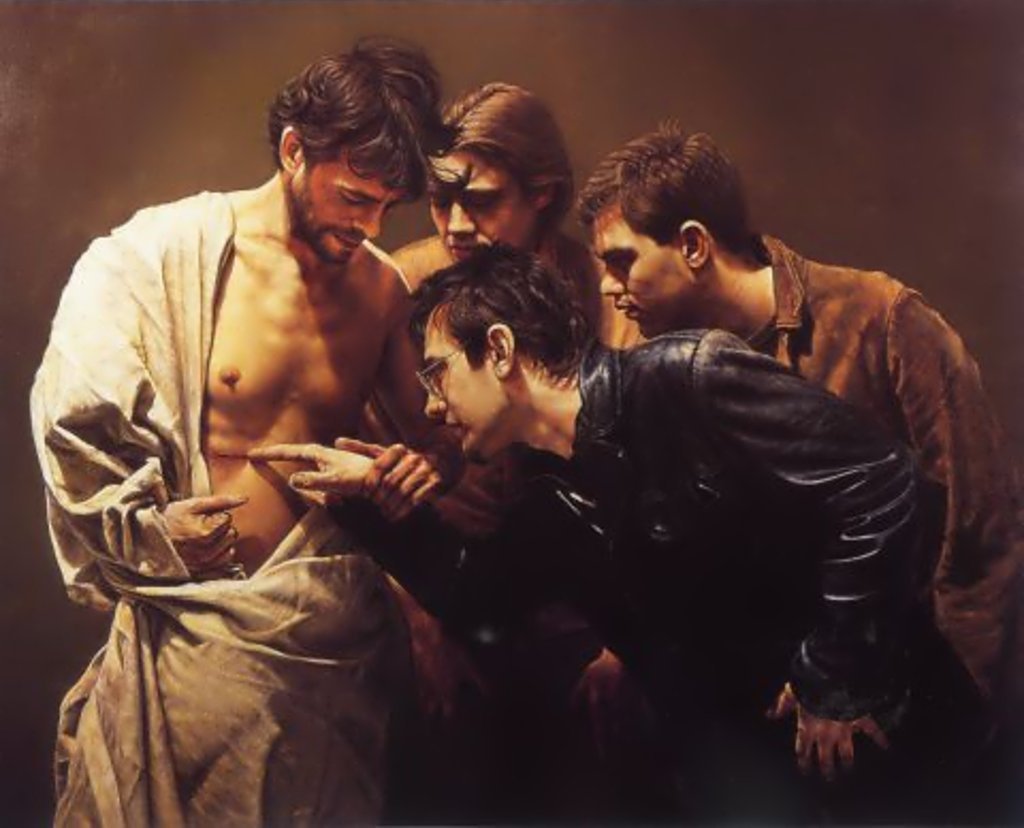
In today’s Gospel, we hear, over and over, the word “see”. The disciples rejoiced when they saw the Lord (Jn 20:20). They tell Thomas: “We have seen the Lord” (v. 25). But the Gospel does not describe how they saw him; it does not describe the risen Jesus. It simply mentions one detail: “He showed them his hands and his side” (v. 20). It is as if the Gospel wants to tell us that that is how the disciples recognized Jesus: through his wounds. The same thing happened to Thomas. He too wanted to see “the mark of the nails in his hands” (v. 25), and after seeing, he believed (v. 27).
Despite his lack of faith, we should be grateful to Thomas, because he was not content to hear from others that Jesus was alive, or merely to see him in the flesh. He wanted to see inside, to touch with his hand the Lord’s wounds, the signs of his love. The Gospel calls Thomas Didymus (v. 24), meaning the Twin, and in this he is truly our twin brother. Because for us too, it isn’t enough to know that God exists. A God who is risen but remains distant does not fill our lives; an aloof God does not attract us, however just and holy he may be. No, we too need to “see God”, to touch him with our hands and to know that he is risen, and risen for us.
How can we see him? Like the disciples: through his wounds. Gazing upon those wounds, the disciples understood the depth of his love. They understood that he had forgiven them, even though some had denied him and abandoned him. To enter into Jesus’ wounds is to contemplate the boundless love flowing from his heart. This is the way. It is to realize that his heart beats for me, for you, for each one of us. Dear brothers and sisters, we can consider ourselves Christians, call ourselves Christians and speak about the many beautiful values of faith, but, like the disciples, we need to see Jesus by touching his love. Only thus can we go to the heart of the faith and, like the disciples, find peace and joy (cf. vv. 19-20) beyond all doubt.
Thomas, after seeing the Lord’s wounds, cried out: “My Lord and my God!” (v. 28). I would like to reflect on the adjective that Thomas repeats: my. It is a possessive adjective. When we think about it, it might seem inappropriate to use it of God. How can God be mine? How can I make the Almighty mine? The truth is, by saying my, we do not profane God, but honour his mercy. Because God wished to “become ours”. As in a love story, we tell him: “You became man for me, you died and rose for me and thus you are not only God; you are my God, you are my life. In you I have found the love that I was looking for, and much more than I could ever have imagined”.
God takes no offence at being “ours”, because love demands confidence, mercy demands trust. At the very beginning of the Ten Commandments, God said: “I am the Lord your God” (Ex 20:2), and reaffirmed: “I, the Lord your God am a jealous God” (v. 5). Here we see how God presents himself as a jealous lover who calls himself your God. From the depths of Thomas’s heart comes the reply: “My Lord and my God!” As today we enter, through Christ’s wounds, into the mystery of God, we come to realize that mercy is not simply one of his qualities among others, but the very beating of his heart. Then, like Thomas, we no longer live as disciples, uncertain, devout but wavering. We too fall in love with the Lord! We must not be afraid of these words: to fall in lovewith the Lord.
How can we savour this love? How can we touch today with our hand the mercy of Jesus? Again, the Gospel offers a clue, when it stresses that the very evening of Easter (cf. v. 19), soon after rising from the dead, Jesus begins by granting the Spirit for the forgiveness of sins. To experience love, we need to begin there: to let ourselves be forgiven. To let ourselves be forgiven. I ask myself, and each one of you: do I allow myself to be forgiven? To experience that love, we need to begin there. Do I allow myself to be forgiven? “But, Father, going to confession may seem difficult…”. Before God we are tempted to do what the disciples did in the Gospel: to barricade ourselves behind closed doors. They did it out of fear, yet we too can be afraid, ashamed to open our hearts and confess our sins. May the Lord grant us the grace to understand shame, to see it not as a closed door, but as the first step towards an encounter. When we feel ashamed, we should be grateful: this means that we do not accept evil, and that is good. Shame is a secret invitation of the soul that needs the Lord to overcome evil. The tragedy is when we are no longer ashamed of anything. Let us not be afraid to experience shame! Let us pass from shame to forgiveness! Do not be afraid to be ashamed! Do not be afraid.
But there is still one door that remains closed before the Lord’s forgiveness, the door of resignation. Resignation is always a closed door. The disciples experienced it at Easter, when they recognized with disappointment how everything appeared to go back to what it had been before. They were still in Jerusalem, disheartened; the “Jesus chapter” of their lives seemed finished, and after having spent so much time with him, nothing had changed, they were resigned. We too might think: “I’ve been a Christian for all this time, but nothing has changed in me; I keep committing the same sins”. Then, in discouragement, we give up on mercy. But the Lord challenges us: “Don’t you believe that my mercy is greater than your misery? Are you a backslider? Then be a backslider in asking for mercy, and we will see who comes out on top”.
In any event, – and anyone who is familiar with the sacrament of Reconciliation knows this – it isn’t true that everything remains the way it was. Every time we are forgiven, we are reassured and encouraged, because each time we experience more love, and more embraced by the Father. And when we fall again, precisely because we are loved, we experience even greater sorrow – a beneficial sorrow that slowly detaches us from sin. Then we discover that the power of life is to receive God’s forgiveness and to go forward from forgiveness to forgiveness. This is how life goes: from shame to shame, from forgiveness to forgiveness. This is the Christian life.
After the shame and resignation, there is another closed door. Sometimes it is even ironclad: our sin, the same sin. When I commit a grave sin, if I, in all honesty, do not want to forgive myself, why should God forgive me? This door, however, is only closed on one side, our own; but for God, no door is ever completely closed. As the Gospel tells us, he loves to enter precisely, as we heard, “through closed doors”, when every entrance seems barred. There God works his wonders. He never chooses to abandon us; we are the ones who keep him out. But when we make our confession, something unheard-of happens: we discover that the very sin that kept us apart from the Lord becomes the place where we encounter him. There the God who is wounded by love comes to meet our wounds. He makes our wretched wounds like his own glorious wounds. There is a transformation: my wretched wounds resemble his glorious wounds. Because he is mercy and works wonders in our wretchedness. Let us today, like Thomas, implore the grace to acknowledge our God: to find in his forgiveness our joy, and to find in his mercy our hope.
Second Sunday of Easter, 8 April 2018
IT’S HARD TO BELIEVE, EVEN FOR THOSE WHO HAVE SEEN
Fernando Armellini
Today’s passage is divided into two parts, each corresponding to two appearances of the Risen One. In the first (vv. 19-23), Jesus communicates his Spirit to his disciples, grantingthem the power to overcome the forces of evil. This is the same passage we will discuss at Pentecost. Thomas’s well-known episode is recounted in the second (vv. 24-31).
The doubt of this apostle became proverbial. It is often said of someone who shows some distrust, ‘You’re an unbelieving Thomas.’ Yet, he seems to have done nothing wrong in hindsight: he only asked to see what the others had seen. Why demand from Thomas a faith based solely on the words of the others? Was Thomas the only one with doubts, while the other disciples appear to have quickly and readily believed in the Risen One? It does not seem that things went that way.
The Gospel of Mark states that Jesus appeared to the eleven and reproached them for their unbelief and stubbornness in refusing to believe those who had seen him after he had risen (Mk 16:14). In Luke’s Gospel, the risen Christ addresses the amazed and frightened apostles and asks: “Why are you upset, and how does such an idea cross your minds?” (Lk 24:38). On the last page of Matthew’s Gospel, it even mentions that when Jesus appeared to the disciples on a mountain in Galilee (long after the apparitions in Jerusalem), some still doubted (Mt 28:17).
Therefore, everyone doubted, not just poor Thomas. Why does the evangelist John emphasize the doubts that affected the others? Let us try to understand.
When John writes about the year A.D. 95, Thomas has already been dead for some time. Therefore, this episode is undoubtedly reported to avoid casting the apostle in a negativelight. If his struggles with faith are emphasized, the reason lies elsewhere. The evangelist responds to the persistent questions and objections raised by Christians in his communities.These are third-generation Christians who have not seen the Lord Jesus and may not even know any of the apostles. They find it hard to believe and grapple with doubt; they yearn to see, touch, and verify that the Lord has risen. They wonder: what reasons might lead someone to believe? Is it still possible for us to experience the Risen Lord? Is there evidence that he is alive? Why does he no longer appear? These are the questions we ask today.
To them, Mark, Luke, and Matthew expressed that all the apostles had doubted. They did not grasp it immediately or quickly, the grace to believe in the Risen One. The path of faith was also extended and tiring for them, despite Jesus having provided many signs indicatinghe was alive and had entered the glory of the Father.
John’s answer differs: he views Thomas as a symbol of every disciple’s challenges incoming to believe. It’s hard to know why he chose this apostle; perhaps it was because Thomas struggled more or took longer than others to attain faith.
John wants to teach the Christians in his communities (and us) that the Risen One embodies a life that transcends our senses, which cannot be grasped with bare hands or perceived with our eyes. It can only be attained through faith. This also applied to the apostles, who had a unique experience with the Risen Lord. One cannot have faith in what is tangible. There can be no demonstrations or scientific evidence of the resurrection; it remains a spiritual reality. Anyone wishing to see, observe, or touch is renouncing the grace of faith.
We say, ‘Blessed are those who have seen.’ For Jesus, however, “blessed are those who have not seen” (Jn 20:29), not because it costs them more to believe and thus grants themmore outstanding merit; they are blessed because their faith is more genuine and purer. Indeed, it is the only pure faith. On the other hand, one who sees with his eyes has certainty in the evidence and irrefutable proof of a tangible fact.
Thomas appears twice in John’s Gospel and never presents a good figure. He struggles tounderstand, often equivocating and misinterpreting the Master’s words and choices.
Upon hearing the news of Lazarus’ death, he spoke for the first time. Jesus decides to go to Judea. Thomas believes that following the Master means losing one’s life. He does not understand that Jesus is the Lord of life. Dejected and disappointed, he exclaims: “Let us also go that we may die with him” (Jn 11:16).
During the Last Supper, Jesus speaks about his path, which leads to death and new life. Thomas again interjects, saying, “Lord, we do not know where you’re going, and how can we know the way?” (Jn 14:5). He is filled with confusion, hesitation, and doubt, unable to accept what he cannot understand. This is further illustrated a third time in the episode recounted in today’s passage.
It appears that John appreciates portraying Thomas in this manner. Ultimately, he does justice to him. He places on his lips the highest and most sublime profession of faith, with his words reflecting the conclusion of every disciple’s journey of faith.
At the beginning of the Gospel, the first two apostles approach Jesus, addressing him as Rabbi (Jn 1:38). This marks the first step toward understanding the Master’s identity. Shortlythereafter, Andrew, who has gained more profound insights, tells his brother Simon, “We have found the Messiah” (Jn 1:41). Nathaniel quickly perceives with whom he is dealing and states to Jesus, “You are the Son of God” (Jn 1:49). The Samaritans recognize him as the Savior of the world (Jn 4:43). At the same time, the people acknowledge him as the Prophet(Jn 6:14). The man born blind proclaims him as the Lord (Jn 9:38), and for Pilate, he is the King of the Jews (Jn 19:19). Ultimately, it is Thomas who provides the final word on Jesus’identity, calling him, “My Lord and my God.” This sacred expression is what the Bible refers to as YHWH (Ps 35:23). Therefore, Thomas is the first to acknowledge the divinity of Christ, understanding what Jesus meant when he said, “The Father and I are one” (Jn 10:30).
The conclusion of the passage (vv. 30-31) explains why John wrote his book. He detailedthe ‘signs’—not all of them, but enough—for two reasons: to inspire or reinforce faith in Christ and to show how this faith leads to life.
The fourth evangelist refers to miracles as ‘signs.’ Jesus did not perform them to impress those present. He even condemned anyone who would not believe unless they witnessedmiracles (Jn 4:48). John does not recount these events to impress his readers or’ show’ Jesus’s divine power.
The signs are presented not as evidence but as revelations about the person, nature, andmission of Jesus. One comes to believe in a robust and lasting way from a fact and begins to perceive the reality it indicates. Initially, the believer does not understand the sign in the distribution of the loaves because it does not ‘prove’ that Jesus is the bread of life, nor do they grasp the healing of the man born blind, as it does not establish that Jesus is the light of the world, or the raising of Lazarus, since one still does not see Jesus as the Lord of life.
In the epilogue of the Gospel, John uses the term ‘signs’ in a broad sense: it encompasses everything that reveals the person of Jesus, including his acts of mercy (such as healing andthe multiplication of the loaves) and his words (Jn 12:37). Those who read his book and understand these signs encounter the person of Jesus and are invited to make a choice. Those who recognize him as Lord will choose life and adhere to him.
The Gospel is the sole evidence provided to those seeking reasons to believe. There, the word of Christ resounds, and his presence shines. There are no other proofs beyond this same Word.
To understand, it is worthwhile to recall what Jesus said in the parable of the Good Shepherd: “My sheep know my voice” (Jn 10:4-5, 27). Apparitions are unnecessary; in the Gospel, the shepherd’s voice resounds. His unmistakable voice is enough for the sheep he belongs to to recognize and draw them to himself.
But where can one listen to this voice? Where does this word echo? Is it possible to replicate today the apostles’ experience on Easter day and ‘eight days later’? How? We have observed that both apparitions occur on Sunday. We have also seen that those who experience the Risen One are the same (…one more, one less), to whom the Lord presents himself with the exact words: ‘Peace be with you,’ in both encounters, Jesus shows the marks of his passion. While there would be other details, these four are sufficient to help us answer the questions we posed.
The disciples have gathered in the house. The meeting to which John refers is the one that takes place on the day of the Lord. It is the event during which the whole community is called to celebrate the Eucharist every day following the Sabbath. When all believers are assembled, the Risen One appears. He greets the disciples through the mouth of the celebrant, wishing them, as on the evening of Easter and eight days later: “Peace be with you.”
It is the time when Jesus manifests himself alive to the disciples. Those who, like Thomas, abandon the community meetings cannot experience the Risen Lord (vv. 24-25). They cannot hear his greeting or his Word; they cannot accept his forgiveness or his peace (vv. 19, 26, 23), nor experience his joy (v. 20) or receive his Spirit (v. 22). On the day of the Lord, those who stay home, perhaps to pray alone, can encounter God, but not the Risen One, because he makes himself present where the community is gathered.
What does someone who does not meet the Risen One do? Like Thomas, he will need further evidence to believe, but he will never obtain such evidence. Contrary to what one sees depicted in artists’ paintings, not even Thomas put his hands into the wounds of the Lord. From the text, it does not appear that he touched the Risen One. He also pronounceshis profession of faith after hearing the voice of the Risen One alongside his brothers and sisters in the community. This experience is offered to Christians of every age… every Sunday.
Three gifts of the Risen Lord: the Spirit, forgiveness and mission
Romeo Ballan, MCCJ
The chronology offered in the passage from John’s Gospel regarding “that day, the first of the week” (v. 19). Indeed, the day is the most important in history, since it is the day Christ rose from the dead. The day began with Mary Magdalene arriving at the tomb “early, while it was still dark” (Jn. 20:1). In today’s Gospel it is the evening of that day… the doors were closed for fear of the Jews” (v. 19). We are given the exact space-time dimensions, and even the psychological atmosphere. It is the beginning of a new history for humanity, under the sign of the Risen Christ. To leave Him out now would mean a loss of values that would put the very survival of the human race at risk.
With Jesus present, the closed doors and the fear are swept away. He, the Living One, proclaims “Peace be with you” three times (vv. 19, 21, 26) producing intense joy in the disciples “at the sight of the Lord” (v. 20). Peace and Joy are among the most evident characteristics of the early Christian community (1st Reading): they ate together in happiness and simplicity of heart, and everyone looked up to them (v. 46-7). The favour was justified; the solidarity and missionary outreach of that first community was based on four solid supports (v. 42): the Apostles’ teaching, the breaking of bread, prayer and koinonia (fraternal unity, sharing of goods). For his part, Peter (2nd Reading) exhorts the faithful to be “full of joy, even though you may have to bear being plagued by all sorts of trials” (v. 6). The Pasch of Jesus makes everyone overcome fear, whether believer or missionary. Faith, which brings us to meet the risen Christ, also helps us to overcome many psychological problems, such as anxiety, fear and depression.
Christ offers the community of believers three outstanding gifts: the Holy Spirit, forgiveness of sins and mission. The greatest fruit of Easter is certainly the gift of the Holy Spirit, whom Jesus breathes over his disciples: “Receive the Holy Spirit” (v. 22). This is the Spirit of renewed and redeemed creation poured out by Jesus in the moment of his death on the Cross (Jn. 19:30), as a prelude to Pentecost (Acts, chapter 2 ff).
For John the gift of the Spirit is essentially linked to the gift of peace and, hence, to the forgiveness of sins. As Jesus said: “For those whose sins you forgive, they are forgiven” (v. 23) True peace has its roots in the purification of hearts, in reconciliation with God, with one’s brethren, with the whole of creation. This reconciliation is the work of the Spirit, because “He is the remission of all sins” (cf. The Prayer over the Gifts in the Mass of the eve of Pentecost, and the new formula of Absolution in the Sacrament of Reconciliation). For the Evangelist Luke “conversion and the forgiveness of sins” are the message that the disciples must proclaim “to all nations” (Lk. 24:47). The Sacrament of Reconciliation is, therefore, a priceless Easter gift of Jesus: it is the Sacrament of Christian joy (Bernhard Häring).
The gifts of the Risen One are to be proclaimed and shared out among the whole human family. Hence Jesus, on the very same evening, proclaims a universal mission, which he entrusts to the Apostles and their successors: “As the Father sent me, so I am sending you” (v. 21). They are words which bind forever the mission of the Church with the life of the Trinity, because the Son is the Missionary sent by the Father to save the world, through love. “As the Father has sent me, so I am sending you” are words to be read alongside these others: “As the Father has loved me, so also I love you (cf. Jn. 15:9), thus forging an unbreakable link between mission and love, love and mission. These words make it quite obvious that the universal Mission is born from the Trinity (AG 1-6) and is the Paschal gift and commitment of the Risen Jesus.
The three gifts of the Risen One: Spirit, reconciliation and mission, are lived by us in faith. Even without seeing the Lord, we are blessed (v. 29) if we believe in Him and love Him. So we are grateful to Thomas (v. 25) who wanted to put his hand into the wound of Christ’s Heart, which St. Ambrose calls the secret room of the Church (“cubiculum est Ecclesiae”). That Heart is the sanctuary of the Divine Mercy, which is the title and treasure of this Sunday, celebrated with increasing devotion by increasing numbers of people. The Divine Mercy has always been the most widespread and comforting revelation of the Christian mystery: “The earth is full of human misery, but full to overflowing with God’s mercy” (St. Augustine). This is the permanent ‘good news’ that Mission takes to the whole of humanity.
