1st Sunday of Lent – Year C
Luke 4: 1-13
- First Reading
Deuteronomy 26:4-10
Moses describes the offering of praise for God’s deliverance of Israel. - Responsorial Psalm
Psalm 91:1-2,10-11,12-13,14-15
A prayer for God’s protection - Second Reading
Romans 10:8-13
Paul teaches that we are saved by faith. - Gospel Reading
Luke 4:1-13
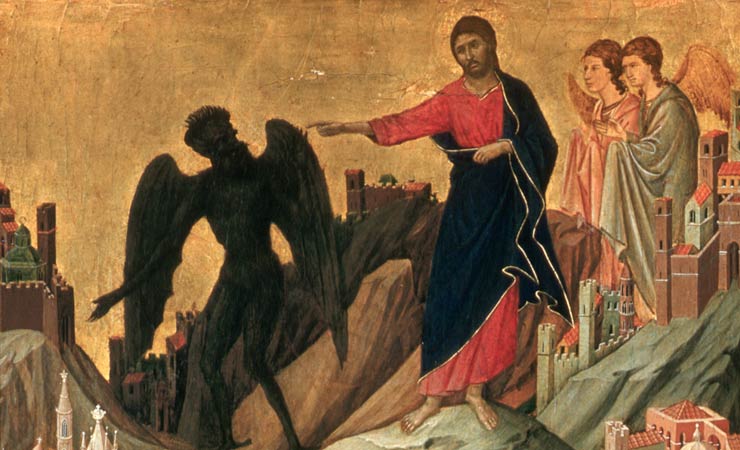
In the desert, Jesus is tempted by the devil.
Background on the Gospel Reading
In each of the three Synoptic Gospels, after his baptism, Jesus is reported to have spent forty days in the desert, fasting and praying. In Luke and in Matthew, the devil presents three temptations to Jesus. The devil tempts Jesus to use his power to appease his hunger, he offers Jesus all the kingdoms of the world if Jesus will worship him, and he tempts Jesus to put God’s promise of protection to the test. In each case, Jesus resists, citing words from Scripture to rebuke the devil’s temptation.
Each temptation that Jesus faces offers insight into the spirituality we hope to develop as we keep the forty days of the Season of Lent. We can trust God to provide for our material needs. We worship God because God alone has dominion over us and our world. We can trust God to be faithful to his promises. Jesus’ rejection of the devil’s temptations shows that he will not put God to the test. Grounding himself on the Word and authority of Scripture, Jesus rebukes the devil by his confidence in God’s protection and faithfulness.
This Gospel highlights for us one of the central themes of the Season of Lent. We are dependent upon God for all that we have and all that we are. Anything that leads us to reject this dependency or to distrust its sufficiency, is a temptation from the devil.
Luke ends his report of Jesus’ temptation in the desert by noting that the devil departs for a time. The implication is that the devil will return. Jesus knows that he will be tempted again in the Garden of Gethsemane. The depth of Jesus’ trust in God is shown most fully when Jesus rejects the temptation to turn away from the task God has given to him. Jesus’ final rebuke of the devil is his sacrifice on the Cross.
Jesus’ responses to the temptations of the devil teach us how we can respond to temptation. As we start our journey through Lent, this Sunday’s Gospel calls us to adopt the same confidence that Jesus had in the face of temptation: God’s word alone will suffice, God’s promise of protection can be trusted, and God alone is God.
Using and Abusing Power
Kathleen Rushton RSM
In the temptations of Jesus in Luke’s gospel (Lk 4:1-13) the character called “devil” (Greek diabolos; Hebrew satan) is one who tests loyalty to God. Usually loyalty testing is called “tempting” or “temptation.”
In Job (1:6) we find that diabolos was thought of as a being who was part of the heavenly court and who tested the trustworthiness of God’s faithful ones. By the time the gospels were written, people no longer thought of the diabolos as part of the heavenly court. The diabolos was understood to be an adversary or tempter who exposed the people to evil. The diabolos became the explanation for the evil impulse in the world.
The core of Jesus’ temptations is the enticement to abuse relationships — whakawhanaungatanga (right relationship) with Earth, people and God. The biblical text of the temptations of Jesus assists us now to reflect on the use and abuse of power in relationship with Earth, people and God.
Literary Context
Luke frames the temptations on one side with Jesus’ baptism when he is immersed in the waters, the womb of Earth (Lk 3:21), and his genealogy (Lk 3:23-38) and on the other, with the beginning of his teaching (Lk 4:14–30). According to the biblical scholar, John Pilch, the Mediterranean cultural world of Jesus held “a deeply rooted belief in spirits who exist in numbers too huge to count and whose major pastime is interfering capriciously in daily human life.” People depended on an array of amulets, formulas and symbols to ward off attacks from spirits. Luke writes the gospel story against this cultural background.
The highest honour is given to Jesus at his baptism when “a voice came from heaven” declaring: “You are my Son, the Beloved” (Lk 3:22). The genealogy of Jesus echoes “son of” to stress this divine testimony and concludes by identifying Jesus as “son of Adam, son of God.” Culturally such a declaration would have been important for the social and public acknowledgement of paternity. It gave a child legitimacy, social standing and required the father to accept responsibility for the child.
The voice from heaven not only acknowledges Jesus as “my Son” but continues: “with you I am well pleased.” Further, those hearing this story would know that all the spirits heard it too. Therefore a test should follow to see if it was true. Spirits would try to make Jesus do something displeasing to God.
The biblical context
Jesus is not protected by customary amulets. Instead he returned from the Jordan river “full of the Holy Spirit,” which is how Luke describes prophetic figures. Jesus is led into the wilderness by the Spirit where for 40 days he was tempted by the diabolos.
Echoes of the symbolic biblical reality can be heard. The Greek word for “tested/tempted” is the same word used for the testing of the people by God in the wilderness of Zin for 40 years and for their testing of God (Exodus 16:4; 17:2; Deuteronomy 8:2).
Jesus engages in one-to-one dialogue with the diabolos. Both quote Scripture. Jesus replies to each temptation by quoting Deuteronomy (8:3; 6:13; 6:16). The diabolos quotes from Psalm 91:11–12 (used as the responsorial psalm for the First Sunday of Lent). The diabolos is the chief opponent along with his helpers, demons and unclean spirits, of a counter-reign to God’s basiliea (Lk 11:14–20).
Right relationship with creation
Jesus was probably in the Judean wilderness of Perea. Life was sustainable there for nomads and for settlements because food and water were available, though limited. The wilderness was also a place which enabled deeper encounter with the self and discovery of new purpose, when a person was freed from life in the “real world.” God was felt to be close in the wilderness. The diabolos tests Jesus at the level of physical hunger as he had eaten nothing for 40 days (Lk 4:2). The story begins and ends with references to “stone” (Lk 4:3, 11) which the diabolos tempts Jesus to use to prove his filial relationship with God. The challenge is direct: “If you are the Son of God … change this stone into bread”.
Jesus refuses to use his power to change the Earth element, stone, and mimic the power of God to give “bread in the wilderness” (Exodus 16:14-21). Earth is to be cared for and respected, not manipulated and exploited. Jesus does not have to prove he is “Son of God.” He honours his genealogical connection as “son of Adam” so preserving the link in Genesis 2:7 between ādām from hādāma (from the earth/ground). In other words, he is an earthling from the earth, a groundling from the ground.
Right relationship with people
The location of the second temptation is unclear. The diabolos led Jesus “up” and showed him “all the kingdoms of the world (oikoumenē).” The word for “world” suggests the inhabited world, the whole household of Earth. “Up” may mean the traditionally known Mount of Temptation or Jebel Quruntul. You can see for miles from the top — the oasis city of Jericho, the oldest city on earth, with the Dead Sea to the south, then on the western skyline is the towering Mount of Olives and views of surrounding lands divided into kingdoms.
The diabolos promises that all this political and military control of humans, kingdoms and natural resources will be given to Jesus if he worships the diabolos. The word used for “worship” suggests the homage made to rulers in the East. Jesus refuses again.
Right relationship with God
The third temptation, which focuses on Jesus’ ability to force God’s protection, is at the Temple in Jerusalem — the place where Luke’s gospel begins and ends. It is the symbolic meeting place of Heaven and Earth.
The diabolos placed Jesus on its pinnacle (pterugion). The word means “wing” and evokes the wings of the eagle, an image of God’s care and protection (Deuteronomy 32:11). Above the entrance of the Temple were two symbolic eagle’s wings. However, shadows surround the Temple for it was reconstructed by Herod, exercising his power and exploitation during his massive programme of rebuilding of the city. The third temptation begins also with: “If you are the Son of God . . .” The diabolos refers again to a stone when quoting Psalm 91 on the protection of God.
The diabolos then departs “for a time” (Lk 4:13). Later in the gospel we find the threefold betrayal by Peter (Lk 22:54–62) and the threefold taunting of Jesus on the cross (Lk 23:35; 37, 39). But John the Baptist spoke of the “more powerful one” than himself (Lk 3:16). Jesus will speak of himself and his actions using similar words: that only a “more powerful one” or “one stronger” may cast out the evils God’s people face (Lk 11:22).
Reflecting on “right relationship” during Lent
The wilderness of the 40 days of Lent, a time of closeness to God, offers us space to reflect on Jesus’ refusal to abuse power personally, structurally and ecologically. We might think about how we are tempted to exert control over the material world. How we are tempted to exert control over people. And how we are tempted to force God to protect us.
https://hail.to/tui-motu-interislands-magazine/publication/ak395Yu/
GOSPEL REFLECTION
Fernando Armellini
Every year, on the first Sunday of Lent, the liturgy wants to reflect on the temptations of Jesus. It presents the way in which the Master has confronted them to tell us how they can be recognized and overcome.
Reading the passage today, however, one gets the impression that the experience of Jesus cannot be of much help: his temptations are too different from ours, are strange, even outlandish. Who among us would cede to the solicitation of worshipping the devil? Who would listen to his proposal of turning a stone into bread or his invitation to throw oneself out of a window? No, our temptations are far more serious, more difficult to win, then they do not last only a day, but accompany us for a lifetime.
This difficulty stems from the lack of understanding of the “literary genre,” namely, the way used by the author to communicate his message. Today’s Gospel is not the faithful chronicle, written by an eyewitness of the battle between Jesus and the devil (neither Luke nor any other have seen it). The passage is a lesson in catechesis and wants to teach us that Jesus was put to the test not with three, but “with all kinds of temptation”—as the text clearly states (v. 13).
To put it in simple and clear words: we are not in front of the story of three isolated incidents of Jesus’ life, but three parables in which, through images and biblical references, states that Jesus was tempted in all points like us, with an only difference: he has never been won by sin (Heb 4:15). These three frames are a symbolic synthesis of the struggle against the evil which he sustained in every moment of his life.
Maybe someone is still a bit baffled by the idea that Jesus had doubts like us, had encountered difficulties in fulfilling his mission, and had only gradually discovered the Father’s plan. We are almost afraid to lower him too much to our level. But God did not feel any aversion to our weakness, and made it his, in our mortal flesh and he overcame sin.
Before you consider these three “parables” we make another premise.
Unlike Matthew who says that Jesus was tempted just at the end of the forty days of fasting (Mt 4:2), Luke states that the temptation accompanied Jesus during his entire time in the desert. With this call to the desert and to the number forty, Luke intends to connect the experience of Jesus with that of Israel, put to the test during the Exodus. He repeats the experience of his people: “Your God has brought you through the desert for forty years to test you and know what was in your heart, whether you would keep his commandments or not” (Deut 8:2). Unlike Israel, Jesus, at the end of his “forty days,” will go out of the “desert” fully victorious. Evil will be forced to admit its utter helplessness against him.
Now we consider the three frames in which all the trials passed by Jesus are condensed.
The first temptation: “Tell this stone to turn into bread” (vv. 3-4). The account of the temptations follows immediately after the baptism that has been commented on the feast of the Baptism of the Lord. We noted then that Jesus, the just one, the holy one, did not begin his mission scolding sinners. He did not merely give them directions, maintaining his distance, as did the Pharisees. He went to be baptized along with the sinners, in the lowest point on earth. He mixed with them, has become one of them, he has chosen to walk alongside them the path that leads to liberation.
Sharing our human condition in everything is not easy. So here is the first temptation that Jesus had (not only once, but throughout life): to use his own divine power to escape the difficulties that ordinary people meet. They are hungry; they get sick and tired; they have to study to learn, can be deceived, are subject to misfortune and oppressed by injustice … Well, he can get out of these difficulties and the devil invites him to do so. He proposes not to exaggerate in identifying himself with people. He suggests to him to work miracles for his own personal gain. If Jesus had listened to him he would have given up to be one of us. He would not be truly man, he only pretended to be.
Jesus understood how diabolical this project was. Yes, he used the power to perform miracles, but never for himself, always for others. He worked, sweated, suffered hungered, thirsted, spent sleepless nights and did not want privileges. The highlight of this temptation was on the cross. There he was again invited to perform a miracle for himself; he was challenged to come down. If he had made the miracle, if he had refused the “defeat,” Jesus would have been a winner in people’s eyes, but he would have been a loser before God.
This temptation persists, devious, every day, even to us. It reappears first as an invitation to a selfish withdrawal to ourselves without thinking about others, as an invitation to reject the attitude of solidarity assumed by Christ.
If he gives in to this temptation when the ability that God has given are used to satisfy one’s whims and not to help the brothers; when he adapts to the current mentality in which everyone tries to make do, thinking only of one’s own advantage, Jesus chose to be poor and defeated with others rather than become rich and feel good alone.
In this first scene, the wrong way with which man interacts with the material realities is identified and denounced. The selfish use of assets, to accumulate for oneself, to live by the work of others, to seek pleasure at all costs, to squander in the luxury and in the superfluous, while others lack the necessary is evil. Jesus responds to the proposal of the devil by referring to a text of Scripture: “Man lives not on bread alone” (Deut 8:3). Only he who considers his own life in the light of the Word of God is capable of giving to the realities of this world the right value. They are not looked down upon, destroyed, rejected, and not even turned into idols. They are just creatures, woe to consider them absolute.
The second temptation: “I will give you power over the nations … for they have been delivered to me …” (vv. 5-8). What the devil says seems a bit exaggerated. Yet it’s true: the logic that rules the world, that governs the relationship between the people is not that of the Sermon on the Mount (Mt 5–8), not that of the Beatitudes (Lk 6:20-26), but the opposite, that of the evil one (Jn 12:31; 14:30; 16:11).
The first temptation denounced the wrong way of dealing with things, the latter helps to identify evil ways with which we can relate to people, with our own kind.
The choice is between to dominate and to serve, to compete and to be in solidarity, to overpower and to consider ourselves servants. This choice is manifested in every attitude and in every condition of life. Who is educated and has reached a prestigious position can help to better the lives of the less fortunate, but he can also use it to humiliate those who are less endowed. Who has power and is rich, can serve the poorest and those who have been disadvantaged, but he can lord it over them too. The lust for power is so overwhelming that even the poor are tempted to overwhelm those who are weaker.
Authority is a charism, a gift of God to the community so that everyone can find in it his place and be happy. Power instead is evil, even if it is exercised in the name of God. Wherever dominion over persons is exercised, wherever one struggles to prevail over others, wherever someone is forced to kneel or bow down in front of another person, there is at work the logic of evil.
Jesus did not lack the talents to emerge, to climb all the steps of the religious and political power. He was intelligent, lucid, courageous, enchanted the crowds. He would certainly have been successful … but on one condition, that “he worshiped Satan,” that is, to come into compliance with the principles of this world: competition, resorting to violence, overwhelming the others, allying oneself with the powerful and using their methods. His choice was the opposite: he made himself a servant.
The third temptation: it is the most dangerous because it puts into question the relationship between man and God. The diabolical proposal is based even on the Bible: “Throw yourself down from here—says the tempter—for it is written …” (vv. 9-12). The most insidious wiles of evil are to show itself up with an attractive face, to assume a pious stance, to use the same Word of God (crippled and misleadingly interpreted) to lead people astray.
The maximum target of evil is not to provoke some moral failure, some fragility, some weakness, but to basically undermine the relationship with God. This is achieved when, in the mind of man, sneaks a doubt that the Lord does not keep his promises, unfaithful to his word, who ensures his protection but then abandon those who gave him trust. The need to “have proof” arises from this doubt. In the desert, the people of Israel, exhausted by hunger, thirst, and fatigue, have succumbed to this temptation and exclaimed: “Is the Lord with us, or not?” (Ex 17:7). The people provoked God, saying: if he’s on our side, if he really accompanies us with his love, let him manifest himself by giving us a sign, performing a miracle.
Jesus never succumbed to this temptation. Even in the most dramatic scenario, he refused to ask the Father proof of his love. He has not doubted his loyalty even when on the cross, the absurdity of what was happening to him, could have misled him into thinking that the Lord had forsaken him.
When the Lord does not realize our dreams we begin the grievances: “Where is God? Who knows if he exists! Is it worth continuing to believe if he does not intervene to support those who serve him?” If he does not give evidence of love that we demand, the fragile faith is in danger of collapse.
God has not promised to his faithful to protect them from the difficulties and tribulations. He has not promised to free them miraculously from disease, pain, but to give them strength because they don’t come out defeated by the evidence. It’s unthinkable to think that God treats us differently from the way he treated his only Son.
Today’s passage ends with an annotation: “Having exhausted every way of tempting Jesus, the devil left him to return another time” (v. 13).
Luke above all speaks of every kind of temptation, therefore, the three frames he depicted had to be interpreted as a synthesis of all the temptations. They represent, in a schematic way, the wrong ways of dealing with three realities: with things, with people, with God.
Luke gives us a glimpse, from the beginning of his Gospel, of the time when the temptation will manifest itself in the most violent and dramatic way: on the cross.
The devil has not strayed definitively; he withdrew waiting to return at the appointed time. He and his seductive work will be discussed later during the passion when he will enter Judas and push him to betray Jesus (Lk 22:3). That will be the manifestation of the empire of darkness (Lk 22:53), empire, that just when it thinks of celebrating its triumph, it will be defeated.
Fernando Armellini
Italian missionary and biblical scholar
https://sundaycommentaries.wordpress.com
CHANGE EVERYTHING INTO BREAD
José Antonio Pagola
It’s our big temptation. Reduce everything to the horizon of our life for the mere satisfaction of our desires; pawn ourselves in changing everything into bread with which to feed our appetites.
Our greatest satisfaction, and sometimes our only one, is to absorb and consume products, articles, objects, spectacles, books, TV. Until love has frequently ended up changed into mere sexual satisfaction.
We run the risk of seeking pleasure way beyond the limits of necessity, even to the detriment of our very life and our living together. We end up fighting to satisfy our desires, though it be at the cost of everyone else, provoking competition and war among ourselves.
We deceive ourselves if we think that this is the path to liberation and life. On the contrary, have we ever experienced that the aggravated pursuit of pleasure leads to boredom, loathing, and emptiness of life? Aren’t we seeing that a society that cultivates consumption and satisfaction does nothing but generate a lack of solidarity, irresponsibility and violence?
This civilization that has «educated» us for the unreasonable and out-of-bounds pursuit of pleasure, needs a change of direction that can infuse us with a new breath of life.
We need to return to the desert. Learn from Jesus, who denied himself the working of miracles for pure utility, whim, or pleasure. Listen to the truth that is enclosed in his unforgettable words: «Human beings live not on bread alone, but on every Word that comes from the mouth of God».
Don’t we need to free ourselves from our greed, selfishness and superficiality, in order to awaken in us love and generosity? Don’t we need to listen to God, who invites us to enjoy creating solidarity, friendship and fraternity?
José Antonio Pagola
Translator: Fr. Jay VonHandorf
http://www.feadulta.com
A Lent for sharing the Word and Bread
Romeo Ballan, mccj
“In the desert a man understands his own worth and the worth of his gods” (A. de Saint-Exupéry)”, that is, his ideals and his interior resources. “In the desert of the world”, nourished with the Word and fortified by the Spirit, we have set out once more to celebrate the period of Lent, the “sacramental sign of our conversion” in order to overcome “the constant seductions of the evil one” (opening prayer) through the invincible weapons of fasting, prayer and almsgiving. Lent lays out before us once again the fundamental themes of salvation, and therefore of mission: the primacy of God and His loving plan for humankind, the redemption that is offered to us freely through the sacrifice of Christ, the constant struggle against sin, the relationship of brotherhood and respect with our fellows and with all creation… These are topics that belong to the desert-period of Lent.
The Temptations (Gospel) were not ‘let’s pretend’ for Jesus; they were real tests, as they are for each believer and the Church. “If Christ had not experienced the temptations as real temptations, if temptation had no meaning for him, the man and the Messiah, his reactions could not be an example for us, as it would have nothing to do with ours” (C. Duquoc). It is precisely because he was tested that he is an example for us, and is able to come to the aid of anyone in time of trial (see Heb 2:18; 4:15).
Jesus really clashed with Satan over the options for possible methods and procedures in carrying out His mission as Messiah. The three temptations are a meaningful synthesis of a long period of struggle against evil, sustained by Jesus during the 40 days in the desert (v. 2) and throughout his whole life, including the Cross, when the devil returned “at the appointed time” (v. 13). The temptations represent different ‘models’ of the Messiah – so also of us and of mission too! For Jesus the temptations were “three shortcuts to avoid going through the Cross” (Fulton Sheen). They overturned relationships with material things, with other persons and with God himself. They were temptations to become (a) a social reformer: turning stones into bread for himself and for others would have guaranteed public success and acclaim; (b) a messiah of power: a power based on dominion over people and over the world would have satisfied both personal and collective pride; (c) a messiah of miracles: such a spectacular gesture would have made him famous.
Jesus overcomes the temptations and opts to respect the primacy of God; he trusts in his Father and His plan for the salvation of the world. He refuses to make a selfish use of material things for his own profit (now he does not change stones into bread for himself but later he will multiply bread and fish for the hungry crowd); he refuses to dominate other people, opting to continue to serve them; he adheres to his son-Father relationship with God, trusting in His faithfulness. He accepts the Cross out of love, and pardons as he dies: this is the only way to break the spiral of violence and to take from death its ‘sting’: death is overcome by Life.
Jesus faces and overcomes the temptations in the power of the Holy Spirit that fills him (v. 1). It is the Spirit of his Baptism (Lk 3:22), of Easter and Pentecost. It is also the Spirit of Mission. At various times it was thought that power, money, dominance, a feeling of superiority, hyper-activism… were paths to follow in the Apostolate. The missionary is often tempted by such illusions, and so needs the Spirit of Jesus, the first agent of mission (RMi 21). The Spirit makes us understand that the desert of Lent is a time of grace (kairós): the time of essential things, the time to fill with things of real value; the gift of living in silence, far from the pollution of noise, haste, money and futility; a time for missionary sharing! (*)
Lent is a time of salvation, centred on faith in Christ who died and rose again (2nd Reading): He is the Lord of all peoples, who offers Salvation abundantly to all those who call upon His name, without any distinction of affiliation (v. 12-13). This primacy of God is seen in the offering of the first-fruits of the earth (1st. Reading). It is a gesture of submission and propitiation. But it is also a form of sharing with those in need: the offering of first fruits is also destined for the foreigner, the orphan and the widow, “so that, in your towns, they may eat to their heart’s content” (v. 10-12). There is a precious sign here of spiritual and missionary progression: those who approach God and live in tune with Him discover “others”, both far and near. And learn solidarity and generosity!
