6th Sunday in Ordinary Time – Year C
Luke 6:17,20-26
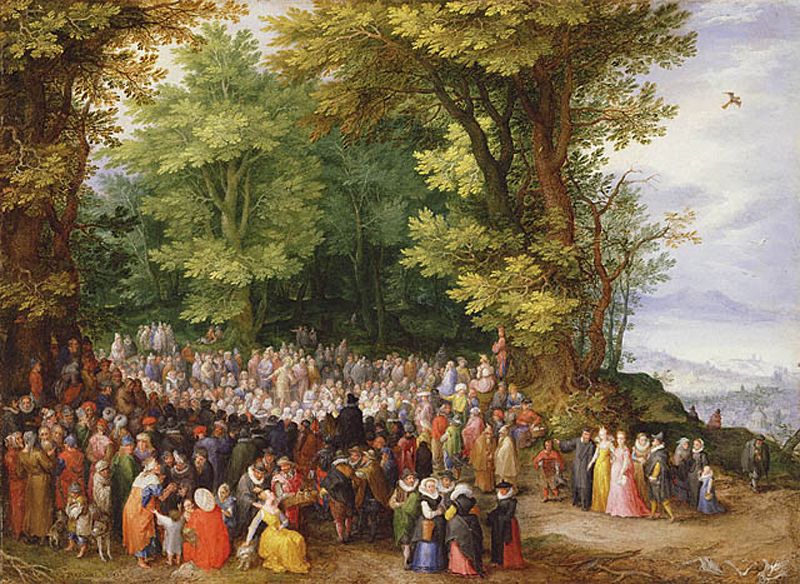
Jesus came down with the Twelve and stopped at a piece of level ground where there was a large gathering of his disciples with a great crowd of people from all parts of Judaea and from Jerusalem and from the coastal region of Tyre and Sidon. Then fixing his eyes on his disciples he said:
‘How happy are you who are poor: yours is the kingdom of God.
Happy you who are hungry now: you shall be satisfied.
Happy you who weep now: you shall laugh.
Happy are you when people hate you, drive you out, abuse you, denounce your name as criminal, on account of the Son of Man. Rejoice when that day comes and dance for joy, for then your reward will be great in heaven. This was the way their ancestors treated the prophets.
‘But alas for you who are rich: you are having your consolation now.
Alas for you who have your fill now: you shall go hungry.
Alas for you who laugh now: you shall mourn and weep.
‘Alas for you when the world speaks well of you! This was the way their ancestors treated the false prophets.’
The Beatitudes
Pope Francis
Today’s Gospel presents us Saint Luke’s passage on the Beatitudes (cf. 6:17, 20-26). The text is arranged into four beatitudes and four admonitions denoted by the expression, “woe to you”. With these assertive and sharp words, Jesus opens our eyes and lets us look with his gaze, beyond appearances, beyond the surface and teaches us to discern situations with faith.
Jesus proclaims the poor, the hungry, the suffering and the persecuted blessed, and he admonishes those who are rich, satisfied, who laugh and are praised by the people. The reason behind this paradoxical beatitude lies in the fact that God is close to those who suffer, and intercedes to free them from their bondage. Jesus sees this; he already sees the beatitude beyond its negative reality. And likewise, the “woe to you” addressed to those who are doing well today, has the purpose of “waking” them from the dangerous deceit of egotism, and opening them up to the logic of love, while they still have the time to do so.
The page from today’s Gospel thus invites us to reflect on the profound sense of having faith, which consists in our trusting completely in the Lord. It is about demolishing worldly idols in order to open our hearts to the true and living God. He alone can give our life that fullness so deeply desired and yet difficult to attain. Brothers and sisters, indeed there are many in our day too who purport to be dispensers of happiness: they come and promise us swift success, great profits within our reach, magical solutions to every problem and so on. And here it is easy to slip unwittingly into sinning against the first Commandment: namely idolatry, substituting God with an idol. Idolatry and idols seem to be things from another age, but in reality they are of all ages! Even today. They describe certain contemporary attitudes better than many sociological studies do.
This is why Jesus opens our eyes to reality. We are called to happiness, to be blessed, and we become so as of now, to the measure in which we place ourselves on the side of God, of his Kingdom, on the side of what is not ephemeral but rather endures for eternal life. We are happy if we acknowledge we are needy before God — and this is very important: “Lord, I need you” — and if, like him and with him, we are close to the poor, the suffering and the hungry. We too are like this before God: we are poor, suffering, we are hungry before God. Although we possess worldly goods, we experience joy when we do not idolize or sell our souls out to them, but are able to share them with our brothers and sisters. Today the liturgy invites us once again to question ourselves about this and to be truthful in our heart.
Jesus’ Beatitudes are a decisive message which urges us not to place our trust in material and fleeting things, not to seek happiness by following smoke vendors — who are often vendors of death — experts in illusion. We should not follow them because they are unable to give us hope. May the Lord help us open our eyes to acquire a more penetrating view of reality, to heal the chronic shortsightedness with which the worldly spirit infects us. With his paradoxical Word he stirs us and enables us to recognize what truly enriches us, satisfies us, gives us joy and dignity; in other words, what truly gives meaning and fullness to our lives. May the Virgin Mary help us listen to this Gospel passage with open hearts and minds so that it may bear fruit in our life and that we may become witnesses of the happiness that does not disappoint, that of God who never disappoints.
Angelus 17/02/2019
The Beatitudes: A Good News
Fernando Armellini
Introduction
Those who has the money to invest, do not rely on the first sales pitch that is on the street. He asks for information, seeks advice from some expert in economics, checks which actions are down and which are rising, which gives major reliability and which are on sale. Only at the end, after careful consideration of the risks, he chooses what to buy.
Our life is a precious capital that God has placed in our hands and must be productive. What are the values at play? What are the actions that will bump up the capital? Some are in great demand and majority of the people is betting everything on them: success at any cost, career, money, health, glory, the look, the pursuit of pleasure. Will it be a right choice?
Other actions instead depreciate: the service to the last ones without gain, patience, endurance, the renunciation of the superfluous, generosity toward those in need, moral rectitude…. How is one, who relies on these values, considered in our culture: wise, naive, a dreamer, an idealist?
Had we many lives, we would grope to play one on each wheel, but we have only one, unrepeatable life: we are not allowed to make mistakes. The advice from a reliable connoisseur is essential and urgent, but there is the looming danger of choosing the wrong advisor. A wise saying always proves right: “Do not trust anyone, not even friends.” Focus on the values that God guarantees.
Gospel: Luke 6:17,20-26
Everybody likes compliments. Those of prestigious, powerful, illustrious persons are particularly appreciated.
Jesus also directs his compliments (“blessed” means: Congratulations for the choice you have made). He addresses them to four categories of persons and warns against other opposite, dangerous choices because they are attractive and apparently gratifying.
The rabbis of Jesus’ time often used the literary form of beatitudes and curses.
To inculcate values of which it’s worth is to build up life, they say: “Blessed is he…” to warn against deceiving and illusory proposal they instead use the expression: “Woe to whoever behaves in this or that way.” Jeremiah too—we have heard him in the first reading—uses the same wisdom language; he speaks of blessed and of cursed. This being the way of communicating used by the wise people in Israel, it’s no wonder that in the Gospels tens of beatitudes and repeated threats are found. We remember some of these beatitudes: “Blessed is she who believed” (Lk 1:45); “Blessed the womb that carried you.” (Mt 12:49); “Blessed are those servants that the master at his return will find still awake.” (Lk 12: 7); “Blessed are those who will believe even without seeing.” (Jn 20:29”); “When you give banquet invite the poor, the disabled, the lame, the blind and you will be blessed.” (Lk 14:13-14); “Blessed is he who is not scandalized in me.” (Mt 11: 6); “Blessed are your eyes that see” (Mt 13:16).
These few citations are enough to prove how, at Jesus’ time, the recourse to beatitudes to convey a teaching was common.
The most noted beatitudes are those of Matthew (Mt 5:1-12) and those of Luke (Lk 6:20-26) that are proposed in today’s gospel. It’s worth to disclose the principal differences between these two lists.
In Matthew, Jesus proclaims the Beatitudes sitting on top of a mountain (Mt 5:1), while in Luke he announces them in a plain (Lk 6:17), and this is a minor detail. The fact that in Matthew there are eight beatitudes, whereas in Luke there are only four and are accompanied by many “Woe to you!” is more significant.
Matthew “spiritualizes” the Beatitudes. He speaks of “… the poor in spirit”, of people who “hunger and thirst for justice …”. In Luke, the beatitudes are rather strongly “terrestrial.” He says: “Blessed are you poor, you who are hungry now, you who weep now” and denounces as dangerous opposite situations: “Woe to you who are rich, for you who are full now, to you who laugh now. Nothing spiritual in Luke: it’s all very real.
Now we come to today’s passage. To understand it, it is necessary to establish to whom are the beatitudes addressed to. “There was a great crowd of his disciples and a great multitude of people … he lifted up his eyes on his disciples, he said: Blessed are you poor …” (vv. 17-20). It is clear that the recipients of the “beatitudes” and the subsequent “woe to you” are not the crowds, but only the disciples and, ultimately, the Christian community.
Let’s start from the first beatitude: Blessed are you poor!
In what sense Peter, Andrew, John and the other apostles are considered poor? Certainly, they are not rich, neither miserable. They own a home and a boat; many people are worse off. Why only they are proclaimed blessed? What extraordinary thing have they done?
To understand the significance of this beatitude we can start from the last verse of last Sunday’s Gospel. After the miraculous catch of fish, Jesus entrusts to Simon the task of removing men from death and bringing them to life. Luke concludes: “They pulled their boats to land, they left everything and followed him” (Lk 5:11). A little later in the same chapter, another call is narrated, that of Levi, and the conclusion is the same: “And leaving everything, he rose and followed him” (Lk 5:28).
In Luke’s Gospel, to leave everything is taken as a kind of refrain, at the end of each call: “Sell everything you have, give to the poor”—Jesus asks the rich aristocrat (Lk 18:22).
This voluntary poverty is not something optional, not a counsel reserved for some who want to behave like heroes or be better than the others. It is what characterizes the Christian: “Any of you who does not renounce all his possessions cannot be my disciple” (Lk 14:33).
How to deprive themselves of all the goods? Must they throw out of the window what they have—with the risk of their going into the hand in loafers—and reducing themselves to misery, becoming beggars? It would be a foolish, a senseless interpretation of Jesus’ words. He never despised wealth, he never invited them to destroy it. He denounced, yes, the risks and dangers: the heart can get attached to them and can become an insurmountable obstacle for those who want to enter the kingdom of God (Lk 18:24-25). The goods of this world are precious, essential to life, but must be kept in place, woe if we overestimate them or worse turn them into idols.
The one who, enlightened by the word of Christ, gives the goods their proper value is poor in the evangelical sense. He appreciates, esteems them; he knows that they are a gift from God. It’s because they are a gift, one should appropriate them. He realizes that they do not belong to him, that he’s only an administrator and invests them in accordance with the plans of the master. He received all as a gift, he transforms them as a gift.
Poor in the evangelical sense is the one who does not possess anything for himself, who gives up worshiping money, refuses the selfish use of their time, of their intellectual abilities, erudition, diplomas, social position … He is one who is similar to the Father in heaven who, while possessing all, is infinitely poor because he does not keep anything for himself; he is the total gift.
The ideal of the Christian is not poverty, but a world of evangelical poor, a world where no one accumulates for oneself, no one squanders, each puts at the brothers’ disposition everything he has received from God. “Blessed are you poor!” is not a message of resignation, but of hope, hope in a new world where no one is in need (Acts 4:34).
The promise that accompanies this beatitude does not refer to a distant future, does not ensure the entry into heaven after death, but announces an immediate joy: “Yours is the kingdom of God.” From the moment one chooses to be and to remain poor, he or she enters the “kingdom of God,” in new condition.
Those who do not make this decisive step continue to think according to earthly logic. They have the heart tied to the wealth they have and have placed in them their hopes of happiness. They are not free … They are not yet blessed.
Only true disciples are blessed because they understood that human life does not depend on the goods they possess and, not having the heart tied to “money,” they can also open it to salvation that goes beyond this world.
What are the consequences of the choice of evangelical poverty? What should the disciples who renounce the selfish use of wealth expect?
Jesus responds to these questions with the second beatitude: Blessed are you who are hungry now (v. 21).
No illusion, no deception, no promise of an easy, wealthy and comfortable life. Real hunger, not the spiritual one, will be the inevitable consequence for those who put everything they own in service of others. They will experience poverty, hardships, privations; sometimes they will lack even the necessary, but they will be blessed.
To them, Jesus addresses his compliments and assures: “The Lord will fill you up.” Through you, God will build the new world in which every hunger, every need will be satisfied; through you, God will prepare a banquet for all those who do not have the minimum required for subsistence (Is 25:6-8), through you, he “will satisfy his poor with bread” (Ps 132:15), “will give food to the hungry” (Ps 146:7).
The third beatitude—Blessed are you who weep now—also takes into consideration a state of distress and pain (v. 21). Whoever made himself poor experiences sadness and despair because, despite all his sacrifices and commitment, he does not immediately and miraculously see the problems of the poor solved. He experiences disappointment and even comes to the point of crying.
God will comfort him, transforming his cry into joy. The seeds of good which he casts in pain will grow and give abundant fruit (Ps 126:6). His condition is similar to that of the woman about to give birth “is afflicted, but when she has given birth to the child, she no longer remembers the anguish, for the joy that a man has come into the world” (Jn 16:21).
The last beatitude—Blessed are you when you are persecuted, insulted, hated…—is different from previous ones. It is longer; it does not describe the current condition of the disciples but announces that something painful will happen in the future; it does not contain the promise of a reversal of the situation, but invites them to rejoice, and rejoice even when they become object of harassment on account of the Son of Man (vv. 22-23).
Whoever refuses to comply with the principles that dominate in this world—those of selfishness, competition, oppression, the search for self-interest—is fought and banned as dangerous to the established order. The ancient world is not resigned to disappear, does not consent to surrender peacefully the passage to a society founded on the principles of free gift, the availability of selfless service, the search for the last place. Whoever opts for this new world is at odds with the mentality shared by many and is immediately isolated and persecuted. The approval and the consent of people is a negative sign. Persecution is the fate that all the just ones share: the prophets of the Old Testament were treated that way.
The disciple is not happy “despite” the persecution; he does not rejoice because one day the suffering will end and in the future, he will enjoy a reward in heaven. He is blessed at the very moment when he is persecuted. Persecution, in fact, is the irrefutable proof that he is following the Master.
The four woes add nothing to this message; they simply reaffirm, in a negative way, the beatitudes.
They are directed to the disciples to warn them of the danger still looming on them that of letting themselves be lured again by the “logic of Satan,” by the principles of this world.
Whoever starts again to worship the bank account and career, who thinks of one’s own interest, loses oneself behind the flattery and seduction by wealth, accumulates for oneself and squanders, while others are crying and dying of hunger, is “cursed.” It’s not that God hates him or punishes him. He is “cursed” because he has made the wrong choice. He placed himself outside the “kingdom of God”. He receives praise and compliments of people, but not those of God.
https://sundaycommentaries.wordpress.com
The Beatitudes: Portrait of Jesus and of the missionary
Romeo Ballan, mccj
Gandhi, the father of modern India and the promoter of the strategy of active-non-violence, said: “The Sermon on the mountain went straight to my heart. It is on account of this sermon that I have learned to love Jesus”. His admiration refers in particular to the Beatitudes which are at the heart of Jesus’ programme. It is a message to be understood in the wider biblical context concerning the meaning of existence. Guess right or wrong, win or lose, overcome or be defeated, run with the crowd or against it, end with ‘blessed’ or ‘cursed’… the list could be almost endless. Jesus adds his own list of alternatives in the Beatitudes: a programme for living one’s life (Gospel): “Blessed are you…; Alas for you…” (v. 20,24). The literary style adopted by Jesus is very similar to that of Jeremiah (I Reading). It was common practice of teachers in those days to use contrasting images, parallel and repetitive, to put across their message, because they helped the people to grasp and remember, in cultures that were almost exclusively oral. It is a teaching method that missionaries still come across in many parts of the world.
Obviously, the message is more important than the literary style. And the list of alternatives underlines what is at stake, both in the words of Jeremiah and those of Jesus: it is life, it is salvation, and eternal salvation itself. To be like the tamarind (dry scrub) in the desert (that is, to be without fruit or, indeed, life) or to be like a tree planted by the waterside (with no fear of the heat and with plenty of fruit) are the results of two opposing life-options. They are choices that the prophet characterises with a shocking judgement: a curse… or a blessing…The moral reason for such severity lies, for Jeremiah, in the option to put his trust in a man (v. 5), or to put his trust in the Lord (v. 6).To ‘put one’s trust’is the verb of faith: that is, to find the spot where the house is firm, where the foundation of the building is laid on a rock. The Responsorial Psalm takes up the same theme, with a wealth of images taken from farming and social relationships.
Jesus proposed the same programme (Gospel): organise one’s life, having God for the single point of reference for everything, so that the final result is deserving of a “Happy are you…” and not of an “Alas for you…” To opt for Jesus means to work for the needy, to discover the blessedness that is found even in the realities that are commonly considered negative and disheartening by most people: blessed are you who are poor, blessed are you who are hungry, you who weep, you who are hated, abused and driven out. Rejoice! (v. 20-23).
The parallel in Luke continues in the opposite images, marked by ‘alas for you’ (v. 24-26). The ‘alas for you’, though, rather than threats announcing punishments, are lamentations of Jesus, bitter sorrow for the unhappy situation of all those who follow worldly objectives of wealth, selfish satisfactions, getting the better of others, prestige, honours… Jesus is feeling sorry: alas for you!
Only someone who trusts completely in God is able to live a free life: sharing rather than accumulating, being happy with few belongings, finding ‘perfect happiness’ even when insulted, rejected, persecuted. The spiritual joy of the Beatitudes has nothing to do with masochistic pleasure. Nevertheless, it does not take away the pain that we experience in difficult situations; however, it can read a higher message within them, a new wisdom, a way of salvation, a mysterious paschal fruitfulness, a “sign of renewed humanity” (opening prayer). Even though they cannot be read easily at first.
The Beatitudes are a self-portrait of Jesus: poor, suffering and persecuted… He has chosen the way of passion, death and resurrection, so as to give life to the world (2nd. Reading). The way of life entrusted by Jesus to the Apostles – and to missionaries of all ages – cannot be different: the Missionary is a man/woman of the Beatitudes, as Pope John Paul II described them. In particular, in the Beatitudes of persecution and poverty which are lived in sharing. This is confirmed by the dozens of missionaries who are victims of violence each year. Along with them there is the witness of other professionals (volunteers, journalists, military…) who died on active service. Their deaths are often due to bandits and robbers, but religious and social motives are also evident. To opt for Christ means to act always in favour of the weak and needy, with whom Christ identifies himself: hungry, naked, sick, imprisoned, strangers… We are sure of it by the two last final sentences of Matthew: “Come you whom my Father has blessed” or “go away from me” (Mt 25:34.41). There is consistency between the Gospel of the Beatitudes and the test of the final judgement. The path of the Beatitudes leads to ultimate Blessing, to real and lasting happiness!
