Feast of the Holy Family – Year C
Luke 2: 41-52
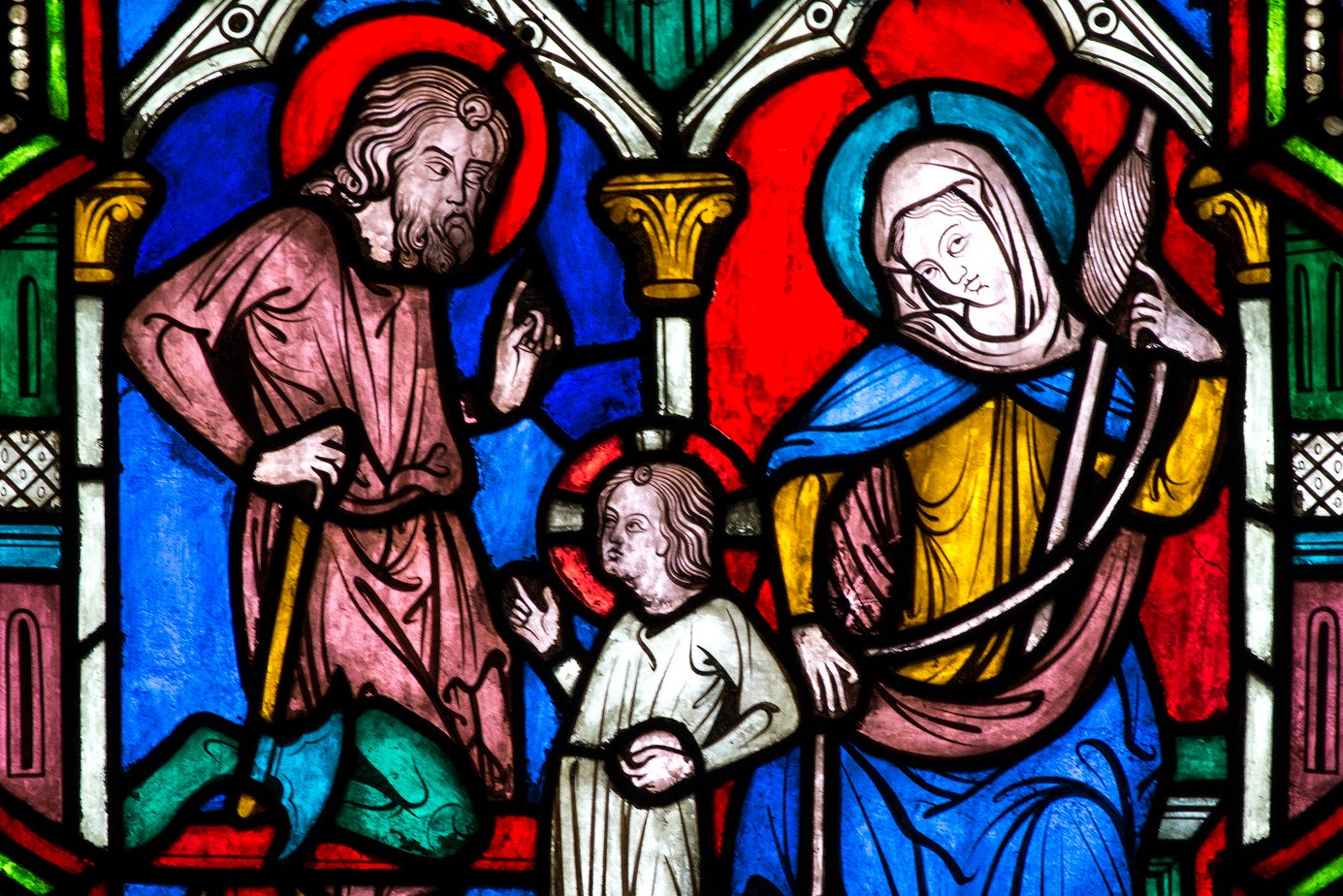
Every year the parents of Jesus used to go to Jerusalem for the feast of the Passover. When he was twelve years old, they went up for the feast as usual. When they were on their way home after the feast, the boy Jesus stayed behind in Jerusalem without his parents knowing it. They assumed he was with the caravan, and it was only after a day’s journey that they went to look for him among their relations and acquaintances. When they failed to find him they went back to Jerusalem looking for him .
Three days later, they found him in the Temple, sitting among the doctors, listening to them, and asking them questions; and all those who heard him were astounded at his intelligence and his replies. They were overcome when they saw him, and his mother said to him, ‘My child, why have you done this to us? See how worried your father and I have been, looking for you.’
‘Why were you looking for me?’ he replied. ‘Did you not know that I must be busy with my Father’s affairs?’ But they did not understand what he meant.
He then went down with them and came to Nazareth and lived under their authority.
His mother stored up all these things in her heart. And Jesus increased in wisdom, in stature, and in favour with God and men.
Astonishment and anxiety
Pope Francis
Today we are celebrating the Feast of the Holy Family, and the liturgy invites us to reflect on the experience of Mary, Joseph and Jesus, united by an immense love and inspired by great trust in God. Today’s Gospel passage (cf. Lk 2:41-52) recounts the journey of the family of Nazareth to Jerusalem, for the celebration of Passover. But, on the return journey, the parents realize that their 12-year-old son is not in the caravan. After three days of searching and fear, they find him in the temple, sitting among the teachers, focused on a discussion with them. At the sight of the Son, Mary and Joseph “were astonished” (v. 48) and the Mother revealed their fear to him, saying: “your father and I have been looking for you anxiously” (ibid.)
Astonishment — they “were astonished” — and anxiety — “your father and I, anxious” — are the two elements to which I would like to call your attention: astonishment and anxiety.
In the family of Nazareth astonishment never waned, not even in a dramatic moment such as Jesus being lost: it is the ability to be astonished before the gradual manifestation of the Son of God. It is the same astonishment that even strikes the teachers of the temple, “amazed at his understanding and his answers” (v. 47). But what is astonishment; what is it to be astonished? Being astonished and being amazed is the opposite of taking everything for granted; it is the opposite of interpreting the reality that surrounds us and historical events according to our criteria alone. A person who does this does not know what amazement is, what astonishment is. Being astonished is being open to others, understanding others’ reasons: this attitude is important for mending compromised interpersonal relationships, and is also indispensable for healing open wounds in the familial environment. When there are problems in families, we take for granted that we are right and we close the door to others. Instead, it is important to think: ‘What is good about this person?’, and to be astonished by this ‘good’. And this helps family unity. If you have problems in the family, think about the good things in the family member with whom you have problems, and be astonished by this. This will help to heal familial wounds.
The second element that I would like to grasp from the Gospel is the anxiety that Mary and Joseph felt when they could not find Jesus. This anxiety reveals Jesus’ centrality in the Holy Family. The Virgin and her husband welcomed that Son, protected him and watched him grow in age, wisdom and grace in their midst, but above all he grew in their hearts; and, little by little, their affection for him and their understanding of him grew. This is why the family of Nazareth is holy: because it was centred on Jesus; all of Mary and Joseph’s attention and concerns were directed toward him.
That anxiety that they experienced in the three days that Jesus was missing should also be our anxiety when we are distant from him, when we are distant from Jesus. We should feel anxious when we forget Jesus for more than three days, without praying, without reading the Gospel, without feeling the need of his presence and of his comforting friendship. And many times, days pass in which I do not remember Jesus. But this is bad, this is really bad. We should feel anxious when these things happen. Mary and Joseph searched for him and found him in the temple while he was teaching: for us too, it is especially in the house of God that we are able to encounter the divine Teacher and receive his message of salvation. In the Eucharistic celebration we have a living experience of Christ; he speaks to us; he offers us his Word; he illuminates us, lights our path, gives us his Body in the Eucharist from which we draw vigour to face everyday difficulties.
And today let us go home with these two words: astonishment and anxiety. Do I know how to be astonished, when I see the good things in others, and in this way resolve family problems? Do I feel anxious when I am distant from Jesus?
Let us pray for all the families in the world, especially those in which, for various reasons, peace and harmony are lacking. And let us entrust them to the protection of the Holy Family of Nazareth.
Angelus 30/12/2018
Neither devalued nor idolized
Fr. Fernando Armellini
To our families, we are sure, a lifestyle better than that of the family of Nazareth cannot be offered. However, the fact recounted in today’s Gospel is quite disconcerting. Mary and Joseph forget the son in Jerusalem and for one day they peacefully walk without worrying about him. Jesus moves away from his parents without asking permission. When the mother asks for an explanation of his behavior he seems to even answer her badly. Mary and Joseph do not understand his words; only at the end, the passage recalls that Jesus returns to Nazareth and, from then on, he remains obedient to them. This is a great decision but how do you explain his previous “disobedience?” It is true that read as a chronicle, this passage presents some difficulties. How to interpret it?
We know that a chance encounter with a person is told in a very different way if he or she has never been seen or has become the best friend. Luke does not write his Gospel the day after the events occurred, but fifty years after Easter. The faith in the risen Christ appears on every page of his work. The death and resurrection of Jesus have made him and the Christians of his community understand what Mary and Joseph, seventy years ago, could not even guess. In a twelve-year-old child, he recognizes the Christ, the Son of God, the Savior, the one who is obedient to the Father even to the gift of life.
After this introduction let delve into today’s passage.
The law of Israel prescribed (only for adult men) the three times a year pilgrimage to Jerusalem during the main holidays (Ex 23:17; Dt 16:16). For those who lived far away, however, it was virtually impossible to observe this precept. Many Jews already considered it a great fortune to be able to fulfill the holy journey even once in a lifetime. Mary and Joseph, living in Nazareth, were about three days’ journey away from Jerusalem. They went up every year to celebrate Easter.
The fact narrated in today’s gospel happens on the occasion of one of these pilgrimages. Jesus was twelve years old, is therefore almost an adult (at thirteen years in Israel one becomes an adult and is required to comply with all the precepts of the law).
The temple is a beautiful building, surrounded by large porches under which the rabbis and scribes explain the Holy Scriptures, recite Psalms and distribute their pious advice to pilgrims. Jesus is eager to discover the will of the Father and knows where to find it: in the holy books of his people, in the Bible.
That’s the reason why he stops in Jerusalem. He wants to understand the Word of God. Walking around the temple during the feast, maybe he is impressed by the explanations given by some well prepared and more pious master than others. He wants to hear it again, ask him some questions and clarify his doubts. The pilgrims who hear him converse with the rabbis, stop, amazed and admired his precocious and extraordinary intelligence. It is not easy to find a boy his age that shows so much love for the Bible and is able to raise such profound questions.
The purpose of Luke’s account is not to emphasize the intelligence of Jesus, but to prepare the reader to understand the answer he gives to his mother, worried and surprised by his behavior. These are the first words he speaks in the Gospel of Luke. Then—for the evangelist—they are of particular importance, as the program throughout his life is. The answer is formulated with two questions: “Why were you looking for me? Did you not know that I must be in my Father’s house?” (v. 49).
The children usually put countless questions, even Jesus has certainly addressed many to his parents. This is the first time that they are not able to give an answer, for this their amazement is noted: “They did not understand this answer” (v. 50). They realize that he begins to distance himself from the narrow family environment and opens himself to a wider horizon. He is born in a family, but he does not belong to it. He is a citizen of the world and like every child is a gift from God to all mankind.
In apparent contrast to what we are saying, the last part of today’s Gospel (vv. 51-52) points out that Jesus returns to Nazareth and is obedient to his parents. It would seem that after the escapade … he gets better in exercising judgment. The meaning of the statement, however, is different. In Israel, there is a commandment that requires “to honor the parents.” This implies a duty to help them in their old age, but, above all, to follow their religious faith. Parents are instructed to tell their children what the Lord has done for his people (Dt 6:20- 25). To obey the parents means to welcome their teachings and imitate their loyalty to God.
In this sense, Jesus honored his parents, has assimilated their deep faith in the God of Abraham and the love for the Word of God to which he will make constant reference throughout his life.
We could end here, but biblical scholars invite us to read deeper into this passage. They believe that Luke wrote it to recall, since the beginning of his Gospel, in a symbolic way, the facts of the death and resurrection of Jesus. Which ones? I will mention a few.
First, both episodes occur in Jerusalem during the feast of Easter. Both times Jesus goes to Jerusalem to fulfill the will of the Father and both times all return to their homes and leave him alone. The parents leave and do not understand that he must be about his Father’s business. The apostles abandon him and do not understand how the gift of life introduces into the glory of the resurrection (Lk 24:12).
As in today’s Gospel, in the stories of Easter Jesus must do the will of the Father (Lk 24:7,26,44). The women desperately look for him. They do not find him, and hear the same question: “Why do you look for the living among the dead?” (Lk 24:5). Jesus (resurrected) is met on “the third day.” The disciples (as Mary and Joseph) do not understand neither the incident nor the words that are put to them. On Easter Sunday, Jesus sits as a teacher and asks questions about the Scriptures (Lk 24:44). He teaches the Word of God in order to “warm the heart” and enrapture his listeners (Lk 24:32), just as he did as a child.
In the temple, the rabbis put questions to Jesus. They, who also know the Bible well, cannot grasp the ultimate meaning. There is only one person who can illuminate the darkness of those texts, Jesus. In fact, it is he who, after the resurrection, opens the minds of his disciples to understand the Scriptures (Lk 24:32). The Old Testament becomes comprehensible only when read in the light of the death and resurrection of Christ.
If these references to the events of Easter are—as biblical scholars believe— intentional, then the purpose for which Luke has included this episode in his Gospel becomes clear. He wants the Christians of his community not to be discouraged if they still neither understand nor welcome the Father’s plan. It is not easy to accept the idea that life passes through death. He urges them not to escape, but return to Jerusalem where observing and listening to the Master, they will gradually leave their heart open to the will of the Father.
Faced with the often inexplicable and incomprehensible events there is only one correct attitude: “To keep all these things in our hearts,” as Mary did and ponder them in the light of the Word of God. It was not also easy for her to understand and accept the path to which God wanted his son to tread.
