Fourth Sunday of Advent – Year C
Luke 1: 39-45
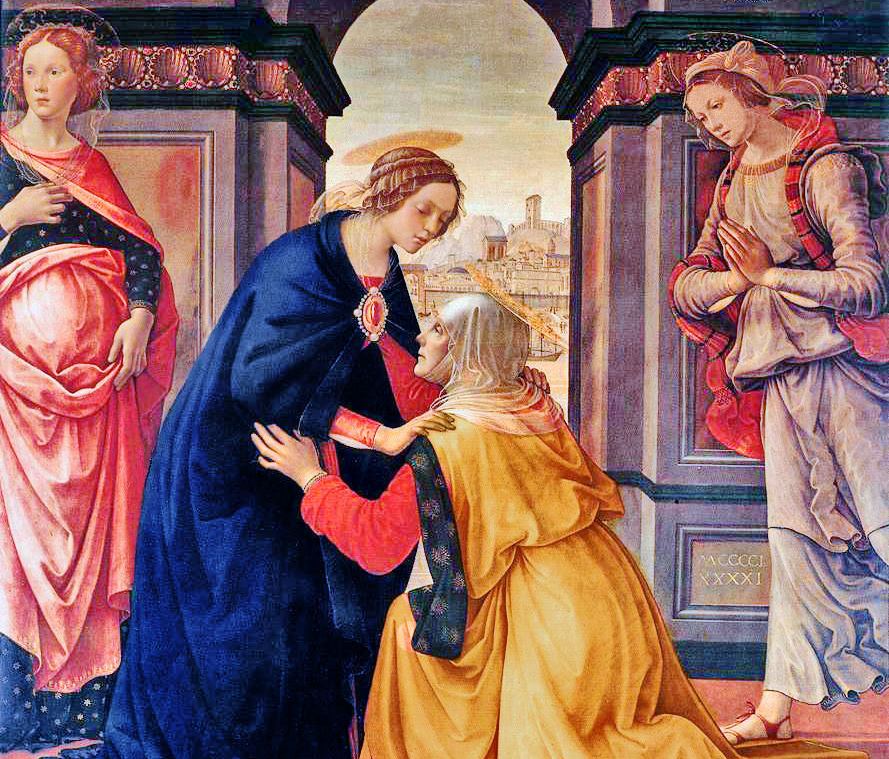
Mary set out and went as quickly as she could to a town in the hill country of Judah. She went into Zechariah’s house and greeted Elizabeth. Now as soon as Elizabeth heard Mary’s greeting, the child leapt in her womb and Elizabeth was filled with the Holy Spirit. She gave a loud cry and said, ‘Of all women you are the most blessed, and blessed is the fruit of your womb. Why should I be honoured with a visit from the mother of my Lord? For the moment your greeting reached my ears, the child in my womb leapt for joy. Yes, blessed is she who believed that the promise made her by the Lord would be fulfilled.’
To pause in three “places” of astonishment
Pope Francis
The Gospel for this Sunday of Advent highlights the figure of Mary. We see her when, just after having conceived in faith the Son of God, she makes the long trip from Nazareth, in Galilee, to the hill country of Judah, to visit and help her cousin Elizabeth. The Angel Gabriel had revealed to her that her elderly relative, who did not have children, was in her sixth month of pregnancy (cf. Lk 1:26-36). That’s why Our Lady, who carried within her a gift and an even greater mystery, goes to see Elizabeth and stays with her for three months. In the meeting between these two women — one old and the other young — it is the young one, Mary, who offers the first greeting. The Gospel says: “she entered the house of Zechariah and greeted Elizabeth” (Lk 1:40). After this greeting, Elizabeth feels enveloped in great astonishment — don’t forget this word, astonishment. Astonishment. Elizabeth feels enveloped in great astonishment which is echoed in these words: “And why is this granted me, that the mother of my Lord should come to me?” (v. 43). And they embrace and kiss each other, joyfully, these two women. The elderly woman and the young one, both pregnant.
To celebrate Christmas in a fruitful manner, we are called to pause in “places” of astonishment. And what are these places of astonishment in everyday life? There are three. The first place is the other, in whom we recognize a brother or sister, because since the birth of Jesus occurred, every face is marked with a semblance to the Son of God. Above all when it is the face of the poor, because God entered the world poor, and it was to the poor, in the first place, that he allowed himself to draw near.
Another place of astonishment — the second place in which, if we look with faith, we actually feel astonishment, is history. So many times we think we see it the right way, and instead we risk reading it backwards. It happens, for example, when history seems to us to be determined by the market economy, regulated by finance and business, dominated by the powers that be. The God of Christmas is instead a God who “shuffles the cards” — he likes doing so! As Mary sings in the Magnificat, it is the Lord who puts down the mighty from their thrones and exalts those of low degree, who fills the hungry with good things and sends the rich away empty (cf. Lk 1:52-53). This is the second type of astonishment, astonishment in history.
The third place of astonishment is the Church. To look on her with the astonishment of faith means not limiting oneself to consider her only as a religious institution, which she is, but to feel her as a mother who, despite her blemishes and wrinkles — we have so many of them! — allows the features of the beloved bride purified by Christ the Lord to shine through. A Church that is able to recognize the many signs of faithful love that God continuously sends her. A Church for which the Lord Jesus will never be a possession to be jealously protected; those who do this err. The Lord Jesus will always be the One who comes to meet her and whom she knows how to await with trust and joy, giving voice to the hope of the world. The Church that calls to the Lord, “Come Lord Jesus”. The Mother Church that always has her doors open wide, and her arms open to welcome everyone. Moreover, Mother Church goes out from her own doors to seek with a mother’s smile all those who are far and bring them to the mercy of God. This is the astonishment of Christmas.
At Christmas, God gives us all of himself by giving his Only Son, who is all his joy. It is only with the heart of Mary, the humble and poor daughter of Zion, who became the Mother of the Son of the Most High, that it is possible to rejoice and be glad for the great gift of God and for his unpredictable surprise. May she help us to perceive the astonishment — these three wonders: the other, history and the Church — through the birth of Jesus, the gift of gifts, the undeserved gift who brings us salvation. The encounter with Jesus will enable us too to feel this great astonishment. We cannot have this astonishment, however, we cannot encounter Jesus, if we do not encounter him in others, in history and in the Church.
Angelus, 20.12.2015
To rejoice at and to proclaim the Birth of Jesus
Romeo Ballan, mccj
On the threshold of Christmas, the Word of God today offers us the keys to understanding, enjoying and proclaiming to others the mystery we are celebrating. The keys are Mary, the flesh and littleness. First of all Mary, whom the evangelist Luke presents to us in the action of visiting her cousin Elizabeth (Gospel). In a climate of faith and of intense joy, we have the encounter between two women who have become pregnant through a special divine intervention: Elizabeth in her old age; Mary in her virginity. Both are filled with the Holy Spirit (v. 41; Lk 1:35), both are aware of and recognise the signs of the presence of the Spirit, ready to praise and thank Him for his wonderful works (vv. 42-45;46-48). These elements make of the Visitation a mystery of faith, of joy, of service, of missionary proclamation. Mary, hurrying her footsteps (v. 39), carrying Jesus in her womb, is the image of the missionary Church taking to the world the proclamation of the Saviour.
“Blessed is she who believed”, exclaims Elizabeth (v. 45). It is the first Beatitude of the Gospel. Through faith Mary conceived the Son of God in her heart before giving birth to him in the flesh. She believed, that is, she trusted, she abandoned herself to God. Mary’s words: “You see before you the Lord’s servant, let it be done…” (v. 38) are in tune with the assent of Jesus who, according to the author of the Letter to the Hebrews (2nd. Reading), on coming into the world said: “Here I am, I am coming to do your will, God” (v. 7). This is the one cult that is pleasing to God, the worship of the true adorers of the Father “in spirit and in truth”, as Jesus himself will reveal to the Samaritan woman (Jn 4:23).
For a long time – we might say for always – God takes no pleasure in the smell of incense or of the smoke form the burning flesh of animals sacrificed in the temple, as the letter to the Hebrews says (v. 6-8). He wants to dwell in a temple of flesh, in the hearts of people, to become the centre of every thought and of every concern, the reason for every option and decision, the root of every joy. Only at this level can we speak of a true conversion of the heart, a conversion that goes beyond external gestures that are purely ritual, beyond superficial practices and abstract formulae learned by rote.
Jesus is the true adorer of the Father: from his first coming into the world he does not offer Him animals or incense (v. 5-6), but presents himself, his body, as an offering of love for the sanctification of all (v.10), excluding no-one, because ”he is not ashamed to call them brothers” (Heb 2:11). “Caro salutis est cardo” (the flesh is the hinge of salvation), was a favourite expression of the Fathers of the early centuries, with their great ‘feeling’ for both the human and the divine. With that expression they stressed that God wanted to make his salvation concrete and manifest, making it pass through the human flesh of the Son of God,the son of Mary. It is at the school of Mary that the Pope invites us to meet Jesus at Christmas and in the Eucharist.
All this wonderful work of salvation is carried out through small and simple signs, humble persons and events. The biblical example of the day is Bethlehem (1st. Reading), a tiny village, but the cradle of a ruler who “will feed his flock in the power of the Lord”, will give security and peace to the people, “for his greatness will extend to the most distant parts of the country” (v. 3). Bethlehem is an insignificant little place, but God chooses it for the birth of the one who is the ‘Best news of All’ for all nations. At the very beginning of this event we find Mary, who rejoices and sings, aware that God “has looked upon the humiliation of his servant” (v. 48).
Even today God carries out his great works through weak instruments, humble gestures, situations that – humanly speaking – are hopeless. One is led to ask: so who, then will be saved? Those who, with a pure and ready heart, welcome the mystery of that Child born in Bethlehem two thousand years ago; those who listen to his message and become builders of his peace, carriers of his joy, missionaries who announce him. Like Mary, like the shepherds!
RICH IN THEIR POVERTY
Fernando Armellini
“Answer me, for I am poor” (Ps 86:1), so prays the Psalmist. It surprises the reason he thinks to convince God to intervene on his behalf: I am poor. To gain access to the palaces of the sovereigns, of the rulers of this world, solid recommendations are necessary, titles of merit must be exhibited, credentials and merits are required. It is not like this with God: the only certificate needed to be received in audience is the state of poverty.
His sympathies are with the little ones, the defenseless, the derelict. He, “the father of orphans and defender of widows” (Ps 68:6), prefers those who count for nothing, those who are despicable in people’s eyes. “The Lord has chosen you,” Moses tells the Israelites, “not because you are more numerous than all the other peoples (you are, in fact, the smallest of all peoples), but because the Lord loves you” (Deut 7:7-8).
“The thoughts of the Lord are not our thoughts, and his ways are not our ways” (Is 55:8), which is why they are difficult to understand. Gideon, called to perform an arduous task, objects in amazement: “Oh, Lord! How shall I deliver Israel? My family is the darkest in Manasseh, and I am the most insignificant in my father’s house!” (Jdg 6:15).
Today’s readings present us with a series of situations and minor characters in whom God has worked wonders. They are an invitation to recognize—as Mary did—our poverty and to dispose of ourselves to welcome the work of salvation that the Lord comes to accomplish.
Gospel: Luke 1:39-48
If we interpret this account as a news piece, we wonder why Luke wrote it. Indeed, the gesture of Mary who goes to congratulate her cousin who has received from God the longed-for gift of motherhood is courteous, but it is still a marginal episode; it does not constitute a significant stage in the life of Jesus and does not represent an important point of reference for our faith.
A second observation: some details of this story are at least strange. A strong emotion—mothers assure us—causes sensations even in the fetus and can stimulate some of its movements, but how could it be established that it was a jolt of joy? Nor is it easy to explain Mary’s haste (v. 39) to visit Elizabeth in her sixth month of pregnancy. It is usually said that she rushed to help her cousin. But this is an unconvincing explanation: how could a twelve-year-old girl (this was the age that Mary must have been) presume to take the place of mature and experienced friends and relatives that Elizabeth certainly had in Ain Karim? It is not clear why she left after three months (Lk 1:56), that is precisely at the time of the birth when her cousin would have needed more assistance.
A third observation—and it is the most important one—Is that Mary and Elizabeth, instead of conversing simply, as happens between friends, exchange phrases carefully chosen from the Bible, alluding to episodes and characters from the Old Testament with a fineness and competence that is truly impressive. More than a chat between women of the people, it seems to be a dialogue between two biblical scholars and well-prepared biblical scholars.
Let us pay attention: the Gospel is not a collection of information, written to satisfy curiosity, but it is a text of catechesis. It aims to nourish the disciple’s faith and wants to make us understand who Jesus is, to whom we are called to give our adherence. To grasp the message, it is always necessary to keep in mind the language used in the time it was written and pay close attention to the references, sometimes explicit, other times a bit veiled, to the Old Testament.
After this introduction, let’s try to understand what Luke wants to teach us in today’s passage. Let us begin with the apparently banal and superfluous note with which the story begins: “As soon as Mary entered the house of Zechariah, she greeted Elizabeth” (v.40). Had it been the usual ‘good morning!’ the evangelist would not have underlined it. If he emphasizes it, it means that this greeting is significant for him, and in the following verse, he recalls it again: “When she heard the greeting, the Baptist leaped for joy.”
The Jews of that time and those of today, when they meet, make only one wish: Shalom – Peace. Peace indicates the accumulation of goods that God has promised to his people and that must be realized at the coming of the Messiah: “In his days,” said the Psalmist, “justice will flourish and peace will abound, until the moon is extinguished” (Ps 72:7). The Messiah is called by the prophet Isaiah the “prince of peace” (Is 9:5).
On Mary’s lips, the word peace is a solemn proclamation: the announcement that the awaited Messiah has come into the world and with him has begun the kingdom of peace of which the prophets spoke. Like Mary on the mountains of Judea, like the angels who in Bethlehem sang: “Peace on earth to those whom God loves” (Lk 2:14), today Christ’s disciples speak only words of peace. “Into whatever house you enter,” Jesus recommended, “first say, ‘Peace be to this house'” (Lk 10:5).
Elizabeth’s words to Mary: “Blessed are you among women!” are not original. In the Old Testament, two women are greeted similarly: Jael (Jdg 5:24) and Judith (Jdt 13:18). What had they done that was extraordinary? They had succeeded (an unprecedented feat for women!) in annihilating the oppressors of their people. The Bible does not record these stories to endorse war, but only to show, using examples understandable to the mentality of the time, how God is accustomed to performing marvelous deeds using fragile and unsuitable instruments.
Applying this exact phrase to Mary, Luke affirms that she too belongs to the category of weak and poor instruments with which God is used to carrying out his works of salvation. Through Mary, he has realized the most extraordinary event in history: he has given his son to people.
Elizabeth continues: “To what do I owe that the mother of my Lord should come to me?” (v. 43). This phrase is also copied from the Old Testament. It was pronounced by David on a very solemn occasion when the ark of the covenant was brought to Jerusalem,in which the Lord was believed to be present. In receiving it, the king exclaimed, “How shall the ark of the Lord come to me?” (2 Sam 6:9).
Other significant details place Mary’s visit in parallel with the episode of the ark of the covenant: both Mary and the ark remain three months in a house in Judea. The ark is received with dances, shouts of joy, songs of celebration and is a source of blessings for the family that welcomes it (2 Sam 6:10-11) and Mary, entering the house of Zechariah, makes little John (representing all the people of the Old Testament who rejoice for the coming of the Messiah) jump for joy. It is thus quite evident that Luke intends to present Mary as the new ark of the covenant. Since God has chosen to become man, he no longer dwells in stone buildings, a temple, or a sacred place, but the womb of a woman. Mary’s son is the Lord himself.
Wherever Mary—the new ark of the covenant—arrives, there is an explosion of joy: the Baptist leaps for joy (v. 41), Elizabeth cries out her joy at having been visited by the Lord (v. 42), the poor exult because the moment of their liberation has arrived (vv. 46-48).It is the joy that characterizes the messianic times. Zechariah will experience it when he blesses the Lord because “he has visited and redeemed his people” (Lk 1,68); it will be announced by the angel to the shepherds: “Behold, I bring you good news of great joy, which will be for all the people” (Lk 2:10). Simeon will rejoice when he takes the child in his arms and contemplates with his own eyes the “salvation prepared by God before all peoples, a light to enlighten the nations” (Lk 2:29-32). Welcoming the Lord who comes does not mean renouncing joy but opening wide the doors to true joy.
Mary is proclaimed blessed because “she believed in the fulfillment of the Lord’s words” (v. 45). How many promises God has made through the mouths of his prophets! However, when these took a long time to be fulfilled, people began to doubt the faithfulness of the Lord. They thought they had misunderstood or been deceived. They began to trust their reasoning, their projects, their own choices, and they met with systematic failures. On the other hand, Mary is blessed because she trusted God; shecultivated the certainty that, despite all appearances to the contrary, the word of the Lord would be fulfilled.
Blessed is she who believed. This is the first beatitude we encounter in Luke’s Gospel,and—note—it is formulated in the third person (not: Blessed are you…). This indicates that the beatitude is not reserved for Mary but should be extended to all those who trust the word of the Lord. In John’s Gospel, this same beatitude is found at the end. The Risen One addresses it to Thomas: “Blessed are those who, though they have not seen, will believe” (Jn 20:29). Authentic faith, which Mary gives proof, does not need visions, demonstrations, or verifications. It is based on listening to the Word and is manifested in unconditional adherence to this Word.
It is not easy to believe, especially when asked to go against ‘common sense.’ It takes a lot of courage to believe that God’s promises to the peacemakers, to the non-violent, to those who turn the other cheek, to those who do not take revenge, to those who give their lives out of love will be fulfilled. Mary shows that the Lord’s words are worth trusting, always. “Blessed are those who—as she did—hear the word of God and keep it”(Lk 11:28).
The Gospel passage concludes with the first verses of the hymn of praise to the Lord that Luke placed on Mary’s lips. Mary is the first to realize the wonders worked by the Lord and to sing them. It all begins with the gaze that God turns to her, completely different from that of people. People look towards those who can enrich them. God turns his eyes on those who count for nothing, despised, unproductive, and in painful conditions. Judith prayed to him in this way: “You are the God of the humble, you are the rescuer of the derelict, the refuge of the weak, the protector of the disheartened, the savior of the desperate” (Jdt 9:11).
Mary understood that God’s gaze is not attracted by merits, spiritual perfection, but by human need. She placed herself among the poor and became the interpreter of their feelings of gratitude.
