18th Sunday in Ordinary Time – Year B
John 6: 24-35
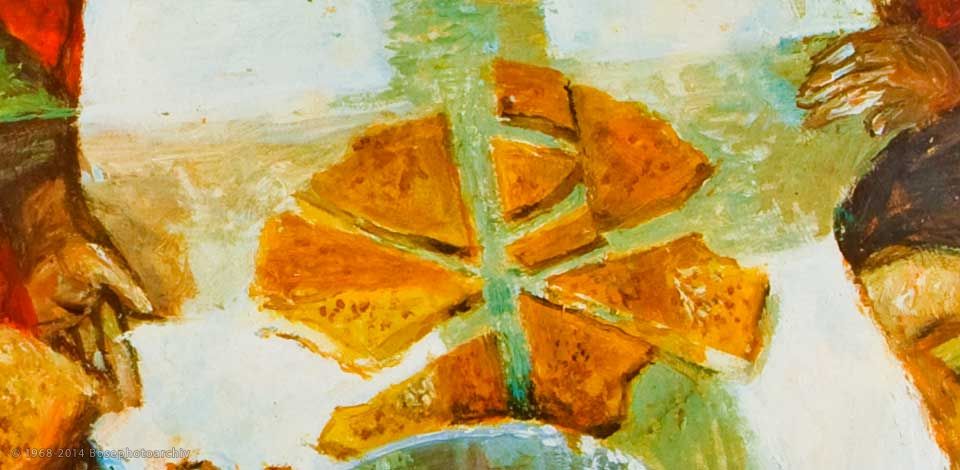
When the people saw that neither Jesus nor his disciples were there, they got into boats and crossed to Capernaum to look for Jesus. When they found him on the other side, they said to him, ‘Rabbi, when did you come here?’
Jesus answered: ‘I tell you most solemnly, you are not looking for me because you have seen the signs but because you had all the bread you wanted to eat. Do not work for food that cannot last, but work for food that endures to eternal life, the kind of food the Son of Man is offering you, for on him the Father, God himself, has set his seal.’
Then they said to him, ‘What must we do if we are to do the works that God wants?’
Jesus gave them this answer, ‘This is working for God: you must believe in the one he has sent.’
So they said, ‘What sign will you give to show us that we should believe in you? What work will you do? Our fathers had manna to eat in the desert; as scripture says: He gave them bread from heaven to eat.’
Jesus answered: ‘I tell you most solemnly, it was not Moses who gave you bread from heaven, it is my Father who gives you the bread from heaven, the true bread; for the bread of God is that which comes down from heaven and gives life to the world.’ ‘Sir,’ they said ‘give us that bread always.’ Jesus answered: ‘I am the bread of life. He who comes to me will never be hungry; he who believes in me will never thirst.
Two question we can ask ourselves
Pope Francis
The initial scene of the Gospel in today’s liturgy (see Jn 6,24-35) shows us some boats moving towards Capernaum: the crowd is going to look for Jesus. We might think that this is a very good thing, yet the Gospel teaches us that it is not enough to seek God; we must also ask why we are seeking him. Indeed, Jesus says: “You seek me, not because you saw signs, but because you ate your fill of the loaves” (v. 26). The people, in fact, had witnessed the miracle of the multiplication of the loaves, but they had not grasped the meaning of that gesture: they stopped at the external miracle, they stopped at the material bread: there only, without going beyond, to the meaning of this.
Here then is a first question we can ask ourselves: why do we seek the Lord? Why do I seek the Lord? What are the motivations for my faith, for our faith? We need to discern this, because among the many temptations we encounter in life, among the many temptations there is one that we might call idolatrous temptation. It is the one that drives us to seek God for our own use, to solve problems, to have thanks to Him what we cannot obtain on our own, for our interests. But in this way faith remains superficial and even, if I may say so, faith remains miraculous: we look for God to feed us and then forget about Him when we are satiated. At the centre of this immature faith is not God, but our own needs. I think of our interests, many things … It is right to present our needs to God’s heart, but the Lord, who acts far beyond our expectations, wishes to live with us first of all in a relationship of love. And true love is disinterested, it is free: one does not love to receive a favour in return! This is self-interest; and very often in life we are motivated by self-interest.
A second question that the crowd asks Jesus can help us: “What must we do, to be doing the works of God?” (v. 28). It is as if the people, provoked by Jesus, were saying: “How can we purify our search for God? How do we go from a magical faith, which thinks only of our own needs, to a faith that pleases God?” And Jesus shows the way: He answers that the work of God is to welcome the One whom the Father has sent, that is, welcoming Himself, Jesus. It is not adding religious practices or observing special precepts; it is welcoming Jesus, it is welcoming Him into our lives, living a story of love with Jesus. It is He who will purify our faith. We are not able to do this on our own. But the Lord wants a loving relationship with us: before the things we receive and do, there is Him to love. There is a relationship with Him that goes beyond the logic of interest and calculation.
This applies to God, but it also applies to our human and social relationships: when we seek first and foremost the satisfaction of our needs, we risk using people and exploiting situations for our own ends. How many times have we heard it said of someone; “But he uses people and then forgets about them”? Using people for one’s own gain: this is bad. And a society that puts interests instead of people at its centre is a society that does not generate life. The Gospel’s invitation is this: rather than being concerned only with the material bread that feeds us, let us welcome Jesus as the bread of life and, starting out from our friendship with Him, learn to love each other. Freely and without calculation. Love given freely and without calculation, without using people, freely, with generosity, with magnanimity.
Let us now pray to the Holy Virgin, She who lived the most beautiful story of love with God, that she may give us the grace to open ourselves to the encounter with her Son.
Angelus 1/8/2021
There is Bread that Gives Eternal Life
Fernando Armellini
Introduction
A person’s dream has always been to have life, eternal life. To achieve this, Gilgamesh, the hero of Mesopotamian literature, had challenged the monster Humbaba in the garden of cedars. Then he went down the abyss of the seas to take possession of the grass which is called “the old becomes young.” He reached it but a snake stole it from him. The destiny of man is sad; he is born to die. Dejected, the psalmist also concluded: “For redeeming one’s life demands too high a price and all is lost forever. Who can remain forever alive and never see the grave” (Ps 49:9-10). Despite of being short as a breath (Ps 144:4), this life is sacred and inviolable.
In the Hebrew language the word “to live” is never applied to animals or plants, but only to humans, and is used as a synonym of “to heal,” “to recover health,” “to be happy.” Only one who lives a peaceful existence, free from disease, full of joy, really lives. Tears and pain are signs of death.
Bread maintains, but does not ensure biological life forever; it is destined to be extinguished, and the legendary plant of immortality is a chimera, an illusion. But God has a bread that communicates eternal life, and has given it to the world, because he wants everyone to have life and have it abundantly (Jn 10:10). “While all was in quiet silence and the night was in the middle of its course” (Wis 18:14), he sent his word, “Whatever has come to be, found life in him; life which comes for human beings, was also light” (Jn 1:4).
Gospel: John 6:24-35
The final scene of last Sunday’s gospel marked, according to human criteria, the pinnacle of Jesus’ success. A huge crowd cheered him and, moved by an irrepressible enthusiasm, tried to take him to make him king. What looked like a triumph was, however, for Jesus, the most disappointing of results, the evidence that he was not able to make people understand the sign. His gesture had been misunderstood: he had proposed sharing and they had understood comfortable multiplication of food.
To reflect on the way in which to introduce the crowd in understanding the signs of bread, Jesus withdrew to the mountain (Jn 6:15), but the next day they tracked his trail and catching up with him in Capernaum, they ask him, “Master, when did you come here?” (vv. 24-25).
Jesus does not answer the question put to him, but to the real one, the one that all would like to ask: “Will you repeat the miracle today? Will you guarantee us bread forever?” He goes right to the heart of the problem: “You look for me, not because of the signs which you have seen, but because you ate bread and were satisfied. Work then, not for perishable food, but for the lasting food which gives eternal life” (vv. 26-27).
He realized that they are not seeking him because they are hungry of his word, because they want to deepen his message and be helped to understand the gesture he did. They only hope to continue to have food in abundance, for free, without working.
In the first part of the passage (vv. 24-27), Jesus begins to disperse the confusion that has been created. He did not come to turn, with the magic wand, the stones into bread, but to teach that love and sharing produce bread in abundance. He then accompanies the audience from the first step of faith, that of the admiration and gratitude for the food received, then a second step, higher, that of understanding the message contained in the gift that he has given.
In the misunderstanding of the people of Capernaum, the evangelist wants that every Christian sees, as a watermark, his own incomprehension. He turns to the disciple the invitation to verify, to ask oneself of the motive of seeking the Lord, taking refuge in him, praying and practicing religion. Many, such as those who have witnessed the miracle of the loaves, should admit to being moved by the secret hope of obtaining from Jesus the food which perishes: special graces, miracles, health, success, wealth, protection against misfortunes. The proliferation, in certain sectors of the Church, of practices related to magic to achieve healing and secure the favor of the Lord, proves that the misunderstanding on the “bread” that Jesus offers is always present. Even the Samaritan woman did not understand that the Master was giving her a water different from that of the well.
So what is the food “which endures to eternal life”?
In last Sunday’s gospel there is perhaps one overlooked detail: at the beginning of the story there were the loaves and fish, then later, oddly enough, they were forgotten and all the attention was focused on the bread. Even at the end, after the collection of the twelve baskets of leftover bread, we would have expected a reference to the fish, instead nothing. They had appeared and shall not be remembered even in the long discourse of Jesus.
The symbolism of the “five loaves” and the “two fish” will be obvious to those who know the language of the Bible and remember the words of Moses: “Man lives not on bread alone, but that all that proceeds from the mouth of God” (Dt 8:3), and the invitation addressed to the inexperienced of the Wisdom of God, “Come, eat of the bread” (Prov 9:5); “Why spend money on what is not food, and labor on what does not satisfy?” (Is 55:1). Here is the bread of the Lord: his word, his teaching; the “five” books of the Pentateuch, the Torah, are the bread of life.
And the “two fish?” They are the bread of bread representing the other two series of sacred books of Israel, the Prophets and the other scriptures, which were used as complement to the Torah. They helped to better understand and assimilate it.
It is only the bread that remains. On the boat—Mark notes—the disciples “had only one loaf with them” (Mk 8:14), Jesus, whose word is all the food that God has given to his people. Who has him does not need other bread, has no need of other revelations.
It is in this symbolism that Jesus wants to introduce to his listeners who instead insist on thinking only of material food.
How do we nourish ourselves with this bread? “What must we do?”—the crowd of Capernaum ask Jesus. The answer is given in the second part of the passage (vv. 28-33).
Not many works, but only one, to believe in him whom the Father sent. No other thing is required.
In the Gospel of John the word “faith,” so dear to Paul, is never found. The verb “to believe” often recurs. It indicates the vital act of one who unconditionally trusts the word of Jesus, who takes his Gospel and assimilates it as happens with food. The Gospel was written “that you may believe that Jesus is the Christ, the Son of God. Believe and you will have life in his name” (Jn 20:31). He who believes in this way has eternal life (Jn 3:16; 6:40,47).
It is not enough to be convinced that Jesus existed, that he was a great character, who preached love and laid down rules of a wise life. The atheists are also convinced of all this. When the bride declares “to believe” in her husband, she means that she trusts him blindly, shares his choices, is willing to risk her life with him, sure that, with no other, she could be happy.
Jesus asks this blind trust. That is the reason why the Jews, before giving it to him, demand of him a concrete evidence, a great miracle (vv. 30-33). The fact of the loaves is not enough because Moses did so much more; he not only gave manna for a meal and only five thousand men; he has fed an entire people for forty years.
(Jesus clarifies: it was not Moses who gave the bread from heaven. It was my Father, the same one who gives today to the world, no longer the manna, but the food that feeds a life not destined to perish, the true bread from heaven that gives life to all humanity. The moldy manna (Ex 16:20) decomposes, just as rust corrodes or as thieves steal the treasures accumulated in this world, but the bread of Christ does not perish when collected and stored in baskets, redistributed, always entire and tasty to those who are hungry.)
What is this bread of heaven? Why does Jesus not give it at once to all? In the last part of the passage (vv. 34-35) the answer to these questions is given.
“Give us this bread always”—asks the crowd. A similar sentence was pronounced even by the Samaritan woman: “Give me this water” (Jn 4:15). The woman did not understand what water was promised by Jesus. She kept thinking of the water from the well. Now, the people fall into the same mistake. They cannot detach their thoughts from the material bread.
Jesus makes it clear: “I am the bread of life; whoever comes to me shall never be hungry, and whoever believes in me shall never be thirsty” (v. 35).
The Bible often uses images of hunger and thirst to indicate the need for God. “My soul thirsts for God, for the living God,” sang the psalmist (Ps 42:3) and Jeremiah confessed to the Lord: “I devoured your word when they came. They were my happiness and I felt full of joy” (Jer 15:16).
Man longs for life and all that favors and feeds it. In this search of food, unfortunately, one is often mistaken, because the sages taught, “the hungry finds any bitter thing sweet” (Prov 27:7). The only bread that satisfies the need for happiness is the word of Christ. His gospel, and not the manna in the desert, is the bread that came down from heaven. So that it can communicate life, however, it should not be a text to be read and evaluated in a detached way, as it is done with the sayings of the sages of the past, but be treated as the bread that becomes life of those who eat it.
These statements of Jesus do not yet refer to the Eucharist. The bread is he himself as the Word of God.
https://sundaycommentaries.wordpress.com
BREAD OF ETERNAL LIFE
by José Antonio Pagola
Why does Jesus hold our interest after 20 centuries? What can we expect of him? What can he give to support men and women of our time? Is he perhaps going to solve the problems of today’s world? The Gospel of John speaks of a very interesting dialogue that Jesus holds with a crowd on the shores of Lake Galilee.
The day before, they have shared a surprising and free meal with Jesus. They have eaten bread until they were filled. How would they just allow him to walk away? What they look for is that Jesus repeat his action and again feed them for free. They aren’t thinking about anything else.
Jesus upsets them with an unexpected proposition: «Do not work for food that goes bad, but work for food that endures for eternal life». But how would we not be worried about our daily bread? Bread is indispensible for life. We need it and ought to work so that no one ever lacks it. Jesus knows that. Bread is number one. Without eating we can’t subsist. That’s why he’s so worried about the hungry and the beggars, who don’t receive from the rich even the crumbs that fall from their tables. That’s why he speaks ill of the foolish landowners who store up grain without thinking of the poor. That’s why he teaches his followers to ask the Father every day for bread for all God’s children.
But Jesus wants to awaken in them a different kind of hunger. He speaks to them of the bread that doesn’t only satisfy hunger for one day, but can satisfy the hunger and thirst for life that exists in the human heart. We must never forget it. Within us is a hunger for justice for all people, a hunger for freedom, peace, truth. Jesus presents himself as that Bread that comes to us from the Father not to fill us with food, but «to give life to the world».
This Bread that comes down from God «gives life eternal». The food we eat each day keeps us alive for years, but comes the time when that food can’t defend us from death. It’s useless to keep on eating. It can’t give us a life that’s greater than death.
Jesus presents himself as «bread of eternal life». Each one of us needs to decide how we want to live and how we want to die. But those who call ourselves followers of Jesus need to know that to believe in Christ is to nourish an unprecedented power in us, to begin to live in a way that doesn’t end in our death. Simply speaking, to follow Jesus is to enter into the mystery of death, sustained by his resurrecting power.
When they heard his words, those people of Capernaum cried out from the depths of their hearts: «Sir, give us that bread always». With our wavering faith, we sometimes don’t dare to ask for such a thing. Perhaps we only worry about the food for each day. And sometimes just for ourselves alone.
José Antonio Pagola
Translator: Fr. Jay VonHandorf
