15th Sunday in Ordinary Time – Year B
Mark 6:7-13
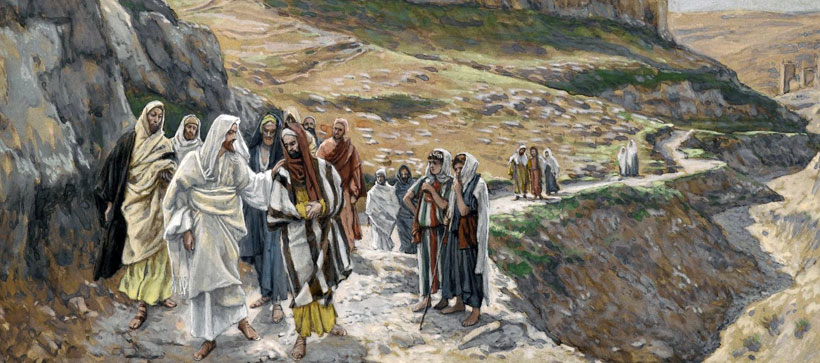
Jesus made a tour round the villages, teaching. Then he summoned the Twelve and began to send them out in pairs giving them authority over the unclean spirits. And he instructed them to take nothing for the journey except a staff – no bread, no haversack, no coppers for their purses. They were to wear sandals but, he added, ‘Do not take a spare tunic.’ And he said to them, ‘If you enter a house anywhere, stay there until you leave the district. And if any place does not welcome you and people refuse to listen to you, as you walk away shake off the dust from under your feet as a sign to them.’ So they set off to preach repentance; and they cast out many devils, and anointed many sick people with oil and cured them.
The mission has a centre; the mission has a face
by Pope Francis
Today’s Gospel passage (cf. Mk 6:7-13) narrates the moment Jesus sends the Twelve [Apostles] on mission. After calling each of them by name “to be with him” (Mk 3:14), listening to his words and observing his gestures of healing, he now calls them again to “send them out two by two” (6:7) to the villages he was going to visit. It is a sort of “internship” of what they would be called to do following the Resurrection of the Lord, through the power of the Holy Spirit.
The Gospel passage pauses on the style of the missionary which we can sum up in two points: the mission has a centre; the mission has a face.
First of all, the missionary disciple has his centre of reference who is Jesus himself. The narrative indicates this by using a series of verbs which have him as the subject — “He called to him”; he “began to send them”; he “gave them authority”; “he charged them”, “he said to them” (vv. 7, 8, 10) —, so that the going out and working of the Twelve appears to be radiating from a centre, reaffirming the presence and work of Jesus in their missionary actions. This demonstrates that the Apostles have nothing of their own to proclaim, nor any abilities to manifest, but rather that they speak and act as “emissaries”, as messengers of Jesus.
This episode of the Gospel also applies to us and not only to priests but to all baptized people called to witness to the Gospel of Christ in the various spheres of life. And for us too, this mission is authentic only in so far as its unchanging centre who is Jesus. It is not an initiative of faithful individuals nor of groups and not even of large gatherings. It is the mission of the Church, inseparably united to her Lord. No Christian proclaims the Gospel “on his/her own”, but is only sent by the Church who received the mandate from Jesus himself. Indeed it is Baptism that makes us missionaries. A baptized person who does not feel the need to proclaim the Gospel, to proclaim Jesus, is not a good Christian.
The second characteristic of the missionary’s style is, so to speak, a face, which consists in the poverty of means. His accoutrement responds to a criteria of modesty. Indeed the Twelve have the order to “take nothing for their journey except a staff; no bread, no bag, no money in their belts” (6:8). The Teacher wants them to be free and unhampered, without reserves and without favours, certain only of the love of the One who sends them, strengthened only by his Word which they go to proclaim. The staff and the sandals are the gear of pilgrims because that is what the messengers of the Kingdom of God are, not omnipotent managers, not irreplaceable officials, not celebrities on tour. (…) And to this “face” also belongs the way the message is received: it can happen that one is not welcomed or listened to (cf. v. 11). This too is poverty: the experience of failure. The experience of Jesus who was rejected and crucified anticipates the destiny of his messenger. And only if we are united to Him, who died and Rose, can we find the courage to evangelize.
May the Virgin Mary, the first disciple and missionary of the Word of God, help us to convey to the world the message of the Gospel in a humble and radiant exultation, beyond any rejection, misunderstanding or tribulation.
Angelus 15/07/2018
Stripped of Everything to be Free and Credible
by Fernando Armellini
Introduction
Looking straight at the paralytic who was begging at the temple gate called “Beautiful,” Peter said, “Look at us.” He looked at them, expecting to receive something from them. But Peter continued: “I have neither silver nor gold, but what I have I give you; in the name of Jesus Christ of Nazareth, the Messiah, walk!” (Acts 3:1-10).
The cripple was expecting anything but this. His fortune was to have met the two disciples who, faithful to the provisions of the Master, did not bring anything with them. Had they had money, they would have given alms, then he would have gone away, leaving him in a condition as before. The wonder took place because Peter and John were conscious of being custodians of a divine power, a word that can restore anyone who lies on the ground, unable to manage his own life, and depends on the compassion of others.
It is commendable that, where no one acts, the church performs a substitute work in areas where she is not specifically competent, but refuses to be identified with the humanitarian institutions. She keeps vigilance to avoid being innocently involved in spectacular and lucrative initiatives, so as not to compete with civilian structures that, through the commitment of lay Christians, is instead called to animate. She possesses a divine word and it is on this word that she relies, resisting the temptation to resort to means that people consider more effective. When she uses them, she can also do good, but she limits herself to begging, putting a new patch on an old garment, while her task is to create a completely new man, society, and world.
Gospel Reflection
In the first reading we came across two significant and opposite characters: Amaziah, the priest well integrated into the religious structure, full of merits and privileges and Amos, the rugged herdsman who suddenly began to be the prophet.
The first is a successful man, acclaimed and respected for being a friend of the powerful that he has achieved a prestigious position. He is not to be envied. He has it all, but he is not free. At any time he can be restricted by the sovereign who gives the bread, but he can also deny him. He is forced to show respect and unconditional veneration, to be always ready to flatter, to go along with the political games of his protector and turn a blind eye to his misdeeds.
Amos is poor, but independent. He can say what he thinks, has nothing to lose, nothing to defend and owes nothing to anyone.
Poor to be free could be the motto that summarizes the conditions laid down by Jesus in today’s Gospel to those who are called to proclaim his word.
They should look like Amos, not Amaziah.
The passage opens with the sending out of the twelve (v. 7).
All are sent, without exception. This indicates that the proclamation of the gospel is not a chore reserved for members of the community. The disciple who does not feel the need to share with others the gift received, probably is not yet convinced that, discovering Christ, he has found the most precious treasures.
The apostles are sent out two by two, not to keep each other company, but for a theological reason. Unlike Hinduism, Buddhism and all religions that propose as ideal the achievement of one’s own spiritual perfection, inner balance, purification—these objectives can be achieved even in a more complete loneliness and isolation—Christianity cannot but be lived in community, and to build a community, there need to be at least two. This is the reason why even the work of evangelization is never of individuals who preach their own personal insight or inspiration. Whoever proclaims the gospel must remain in full harmony and communion with the Church.
There is another important novelty introduced by Jesus. The rabbis did not go to look for disciples. The students were the ones who came to them to learn the Torah. Jesus instructs his apostles to go and offer the gospel message to people in their homes, in the environments in which they live. They do not have to wait for someone to look for them.
Finally, a power is conferred on the apostles. It may surprise us that Jesus did not give them the authority to command, to issue enforced regulations. The only power that the apostles received is the same that Jesus exercised: to give orders to “unclean spirits.” “Unclean spirits” are all forces that turn people away from God and from life, arouse bad feelings and cause oppression, violence and injustice. In comparison with these negative forces that dominate the world, the Christian community will certainly come out victorious, because the Master has invested her with an irresistible force, his own Spirit.
In the second part of the passage (vv. 8-9) the instructions regarding the equipment that the messengers of the Gospel can bring with them. It must be very light: only one tunic, a pair of sandals, a stick and nothing else. The rest is a baggage that weighs down. The material resources must be reduced to the essentials.
Let’s start with the stick. It was the weapon of the poor, therefore, in Matthew’s Gospel, Jesus forbids it (Mt 10:10). The disciples of Christ are peacemakers, therefore, they repudiate all the tools that prompt the use of violence.
In today’s passage, however, the apostles are allowed. The reason is that, in the Bible, the stick also has another symbolic meaning. Moses and Aaron, in pairs (“two by two”, as Jesus also recommended) fought against the oppressive forces of the pharaoh. They brought to completion the work of liberation of their people using a cane, a sign of God’s power. With it Moses worked wonders before Pharaoh (Ex 7:9-12). He stretched out his hand over the land of Egypt, and brought the locusts (Ex 10:13), divided the Red Sea (Ex 14:16), brought forth water from the rock (Ex 17:5-6).
Even the disciples of Christ have only a stick in his hand to carry out the work of liberating man from “unclean spirits.” They can rely on a single force, the one delivered to them by Jesus: his word.
What they should not carry with them is indicated: no food, no bag, no money … (vv. 8-9).
Jesus clearly uses paradoxes. There is need of being attentive in not giving a reductive interpretation to his words, not making his message feeble, depriving it of its provocative content. It is inane to believe that, if he were alive today, he would not be so severe and would adapt to the needs of modern life. He had nowhere to lay his head (Lk 9:58), but today he would change style and would not hesitate to invest wisely, the money of alms, to fight the sons of darkness with their own weapons.
Times have changed, it is true, and the words of Jesus are not to be taken literally. However, from these it clearly reflects the concern that, among the disciples, the leaven of this world infiltrates, the belief that the success of the mission depends on the amount of material means available to them.
Jesus never despised material goods, but has never presented poverty as an ideal life. However, he warned his disciples against the danger of being influenced by wealth. They are not free to speak the truth and to express what they think if they have to please someone, who, like Amaziah is paid, and must be grateful.
Over the centuries the church has paid a heavy price to the agreements and alliances with the powerful of this world, the compromises with those who have offered privileges, favors and guarantees. She paid for them with the loss of freedom and autonomy.
There is another more important reason that pushes Jesus to demand from his messengers that they present themselves without money and completely bare of all forms of power. Who flaunts superiority inevitably generates suspicion and provokes refusal; who reveals the desire to impose oneself, to obtain ideological victories, becomes disagreeable and brings forth objections. People trust only those who do not instill fear, those who are proud, for this the most effective way to win the trust is to hand over one’s life in the hands of those to whom the Gospel is offered, showing that they depend on them for their upkeep.
Haversack is not allowed, simply because it is not needed. It is a burden and an unnecessary annoyance. The disciple is not allowed to store supplies for the next day. He asks the Father for daily bread. If he gets more, he hands over to those in need what is leftover or surplus.
The complete detachment required by the Master does not only imply the renunciation of material goods. It also includes the rejection of preconceived ideas, traditions, hide-bound beliefs that always tempt to keep one behind or to which one easily clings to in so emotional and irrational way. Certain uses, habits, devotional practices, religious customs, tied to a specific historical and cultural past and innocently confused and equated to the gospel by someone are heavy burdens.
In the third section (vv. 10-11) Jesus speaks of the welcome given to his envoys. Some will be hosted with joy and gratitude; others will be rejected with disdain and contempt. How to react?
“In whatever house you enter, stay there until you leave the place” (v. 10).
At first glance, this recommendation seems an invitation to visit only one family, leaving aside the others. In fact Jesus warns of a serious mistake that could jeopardize the work of his missionaries: who proclaims the gospel will always find pious and generous persons who will offer hospitality in their homes. However, as you can imagine, the first accommodation will not be the best, it will be just one of luck, rather precarious, in which one must adapt to live.
Later, however, the missionaries will certainly meet people well disposed towards them and they will be offered a more comfortable home, then another even better and so on until they will have the chance to establish themselves in palaces.
Jesus recommends: stay in the first house. The disciples are asked a witness of an austere, sober life devoid of any ostentation of luxury. At stake is the credibility of the mission.
And when they are cast out? They will shake the dust from their feet (v. 11).
It was the gesture that every Israelite did leaving the land of the heathens, and entering the holy land. He thus expressed his belief that “the earth partakes of the character of its inhabitants” (Num 5:17) and that, to take leave of the wicked, it would be necessary also to get rid of their dust.
Jesus suggests to his disciples to make this gesture, not as a sign of rejection and contempt, but “a testimony for them.” Note: for them, not against them.
That demand of Jesus is an expression of respect, a call not to insist more than what is needed. They must not be naggers so as not to get the opposite effect, that of annoying people and finally moving them away from the faith.
The authentic apostles are careful never to violate the freedom of others, not to become fanatic and intolerant squealers. They are conscious of being sent to bring a proposal, not to engage in theological battles. Their job is not getting many conversions, but faithfully proclaim the word of Christ. The adhesion or rejection, the more or less abundant fruit do not depend on them, but on the type of soil on which they will sow the seed in abundance, but with gentleness and respect.
The last verse (v. 12) narrates the success of the apostles’ mission. With the power conferred by the Master, they carry out the work of salvation for which they were sent. The sign of this salvation is the defeat of all forms of evil: physical evil (diseases) and moral evil (the expulsion of demons).
https://sundaycommentaries.wordpress.com
A NEW STAGE OF EVANGELIZATION
by José Antonio Pagola
Pope Francis is calling us to a «new stage of evangelization marked by Jesus’ joy». What could it consist of? Where can its novelty lie? What needs to change? What was Jesus’ real intention when he sent his disciples to continue his evangelizing work?
Mark’s story makes it clear that Jesus is the source, the inspiration, and the model of doing evangelization for his followers. They are to do nothing in their own name. They are «sent» by Jesus. They won’t preach themselves: only announce his Gospel. They won’t have other interests: only dedicate themselves to opening up paths to God’s reign.
The only way to push a «new stage of evangelization marked by Jesus’ joy» is to purify and intensify this connection with Jesus. There won’t be a new evangelization if there aren’t new evangelizers, and there won’t be new evangelizers if there’s not a more living, lucid and passionate contact with Jesus. Without him we will do everything except introduce his Spirit into the world.
When he sent them, Jesus doesn’t leave his disciples abandoned to their own power. He gives them his «power», which isn’t a power to control, govern or dominate others, but his power to «cast out evil spirits», free people from what enslaves, oppresses and dehumanizes them.
The disciples know full well what Jesus has put them in charge of. They’ve never seen him govern anyone. They’ve always known him to heal wounds, alleviate suffering, regenerate lives, help people live free from fear, spread trust in God. «Heal» and «free» are priority tasks in Jesus’ way of acting. They will give a radically different face to our evangelization.
Jesus sends them out with what’s necessary to go walking. According to Mark, they will only take a staff, sandals and one tunic. They don’t need anything else to be witnesses of what’s essential. Jesus wants them to be free and without hindrances, always available, without getting comfortably settled, trusting in the power of the Gospel.
Without recovering this evangelical style, there’s no «new stage of evangelization». What’s important isn’t to put in place new activities and strategies, but to let go of customs, structures and compulsions that keep us from being free to spread what’s essential in the Gospel truly and simply.
In the Church we’ve lost that itinerate style that Jesus suggests. Her walking is slow and tiresome. We don’t know how to accompany humanity. We don’t have the agility to pass from a culture that’s over and done with, to the culture of now. We hold onto power that we’ve had. We get caught up in interests that don’t coincide with God’s reign. We need conversion.
José Antonio Pagola
Translator: Fr. Jay VonHandorf
