14th Sunday in Ordinary Time – Year B
Mark 6:1-6
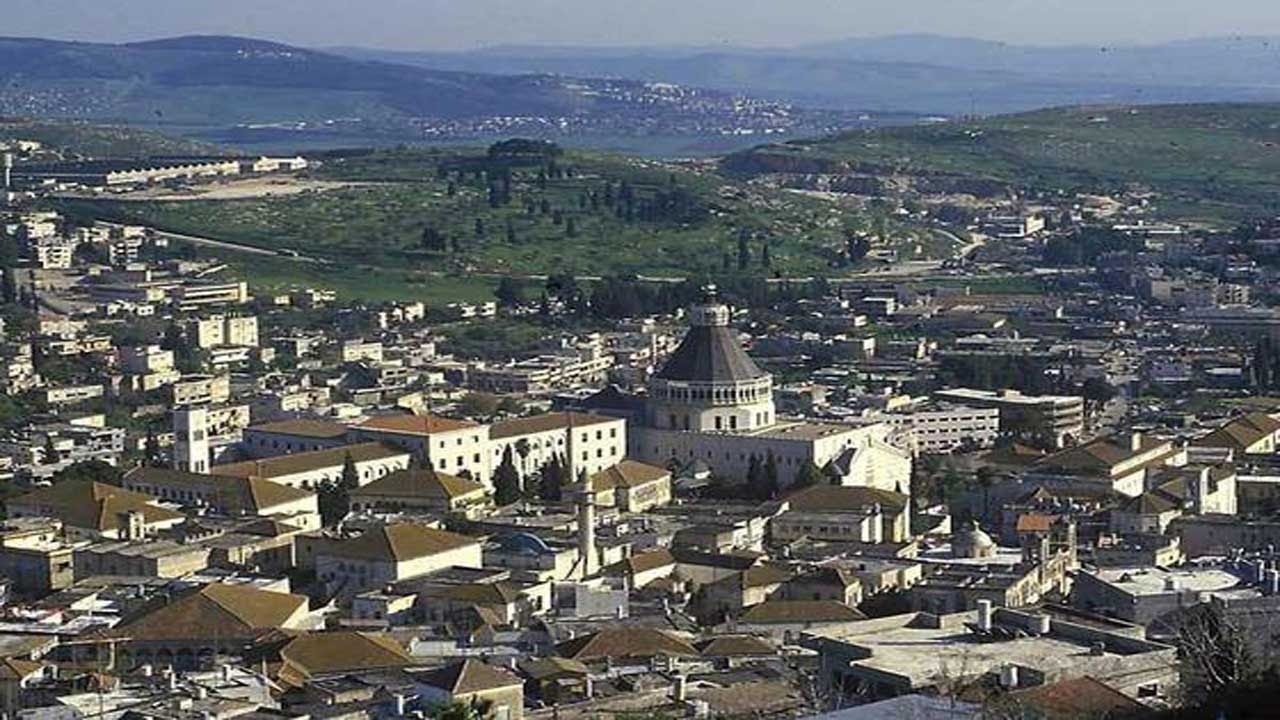
Jesus went to his home town and his disciples accompanied him. With the coming of the sabbath he began teaching in the synagogue and most of them were astonished when they heard him. They said, ‘Where did the man get all this? What is this wisdom that has been granted him, and these miracles that are worked through him? This is the carpenter, surely, the son of Mary, the brother of James and Joset and Jude and Simon? His sisters, too, are they not here with us?’ And they would not accept him. And Jesus said to them, ‘A prophet is only despised in his own country, among his own relations and in his own house’; and he could work no miracle there, though he cured a few sick people by laying his hands on them. He was amazed at their lack of faith.
God revealed in the smallness of our flesh
Pope Francis
This Sunday’s Gospel (Mk 6:1-6) tells us about the disbelief of Jesus’s fellow villagers. After preaching in other villages in Galilee, Jesus returned to Nazareth where he had grown up with Mary and Joseph; and, one sabbath, he began to teach in the synagogue. Many who were listening asked themselves: “Where does he get all this wisdom? But, isn’t he the son of the carpenter and Mary, that is, of our neighbours that we know so well?” (cf. vv. 1-3). Confronted with this reaction, Jesus confirms the truth that had even become a part of popular wisdom: “A prophet is not without honour, except in his own country, and among his own kin, and in his own house” (v. 4). We say this many times…
Let us reflect on the attitude of Jesus’s fellow villagers. We could say they knew Jesus, but they did not recognise him. There is a difference between knowing and recognizing. In essence, this difference makes us understand that we can know various things about a person, form an idea, rely on what others say about that person, we might perhaps meet that person every now and then in the neighbourhood; but all that is not enough. This is a knowledge, I would say ordinary, superficial, that does not recognise the uniqueness of the person. We all run this risk: we think we know so much about a person, even worse, we use labels and close the person within our own prejudices. Jesus’s fellow villagers knew him for thirty years in the same way and they thought they knew everything! “But isn’t this the boy we saw growing up, the son of the carpenter and Mary? Where do these things come from?”. The distrust…in reality, they never realised who Jesus truly was. They remained at the exterior level and refused what was new about Jesus.
And here, we enter into the true crux of the problem: when we allow the convenience of habit and the dictatorship of prejudice to have the upper hand, it is difficult to open ourselves to what is new and allow ourselves to be amazed. We control: through attitudes, through prejudices… It often happens in life that we seek from our experiences and even from people only what conforms to our own ideas and ways of thinking so as never to have to make an effort to change. And this can even happen with God, and even to us believers, to us who think we know Jesus, that we already know so much about Him and that it is enough to repeat the same things as always. And this is not enough with God. But without openness to what is new and, above all – listen well – openness to God’s surprises, without amazement, faith becomes a tiring litany that slowly dies out and becomes a habit, a social habit.
I said a word: amazement. What is amazement? Amazement happens when we meet God: “I met the Lord”. But we read in the Gospel: many times the people who encountered Jesus and recognised him felt amazed. And we, by encountering God, must follow this path: to feel amazement. It is like the guarantee certificate that the encounter is true and not habitual.
In the end, why didn’t Jesus’s fellow villagers recognise and believe in Him? But why? What is the reason? In a few words, we can say that they did not accept the scandal of the Incarnation. They did not know this mystery of the Incarnation, but they did not accept the mystery: they did not know it. They did not know the reason and they thought it was scandalous that the immensity of God should be revealed in the smallness of our flesh, that the Son of God should be the son of a carpenter, that the divine should be hidden in the human, that God should inhabit a face, the words, the gestures of a simple man. This is the scandal: the incarnation of God, his concreteness, his ‘daily life’. And God became concrete in a man, Jesus of Nazareth, he became a companion on the way, he made himself one of us. “You are one of us”, we can say to Jesus. What a beautiful prayer! It is because one of us understands us, accompanies us, forgives us, loves us so much. In reality, an abstract, distant god is more comfortable, one that doesn’t get himself involved in situations and who accepts a faith that is far from life, from problems, from society. Or we would even like to believe in a ‘special effects’ god who does only exceptional things and always provokes strong emotions. Instead, brothers and sisters, God incarnated Himself: God is humble, God is tender, God is hidden, he draws near to us, living the normality of our daily life.
And then, the same thing happens to us like Jesus’s fellow villagers, we risk that when he passes by, we will not recognize him. I repeat that beautiful phrase from Saint Augustine: “I am afraid of God, of the Lord, when he passes by”. But, Augustine, why are you afraid? “I am afraid of not recognising him. I am afraid that when the Lord passes by:Timeo Dominum transeuntem. We do not recognize him, we are scandalised by Him, we think with our hearts about this reality.
Now, in prayer, let us ask the Madonna, who welcomed the mystery of God in her daily life in Nazareth, for eyes and hearts free of prejudices and to have eyes open to be amazed: “Lord that we might meet you!”, and when we encounter the Lord there is this amazement. We meet him in the normal: eyes open to God’s surprises, at His humble and hidden presence in daily life.
Angelus 4th July 2021
The risk of being homeless
Fernando Armellini
Introduction
The skilled politician always manages relations with the religious structure with foresight. He does not fight but flatters it. He tries to make it an ally because he knows that the religious subject is more reliable and also the more devoted, if he can manage to convince him that supporting the established order is tantamount to promoting the kingdom of God. One in power is opposed to that which disrupts the balance of the society or institution. He arrives to his goal when he conveys the idea that there is an equation between what is normally thought and the gospel message, between the principles set forth by the current morals and the values preached by Christ, between the Beatitudes of the world and those of the mountain.
It is a subtle strategy in which, often in good faith, many Christians are involved, but that leads to distort the gospel. The church hierarchy and also the people adapt themselves at times, but never the prophet, who is not, constitutionally, a restless and dissatisfied person, but one who has received and assimilated the thoughts of the Lord. For this he refuses to put God’s seal on man’s plans and denounces the structures marked by sin. His words annoy, provoke irritation and the fate that awaits him cannot be but misunderstanding and rejection.
It happened to Jeremiah, threatened by his countrymen: “Do not prophesy any more in the name of the Lord and we will spare your life;” (Jer 11:21) and warned by God: “Take care, even your kinsfolk and your own family are false with you” (Jer 12:6).
It also happened to Jesus in Nazareth.
Gospel reflection
Various details of this passage are not immediately clear. The inhabitants of Nazareth were astonished by the miracles performed by Jesus (v. 2), but then are “shocked” (v. 3). How to reconcile these two apparently contradictory reactions? To scandalize does not mean to cause a minor disagreement, but being in total disagreement. The neighbors were shocked by his words to the point of considering them an insurmountable obstacle, a major hindrance to their faith. Therefore he must have said or done something particularly provocative.
It is not clear why he was not be able to perform miracles because of their lack of faith (v. 5), even his wonder at the incredulity of the villagers is surprising. He just said that “prophets are despised only in their own country, among their relatives and in their own family” (v. 4), so their refusal should not be strange to him.
We point out one last detail: Jesus in Capernaum was involved in tragic conflicts with the political and religious authorities. He attacked the formalism of the scribes and Pharisees, denounced their hypocrisy and hardness of heart, but he never had any problems with simple people. Now instead it is the people, the peasants of his country who do not understand and reject him. There is, in fact, no reference to the presence of religious leaders. How do you explain this unusual reaction?
After spending a few months in Capernaum, visiting the villages of Galilee, preaching the gospel and healing the sick, Jesus returns to his native village (v. 1).
Some time before his relatives tried to convince him to return to his family and to resume his decent work as a carpenter, but he did not accede to their proposal. Looking on those around him to listen to him, he exclaimed: “Here are my mother and my brothers! Whoever does the will of God is brother and sister and mother to me” (Mk 3:31-35).
Now, on his own initiative, he returns to Nazareth, accompanied by a group of disciples. It’s not a courtesy visit to his mother, brothers, sisters, friends, but it is a gesture of unambiguous meaning for those who, so far, has accompanied his choices in life. He returns to Nazareth to present to the ancient family, his new family, consisting of those who responded to his call. They left their nets and father on the boat with the hired servants (Mk 1:16-20), the custom-house (Mk 2:13) and followed him along the path he had chosen.
The lack of understanding towards him does not occur immediately upon his arrival. According to Mark’s account he spends a few days at home, without incidents. The dissent explodes only when, “the Sabbath came, he began to teach in the synagogue” (v. 2).
This fact should be emphasized because it is significant. As long as he remains quiet in the house where he grew up, that is, as long as he remains within the traditional mold of his people, shows appreciation of the religious beliefs transmitted by the rabbis and shared by all, no one has anything to say about him. Problems arise as soon as he leaves the house and makes public the decision to set up a new home, a new family.
The reaction of the villagers is twofold: on the one hand they are amazed by his words and admire the works he does, on the other hand they are plagued by many questions.
Raised in the faith of their fathers, they believe in the Lord who made a covenant with his people, and reserves his blessings to the children of Abraham, those who belong to the House of Israel, and sit at the feet of the rabbis to listen to the Torah.
For the people of Nazareth, Jesus is an insoluble enigma. He grew up, like them, in a family with solid religious principles, belongs to the chosen people, to that which, for 119 times in the Bible, it is called the House of Israel. Now he gives the impression of being out of place in this house. It seems that he considers it too small and wants to open it to all.
They know that, in Capernaum, he expressed his admiration for the gesture of four men who brought down the roof of a house to introduce a paralytic (Mk 2:4). He approved their action because it was a sign that the House of Israel was to be accessible to those excluded. He called sinners into his house and wanted them to join in the banquet, a symbol of the kingdom of God (Mk 2:15-17). He touched the lepers and made them pure, fit to belong to his new family (Mk 1:41), provided that they remain seated around him, listen to his word and put it into practice.
The door of the House of Israel was thus open to all. This is the scandal of the villagers. With his message and actions, Jesus broke the balance, is demolishing the house in which they have placed all their hopes. They feel challenged; they capture, in his words and in his choices the call to abandon the safety offered by the religion of their fathers, to embrace the risks of the kingdom and enter his house, in his new family, made up of disciples who believed in him.
The series of questions they put are justified (vv. 2-3). What guarantees can “the carpenter, the son of Mary” offer? For more than thirty years, has done nothing but fix doors and windows, make hoes and plows, and they know his brothers and sisters. Where does the message that he expounds come from? Who gives him the power to work wonders?
The problem that most intrigues them is not concerning the content of his teaching, but the origin of this new doctrine. They do not question the goodness of his works, but their origin. They wonder: are they done in the name of God, or, as the scribes that came from Jerusalem insinuated (Mk 3:22), they come from the evil one?
They conclude: it is better not to trust this man who proposes dangerous novelty.
One notes that they do not name him but identify him with the profession he exercised and strangely, with reference to his mother, perhaps to give greater emphasis to their negative opinion. They do not relate him with his father who, in Israel, is the link with the tradition from which he cuts himself off. They prefer not to risk, clinging to their ancient customs and habits. They do not want to give up the old house and the securities offered by the ancient family.
The very painful but inevitable separation of Jesus from his family, neighbors and friends happens.
It is the destiny of all the prophets, who are despised only in their own country, among their relatives and in their own family (v. 4).
The attitude taken by the people of Nazareth is repeated even today.
Jesus comes again to those who believe they know him and of belonging to his family and advances his proposal. He asked, as God did to Abraham, to leave everything that the home, the family and the country represent. He invites them to reconsider the religious convictions, assimilated during childhood and ever more deepened and made to evolve. He requires that they distance themselves from the principles of the current morals, ideals and values proposed by the society in which they live. The answer he receives is, in most cases, the same: first misunderstanding, then rejection.
This incredulity, however, has always dramatic consequences. Jesus is reduced to impotence, becomes unable to make those miracles that his word and contact with his person produced everywhere. He offers his salvation, but he cannot impose it, because he loves and love respects freedom.
If in today’s world miraculous events do not happen, if the conditions of life are undergoing radical transformations, if they do not establish peace, justice and reconciliation between peoples, the reason is always the same: men do not have the courage to grant full trust in Christ and his word.
There is, yes, a few small changes, as in Nazareth, he cured some who were not seriously ill: a bit more of charity and less offensive word, but the great wonders, the amazing signs of the presence of the kingdom of God in the world cannot occur where faith is lacking or missing altogether.
https://sundaycommentaries.wordpress.com
REJECTED BY HIS OWN
by José Antonio Pagola
Jesus isn’t a Temple priest, busy about taking care of and promoting religion. Nor does anyone confuse him with a Teacher of the Law, dedicated to defend the Torah of Moses. The Galilean villagers see in his healing actions and in his words of fire the actions of a prophet moved by God’s Spirit.
Jesus knows that a difficult life of conflict awaits him. The religious leaders will confront him. It’s the destiny of every prophet. He doesn’t yet suspect that he will be rejected precisely by his own people, those who know him best from his childhood.
It seems that Jesus’ rejection in his village of Nazareth was often commented upon by early Christians. Three Gospel writers recount the episode in great detail. According to Mark, Jesus arrives at Nazareth accompanied by his disciples and with the reputation of being a prophetic healer. His neighbors don’t know what to think.
When the Sabbath arrives, Jesus enters into the small village synagogue and «begins to teach». His neighbors and relatives hardly listen to him. Within them all kinds of questions are arising. They know Jesus from childhood: he’s one more neighbor. Where has he learned that surprising message about God’s reign? From whom has he received that power to heal? Mark says that Jesus «had them upset». Why?
Those villagers believe that they know all about Jesus. They have an idea of him from his childhood. Instead of welcoming him as he presents himself before them, they get stuck by the image they have of him. That image keeps them from opening themselves up to the mystery that Jesus contains. They resist discovering that in him the saving God has drawn near.
But there’s something more. To receive him as a prophet means being ready to listen to the message he’s directing to them in God’s name. And this can lead to problems. They have their synagogue, their sacred books and their traditions. They live their religion in peace. Jesus’ prophetic presence can break the tranquility of their village.
We Christians have plenty of different images of Jesus. Not all of them coincide with the image of those who knew Jesus up close and followed him. Each one of us has our own idea of him. This image conditions our way of living our faith. If our image of Jesus is poor, partial or distorted, our faith will be poor, partial or distorted.
Why do we push ourselves so little to know Jesus?
Why does it scandalize us to recall his human features?
Why do we resist confessing that God has been made incarnate in a prophet?
Do we maybe sense that his prophetic life would oblige us to profoundly change our communities and our life?
José Antonio Pagola
http://www.feadulta.com
