Pentecost Sunday
John 20:19-23
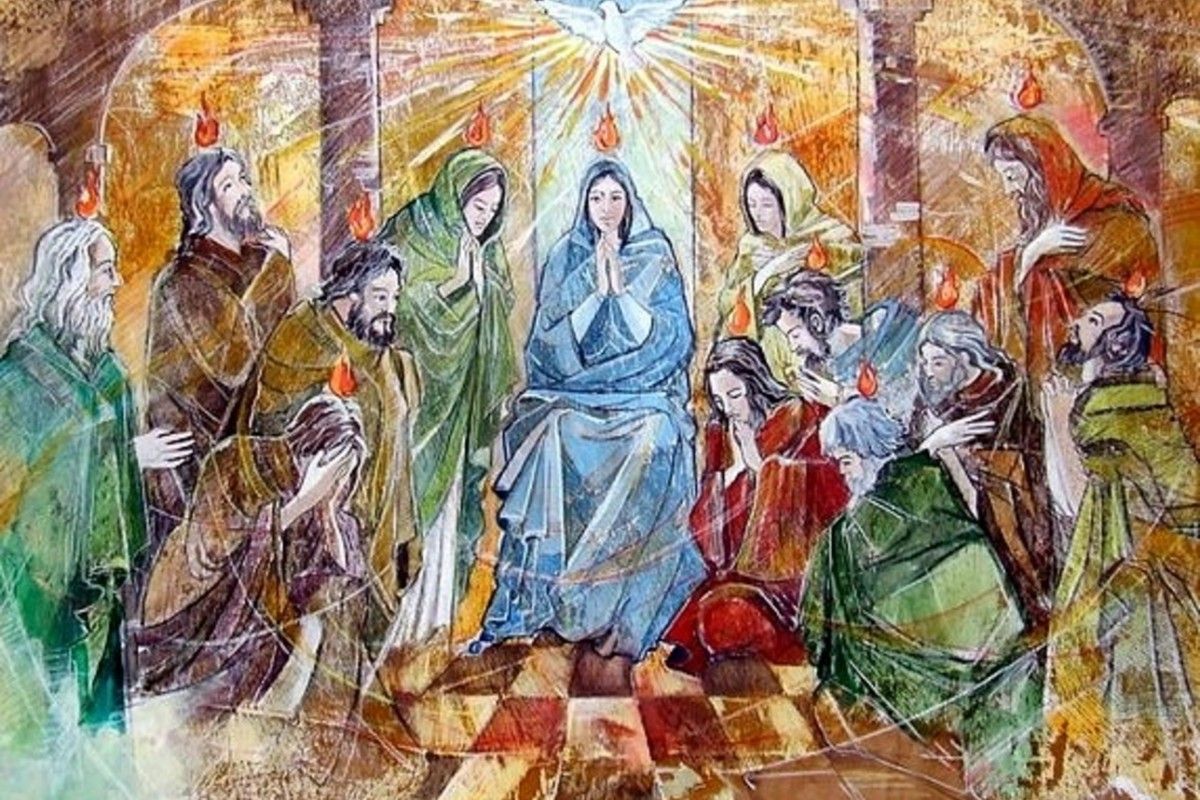
The Spirit Opens Hearts and Frontiers
Romeo Ballan mccj
Initially the Jewish feast of Pentecost – seven weeks, namely 50 days, after Easter – was the celebration of the wheat harvest (see Es 23,16;34,22). Later on, the remembrance of the promulgation of the Law on Mount Sinai was added. Thus Pentecost moved from being a farmers holiday, to being an historical celebration: a memorial of the great covenants between God and the people (see Noah, Abraham, Moses, Jeremiah 31,31-34, Ezechiel 36,24-27…). Beside noting a change in the calendar, it is important to acknowledge the new perspective in dealing with the law and the way to understand and live this covenant. The law was a gift of which Israel was proud, but it was a transitory and insufficient stage.
It became necessary to move forward in interiorizing the law, a journey that reached its apex in the gift of the Holy Spirit, who is given to us, instead of the law, as the true and definitive source of new life. Christian Pentecost celebrates the gift of the Spirit, “who is Lord and gives life.” Israel became a people rallying by the law. In the family of God the fusion no longer comes from an external command, albeit an excellent one, but from the inside, from the heart, in virtue of the love that the Spirit gives us, “because the love of God has been poured out into our hearts through the Holy Spirit.” (Rm 5,5) Thanks to Him “we are children of God” and cry out: “Abba, Father!” We are the people of the new covenant, called to live a new life, by virtue of the Spirit who makes of us the family of God, with the dignity of children and heirs (Rm 8,15-17).
This dignity must be matched by a correspondent style of life. Paul (second reading) describes in concrete terms tow different and opposite styles of life, according to each one’s choice: the works of the flesh (v. 19-21) or the fruits of the Spirit (v. 22). For those who belong to Jesus Christ and live in the Spirit there is only one choice: “We walk with the Spirit.” (v. 25)
The Spirit sets individuals and human and Christian groups on their journey, by renewing them and transforming them from within. The Spirit opens the hearts, purifies them, heals and reconciles them, makes them go beyond all borders, leads them to communion. It is a Spirit of unity (of faith and love) in the plurality of charisms and cultures, as we see in the event of Pentecost (first reading), in which unity and plurality are wedded, both of them being gifts of the same Spirit. Different people understand one language common to all of them (v.9-11). St. Paul clearly credits the Spirit with the power to make the Church one and diverse in the plurality of charisms, ministries and operations (see 1Cor 12,4-6). The Church faces the timeless challenge to be catholic and missionary, to move from Babel to Pentecost, as Benedict XVI teaches us. (*)
The Holy Spirit is most certainly the greatest fruit of Easter in the death and resurrection of Jesus: He breathes it on to the disciples (John 20,22-23). It is the Spirit of the forgiveness of sins and the Spirit of the universal mission. Even more, he is the protagonist of mission (see RMi chap.3; EN 75ff) that Jesus entrusted to the apostles and to their successors. The Spirit is always at work: in the simple and hidden daily missionary activity, and in more solemn moments. I’m thinking, for instance, of the 3rd American Mission Congress (CAM – 3), that even now is being organized and planned for August 2008 in Quito, Ecuador, in the hope of “renewing the event of Pentecost in the local Churches,” in view of a more solid involvement in the new evangelization and in the mission ad gentes.
For such a mission the Spirit is given to us as a guide “to the entire truth” and as the Consoler (Gospel). More, also the Spirit’s power of healing and making whole is connected to its creative and purifying activity. It is a concrete and effective power, that creates a special sensitivity in the missionary world, even though discernment is not always easy. At times the healing power involves the body as well, but more often than not it touches the human spirit, healing internal injuries and offer the balsamic effect of peace and reconciliation.
Pentecost Sunday Reflection
Fernando Armellini
Introduction
The natural phenomena that impress most the imagination of humans—fire, lightning, hurricane, earthquake, thunder (Ex 19:16-19)—are used in the Bible to describe the manifestations of God.
The sacred authors used images also to present the outpouring of the Lord’s Spirit. They said that the Spirit is a breath of life (Gen 2:7), the rain that irrigates the land and transforms the desert into a garden (Is 32:15; 44:3), a force that restores life (Ex 37:1-14), the rumble from the sky, wind that strongly blows, thunder, tongues of fire (Acts 2:1-3). All vigorous images that suggest the idea of—an uncontrollable bursts of strength!
Where the Spirit comes, radical upheavals and transformation always happen: barriers fall, doors are opened wide; all the towers built by human hands and designed by “the wisdom of this world” shake; fear, passivity and quietism disappear; initiatives are developed and courageous decisions are made.
Who is dissatisfied and aspires the renewal of the world and of humanity can count on the Spirit: nothing can resist its power. One day the prophet Jeremiah asked himself discouragingly: “Can an Ethiopian change his skin or a leopard his spots? And can you do good, you who are accustomed to do evil?” (Jer 13:23) Yes—one can answer him—every prodigy is possible where the Spirit of God erupts.
First Reading: Acts 2:1-11
Jesus promised his disciples that he would not leave them alone and that he would send the Spirit (Jn 14:16,26). Today we celebrate the feast of this gift of the Risen One.
Reading the passage from the Acts we are amazed by the numerous “prodigies” that occurred on the day of Pentecost: thunder and strong wind, flames of fire coming down from heaven, the apostles speaking all languages.
We also wonder why God has waited fifty days before sending his Spirit upon the disciples.
To understand this page of theology (not news) we need to delve a little into the symbolic language used by the author.
Luke places the descent of the Spirit at Pentecost. Yet, in today’s gospel, John tells us that Jesus imparted the Spirit on the day of the Resurrection (Jn 20:22). How does one explain this lack of agreement on the date?
We must say clearly: the paschal mystery is unique. Death, Resurrection, Ascension and the gift of the Spirit took place in the same moment, in the moment of Jesus’ death. Recounting what happened on Calvary on that Good Friday, John says: “he bowed his head and Jesus gave up the Spirit” (Jn 19:30).
Why then did Luke present this unique, sublime, ineffable mystery of Easter as if it had happened in three successive moments? He did it to help us understand the many aspects.
John has placed the outpouring of the Spirit on the day of Easter to show that the Spirit is the gift of the Risen One. Now we see why Luke situates it in the context of the feast of Pentecost.
Pentecost was a very ancient Jewish holiday, celebrated fifty days after Easter. It commemorated the arrival of the people of Israel at Mount Sinai. We all remember what happened in that place: Moses climbed the mountain; he encountered God and received the Law to be transmitted to his people.
The Israelites were very proud of this gift. They said that before them, God had offered the Law to other peoples. They had refused it, preferring to continue with their vices and excesses. To thank God for this predilection, the Israelites had set up a feast: the Pentecost. Saying that Spirit descended upon the disciples on the day of Pentecost, Luke wants to teach that the Spirit has replaced the old law and became the new law for the Christian.
To explain what he means we resort to a comparison. One day Jesus said: “Do you ever pick grapes from thorn bushes, or figs from thistles?” (Mt 7:16). It would be foolish to imagine that surrounding the bramble with attention, pruning it, creating around it a milder climate would make it produce grapes. However, if—with a marvel of genetic engineering—one could turn it into a vine, then any external intervention would not be necessary. The bramble would spontaneously produce grapes.
Before receiving the outpouring of the Spirit, the world was like a big bramble. God had given people great directions—a set of rules, precepts, many recommendations. He expected fruits, the work of justice and love (Mt 21:18-19), but these have not arrived because the tree was bad: “No poor tree bears good fruit… and the evil person draws evil things from the evil stored in his heart” (Lk 6:43.45).
What did God do then? He decided to change the hearts of people. With a new heart—he thought—they would no longer have need of any external law. They would have done good by following the impulses coming from within them.
Here’s what the law of the Spirit is: it is the new heart; it is God’s life. When it enters in a person, it transforms him and from bramble it becomes a fruitful tree, able to spontaneously produce the works of God.
When a person is filled with the Spirit, something unheard of happens in him. He loves with the love of God himself. From that moment “he does not need someone to teach him” (1 Jn 2:27); he won’t require another law. John comes to say that the man animated by the Spirit becomes even incapable of sinning: “Those born of God do not sin, for the seed of God remains in them; they cannot sin because they are born of God” (1 Jn 3:9).
And what about the thunder, the wind, the fire? But it’s clear: we are going to see in the book of Exodus phenomena that accompanied the gift of the old law: “On the morning of the third day there was thunder and lightning and a dense cloud over the mountain. All the people in the camp trembled” (Ex 19:16). “All the people witnessed the thunder and lightning and heard the blast of the trumpet and saw the mountain smoking” (Ex 20:18).
The rabbis said that at Sinai, on the day of Pentecost, when God gave the Law, his words took the form of seventy tongues of fire, indicating that the Torah was destined to all peoples (thought to be exactly seventy at that time).
If the old law was given in the midst of thunder, lightning, flames of fire… how could Luke present the gift of the Spirit—the new law in a different way? If he wanted to be understood he had to use the same images.
And the many languages spoken by the apostles?
Probably Luke refers to a very common phenomenon in the early church. After receiving the Spirit, the believers began to praise God in a state of exaltation. As if in ecstasy, they uttered strange words in other languages.
Luke has used this phenomenon in a symbolic sense to teach about the universality of the church. The Spirit is a gift meant for all persons and all peoples. Faced with this gift of God, all barriers of language, race and tribe collapse. On the day of Pentecost the opposite of what happened at Babel occurred (Gen 11:1-9).
People began to misunderstand and to distance from each other. Here the Spirit puts into action an opposite movement. He brings together those who are scattered.
Whoever lets himself be guided by the word of the gospel and by the Spirit speaks a language that everyone understands and everyone joins in: the language of love. It is the Spirit who transforms mankind into one family where all understand and love each other.
Second Reading: 1 Corinthians 12:13b-7,12-13
What causes divisions within the community? Envy, reciprocal jealousy! Those who have good qualities (intelligent, strong, good health, have studied…) instead of humbly putting their talents at the service of the brothers and sisters, they begin to expect honorary titles. They demand more respect and believe they are entitled to privileges. They want to occupy the first places. Thus the ministries of the community, from opportunities to serve, become opportunities to establish, assert their power and prestige.
In the community of Corinth, Christians were no better than those of today. They were committing the same sins; they had the same defects. Specifically, they were divided because of the different charisms (that is, of the various gifts) that each had received from God.
Paul writes to these Christians to remind them that the many gifts, qualities that each of them has, are not given to create divisions, but to promote unity. Paul says: “the Spirit reveals his presence in each one with a gift that is also a service” (v. 7). And this is so because the source of all gifts is one: the Spirit. Paul says: “There is diversity of gifts, but the Spirit is the same” (v. 4).
To clarify this idea of unity and mutual service, Paul uses the comparison of the body.
Christians form one body, made up of many members. Each part must perform its function for the good of the whole organism. So it happens with different gifts of which every member of the community is enriched: they serve so that everyone can show to others his love through humble availability to serve.
_________________________
Gospel: John 20:19-23
For the first Christians, the first day of the week is important because it is the day of the Lord (Rev 1:10). It is that day in which the community usually reunites to break the Eucharistic bread (Acts 20:7; 1 Cor 16:2).
It is evening. The temporal indication with which the evangelical passage starts is precious. Perhaps it indicates the late hour in which the early Christians normally used to gather for their celebration.
The doors are locked for fear of the Jews (v. 19). Jesus certainly did not announce triumphs and easy life to his disciples. “You will have trouble in the world” he said (Jn 16:33). However, the main reason for insisting on closed doors (Jn 20:26) is theological. John wants to make it clear that the Risen One is the same Jesus that the apostles have seen, known, heard, touched, but is in a different condition. He is not back to his previous life (as Lazarus did). He enters into a completely new existence.
The body is no longer made of material atoms. It is imperceptible to the verification of the senses.
The resurrection of the flesh is not equivalent to the resuscitation of a corpse. It is the mysterious blossoming of a new life from a finite being. Paul explains this fact through the image of the seed. He says that “the body is sown in decomposition; it will be raised never more to die. It is sown in humiliation, but it will be raised for glory. It is buried in weakness, but the resurrection shall be with power. When buried it is a natural body, but it will be raised as a spiritual body” (1 Cor 15:42-44).
When Jesus shows his hands and his side, the disciples rejoice. A surprising reaction: they should be sad seeing the signs of his passion and death. Instead they rejoice, not because they find themselves in front of the Jesus whom they accompanied along the roads of Palestine, but because they see the Lord (v. 20). They realize that the Risen One, who is revealing himself to them, is the same Jesus who gave his life.
John places the manifestations of the Risen One in the context of the first day of the week. He wants to tell the Christians of his community that they too can meet the Lord. They will not encounter Jesus of Nazareth with the material body he had in this world, but the Risen One, every time they come together “in the Lord’s day”.
After having twice addressed them the greeting: “Peace be with you!” (vv. 19,21) “Jesus gives His Spirit to the disciples and confers them the power to forgive sins” (vv. 21-23).
The disciples are sent to fulfill a mission: “As the Father has sent me, so I send you.”
When he was in the world, Jesus made the face and the love of the Father present (Jn 12:45). Now, having left this world, he continues his work through the disciples to whom he confers his Spirit.
Welcoming him was welcoming the Father who sent him, now welcoming his envoys is welcoming him (Jn 13:20).
To understand the mission entrusted to the apostles, the forgiveness of sins through the outpouring of the Spirit, we must refer to the religious conceptions of the people of Israel and to the words of the prophets.
At the time of Jesus it was widely thought that the people were acting bad. They defiled themselves with their idols. They were unclean because an evil spirit moved them. We wondered when God would intervene to rescue them and to instill in them a good spirit.
In the Letter to the Romans Paul makes a dramatic description of the miserable condition of the person who is at the mercy of the evil spirit: “I cannot explain what is happening to me, because I do not do what I want, but on the contrary, the very things I hate. I know that what is right does not abide in me, I mean in my flesh. I can want to do what is right, but I am unable to do it. In fact I do not do the good I want, but the evil I hate” (Rom 7:15-19).
Through the mouth of the prophets God promised the gift of a new spirit, of His Spirit: “Then I shall pour pure water over you and you shall be made clean—cleansed from the defilement of all your idols. I shall give you a new heart and put a new spirit within you. I shall remove your heart of stone and give you a heart of flesh. I shall put my spirit within you and move you to follow my decrees and keep my laws” (Ezek 36:25-27).
This outpouring of the Spirit of the Lord would renew the world. He will flood it—said the prophet Ezekiel—like a rushing torrent of water which, when it enters the desert, makes it fruitful and turns it into a garden. “Near the river on both banks there will be all kinds of fruit trees with foliage that will not wither and fruit that will never fail; each month they will bear a fresh crop because the water comes from the temple. The fruit will be good to eat and the leaves will be used for healing” (Ezek 47:1-12). They are delightful images that admirably describe the life-giving work of the Spirit.
On Easter day these prophecies are fulfilled. In a symbolic gesture—Jesus breathed on them—the Spirit is consigned. This breath recalls the moment of creation, when “the Lord God formed man, dust drawn from the clay, and breathed into his nostrils a breath of life” (Gen 2:7). The breath of Jesus creates the new man. This man is no more a victim of the forces that lead to evil but is animated by a new energy that drives him to do good.
Where the Spirit goes, evil is won, sin is forgiven—cancelled, destroyed—and the new man modeled on the person of Christ is born.
The mission that the Risen One entrusts to his disciples is to forgive sins, thus continuing his work as the “Lamb of God, who came to take away the sins of the world” (Jn 1:29).
What does it mean to forgive sins? These words have been interpreted—in the right way, but limited—as the conferment to the apostle of the power to absolve sins. It’s not the only way to forgive, that is, to neutralize in order to overcome sin. The right conferred by Jesus is much more extensive and covers all the disciples who are animated by his Spirit: it is that of cleansing the world of every form of evil.
The powers are not two—to forgive or to retain—at the discretion of the confessor that evaluates each case. The power is only one—that of annihilating, in all ways—sin. But this can also be not forgiven, if the disciple is not committed to creating the conditions so that all may open their hearts to the action of the Spirit, the sin is not remitted.
Of this failure of the mission, the disciple is responsible.
https://sundaycommentaries.wordpress.com
As we celebrate the Feast of Pentecost, the season of Easter reaches its final climax. This Sunday we celebrate and experience the powerful outpouring of the Holy Spirit on the whole church and on all those who call themselves disciples and followers of the risen Lord.
Last Sunday when we celebrated the Ascension of Jesus, he promised his followers that he would send them the Holy Spirit and that they would be filled with power from high. Theirs and our waiting is over. Today with the whole church we celebrate Pentecost Sunday. This is not something that happened a long time ago to other people. It is happening today, here and now. Today each of us is filled with and anointed with the same powerful Holy Spirit.
The first followers of Jesus weren’t strong, courageous or even very faithful. They betrayed Jesus. They denied and deserted him when we he needed them the most. After his death they hid themselves away in fear. They had lost all heart and hope.
Then the strangest thing happens to them. The house is filled with the sound of a mighty wind and the sight of fire! These frightened and frail men and women are now transformed. Through the Holy Spirit, they are given new hope, new heart and new purpose. Their fear and silence is replaced by courage and conviction. They leave their hiding place and make their way into the streets and proclaim the good news of the resurrection. They become new people with a new message. At that very moment the missionary church was born.
We are no different than these ordinary men and women. Through our baptism and confirmation, each of us has been filled and anointed with the exact same Holy Spirit. Just as the first followers of Jesus proclaimed the good news about him, we too are called to do likewise today. Just as these men and women were transformed into energetic and outspoken witnesses of Jesus, we too are called and invited to be changed by the Holy Spirit.
There is nothing gentle, mild or gentle about Pentecost. The Holy Spirit is powerful, life-changing and energetic. The Holy Spirit challenges us and calls us to change. Oscar Romero, the Latin American Bishop who was murdered in 1978, and who is soon to be canonised said, ‘The Spirit makes all things new; we are the ones who grow old and want to keep everything to our aged way of doing things… the Spirit is never old, the Spirit is always young.
As we celebrate the birth of the missionary church, we pray that each of us will be refreshed and renewed by the Holy Spirit. May we do what Pope Francis asks of each of us, ‘Go out again and again, without hesitation without fear and proclaim this joy which is for all people…”
Michael Moore OMI
