5th Sunday of Easter (B)
John 15:1-8
Gospel Reflection
Fernando Armellini
The promised land is mentioned in the Bible, not only as one where “milk and honey flow,” but also where vines and olive trees grow (Jos 24:13). Every Jewish family grew, near the house, the vine that provided shade during the long summer (1 K 5:5) and precious grapes which in part were dried to make raisins and some were pressed to get good and strong wine.
Associated with spontaneous joy and celebration, the vine and the vineyard are often used in the Bible, in a symbolic way. They are an expression of God’s blessings. Even Jesus, who grew up in the farming community of Palestine, has used these images in his parables and allegories.
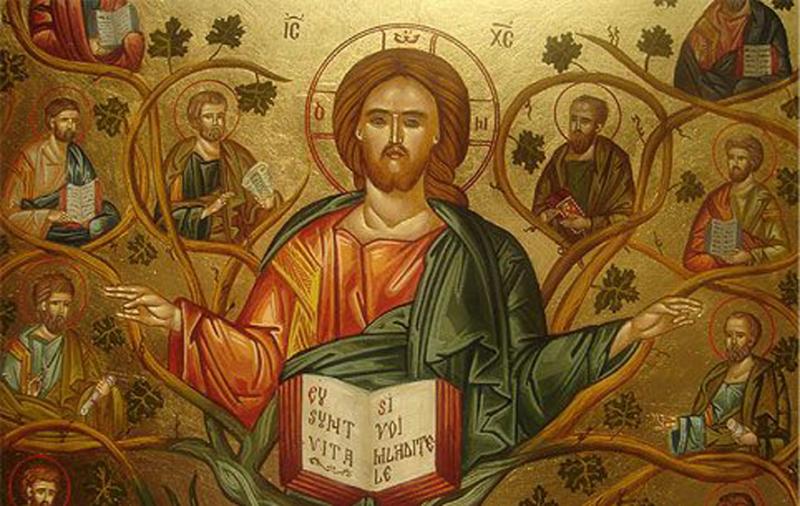
In today’s Gospel, Jesus begins with the solemn affirmation “I am the true vine” (v. 1)
To grasp the meaning and also the challenging part of this sentence it is necessary to note that the vineyard of the Lord, sung by the prophets, was Israel. She was a vine that had produced abundant fruits of faithfulness, when she was “like wild grapes in the desert” (Hos 9:10) and when she responded to the kindness of God: “Praise to my fruitful vineyard. I, Yahweh, am its keeper; I water it every moment. So that no one will harm it, day and night I guard it. I have no wall, who will cleanse me from thorns? I myself will march against them, I will burn them altogether” (Is 27:2-5).
Symbol of Israel—the vineyard of the Lord was, in the temple of Jerusalem, the golden vine that covered the walls of the vestibule and that kept growing more and more, thanks to the vines, the grapes and the golden vine-leaves offered by the pilgrims.
The vine-Israel had been planted in the fertile soil of a hill, but disappointed his God and she began to produce sour grapes (Is 5:1-4). The Lord complained: “I planted you a choice vine, a shoot of wholesome stock, why have you become degenerate, a wild vine?” (Jer 2:21) He took a painful but necessary decision: “I will remove its hedge and it will be burned; I will break down its wall, and it will be trampled on. I will make it a wasteland, I will neither prune nor hoe it and briers and thorns will grow there. I command the clouds, as well, not to send rain on it” (Is 5:5-7).
However, the works that God begins never end in failure. Israel had behaved like an unfaithful vine, but what did the vintner who “looked justice, but found bloodshed, righteousness, but heard cries of distress” (Is 5:7) do?
He did not repudiate her, despite the infidelity because “the call of God and his gifts cannot be nullified” (Rom 11:29). From the old and sterile strain of this vine, a new, genuine shoot, Christ, the true vine, sprouted on the day of Easter.
Jesus is the vine and his disciples, which form the branches, are part of him and it is from them that the Lord expects delicious fruits: justice, righteousness, love; for this he acts as a gardener, as vinedresser: he breaks off and prunes them (vv. 2-3).
The two actions were carried out by the farmers in different seasons of the year. The first was during winter and consisted in the removal of unnecessary branches, the second, done in August, was intended to remove the weakest shoots to foster the best.
The most immediate interpretation of these images can lead to sadness. They seem, in fact, a severe threat to the dead and unproductive branches, which could indicate the Christians who become lukewarm or inconsistent with their faith. Their end would be the fire: “Whoever does not remain in me is thrown away, as they do with branches, and they wither. Then they are gathered and thrown into the fire and burned” (v. 6).
It is a misleading interpretation and inconsistent with God’s special love for the weak.
To prune and to trim are not images of retaliation, but God’s care for every person and every disciple. Being inserted in Christ—or by direct action of the Spirit, as is the case for those who have not been baptized, or rebirth “by water and the Spirit,” as in the case of the baptized Christians—does not put one in the position of automatically producing fruits. The dead branches are not individuals who are less edifying, but the miseries, the infidelities to the Gospel, weaknesses, small and great sins present also in the best of disciples. No one is immune, all have a constant need for purification.
The Manichean separation between good and evil, between those who feel fine because they belong to the institutional church and who are out, is a form of spiritual arrogance and hypocrisy. Anyone who sees dead branches only in the others, who thinks that only others are in urgent need of pruning, even claims to exclude them from the community or declares them outcasts from God, is just an opinionated person, who sees the mote in his brothers’ eye and does not realize the beam that is in his (Mt 7:4).
The discouragement in the face of human miseries in the church is also a sign of mistrust in God’s purifying work. The disappointments caused by the sins of those who profess to be Christians can lead some to the difficult decision to abandon the community. It is an understandable and worthy of respect choice, but still wrong. Who does not understand the brothers/sisters who make mistakes, who rejects them also deviates from the vine, Jesus, who touched the lepers (Mk 1:41) and was “the friend of tax collectors and sinners” (Mt 11:19).
“You are already made clean by the word I have spoken to you” (v. 3). It is not a declaration of innocence of the disciples, but the indication of the instrument the Father uses to prune.
At the Last Supper, Jesus told his disciples: “Not all of you are clean” (Jn 13:11). He was referring to Judas, the disciple representing one who, having given his commitment to Christ, cultivates plans opposed to his: power instead of service, the search for the first place instead of the last. Judas is the image of one who does not allow the Father to intervene in his life, who does not accept to have the mind and heart “cleansed” by the word of God and, therefore, run the risk of perishing.
The comparison with the person of Jesus and his word is a continuous, necessary pruning. This word “is living and effective, sharper than any two-edged sword. It pierces to the division of soul and spirit, joints and marrow, and judges the intentions and thoughts of the heart” (Heb 4:12). There is no dark or secret corner of the heart that escapes his light; there is no shadow of death that it does not dissolve. This indicates the branches that should be removed and the useless leaves that take space and sun rays to the productive branches. It shows just how ephemeral the outward manifestations of piety which do not correspond to a genuine commitment to Christ.
While it entails a painful aspect, being carried out by the Father, this cleansing is always a cause joy; God’s hands cure the wounds he has inflicted (Job 5:17). “What you endure is in order to correct you”—says the author of the Letter to the Hebrews—that you suffer! God treats you like sons and what son is not corrected by his father?” (Heb 12:7).
The sometimes harsh and biting criticisms, which, for many, today are directed to the church, cannot be dismissed too easily, as hateful expressions of prejudiced people who do not love Christ and who do not deserve any consideration. They could instead be references to a life more in keeping with the faith we profess, a healthy although painful pruning.
For whose benefit are the fruits produced? To the glory of the Father—the last verse of the passage answers (v. 8).
God does not expect applause and praises. His glory is the manifestation and the outpouring of his love for humanity. In view of this work, the disciples are associated with Christ in perfect unity, because with him they are one vine.
The vine does not produce grapes for herself, but for others. The branch finds its fulfillment when it is alive, when it sees the buds, flowers, leaves and sweet grapes sprouting.
The Christian does not produce works of love for himself, for the self-satisfaction of his own moral perfection nor to get a prize from God. He is like the Father who is in heaven: loves without expecting anything in return. His reward is the joy of seeing someone happy, verifying that the love of God was manifested through him. Nothing more, but nothing less: for this is the joy of God, and when he will have reached in all the fullness, it will be the kingdom of God.
https://sundaycommentaries.wordpress.com
Jesus the Vine
In last Sunday’s gospel, Jesus described himself as the Good Shepherd that we are called and invited to follow. This Sunday, Jesus offers us another powerful image of himself and our relationship with him. In the gospel Jesus proclaims to us, ‘I am the true vine, and my Father is the vinedresser.’
At the time of Jesus, the vinedresser was a very important and prominent person in the community. They were more than just an ordinary farmer. Grapes were not east to grow and they were more than just an annual or casual crop. The vinedresser sowed the vine and cared for them for decades, if not their whole life. He cared for and tended each vine individually. Each vine was different and needed to be cared for differently. So when Jesus calls God the vinedresser, he is describing God in terms of his relationships and attitude as well as his actions in the lives of his followers and disciples. Just as the vinedresser his totally committed to the vine and the grapes, God is totally committed and dedicated to each of us.
What Jesus the Good Shepherd and Jesus the Vine have in common is intimacy and closeness.Jesus the shepherd is close to us in a very personal and intimate way. He knows us and calls us by our name. It is a very personal relationship. If Jesus is the vine and we are the branches, then we are connected to Jesus in the closet and most personal of ways. Just as a branch cannot live, survive or grow without being attached to vine, we cannot grow, mature and develop as disciples without being close to Jesus. We cannot grow and develop in our spiritual life without being closely linked and connected to Jesus. By being intimately linked to Jesus we are nourished and natured by him; we draw life and energy from him.
Being a follower of Jesus is personal but it is never private. Just as we are connected to Jesus, we are also connected to each other as sons and daughters of God and brothers and sisters of Jesus. To be connected to Jesus the vine, means that we are intimately connected to each other. We are called and invited to be rooted in Jesus and connected to each other.
This is what it means to belong to the church; the People of God and the Body of Christ. Each of us belongs to the Body of Christ. Each of us has our own sacred and important part to play in the building of the Body Christ and in the promotion of the Kingdom of God.
By being connected to the vine, the branches produce rich healthy fruit. As followers and disciples we too are called to price fruits of the Kingdom through the quality of our daily lives.
May we stay rooted to Jesus the vine and connected to each other as brother and sisters.
Michael Moore OMI
