Fourth Sunday of Lent (B)
Laetare Sunday
John 3:14-21
Gospel Reflection
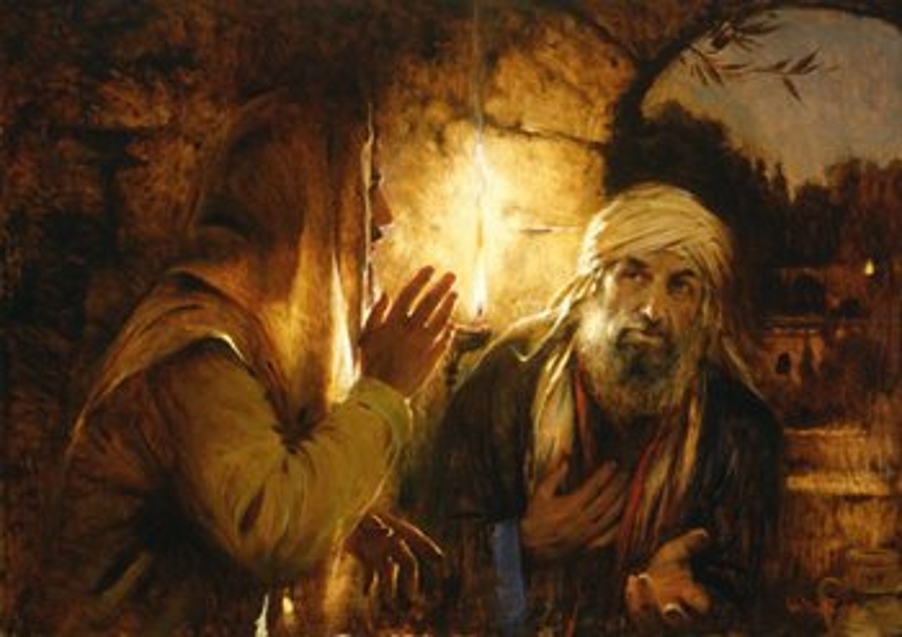
Only John the evangelist speaks of Nicodemus, a distinguished character among the Pharisees. He was perhaps a member of the great Sanhedrin, who, taking advantage of the darkness and silence of the night, went to Jesus. He seems to see him, this man already advanced in years, moving in the dark, verging, circumspect, the walls of the city of Jerusalem, not to be seen by some of his colleagues. He is in search of light and he intuits that Jesus can give it to him: the young rabbi from Nazareth, “the man coming from God as a teacher” (Jn 3:2). He comes into the picture at night and in the night he fades away without the evangelist relating to us how he ended his conversation with Jesus.
After some time he is among the high priests of Jerusalem engaged in a lively discussion to find a way to get rid of Jesus. He will listen to them in silence, then will throw a provocative phrase: “Does our law condemn people without first hearing them and knowing the facts?” He will get a mocking response: “Look it up and see for yourself that no prophet is to come from Galilee” (Jn 7:51-52). Poor Nicodemus, too fair to be comfortable in that assembly of scoffers!
He will make his last appearance on Calvary, along with Joseph of Arimathea, to wrap the body of Jesus in bandages and lay it in the tomb (Jn 19:39-40).
Today’s passage is the last part of his night-time conversation.
In the first part (vv. 13-15) Jesus recalls an incident that occurred during the exodus. He, “the teacher of Israel” (Jn 3:10), has certainly remembered it. In the desert, many Israelites had fallen victims of poisonous snakes. Moses turned to the Lord who had ordered him to make a bronze snake and to hoist it on a pole. Who, after being bitten, raised his eyes to the serpent, saved his life (Num 21:4-9).
The fact is quite unique and seems to tie in with certain magical and idolatrous rites of antiquity. Even in the temple of Jerusalem a bronze serpent was kept which, they said, was the one lifted up by Moses.
It is difficult to determine what really happened during the exodus. The message of the episode is instead clear, and the rabbis had already guessed it. The Israelites were not healed because they looked at the snake, but because they raised their hearts to God. It was the Lord who saved, not the image of bronze. The Book of Wisdom commented on the fact, “For whoever turned towards it was saved, not by the image he saw, but by you, Lord, the Savior of all” (Wis 16:7).
Jesus refers to this fact and interprets it as a symbol of what is going to happen to him: he will be lifted up on the cross and all those who behold him will save their lives.
Nicodemus, who understood little or nothing of what Jesus had said about the need to be “born from above,” certainly knew even less on raising the Son of Man. He surely was surprised, shocked, maybe even a little disappointed. He listened in silence, unable even to make one last question. He could not understand why he lacked the light of the Risen Christ and the claims of Jesus remained shrouded in mystery. It is not so for us today, in the light of the events of Easter, we are able to understand: to look at Jesus “lifted up” means “to believe in him” (v. 15), keeping the eyes focused on the love that he has shown.
The cross is not an amulet worn round the neck or a symbol indicating the conquest of a territory or the consecration of a room. It is the reference point of each gaze of the believer that, in it, the proposal of life made to him by the Master is summarized. Slaves ended up on the cross, only slaves. On the Cross, Jesus proclaims that the fulfilled man according to God is one who has voluntarily made himself slave for love, servant of his brothers even to the point of dying for them.
Today the snakes that wound, that poison the existence and put life off are called pride, envy, resentment, unruly passions. Only an eye turned to Him who was raised can be treated of the poison of death injected in the heart of every person. But one day—ensures the evangelist—“they shall look on him whom they have pierced” (19:37) and be saved.
In the second part of the passage (vv. 16-21) we have a theological meditation on the mission of the Son of man: God did not send him “to condemn the world; but that the world might be saved through him.”
Unlike Matthew who, to address the importance and the eternal consequences of the choices made today, uses the image of the Last Judgment, John uses a different language and more in keeping with today’s mentality. He even excludes that God judges the human and speaks of a judgment that takes place in the present and that’s only salvation.
The theological positions of Matthew and John seem contradictory; in fact, while they use different language and images, the two evangelists offer the same truth. God’s judgment is not pronounced the end of time, but today. In front of each option that humans are called to do, the Lord makes his opinion heard. He indicates what is right according to the wisdom of heaven and warns of the choices of death.
It does not affirm that in the end God will reject forever those who did wrong, those who have followed other criteria, other judgments. God will not drive out anyone; he “wants all to be saved” (1 Tim 2:4). The absurdity of his sentence is presented by Paul with a series of rhetorical questions: “Who shall be against us? Who shall accuse those chosen by God? He takes away their guilt. Who will dare condemn them? Christ who died, and better still, rose and is seated at the right hand of God, interceding for us?” (Rom 8:31-34). The conclusion is obvious: “No creature whatsoever will separate us from the love of God which we have in Jesus Christ, our Lord” (Rom 8:39).
However, at the end of life, when God “will test the work of everyone by fire” (1 Cor 3:13), the conformity or non-conformity of the actions of each person with the person of Christ will be pointed out. God will certainly welcome all in his arms, but someone will be forced to admit of having handled badly or having irretrievably wasted a unique opportunity that was offered. The work of this man—Paul admonishes—“becomes ashes. He will be saved but it will be as if passing through fire” (1 Cor 3:15).é
Fernando Armellini
https://sundaycommentaries.wordpress.com
LOOKING TO THE CRUCIFIED ONE
The Gospel writer John tells us about a strange encounter of Jesus with an important Pharisee called Nicodemus. According to the story, it’s Nicodemus who takes the initiative and goes to where Jesus is «by night». He figures out that Jesus is «a man who comes from God», but he’s moving in darkness. Jesus will conduct him to the light.
In the story Nicodemus represents everyone who sincerely seeks to meet Jesus. That’s why, at one point, Nicodemus disappears from the scene and Jesus keeps up his discourse in order to end with a general invitation to not live in darkness, but to seek the light.
According to Jesus, the light that can illuminate everything is in the Crucified One. The affirmation is daring: «For this is how God loved the world: he gave his only Son, so that everyone who believes in him may not perish but may have eternal life». Can we see and feel the love of God in that man tortured on the cross?
Accustomed from childhood to see the cross all over the place, we haven’t learned to see the face of the Crucified One with faith and with love. Our distracted gaze isn’t capable of discovering in that face the light that could illuminate our life in the hardest and most difficult moments. However, Jesus is sending us signs of life and love from the cross.
In those extended arms that now can’t embrace children, and in those nailed hands that can’t caress lepers or bless the sick, we find God with arms open to welcome, embrace and sustain our poor lives, broken by so many sufferings.
From that face lifeless in death, from those eyes that can no longer look kindly on sinners and prostitutes, from that mouth that can’t cry out his indignation over the victims of so much abuse and injustice, God is revealing to us God’s «crazy love» for humanity.
«For God sent his Son into the world, not to judge the world, but so that through him the world might be saved». We can welcome that God, and we can reject that God. No one is forcing us. We ourselves are the ones who need to decide. But «the Light has already come into the world». Why do we so often reject the light that comes to us from the Crucified One?
He would be able to put light into the most unfortunate and failed life, but «Everyone who does wrong hates the light and avoids it, to prevent his actions from being shown up». When we live unworthily, we avoid the light because we feel bad before God. We don’t want to look on the Crucified One. But on the contrary, «Whoever does the truth comes out into the light». She doesn’t flee to the darkness. She has nothing to hide. She seeks the Crucified One with her gaze. He helps her live in the light.
José Antonio Pagola
https://www.gruposdejesus.com
By grace you have been saved, through faith…
14And just as Moses lifted up the serpent in the desert, so must the Son of Man be lifted up,15 so that everyone who believes in him may have eternal life.”
Lectio
When reading today´s texts, we have the impression that they are a collection of paradoxes. We already know the contrasts that John uses, but this Sunday’s Gospel seems to go beyond any expectation. It is true that the history of salvation, such as the people of Israel understood it, was a basic paradox: the smallest of the peoples living in the Middle East, struggling to survive in conditions of slavery under Egyptian dominion, were elected by Yahweh, the only saving God, to be his chosen people, a son of adoption called to live in sanctity and justice and to become an example for all nations. In that context, the Messiah they expected in Jesus’ time would be the one destined to bring justice to nations and establish a reign of peace exceeding the Pax Romana imposed by Augustus.
Nicodemus’ visit to Jesus allows John to bring together the main themes of his Gospel. What we read today is only the last fragment of a long passage in which Jesus tries to convey a message to reassure the timid (or perhaps, more precisely, “cautious”) Pharisee who comes to him in the middle of the night for some explanation about the very nature of this preacher, whom he considers “a teacher… come from God” (3:2), and of the works he performs.The example of the bronze serpent, alluding to Numbers 21:4-9, introduces one of the “contrasting pairs” used by John. The sinful lack of patience of the people provokes, “down on the ground,” the biting of serpents. Only by “lifting” their eyes to the bronze serpent set “up on high” will they find their cure and salvation. That sign will allow John to speak about us, humans living down on the earth and suffering because of our sins, and about the salvation brought by Jesus, who comes from the Father, “up on high.” Curiously, the process will come to its climax when Jesus will be “lifted” on the cross, a sign of damnation, be “raised” again from the dead… (3:14-15; 2:19-22; 8:28; 12:32-34) allowing us to share in his salvation.
From this first image onward, all is a permanent paradox. The world, which hates Jesus and his followers (7:7; 15:18-19) is loved by God to such an extent that he sent Jesus, his only Son, so that the world “may have eternal life” (3:15). Eternal life, on the other hand, is not what the world expects, immortality or some other philosophical idea, but the result of Jesus’ own glory, and “this is eternal life, that they [the disciples] should know you, the only true God, and the One whom you sent, Jesus Christ” (17:1-3). Those who have sight and are supposed to “see” in depth God’s presence, are in fact blind because they do not accept Jesus, “the light of the world” (1:3-5; 3:19-21; 9:39-41) and therefore condemn themselves to live in darkness. Believing in Jesus means becoming children of God, but this rebirth is not caused “by natural generation nor by human choice nor by a man’s decision but of God” (1:12-13). In fact, through faith, they are “born [again] from above” (3:3-7). As you may see, we could go on and on, for the text offers a good number of connections, each of which leads us to new dimensions of Jesus’ personality and mission.
But there are still two details that deserve our attention. The text from Ephesians, insisting on God’s generosity as the origin and source of our salvation, uses twice the same phrase, “by grace you have been saved” (2:5, 8). This recalls the same idea expressed in John’s hymn, that even if Moses’ Law was a grace by itself, our salvation is the new and final “grace and truth” and proceeds from Jesus’ fullness (1:16-17). As for the long passage from 2 Chronicles, the story of Judah’s punishment and their captivity in Babylon ends with the promise of reconstructing the Temple of Jerusalem and re-establishing worship; and it is Cyrus, a foreign, heathen king, who, (oh, paradox!) encourages that task.
Meditatio
There are so many themes and dimensions involved in today’s liturgy that I propose something quite simple and complex at the same time. Choose one of the images used to describe Jesus’ manifold reality, (truth, light, life, way, bread of life, shepherd, vine), even if it is not in today’s text. Meditating upon any one of them will help you discover the dimensions in which you feel more personally involved and “connected” with Jesus. You will surely find a good number of ways to renew your relationship with him and follow him as if you were to “be born again.”
Oratio
Pray for those who live in the darkness of doubt or uncertainty, for those who cannot find their way in life: that Jesus, the light of the world, may enlighten them and lead them to himself who is the truth. Pray for Christians who at present live in the darkness of suffering, persecution or death threats because of their faith: that Jesus, the life of the world, may comfort and help them in their distress
Contemplatio
We Catholics “examine our consciences” as the first step in the sacrament of reconciliation. We bring to our minds our faults and sins to be aware of the things we should present before God to receive his pardon. That means “being born again,” not in the sense of those who go through a process of a “radical” conversion to the Gospel, but something humbler and simpler, recognizing the need to renew our status as lukewarm sinners. We are approaching Easter. Couldn’t we try to do something as easy as bringing up our old “corpses,” the dead load of routine in our Christian life, and prepare ourselves for the renewal of our liturgical resurrection?
Reflections written by Rev. Fr. Mariano Perrón
http://www.americanbible.org
Transfiguration of men’s eyes and hearts.
In the Gospel readings of the last several Sundays, led by Mark at first, and then by John, we have followed Jesus through the first months of his public life. We have witnessed the powerful moment of his baptism, and then his temptation in the desert. We have seen him choosing his disciples and changing water into wine at the wedding in Cana. And we saw him expel the money changers from the Temple.
Many were those who believed in him because of his first miracles. A few unhesitantly believed with deep faith. Others refused to believe and violently rejected him. But the great majority had a middle-of-the-road, ambiguous faith: a mixture of natural religiosity and natural attraction towards the extraordinary or the miraculous; a faith without too much commitment.
One of those ambiguous believers was Nicodemus. I really like Nicodemus, because he is so much one of us. He believes but does not have the courage to assume all the consequences of his faith totally; nevertheless Jesus takes him seriously. Being a doctor in Israel he knows the Scriptures. He can see that God is with Jesus, but does not go as far as to recognize that God is in Jesus. He comes to him in order to know more, but he comes during the night. He is a seeker, a seeker in the darkness. His faith will grow but he will always remain somewhat ambiguous. He feels close to Jesus but he also stays away from him. He will be there at the time of Jesus’ burial, but not too close.
Today’s Gospel reading is taken from the dialogue between Jesus and Nicodemus as reported in the first chapters of John’s Gospel. Jesus takes Nicodemus where he is on his journey and leads him further. Exactly what He does with us when we come to Him in our own darkness. Nicodemus had come to look for light in darkness; they don’t go together, and Jesus challenged him to choose between light and darkness.
The real light is the one of Transfiguration: it implies death and it requires the doing of truth. Salvation is not for those of have vague beliefs but for those who act in truth or, to translate the Greek literally, those who “do the truth”.
The newness of Jesus’ message appears here in all its light. The message is that God is not an eternally immobile first principle. God has a future and His future is in men’s hands. Salvation is not at the end of history, but is part op it. The cross is planted at the heart of human history, at the heart of a world devoured by strife and misery. The world of the mighty where the lowly are trampled upon was the world that Jesus knew, the world that put him to death, the world that he came to redeem.
It was by assuming human misery that Jesus made it possible for us to be delivered from it. Not through miracles — the signs that the Pharisees demanded as a proof of his messiahship — but through a transfiguration of men’s eyes and hearts. Today the Cross of Christ is planted at the heart of so many parts of the world where there is so much pain and groaning. The future of those countries and of their people — which is our future and God’s future — depends on us. It depends on whether our eyes are transformed enough to allow us to see the sign of the cross planted in the midst of that suffering and bleeding humankind.
