3rd Sunday in Ordinary Time – Year B
Gospel: Mark 1:14-20
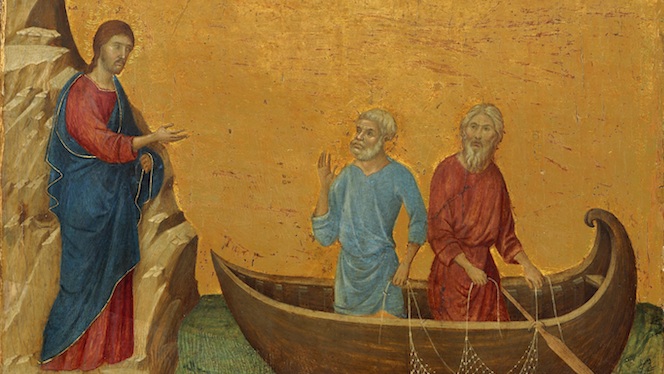
After John had been arrested, Jesus went into Galilee. There he proclaimed the Good News from God. ‘The time has come’ he said ‘and the kingdom of God is close at hand. Repent, and believe the Good News.’
As he was walking along by the Sea of Galilee he saw Simon and his brother Andrew casting a net in the lake – for they were fishermen. And Jesus said to them, ‘Follow me and I will make you into fishers of men.’ And at once they left their nets and followed him.
Going on a little further, he saw James son of Zebedee and his brother John; they too were in their boat, mending their nets. He called them at once and, leaving their father Zebedee in the boat with the men he employed, they went after him.
On this Sunday of the Word,
let us listen to Jesus as he proclaims the Kingdom of God.
Let us consider what he says and to whom he says it.
Pope Francis
What does he say? Jesus begins his preaching with these words: “The time is fulfilled, and the kingdom of God is at hand” (Mk 1:15). God is near, that is the first message. His kingdom has come down to earth. God is not, as we are often tempted to think, distant, up in heaven, detached from the human condition. No, he is in our midst. The time of his distance ended when, in Jesus, he became man. Ever since then, God has been very close to us; he will never retire from our human condition or tire of it. This closeness is the very first message of the Gospel; today’s reading tells us that Jesus “was saying” (v. 15) those words: he kept repeating them. “God is near” was the leitmotif of his preaching, the heart of his message. If this was the opening theme and the refrain of all Jesus’ preaching, it must necessarily be the one constant of the Christian life and message. Before all else, we must believe and proclaim that God has drawn near to us, that we have been forgiven and shown mercy. Prior to every word of ours about God, there is his word to us, his Word who continues to tell us: “Do not be afraid, I am with you. I am at your side and I will always be there”.
The word of God enables us to touch this closeness, since – as the Book of Deuteronomy tells us – it is not far from us, it is near to our hearts (cf. 30:14). It is the antidote to our fear of having to face life alone. Indeed, by his word the Lord consoles us, that is, he stands “with” (con-) those who are “alone” (soli). In speaking to us, he reminds us that he has taken us to heart, that we are precious in his eyes, and that he holds us in the palm of his hand. God’s word infuses this peace, but it does not leave us in peace. It is a word of consolation but also a call to conversion. “Repent”, says Jesus, immediately after proclaiming God’s closeness. For, thanks to his closeness, we can no longer distance ourselves from God and from others. The time when we could live thinking only of ourselves is now over. To do so is not Christian, for those who experience God’s closeness cannot ignore their neighbours or treat them with indifference. Those who hear God’s word are constantly reminded that life is not about shielding ourselves from others, but about encountering them in the name of God who is near. The word sown in the soil of our hearts, leads us in turn to sow hope through closeness to others. Even as God has done with us.
Let us now consider to whom Jesus speaks. His first words are to Galilean fishermen, simple folk who lived by harsh manual labour, by day and night. They were no experts in Scripture or people of great knowledge and culture. They lived in a region made up of various peoples, ethnic groups and cults: one that could not have been further from the religious purity of Jerusalem, the heart of the country. Yet that is where Jesus began, not from the centre but from the periphery, and he did so in order to tell us too that no one is far from God’s heart. Everyone can receive his word and encounter him in person. The Gospel offers a nice detail in this regard, when it tells us that Jesus’ preaching came “after” that of John (Mk 1:14). That word after is decisive: it points to a difference. John received people in the desert, where only those able to leave their homes could go. Jesus, on the other hand, speaks of God in the heart of society, to everyone, wherever they find themselves. He does not speak at fixed times or places, but “walking along the shore”, to fishermen who were “casting their nets” (v. 16). He speaks to people in the most ordinary times and places. Here we see the universal power of the word of God to reach everyone and every area of life.
Yet the word of God also has particular power, that is, it can touch each person directly. The disciples would never forget the words they heard that day on the shore of the lake, by their boats, in the company of their family members and fellow workers: words that marked their lives forever. Jesus said to them: “Follow me, I will make you become fishers of men” (v. 17). He did not appeal to them using lofty words and ideas, but spoke to their lives. He told fishermen that they were to be fishers of men. If he had told them: “Follow me, I will make you Apostles, you will be sent into the world to preach the Gospel in the power of the Spirit; you will be killed, but you will become saints”, we can be sure that Peter and Andrew would have answered: “Thanks, but we’ll stick to our nets and our boats!” But Jesus spoke to them in terms of their own livelihood: “You are fishermen, and you will become fishers of men”. Struck by those words, they come to realize that lowering their nets for fish was too little, whereas putting out into the deep in response to the word of Jesus was the secret of true joy. The Lord does the same with us: he looks for us where we are, he loves us as we are, and he patiently walks by our side. As he did with those fishermen, he waits for us on the shore of our life. With his word, he wants to change us, to invite us to live fuller lives and to put out into the deep together with him.
So dear brothers and sisters, let us not ignore God’s word. It is a love letter, written to us by the One who knows us best. In reading it, we again hear his voice, see his face and receive his Spirit. That word brings us close to God. Let us not keep it at arm’s length, but carry it with us always, in our pocket, on our phone. Let us give it a worthy place in our homes. Let us set the Gospel in a place where we can remember to open it daily, perhaps at the beginning and at the end of the day, so that amid all those words that ring in our ears, there may also be a few verses of the word of God that can touch our hearts. To be able to do this, let us ask the Lord for the strength to turn off the television and open the Bible, to turn off our cell phone and open the Gospel. During this liturgical year, we are reading Saint Mark, the simplest and the shortest of the Gospels. Why not read it at home too, even a brief passage each day. It will make us feel God’s closeness to us and fill us with courage as we make our way through life.
Sunday of the Word 2021
He inaugurated a New Era
by Fr. Fernando Armellini
The passage opens with a brief introduction wherein Jesus goes in the villages of the Galilean mountains and preaches the gospel. “The time is fulfilled—he said—and the kingdom of God has come; Repent and believe the gospel” (vv. 14-15).
This is the first sentence he says and it is the synthesis of all his message.
He speaks of the kingdom of God. His listeners, educated by the prophets, know what he actually refers to. For five hundred years, Israel has had the experience of the monarchy. The Davidic dynasty has included also able sovereigns. However, the analysis that the Bible makes of this historical period is entirely negative. Except for a few noble exceptions, all the kings have fallen away from the Lord. They did not listen to the prophets and led the people to ruin. In 587 B.C. the last king was deported to Babylon with his people.
Was it the end of everything? Someone dreamt of the restoration of the Davidic dynasty; some others put their hopes in a future messiah. All came to the conclusion however that only the Lord could revive the fortunes of Israel, personally picking up the leadership of his people, proclaiming himself king in place of the previous unworthy rulers.
It was the beginning of the waiting for the kingdom of God.
In the early books of the Bible there already is a promise: “The Lord is our king” (Jdg 8:23), “The Lord will reign for ever” (Ex 15:18). Promise is a commitment, reiterated by God through the prophets: “I rule you with an iron hand” (Ez 20:33); “The kingdom will be of the Lord” (Abd 21).
By remembering this expectation, cultivated over the centuries by the Israelites, we can understand the explosive charge of the words of Jesus. The time of waiting—he says—is over; it is time of consolation and peace, the kingdom of God is here; the Lord’s promises are fulfilled.
The content of his message is gospel—the good news.
By this we mean a book, but in Jesus’ time gospel meant only good news. All happy good news were called gospels: a military success, healing from an illness, the end of a war, the birth of an emperor, his ascension to the throne and his visit to a city.
At the beginning of his book, Mark presents Jesus as the herald, in charge of proclaiming such extraordinary news to people, so amazing as to arouse great joy in the listeners.
There are two conditions to experience it: one must repent and believe.
To repent does not mean the firm determination to avoid sin or the other, but it is the decision to radically change the way one sees God, man, the world, history.
We always focused too much on the moral conversion. Often little has been understood that the first change to do is about the image of God we made and which we do not like to give up because it is modelled on our thoughts, judgments and sentiments. We are firmly anchored on the Baptist’s words referred to us by Matthew: “Brood of vipers! Let it be seen that you are serious in your conversion”
(Mt 3:7) or those that Luke attributes to the precursor: “The axe is already laid to the roots of the tree” (Lk 3:9). Mark leaves more space to the intuition of the good news: “The kingdom of God has come.” It is not the perception of the imminence of a terrible punishment, but a novelty that cheers. There is hope for all, even for the most hardened sinner, even for one who feels like a scum, because God does not considered him a waste but a son.
God already revealed himself thus, not only in the Holy Scriptures, but through creation. For this, when man imagines God, any god, he has to imagine him necessarily good. To convert, then, is to go back to see God so infinitely good, because this is already part of our DNA.
Christ has revolutionized the world. He puts love and compassion as its foundation, correcting first the idea of God that is deformed within us.
To convert is also to change the way of looking at man and creation. It is to start seeing everything from the perspective of God, from God’s part, of the loving, patient, slow to anger, full of kindness and interest for his creatures, of the God who knows how to distinguish what appears and what is, the accidental course from the basic choice, the ephemeral from what is lasting.
To assimilate this image of God it is necessary to live in a permanent state of conversion. One will never reach the perfection of the Father who is in heaven, but we must continually work towards it. Who considers himself already converted stands outside the kingdom of God. To feel calm, yes, but never satisfied.
Then one must also believe, that is not equivalent to accepting a package of truth. It
means to follow Christ, with the certainty of arriving, among the numerous contrasts and renouncements, to the fullness of life. To believe is to trust him, his word and his promise: “See I make all things new” (Rev 21:5). To believe is to accept his answers to our questions with unconditional confidence.
The second part of the passage (vv. 16-20) introduces the call of the first four disciples destined to become, after the resurrection of Jesus, the heralds of the gospel.
The episode is divided into two parallel moments corresponding to the calls of the two pairs of brothers: Simon and Andrew (vv. 16-17), James and John (vv. 19-20).
The version of the events referred to us by Mark is different. From the historical point of view, it is difficult to reconcile it with that of John (Jn 1:35-51).
The goal of Mark is not to offer a detailed account of what happened. He does not intend to meet even our legitimate curiosity. He does not tell us, for example, if the four fishermen had already met Jesus, if they had seen some of his miracles. It does not explain how they could give up everything without raising any objection, without questions. He wants to give a lesson of catechesis to anyone who one day feels called by Jesus. The passage does not refer to the vocation of priests and nuns. It speaks about the call of every person to be a disciple. It is about the vocation to baptism.
The scene goes fast, so much so that it is almost hard to follow the frames. Jesus, the protagonist, is moving quickly, in a hurry not only in walking, but in speaking, in inviting to follow him. Its looks like a race against time. In fact it is the anxiety to announce that “the time has come.” There is no choice but the need to hurry to become part of the reign of God.
It was noted that, in the Gospel of Mark, Jesus never stops: passing along the Sea of Galilee (v. 16), he calls and does not turn back to see if the disciples have accepted his invitation. He goes straight over (v. 19), calls the other two and then continues on his way without stopping for a moment (v. 21). Who wants to follow him cannot delude oneself: the road ahead is not easy. The Master leaves no rest even for a moment. He does not grant months off, days or hours of vacation. He demands that the disciple keeps pace, always.
Then other characters appear: Simon and Andrew, James and John. They are not praying or performing some especially important action. They are simply practicing their profession.
Other vocations in the Bible took place in similar circumstances. The prophet Elisha received the invitation to follow Elijah while he was in the field plowing with twelve yoke of oxen before him (1 K 19:19-21). Moses kept the flock of Jethro his father in law (Ex 3:1), Gideon was threshing wheat (Jdg 6:11), Matthew was busy collecting taxes (Mk 2:13-14).
God does not turn to the idlers, people without ideals, without concrete benchmarks, but to those who are fully inserted in their social, economic, family context. The adherence to Christ in faith is never a stopgap, a consolation for those who failed in other goals, but a proposal made to committed people and realized in life.
As all the vocations of which the Bible speaks, that of following Jesus is also completely free. The disciple knows and follows the Master because he is called, because it was revealed to him and offered as a gift. Who is aware of this is not proud nor despise those who have not joined Christ. He thanks the Lord for what he has received and commits so that he can create, also in others, the favorable conditions to receive the same gift.
From the beginning, Jesus presents himself as a master different from those of his time. They remained in their school waiting for the disciples to meet them to learn the lesson and then go back to their homes. The teachers were not choosing the disciples but the disciples were choosing the teacher.
Jesus does not want disciples who seek him to learn a lesson, but people who walk with him, who share his life’s choices.
The first four disciples respond immediately to the call. They trust in Jesus and follow him, even if the destination is still unknown, and the fate to which they are called will be clear only later.
The Ninevites were granted forty days of time to accept or reject the invitation to conversion. Elisha was allowed to “say goodbye to his father and mother” before following Elijah (1K 19:20). To his own Jesus does not grant any postponement. To one he will say: “Let the dead bury their dead; as for you, leave them and proclaim the kingdom of God. Whoever has put his hand to the plow and looks back is not fit for the kingdom of God” (Lk 9:59-62).
The answer to his call must be given immediately. The separation must be total and immediate; nothing can prevent to follow him. Even the most sacred affections, such as those that bind one to the parents and the family, attachment to one’s profession, the need to have an economic and social security, the desire not to lose friends, everything must be sacrificed if it is in conflict with the new life to which Jesus calls.
https://sundaycommentaries.wordpress.com
THE PASSION THAT DROVE JESUS
To be exact, Jesus didn’t teach a «religious doctrine» so that his disciples would learn it and spread it correctly. Jesus actually announces an «event» that he asks to be welcomed, since it can change everything. He’s already experiencing it: «God is being introduced into life with God’s saving power. We need to make room for it».
According to the oldest Gospel, Jesus proclaimed this Good News of God: «The time is fulfilled, and the kingdom of God is close at hand. Repent, and believe the gospel». This is a good summary of Jesus’ message: «A new time is getting near. God doesn’t want to leave us alone in the face of our problems and challenges. God wants to construct a more human life with us. Change your way of thinking and acting. Live by believing this Good News».
Experts think that what Jesus calls «God reign» is the heart of his message and the passion that breathes through his whole life. What’s surprising is that Jesus never directly explains in what does this «reign of God» consist. What he does do is suggest in unforgettable parables how God acts and how life would be if there were people who acted as he did.
For Jesus, «God’s reign» is life as God wants to construct it. That was the fire that he carried within: How would life be in the Empire if God reigned in Rome and not Tiberius? How would things change if people don’t imitate Tiberius, who only seeks power, wealth and honor, but imitate God, who asks for justice and compassion for the least?
What would life be like in the villages of Galilee if God reigns in Tiberias and not Antipas? How would everything change if people weren’t like the great land owners who exploit the peasants, but were like God, who wants to see them eating and not dying of hunger?
For Jesus, God’s reign isn’t a dream. It’s the project that God wants to bring forward in the world. The only objective his followers should have. How would the Church be if it was dedicated only to constructing life as God wants it, not as the masters of the world want it? How would Christians be if we went about converting ourselves into God’s reign? How would we struggle for «daily bread» for every human being? How would we cry out: «Your kingdom come»?

I love all your sermons. Thank you very much. Stay blessed.
"Mi piace""Mi piace"