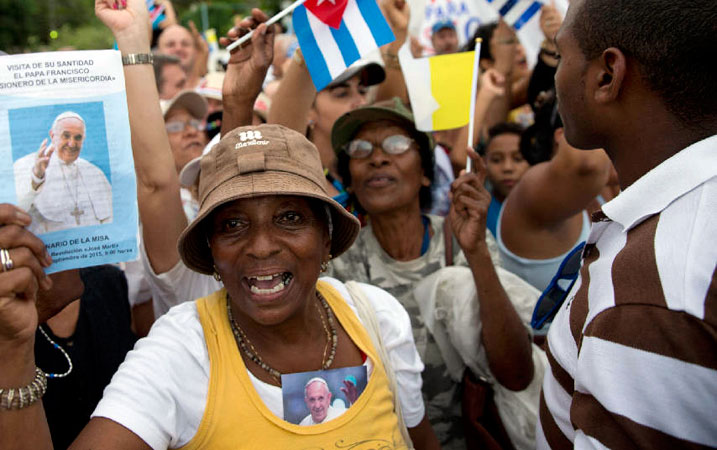
HAVANA — Pope Francis arrived here Saturday to a rapturous reception from ordinary Cubans and, drawing on the famous words of one of his predecessors, called on island nation to “open itself to the world” and on the world “to open itself to Cuba.”
Greeting him on the airport tarmac was the country’s communist president Raul Castro, who offered that in Cuba, “we exercise religious freedom as a right consecrated in our constitution.” They were doubtless welcome words for Francis but incongruous for many Cubans, who consider it’s a right more honored in the breach than the observance.
The arrival ceremony marked the beginning of a 10-day odyssey, the longest foreign trip of his papacy to date, featuring three days in this island nation before moving on to Washington, New York, and Philadelphia Sept. 22-27.
It’s the first time Francis has visited either country, and there’s poetic justice in his combining them in one trip since he’s been credited by both sides with helping heal Cold War tensions. On Saturday he hailed that rapprochement, a diplomatic coup, as an “example of reconciliation for the entire world.”
Overall, Francis’ visit seemed to evoke joy among Cuban civilians, who may not practice the faith with great zeal anymore — statistics show weekly Mass attendance in this nominally Catholic nation is in the single digits — but still have great respect for the Church, and appear thrilled to see a fellow Latin American at the top.
Yet despite the enthusiasm, Francis faces skepticism among dissidents and exiles worried he won’t press the Castro regime hard enough on human rights and religious freedom. They certainly won’t approve of the way Francis went out of his way to send greetings to Fidel, for instance, immediately upon his arrival.
Republican presidential contender Marco Rubio, a Cuban American, on Saturday urged Francis to “use his moral authority … to bring us closer to the day when freedom can finally take root on the island country.”
What’s behind such commentary is a sense that past papal outings here — John Paul in 1998 and Benedict XVI in 2012 — have been disappointing, producing terrific photo-ops for the government, but little concrete change on the ground.
The status of religious freedom here remains a mixed picture. It’s not like the early years after the 1959 Socialist revolution, when scores of priests, nuns, and Protestant pastors were either forced to flee or thrown in jail. But there remain real pressures, including surveillance and harassment, workplace discrimination, and raids on unregistered “house churches.”
Just last Sunday, some 50 members of the “Ladies in White” Catholic protest movement were arrested, marking 22 consecutive Sundays that members have been hauled away.
Francis indirectly invoked those tensions on Saturday, saying he hopes the Church will have “the freedom, the means, and the space” in Cuba to pursue its mission.
Berta Soler, head of the Ladies in White, isn’t holding her breath. “Cuba needs a change, but the pope is not a liberator, nor will he change Cuba,” she said just before Francis arrived.
The Vatican’s approach to Cuba dates to the 1960s, and really hasn’t changed much since. The basic take is that Cuban Communism is less menacing than the Soviet version, and hence the goal should be to engage Cuba rather than confront it.
When John Paul II and Benedict XVI came to Cuba, neither met with any dissidents, and there’s no indication Francis will do so either — though with this notoriously spontaneous pontiff, it’s never wise to go overboard trying to predict what he will or won’t do.
Given that background, Francis becomes simply the latest religious leader to walk a fine line in Cuba — wanting to foster what he called on Saturday “bonds of cooperation and friendship,” but without seeming to blink at the still-oppressive regime.
All this, in turn, is prologue to the even bigger challenges awaiting Francis in the United States.
The pontiff makes his American debut on Tuesday amid high approval ratings and keen media interest, but also ambivalence among some Americans who wonder if his critiques of unfettered capitalism, of what he calls “extreme and selective consumerism,” are to some extent directed at them.
Francis’ itinerary is filled with moments that could stir controversy, including his Sept. 24 address to a joint meeting of Congress and a canonization Mass he’s slated to lead the day before for Junípero Serra, an 18th-century Spanish missionary whose record in dealing with Native Americans has led some to praise him and others to vilify him as a sorry choice for the first person ever canonized on American soil.
Despite those potential land mines, Francis sent a telegram to President Barack Obama as his plane crossed American airspace on Saturday saying he’s looking forward to the visit “with joy.”
If nothing else, Francis can take comfort that he’s already avoided one unfortunate happenstance that marred John Paul’s Cuba trip in January 1998.
Back then, American media outlets were set for saturation coverage and flew their A-list talent to Havana. Just before the pontiff touched down, however, those star correspondents all turned around and flew back to Washington, consigning the pope to relative obscurity. The reason? The Monica Lewinsky scandal had broken out, and it wasn’t hard to discern which was the bigger story.
So far Francis has no such competing frenzy to steal his thunder, so the stage belongs to him alone. All that remains to be seen is what he’ll do with it.
By John L. Allen Jr.
Associate editor September 19, 2015 http://www.cruxnow.com
