The Pope’s words on the economic interests behind wars.
In the response he gave to a young boy yesterday about “the powerful making a living from wars”, Francis returned to the subject of the arms trade and the profit attached to it (Andrea Tornielli, http://vaticaninsider.lastampa.it).
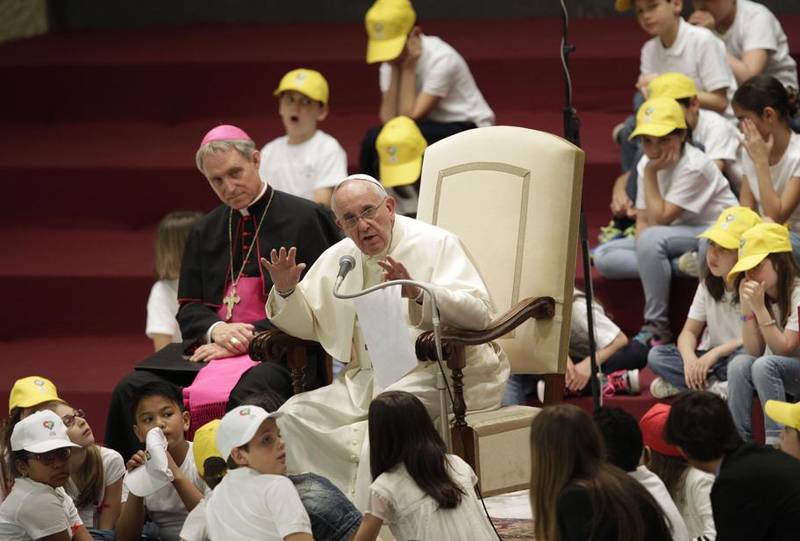
During a meeting and discussion with 7000 children from the “Peace factory”, Pope Francis returned to the issue of the vast economic interests that lie behind wars. “Why do so many powerful people not want peace? Because they live off war, the arms industry is a serious matter! The powerful earn a living by producing and selling arms to countries: it is the industry of death, they make money from it.”
This is not the first time concerns about the arms trade and the increase in military spending have been expressed before in a papal magisterium. One need only read over the words pronounced by Benedict XVI in his Message for the World Day of peace in 2006: “In this regard, one can only note with dismay the evidence of a continuing growth in military expenditure and the flourishing arms trade, while the political and juridical process established by the international community for promoting disarmament is bogged down in general indifference. How can there ever be a future of peace when investments are still made in the production of arms and in research aimed at developing new ones?”
There is no doubt, however, that Francis has returned to this subject again and again, presenting a way of looking at the issue that avoids the ideological simplifications witnessed in the most advanced expressions Islamic fundamentalism an in the analysis provided by some Western think tanks.
On Sunday 2 June 2013, in St. Martha’s House, Pope Francis received a group of 13 Italian soldiers wounded in peace missions – most of them had served in Afghanistan. The soldiers were joined by the families of 24 soldiers who had died in peacekeeping operations. In the homily he pronounced at the mass he celebrated for them, Francis spoke about how frequently we have seen “the great ones of the earth want to solve” local problems, economic problems, economic crises “with a war”. “Why?” Francis asked. “Because, for them, money is more important than people! And war is just that: it is an act of faith in money, in idols, in idols of hatred, in the idol that leads to killing one’s brother, which leads to killing love.”
At the Angelus on 8 September 2013, the day after the Syria peace vigil which saw masses of people from all over the world joining in prayer and fasting together just as the West was planning a potential military intervention against the Assad regime, Francis’ message against the arms business and death traffickers was loud and clear. He beseeched the powerful of the land who are playing their military and commercial game without any regard for the suffering populations whose lives they are placing at risk. Choosing to do the right thing “means saying no to fratricidal hatred, and to the lies that it uses; saying no to violence in all its forms; saying no to the proliferation of arms and their sale on the black market.” “Speaking off the cuff, Francis eloquently added: the doubt always remains: this war over there, this other war over there – because there are wars everywhere – is it really a war over problems, or is it a commercial war, to sell these arms on the black market?”
In an interview with journalist Henrique Cymerman which was published in Catalan daily La Vanguardia on 12 June 2014, Francis stated: “We discard a whole generation to maintain an economic system that no longer endures, a system that to survive has to make war, as the big empires have always done. But since we cannot wage a Third World War, we make regional wars. And what does that mean? That we manufacture and sell arms. And in doing so, the balance sheets of the idolatrous economies — the big world economies that sacrifice man at the feet of the idol that is money — are obviously cleaned up.”
A week after the interview was published, The Economist criticized Francis, comparing him to Lenin. The London weekly was critical of the Pope’s statements regarding the idolatrous economies that are fuelled by war. “By positing a link between capitalism and war, he (the Pope) seems to be taking an ultra-radical line: one that consciously or unconsciously follows Vladimir Lenin in his diagnosis of capitalism and imperialism as the main reason why world war broke out a century ago. And there are plenty of counter-arguments one could offer. Many other ruling powers in history (from feudal warlords to secular totalitarian regimes) have had a more obvious stake in violence and confrontation than capitalism has. And thinkers like Joseph Schumpeter and Karl Popper have argued forcefully that capitalism can consolidate peace, by offering non-violent ways to satisfy human needs,” The Economist wrote.
Francis returned to the subject of war and the economic interests that fuel it, on 13 September 2014, at a mass he celebrated at the Redipuglia Military Sacrarium for the centenary of the start of World War I. “Here lie many victims,” the Pope said. “Today, we remember them. There are tears, there is sadness. From this place we remember all the victims of every war. Today, too, the victims are many… How is this possible? It is so because in today’s world, behind the scenes, there are interests, geopolitical strategies, lust for money and power, and there is the manufacture and sale of arms, which seem to be so important! And these plotters of terrorism, these schemers of conflicts, just like arms dealers, have engraved in their hearts, ‘What does it matter to me?’”
