Half of global wealth held by the 1%:
“Do we really want to live in a world where the 1 percent own more than the rest of us combined?”
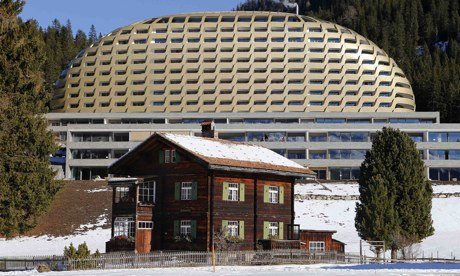 As the World Economic Forum was about to convene in Davos, Switzerland, a new report highlighted growing global inequality and seemed set to challenge the delegates to do something about it. The respected and influential international NGO Oxfam, which holds one of six co-chairs at Davos, predicts that, on current trends, 1 percent of the world’s population will possess more wealth than the other 99 percent by 2016.
See Report: OXFAM 2015 Wealth-having-all-wanting-more
In an interview with Britain’s Guardian daily, the, executive director of Oxfam International Winnie Byanyima said the increased concentration of wealth seen since the deep recession of 2008-09 was dangerous and needed to be reversed. According to Byanyima, “The message is that rising inequality is dangerous. It’s bad for growth and it’s bad for governance. We see a concentration of wealth capturing power and leaving ordinary people voiceless and their interests uncared for.”
The report made headlines in the British media Monday, eliciting a considerable level of comment yet, as is so often the case in our times, practically disappearing as the news-cycle moved into Tuesday. Oxfam’s report showed that the world’s least well-off 80 percent own just 5.5 percent of its wealth, while the share owned by the best-off 1 percent has increased from 44 percent in 2009 to 48 percent in 2014. Meanwhile, in Britain, there is growing concern about downward pressure on living standards especially among the working poor, and the rise of foodbanks even as an economic recovery of sorts appears to be under way; while research has revealed that the UK’s richest 100 families own as much as 30% of UK households.
The flow of news like this, backed by solid research, should and does give rise to reflection—are we to accept such figures on this inequality as inevitable? Is our global economic model inexorable and individuals powerless in its face? Indeed, are there links between this situation and the rise of terror and is the source of that terror a segment of the world’s population that feels itself materially left behind, but articulates its alienation in pseudo-religious language? It’s time for a serious debate about this.
As Oxfam Director Byanyima put it, “Do we really want to live in a world where the 1 percent own more than the rest of us combined? The scale of global inequality is quite simply staggering…” Pope Francis, more than once, has warned of the damage that unrestricted inequality could do but other leaders are not yet responding. The world, not least people of faith, needs to decide if this state of affairs is acceptable; and what the consequences might be of just accepting it and doing nothing.
David Stewart | Jan 20 2015
http://www.americamagazine.org/
New Oxfam report says half of global wealth held by the 1%
Billionaires and politicians gathering in Switzerland this week will come under pressure to tackle rising inequality after a study found that – on current trends – by next year, 1% of the world’s population will own more wealth than the other 99%.
Ahead of this week’s annual meeting of the World Economic Forum in the ski resort of Davos, the anti-poverty charity Oxfam said it would use its high-profile role at the gathering to demand urgent action to narrow the gap between rich and poor.
The charity’s research, published on Monday, shows that the share of the world’s wealth owned by the best-off 1% has increased from 44% in 2009 to 48% in 2014, while the least well-off 80% currently own just 5.5%. Oxfam added that on current trends the richest 1% would own more than 50% of the world’s wealth by 2016.
Winnie Byanyima, executive director of Oxfam International and one of the six co-chairs at this year’s WEF, said the increased concentration of wealth seen since the deep recession of 2008-09 was dangerous and needed to be reversed.
In an interview with the Guardian, Byanyima said: “We want to bring a message from the people in the poorest countries in the world to the forum of the most powerful business and political leaders.
“The message is that rising inequality is dangerous. It’s bad for growth and it’s bad for governance. We see a concentration of wealth capturing power and leaving ordinary people voiceless and their interests uncared for.”
Oxfam made headlines at Davos last year with a study showing that the 85 richest people on the planet have the same wealth as the poorest 50% (3.5 billion people). The charity said this year that the comparison was now even more stark, with just 80 people owning the same amount of wealth as more than 3.5 billion people, down from 388 in 2010.
Byanyima said: “Do we really want to live in a world where the 1% own more than the rest of us combined? The scale of global inequality is quite simply staggering and despite the issues shooting up the global agenda, the gap between the richest and the rest is widening fast.”
Separate research by the Equality Trust, which campaigns to reduce inequality in the UK, found that the richest 100 families in Britain in 2008 had seen their combined wealth increase by at least £15bn, a period during which average income increased by £1,233. Britain’s current richest 100 had the same wealth as 30% of UK households, it added.
Inequality has moved up the political agenda over the past half-decade amid concerns that the economic recovery since the global downturn of 2008-09 has been accompanied by a squeeze on living standards and an increase in the value of assets owned by the rich, such as property and shares.
Pope Francis and the IMF managing director Christine Lagarde have been among those warning that rising inequality will damage the world economy if left unchecked, while the theme of Thomas Piketty’s best-selling book Capital was the drift back towards late 19th century levels of wealth concentration.
Barack Obama’s penultimate State of the Union address on Tuesday is also expected to be dominated by the issue of income inequality. He will propose a redistributive tax plan to extract more than $300bn (£200bn) in extra taxes from the 1% of rich earners in order to fund benefits specifically targeted at working families.
However, the odds of the White House having any success persuading Congress to adopt the plan, given the Republicans’ new grip on both chambers, are extremely long. But Obama’s embrace of what he calls “middle-class economics” – as opposed to the trickle-down economics of the Republicans – is likely to ensure that inequality remains a pivotal theme of the 2016 presidential campaign.
Oxfam said the wealth of the richest 80 doubled in cash terms between 2009 and 2014, and that there was an increasing tendency for wealth to be inherited and to be used as a lobbying tool by the rich to further their own interests. It noted that more than a third of the 1,645 billionaires listed by Forbes inherited some or all of their riches, while 20% have interests in the financial and insurance sectors, a group which saw their cash wealth increase by 11% in the 12 months to March 2014.
These sectors spent $550m lobbying policymakers in Washington and Brussels during 2013. During the 2012 US election cycle alone, the financial sector provided $571m in campaign contributions.
Byanyima said: “I was surprised to be invited to be a co-chair at Davos because we are a critical voice. We go there to challenge these powerful elites. It is an act of courage to invite me.”
Oxfam said it was calling on governments to adopt a seven point plan:
- Clamp down on tax dodging by corporations and rich individuals.
- Invest in universal, free public services such as health and education.
- Share the tax burden fairly, shifting taxation from labour and consumption towards capital and wealth.
- Introduce minimum wages and move towards a living wage for all workers.
- Introduce equal pay legislation and promote economic policies to give women a fair deal.
- Ensure adequate safety-nets for the poorest, including a minimum-income guarantee.
- Agree a global goal to tackle inequality.
Speaking to the Guardian, Byanyima added: “Extreme inequality is not just an accident or a natural rule of economics. It is the result of policies and with different policies it can be reduced. I am optimistic that there will be change.
“A few years ago the idea that extreme poverty was harmful was on the fringes of the economic and political debate. But having made the case we are now seeing an emerging consensus among business leaders, economic leaders, political leaders and even faith leaders.”
Oxfam: 85 richest people as wealthy as poorest half of the world
As World Economic Forum starts in Davos, development charity claims growing inequality has been driven by ‘power grab’
The world’s wealthiest people aren’t known for travelling by bus, but if they fancied a change of scene then the richest 85 people on the globe – who between them control as much wealth as the poorest half of the global population put together – could squeeze onto a single double-decker.
The extent to which so much global wealth has become corralled by a virtual handful of the so-called ‘global elite’ is exposed in a new report from Oxfam on Monday. It warned that those richest 85 people across the globe share a combined wealth of £1tn, as much as the poorest 3.5 billion of the world’s population.
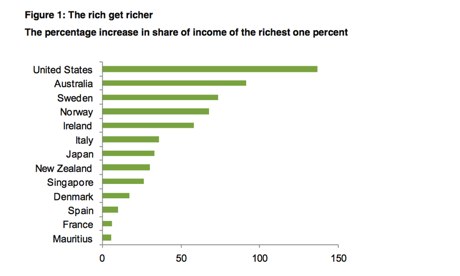 The wealth of the 1% richest people in the world amounts to $110tn (£60.88tn), or 65 times as much as the poorest half of the world, added the development charity, which fears this concentration of economic resources is threatening political stability and driving up social tensions.
It’s a chilling reminder of the depths of wealth inequality as political leaders and top business people head to the snowy peaks of Davos for this week’s World Economic Forum. Few, if any, will be arriving on anything as common as a bus, with private jets and helicopters pressed into service as many of the world’s most powerful people convene to discuss the state of the global economy over four hectic days of meetings, seminars and parties in the exclusive ski resort.
Winnie Byanyima, the Oxfam executive director who will attend the Davos meetings, said: “It is staggering that in the 21st Century, half of the world’s population – that’s three and a half billion people – own no more than a tiny elite whose numbers could all fit comfortably on a double-decker bus.”
Oxfam also argues that this is no accident either, saying growing inequality has been driven by a “power grab” by wealthy elites, who have co-opted the political process to rig the rules of the economic system in their favour.
In the report, entitled Working For The Few, Oxfam warned that the fight against poverty cannot be won until wealth inequality has been tackled. “Widening inequality is creating a vicious circle where wealth and power are increasingly concentrated in the hands of a few, leaving the rest of us to fight over crumbs from the top table,” Byanyima said.
Oxfam called on attendees at this week’s World Economic Forum to take a personal pledge to tackle the problem by refraining from dodging taxes or using their wealth to seek political favours.
As well as being morally dubious, economic inequality can also exacerbate other social problems such as gender inequality, Oxfam warned. Davos itself is also struggling in this area, with the number of female delegates actually dropping from 17% in 2013 to 15% this year.
How richest use their wealth to capture opportunities
Polling for Oxfam’s report found people in countries around the world – including two-thirds of those questioned in Britain – believe that the rich have too much influence over the direction their country is heading.
Byanyima explained: “In developed and developing countries alike we are increasingly living in a world where the lowest tax rates, the best health and education and the opportunity to influence are being given not just to the rich but also to their children.
“Without a concerted effort to tackle inequality, the cascade of privilege and of disadvantage will continue down the generations. We will soon live in a world where equality of opportunity is just a dream. In too many countries economic growth already amounts to little more than a ‘winner takes all’ windfall for the richest.”
The Oxfam report found that over the past few decades, the rich have successfully wielded political influence to skew policies in their favour on issues ranging from financial deregulation, tax havens, anti-competitive business practices to lower tax rates on high incomes and cuts in public services for the majority. Since the late 1970s, tax rates for the richest have fallen in 29 out of 30 countries for which data are available, said the report.
This “capture of opportunities” by the rich at the expense of the poor and middle classes has led to a situation where 70% of the world’s population live in countries where inequality has increased since the 1980s and 1% of families own 46% of global wealth – almost £70tn.
Opinion polls in Spain, Brazil, India, South Africa, the US, UK and Netherlands found that a majority in each country believe that wealthy people exert too much influence. Concern was strongest in Spain, followed by Brazil and India and least marked in the Netherlands.
The WEF’s own Global Risks report recently identified widening income disparities as one of the biggest threats to the world community.
Oxfam is calling on those gathered at WEF to pledge: to support progressive taxation and not dodge their own taxes; refrain from using their wealth to seek political favours that undermine the democratic will of their fellow citizens; make public all investments in companies and trusts for which they are the ultimate beneficial owners; challenge governments to use tax revenue to provide universal healthcare, education and social protection; demand a living wage in all companies they own or control; and challenge other members of the economic elite to join them in these pledges.
