He Is Pope. Elected by All the Rules
An authoritative canonist rebuts the arguments of those who view Bergoglio’s election as invalid and therefore do not recognize him as pope. (Excerpt from an article by Sandro Magister).
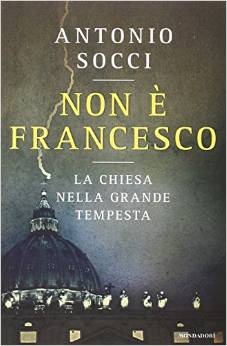 The validity of the election of Pope Francis has been denied by a Catholic writer, Antonio Socci, in a book that has sold very well: “He Is Not Francis.”
Socci substantiates his thesis in about twenty pages out of the almost three hundred of his book. And he does so on the basis of the paragraphs of “Universi Dominici Gregis” that regulate election procedure. This procedure is claimed to have been seriously violated, in his judgment, after the scrutineers found an extra blank ballot among those of the fourth round of voting on March 13, 2014. The conclusion that Socci draws from this is that “Bergoglio’s election is null, it never existed.”
Three months after the release of his book, Socci written that “there has not been a single cardinal who has declared in public or has let me know in private that the events of the conclave did not take place in the way described by my book.”
That’s not all. He added that “there has not been even one authoritative canonist who has demonstrated that the procedures followed were correct, and therefore that the election of Pope Francis is canonically irreproachable.” Neither has there been, among the canonists, anyone who has said he shares Socci’s arguments and has publicly stated that the election of Pope Francis was invalid.
In any case, the following commentary, written by a canonist of sure authority, demonstrates on the basis of strictly juridical arguments the “complete lack of foundation” for Socci’s ideas and therefore the full legitimacy of the election of Pope Francis.
The author is a full professor of canon law and of the history of canon law at the university “Alma Mater Studiorum” of Bologna, as well as being a member of the executive board of the “Consociatio Internationalis Studio Iuris Canonici Promovendo,” and is preparing to publish a book on the strictly canonical profile of events like the resignation of Benedict XVI, the new figure of the “pope emeritus,” and none other than the election of Francis.
The complete text of the commentary can be found on this other page of www.chiesa: Sull’elezione di papa Francesco. The following are its main passages.
ON THE ELECTION OF POPE FRANCIS
by Geraldina Boni
I would like to add a few strictly canonistic remarks on a question that has been the object of extensive attention, above all on the web.
I observe that the journalist Elisabetta Piqué, in the book “Francis. Life and revolution,” reported concerning the election of Pope Francis (and this leak is said to have been confirmed by several cardinals):
“After the voting and before the reading of the ballots, the cardinal scrutineer, who first of all mixes up the sheets placed in the ballot box, realizes that there is one too many: there are 116 and not 115 as there should be. It seems that, by mistake, one of the cardinals has placed two sheets in the box: one with the name of his choice and one blank, which had stuck to the first one. These things happen. It can’t be helped, this round of voting is immediately cancelled, the sheets will be burned later without having been seen, and a sixth round of voting will come next.”
It is not worth it to dwell over the conjectures that unfailingly follow the conclusion of every conclave, based on presumed revelations on the part of subjects bound to strict secrecy. In any case, on the basis of this report Antonio Socci, in the volume “He is not Francis. The Church in the great storm,” has backed the idea of the nullity of Jorge Mario Bergoglio’s election. […]
Even supposing that the electoral operations took place as they are depicted, Socci’s reconstruction has no juridical foundation.
According to paragraph no. 65 of John Paul II’s apostolic constitution “Universi Dominici Gregis,” which regulates the conclave, the ballot must be rectangular in form and must bear on the top half, printed if possible, the words “Eligo in summum pontificem,” while the bottom half must leave room to write the name of the candidate. So the ballot is made in such a way that it can be folded in two. The compilation of the ballot must be done secretly by each cardinal elector, who must write clearly, in handwriting as unrecognizable as possible, the name of the one he chooses, taking care not to write more than one name as in this case the vote would be nullified, and then fold the ballot twice. It therefore appears (and from other instructions of the aforementioned apostolic constitution as well) that the ballots are not placed within an envelope, but are simply folded.
According to no. 66, then, the scrutiny includes: 1. the placement of the ballots in the box provided; 2. the mixing and counting of these; 3. the tally of the votes. It is therefore absolutely plausible that it was precisely at the moment of counting and not of the tally (as attested to by Piqué, who moreover is held to be perfectly credible by Socci) that the hands of the scrutineer encountered the two ballots, the only ones that were actually opened – but not obviously perforated – with the confirmation of a blank ballot inadvertently attached to the one marked with the name.
It was therefore entirely correct to apply scrupulously to the letter no. 68 of the constitution [which prescribes that “If the number of ballots does not correspond to the number of electors, the ballots must all be burned and a second vote taken at once”]. Moreover, no. 5 of the same constitution explicitly rules out the possibility of interpreting the act of election, requiring the norms to be applied just as they appear. Even if the scrutineer opened those two ballots with the reasonable intention of confirming the accidental attachment of a blank sheet to a marked one, this would certainly not constitute a problematic irregularity, nor would it turn the counting phase into that of the tally, each of these being disciplined by its own norms guided by specific “rationes.” […]
It is only after the counting that one must move on to no. 69 [the tallying of the ballots]: it is undeniable how the additional ballot that slipped through the counting phase and went on to that of the tally was in any case due, intentionally or not, to a single cardinal, and an extra ballot is always, apart from the person to whom it can be attributed, an irregularity. But if such an irregularity, according the norms of John Paul II, is always problematic in the preliminary phase of the counting (no. 68), it is no longer so in that of the tally, in particular when the ballots are folded in such a way as to appear to have been compiled by a single elector. […]
Even if it is true that the scenario that took place during the conclave of 2013, at the moment of the counting, meaning that of two ballots folded together, partially corresponds to the one considered in no. 69 that regulates the tally, this does not mean that one can apply a norm set down for another phase of the electoral procedure (and with another “ratio”). It is precisely the rigidity of the apostolic constitution “Universi Dominici Gregis” (emphasized by Socci himself), enhanced when it comes to the act of election – cf. the aforementioned no. 5 – that categorically excludes it. If on the contrary no. 69 were improperly applied, violating the obligation to adhere to what no. 68 rigorously imposes, this could possibly create a problem of the validity of an election.
So since no. 68 was applied completely legitimately, from the juridical point of view this fourth round the voting is incontestably “tamquam non esset,” and it was not to be included and numbered among those that actually took place that day, meaning juridically valid and complete, arriving at the point of the tally. This also eliminates the objection that the maximum number of four rounds of voting per day was exceeded. […]
Nor is it idle to point out that the constitution of John Paul II does not sanction even a simoniac election with invalidity. […] And neither does it do so if the election is the result of pacts, agreements, promises, or other commitments of any kind between cardinals (see the other conjecture of a team of four cardinals thought to have planned Bergoglio’s election as advanced recently by Austen Ivereigh in the book “The Great Reformer. Francis and the Making of a Radical Pope”).
Antonio Socci finally argues: “Even if only one doubtful judgment were to be expressed about the validity of the procedures followed that March 13, 2013, it can be maintained that the conclave must be redone because doctrine teaches that ‘dubius papa habetur pro non papa’ (a dubious pope is to be considered as not a pope), as the great Jesuit cardinal and doctor of the Church Saint Robert Bellarmine writes in the treatise ‘De conciliis et ecclesia militante.’”
On the contrary, even if it really happened as depicted, the procedure followed, as has been shown, would have been entirely “ad normam iuris.” The election of Pope Francis, having reached the stipulated majority at the fifth scrutiny (the first, of course, took place on May 12), would be valid, there would be nothing to “correct,” there would be no doubt, much less “positive” and “insoluble” (as the law postulates), over its validity.
Given the complete lack of juridical foundation for such suppositions, even if the information on which they are based is to be given credit, there also disappears the bugaboo – recklessly agitated – of the current occupancy of the chair of Peter by a dubious pope. In any case, canon law has constantly and unanimously taught that the “pacifica universalis ecclesiae adhaesio” is an infallible sign and effect of a valid election and of a legitimate papacy. And the adherence of the people of God to Pope Francis can in no way be brought into doubt.
5.1.2015
http://chiesa.espresso.repubblica.it/
