Pope’s Holy Land pilgrimage:
All the documents.
“So that they may be one”
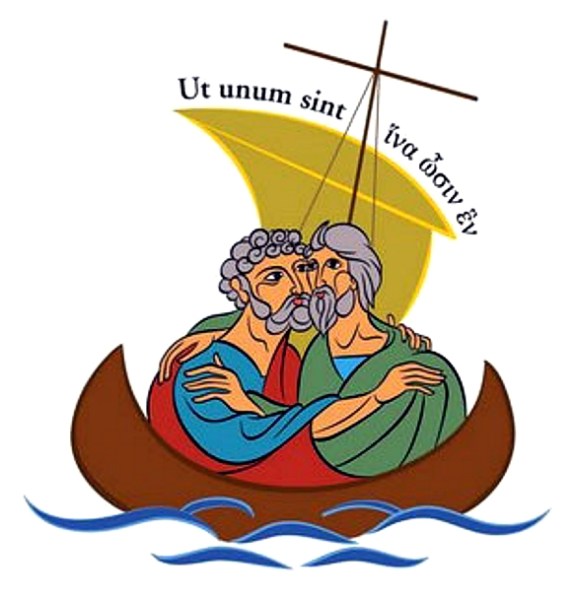 The motto for the pilgrimage is “So that they may be one”. The Holy Father has insisted that at the center of his pilgrimage will be the meeting with Greek Orthodox Patriarch Bartholomew of Constantinople and the heads of the Churches in Jerusalem. This is to commemorate and renew the commitment to unity expressed by Pope Paul VI and Patriarch Athenagoras of Constantinople 50 years ago in Jerusalem.
The logo also expresses this desire for unity, representing the embrace of Saint Peter and Saint Andrew, the first two disciples called by Jesus in Galilee. Saint Peter is the patron of the Church in Rome and Saint Andrew is the patron of the Church in Constantinople. In Jerusalem, in the Mother Church, they embrace. The two apostles are in a boat that represents the Church, whose mast is the Cross of the Lord. The sails of the boat are full of wind, the Holy Spirit, which directs the boat as it sails across the waters of this world.
Program of the Pope’s Holy Land journey.
MAY 24, 2014
o 08:15 Departure from Rome’s Fiumicino airport for Amman
o 13:00 Arrival at the Amman Queen Alia International Airport
o 13:45 Welcome ceremony at the Al-Husseini Royal Palace in Amman, Courtesy visit to Their Majesties the King and Queen of Jordan
o 14:20 Meeting with the Authorities of the Kingdom of Jordan
o 16:00 Holy Mass at the Amman International Stadium
o 19:00 Visit to the Baptismal Site at Bethany beyond the Jordan
o 19:15 Meeting with refugees and young people with disabilities in the Latin Church in Bethany beyond the Jordan
MAY 25, 2014
o 08:15 Farewell from Jordan at the Amman Queen Alia International Airport
o 08:30 Departure by helicopter for Bethlehem from the Amman Queen Alia International Airport
o 09:20 Arrival at the Bethlehem Heliport
o 09:30 Welcome ceremony at the Presidential Palace in Bethlehem, Courtesy visit to the President of the State of Palestine
o 10:00 Meeting with Palestinian Authorities
o 11:00 Holy Mass followed by Regina Coeli in Manger Square in Bethlehem
o 13:30 Lunch with Palestinian families in the Franciscan Convent of Casa Nova in Bethlehem
o 15:00 Private visit to the Grotto of the Nativity in Bethlehem
o 15:20 Greeting of the children from the Dheisheh, Aida and Beit Jibrin refugee camps in the Phoenix Center of the Dheisheh refugee camp
o 15:45 Farewell from the State of Palestine at the Bethlehem Heliport
o 16:00 Departure by helicopter from the Bethlehem Heliport for the Tel Aviv Ben Gurion International Airport
o 16:30 Welcome ceremony at the Tel Aviv Ben Gurion International Airport
o 17:15 Transfer by helicopter to Jerusalem
o 17:45 Arrival at the Jerusalem Helipad on Mount Scopus
o 18:15 Private Meeting with the Ecumenical Patriarch of Constantinople at the Apostolic Delegation of Jerusalem
o 19:00 Ecumenical Celebration on the occasion of the 50th anniversary of the meeting in Jerusalem between Pope Paul VI and Patriarch Athenagoras in the Basilica of the Holy Sepulchre
o 20:15 Dinner with the Patriarchs, Bishops and the Papal Entourage at the Latin Patriarchate of Jerusalem
MAY 26, 2014
o 08:15 Visit to the Grand Mufti of Jerusalem in the building of the Great Council on the Esplanade of the Mosques
o 09:10 Visit to the Western Wall in Jerusalem
o 09:45 Laying of a wreath at Mount Herzl in Jerusalem
o 10:00 Visit to the Yad Vashem Memorial in Jerusalem
o 10:45 Courtesy visit to the two chief rabbis of Israel at Heichal Shlomo Center in Jerusalem, next to the Jerusalem Great Synagogue
o 11:45 Courtesy visit to the President of the State of Israel in the Presidential Residence in Jerusalem
o 13:00 Private audience with the Prime Minister of Israel at Notre Dame Center in Jerusalem
o 13:30 Lunch with the Papal Entourage at Notre Dame Center in Jerusalem
o 15:30 Private visit to the Ecumenical Patriarch of Constantinople in the building next to the Orthodox Church of Viri Galileai on the Mount of Olives
o 16:00 Meeting with priests, religious and seminarians in the Church of Gethsemane at the foot of the Mount of Olives
o 17:20 Holy Mass with the Ordinaries of the Holy Land and the Papal Entourage in the room of the Cenacle in Jerusalem
o 19:30 Transfer from the helipad of Mount Scopus in Jerusalem to the Tel Aviv Ben Gurion International Airport
o 20:00 Farewell from the State of Israel at the Tel Aviv Ben Gurion International Airport
o 20:15 Departure from Ben Gurion International Airport in Tel Aviv for Rome’s Ciampino Airport
o 23:00 Arrival at Ciampino Airport in Rome
ALL THE DOCUMENTS
Pope Francis in Jordan (1)
MEETING WITH THE AUTHORITIES OF THE KINGDOM OF JORDAN
ADDRESS OF POPE FRANCIS
Amman, Saturday, 24 May 2014
Your Majesties, Your Excellencies, Dear Brother Bishops, Dear Friends,
I thank God for granting me this opportunity to visit the Hashemite Kingdom of Jordan in the footsteps of my predecessors Paul VI, John Paul II and Benedict XVI. I am grateful to His Majesty King Abdullah II for his warm words of welcome, as I recall with pleasure our recent meeting in the Vatican. I also greet the members of the Royal Family, the government and the people of Jordan, this land so rich in history and with such great religious significance for Judaism, Christianity and Islam.
Jordan has offered a generous welcome to great numbers of Palestinian and Iraqi refugees, as well as to other refugees from troubled areas, particularly neighboring Syria, ravaged by a conflict which has lasted all too long. Such generosity merits, Your Majesty, the appreciation and support of the international community. The Catholic Church, to the extent of its abilities, has sought to provide assistance to refugees and those in need, especially through Caritas Jordan.
While acknowledging with deep regret the continuing grave tensions in the Middle East, I thank the authorities of the Kingdom for all that they are doing and I encourage them to persevere in their efforts to seek lasting peace for the entire region. This great goal urgently requires that a peaceful solution be found to the crisis in Syria, as well as a just solution to the Israeli-Palestinian conflict.
I take this opportunity to reiterate my profound respect and esteem for the Muslim community and my appreciation for the leadership of His Majesty the King in promoting a better understanding of the virtues taught by Islam and a climate of serene coexistence between the faithful of the different religions. You are known as a man of peace and a peacemaker: thank you! I am grateful that Jordan has supported a number of important initiatives aimed at advancing interreligious dialogue and understanding between Jews, Christians and Muslims. I think in particular of the Amman Message and the support given within the United Nations Organization to the annual celebration of World Interfaith Harmony Week.
I would also like to offer an affectionate greeting to the Christian communities welcomed by this Kingdom, communities present in this country since apostolic times, contributing to the common good of the society of which they are fully a part. Although Christians today are numerically a minority, theirs is a significant and valued presence in the fields of education and health care, thanks to their schools and hospitals. They are able to profess their faith peaceably, in a climate of respect for religious freedom. Religious freedom is in fact a fundamental human right and I cannot fail to express my hope that it will be upheld throughout the Middle East and the entire world. The right to religious freedom “includes on the individual and collective levels the freedom to follow one’s conscience in religious matters and, at the same time, freedom of worship… [it also includes] the freedom to choose the religion which one judges to be true and to manifest one’s beliefs in public” (Ecclesia in Medio Oriente, 26). Christians consider themselves, and indeed are, full citizens, and as such they seek, together with their Muslim fellow citizens, to make their own particular contribution to the society in which they live.
Finally, I cordially invoke peace and prosperity upon the Kingdom of Jordan and its people. I pray that my visit will help to advance and strengthen good and cordial relations between Christians and Muslims. And may the Lord God preserve us from the fear of change which Your Majesty referred to.
I thank you for your courteous and warm welcome. May the Almighty and Merciful God grant happiness and long life to Your Majesties, and may he bless Jordan abundantly. Salaam!
Pope Francis in Jordan (2)
Pope Francis celebrates Mass in Amman’s International Stadium
Pope Francis’ homily
In today’s Gospel, we hear Jesus promise the disciples: “I will pray the Father, and he will give you another Paraclete, to be with you forever” (Jn 14:16). The first Paraclete is Jesus himself; the other is the Holy Spirit.
We are not far from where the Holy Spirit descended with power on Jesus of Nazareth after his baptism by John in the River Jordan (cf. Mt 3:16) and today I will go there. Today’s Gospel, and this place to which, by God’s grace, I have come as a pilgrim, invite us to meditate on the Holy Spirit and on all that he has brought about in Christ and in us. In a word, we can say that the Holy Spirit carries out three actions – he prepares, he anoints and he sends.
At the baptism, the Holy Spirit descended upon Jesus to prepare him for his mission of salvation, the mission of one who is a Servant, humble and meek, ready to share and give himself completely. Yet the Holy Spirit, present from the beginning of salvation history, had already been at work in Jesus from the moment of his conception in the virginal womb of Mary of Nazareth, by bringing about the wondrous event of the Incarnation: “the Holy Spirit will come upon you, will overshadow you – the Angel said to Mary – and you will give birth to a son who will be named Jesus” (cf. Lk 1:35). The Holy Spirit had then acted in Simeon and Anna on the day of the presentation of Jesus in the Temple (cf. Lk 2:22). Both were awaiting the Messiah, and both were inspired by the Holy Spirit. Simeon and Anna, upon seeing the child, knew immediately that he was the one long awaited by the people. They gave prophetic expression to the joy of encountering the Redeemer and, in a certain sense, served as a preparation for the encounter between the Messiah and the people.
These various works of the Holy Spirit are part of a harmonious action, a sole divine plan of love. The mission of the Holy Spirit, in fact, is to beget harmony – he is himself harmony – and to create peace in different situations and between different people. Diversity of ideas and persons should not trigger rejection or prove an obstacle, for variety always enriches. So today, with fervent hearts, we invoke the Holy Spirit and ask him to prepare the path to peace and unity.
The Holy Spirit also anoints. He anointed Jesus inwardly and he anoints his disciples, so that they can have the mind of Christ and thus be disposed to live lives of peace and communion. Through the anointing of the Spirit, our human nature is sealed with the holiness of Jesus Christ and we are enabled to love our brothers and sisters with the same love which God has for us. We ought, therefore, to show concrete signs of humility, fraternity, forgiveness and reconciliation. These signs are the prerequisite of a true, stable and lasting peace. Let us ask the Father to anoint us so that we may fully become his children, ever more conformed to Christ, and may learn to see one another as brothers and sisters. Thus, by putting aside our grievances and divisions, we can show fraternal love for one another. This is what Jesus asks of us in the Gospel: “If you love me, you will keep my commandments. And I will pray the Father, and he will give you another Paraclete, to be with you for ever” (Jn 14:15-16).
Lastly, the Holy Spirit sends. Jesus is the one who is sent forth, filled with the Spirit of the Father. Anointed by the same Spirit, we also aresent as messengers and witnesses of peace. The world has much need of us as messengers of peace, witnesses of peace! The world needs this. The world asks us to bring peace and to be a sign of peace!
Peace is not something which can be bought or sold; peace is a gift to be sought patiently and to be “crafted” through the actions, great and small, of our everyday lives. The way of peace is strengthened if we realize that we are all of the same stock and members of the one human family; if we never forget that we have the same Father in heaven and that we are all his children, made in his image and likeness.
It is in this spirit that I embrace all of you: the Patriarch, my brother bishops and priests, the consecrated men and women, the lay faithful, and the many children who today make their First Holy Communion, together with their families. I also embrace with affection the many Christian refugees; let us all earnestly turn our attention to them, to the many Christian refugees from Palestine, Syria and Iraq: please bring my greeting to your families and communities, and assure them of my closeness.
Dear friends! Dear brothers and sisters! The Holy Spirit descended upon Jesus in the Jordan and thus inaugurated his work of redemption to free the world from sin and death. Let us ask the Spirit to prepare our hearts to encounter our brothers and sisters, so that we may overcome our differences rooted in political thinking, language, culture and religion. Let us ask him to anoint our whole being with the oil of his mercy, which heals the injuries caused by mistakes, misunderstandings and disputes. And let us ask him for the grace to send us forth, in humility and meekness, along the demanding but enriching path of seeking peace.
Pope Francis in Jordan (3)
MEETING WITH REFUGEES AND DISABLED YOUNG PEOPLE
ADDRESS OF POPE FRANCIS
Latin Church, Bethany beyond the Jordan, Saturday, 24 May 2014
Distinguished Authorities, Your Eminences, Excellencies, Dear Brothers and Sisters,
As part of my pilgrimage I have greatly desired to meet with you who have had to leave your homes and your country as a result of violence and conflict. Here in Jordan you have found welcome and refuge. I have wanted also to meet with you, dear young people who bear the burden of physical disabilities.
The place where we are meeting commemorates Jesus’ baptism. Coming here to the Jordan to be baptized by John, Jesus showed his humility and his participation in our human condition. He stooped down to us and by his love he restored our dignity and brought us salvation. Jesus’ humility never fails to move us, the fact that he bends down to wounded humanity in order to heal us: he bends down to heal all our wounds! For our part, we are profoundly affected by the tragedies and suffering of our times, particularly those caused by ongoing conflicts in the Middle East. I think particularly of our beloved Syria, rent by nearly three years of civil strife which has led to countless deaths and forced millions to flee and seek exile in other countries. All of us want peace! But as we observe this tragic conflict, seeing these wounds, seeing so many people who have left their homeland, forced to do so, I ask myself: who is selling arms to these people to make war? Behold the root of evil! Hatred and financial greed in the manufacturing and sale of arms. This should make us think about who is responsible for this situation, for providing arms to those in conflict and thereby sustaining such conflict. Let us think about this and with sincere hearts let us call upon these poor criminals to change their ways.
I thank the Jordanian authorities and people for the generous welcome they have extended to the immense number of refugees from Syria and Iraq. I also thank all those who offer them assistance and solidarity. I think too of the charitable work undertaken by Church institutions such as Caritas Jordanand others, who assist the needy regardless of their religious beliefs, ethnic origin or politics; in this way they reveal the radiant face of Jesus, full of kindness and love. May the Almighty and Merciful God bless all of you and every effort you make to alleviate the sufferings caused by war!
I urge the international community not to leave Jordan, who is so welcoming and so courageous, alone in the task of meeting the humanitarian emergency caused by the arrival of so great a number of refugees, but to continue and even increase its support and assistance. I renew my heartfelt appeal for peace in Syria. May the violence cease and may humanitarian law be respected, thus ensuring much needed assistance to those who are suffering! May all parties abandon the attempt to resolve issues by the use of arms and return to negotiations. A solution will only be found through dialogue and restraint, through compassion for those who suffer, through the search for a political solution and through a sense of fraternal responsibility.
Dear young people, I ask you to join me in praying for peace. You can do this by offering your daily efforts and struggles to God; in this way your prayer will become particularly precious and effective. I also encourage you to assist, through your generosity and sensitivity, in building a society which is respectful of the vulnerable, the sick, children and the elderly. Despite your difficulties in life, you are a sign of hope. You have a place in God’s heart, you are in my prayers. I am grateful that so many of you are here, and for your warmth, joy and enthusiasm. Thank you!
As our meeting concludes, I pray once more that reason and restraint will prevail and that, with the help of the international community, Syria will rediscover the path of peace. May God change the hearts of the violent. May God change the hearts of those who seek war. May God change the hearts of those who manufacture and sell arms and may he strengthen the hearts and minds of peacemakers and grant them every blessing. May God bless you all!
Pope Francis in Bethlehem (1)
MEETING WITH PALESTINIAN AUTHORITIES
ADDRESS OF POPE FRANCIS
Bethlehem Sunday, 25 May 2014
Mr President, Dear Friends, Dear Brothers and Sisters,
I thank President Mahmoud Abbas for his kind welcome and I offer cordial greetings to the representatives of the government and the entire Palestinian people. I thank the Lord for the opportunity to be here with you today in the birthplace of Jesus, the Prince of Peace. I thank all of you for your warm reception.
For decades the Middle East has known the tragic consequences of a protracted conflict which has inflicted many wounds so difficult to heal. Even in the absence of violence, the climate of instability and a lack of mutual understanding have produced insecurity, the violation of rights, isolation and the flight of entire communities, conflicts, shortages and sufferings of every sort.
In expressing my closeness to those who suffer most from this conflict, I wish to state my heartfelt conviction that the time has come to put an end to this situation which has become increasingly unacceptable. For the good of all, there is a need to intensify efforts and initiatives aimed at creating the conditions for a stable peace based on justice, on the recognition of the rights of every individual, and on mutual security. The time has come for everyone to find the courage to be generous and creative in the service of the common good, the courage to forge a peace which rests on the acknowledgment by all of the right of two States to exist and to live in peace and security within internationally recognized borders.
To this end, I can only express my profound hope that all will refrain from initiatives and actions which contradict the stated desire to reach a true agreement, and that peace will be pursued with tireless determination and tenacity. Peace will bring countless benefits for the peoples of this region and for the world as a whole. And so it must resolutely be pursued, even if each side has to make certain sacrifices.
I pray that the Palestinian and Israeli peoples and their respective leaders will undertake this promising journey of peace with the same courage and steadfastness needed for every journey. Peace in security and mutual trust will become the stable frame of reference for confronting and resolving every other problem, and thus provide an opportunity for a balanced development, one which can serve as a model for other crisis areas.
Here I would like to say a word about the active Christian community which contributes significantly to the common good of society, sharing in the joys and sufferings of the whole people. Christians desire to continue in this role as full citizens, along with their fellow citizens, whom they regard as their brothers and sisters.
Mr President, you are known as a man of peace and a peacemaker. Our recent meeting in the Vatican and my presence today in Palestine attest to the good relations existing between the Holy See and the State of Palestine. I trust that these relations can further develop for the good of all. In this regard, I express my appreciation for the efforts being made to draft an agreement between the parties regarding various aspects of the life of the Catholic community in this country, with particular attention to religious freedom. Respect for this fundamental human right is, in fact, one of the essential conditions for peace, fraternity and harmony. It tells the world that it is possible and necessary to build harmony and understanding between different cultures and religions. It also testifies to the fact that, since the important things we share are so many, it is possible to find a means of serene, ordered and peaceful coexistence, accepting our differences and rejoicing that, as children of the one God, we are all brothers and sisters.
Mr President, dear brothers and sisters gathered here in Bethlehem: may Almighty God bless you, protect you and grant you the wisdom and strength needed to continue courageously along the path to peace, so that swords will be turned into ploughshares and this land will once more flourish in prosperity and concord. Salaam!
Pope Francis in Bethlehem (2)
HOLY MASS
HOMILY OF POPE FRANCIS
Manger Square (Bethlehem) Sunday, 25 May 2014
“This will be a sign for you: you will find a child wrapped in swaddling cloths and lying in a manger” (Lk 2:12).
What a great grace it is to celebrate the Eucharist in the place where Jesus was born! I thank God and I thank all of you who have welcomed me on my pilgrimage: President Mahmoud Abbas and the other civil authorities; Patriarch Fouad Twal and the other bishops and ordinaries of the Holy Land, the priests, the good Franciscans, the consecrated persons and all those who labor to keep faith, hope and love alive in these lands; the faithful who have come from Gaza and Galilee, and the immigrants from Asia and Africa. Thank you for your welcome!
The Child Jesus, born in Bethlehem, is the sign given by God to those who awaited salvation, and he remains forever the sign of God’s tenderness and presence in our world. The angel announces to the shepherds: “This will be a sign for you: you will find a child…”.
Today too, children are a sign. They are a sign of hope, a sign of life, but also a “diagnostic” sign, a marker indicating the health of families, society and the entire world. Wherever children are accepted, loved, cared for and protected, the family is healthy, society is more healthy and the world is more human. Here we can think of the work carried out by the Ephpheta Paul VI institute for hearing and speech impaired Palestinian children: it is a very real sign of God’s goodness. It is a clear sign that society is healthier.
To us, the men and women of the twenty-first century, God today also says: “This will be a sign for you”, look to the child…
The Child of Bethlehem is frail, like all newborn children. He cannot speak and yet he is the Word made flesh who came to transform the hearts and lives of all men and women. This Child, like every other child, is vulnerable; he needs to be accepted and protected. Today too, children need to be welcomed and defended, from the moment of their conception.
Sadly, in this world, with all its highly developed technology, great numbers of children continue to live in inhuman situations, on the fringes of society, in the peripheries of great cities and in the countryside. All too many children continue to be exploited, maltreated, enslaved, prey to violence and illicit trafficking. Still too many children live in exile, as refugees, at times lost at sea, particularly in the waters of the Mediterranean. Today, in acknowledging this, we feel shame before God, before God who became a child.
And we have to ask ourselves: Who are we, as we stand before the Child Jesus? Who are we, standing as we stand before today’s children? Are we like Mary and Joseph, who welcomed Jesus and care for him with the love of a father and a mother? Or are we like Herod, who wanted to eliminate him? Are we like the shepherds, who went in haste to kneel before him in worship and offer him their humble gifts? Or are we indifferent? Are we perhaps people who use fine and pious words, yet exploit pictures of poor children in order to make money? Are we ready to be there for children, to “waste time” with them? Are we ready to listen to them, to care for them, to pray for them and with them? Or do we ignore them because we are too caught up in our own affairs?
“This will be a sign for us: you will find a child…”. Perhaps that little boy or girl is crying. He is crying because he is hungry, because she is cold, because he or she wants to be picked up and held in our arms… Today too, children are crying, they are crying a lot, and their crying challenges us. In a world which daily discards tons of food and medicine there are children, hungry and suffering from easily curable diseases, who cry out in vain. In an age which insists on the protection of minors, there is a flourishing trade in weapons which end up in the hands of child-soldiers, there is a ready market for goods produced by the slave labor of small children. Their cry is stifled: the cry of these children is stifled! They must fight, they must work, they cannot cry! But their mothers cry for them, as modern-day Rachels: they weep for their children, and they refuse to be consoled (cf. Mt 2:18).
“This will be a sign for you”: you will find a child. The Child Jesus, born in Bethlehem, every child who is born and grows up in every part of our world, is a diagnostic sign indicating the state of health of our families, our communities, our nation. Such a frank and honest diagnosis can lead us to a new kind of lifestyle where our relationships are no longer marked by conflict, oppression and consumerism, but fraternity, forgiveness and reconciliation, solidarity and love.
Mary, Mother of Jesus, you who accepted, teach us how to accept; you who adored, teach us how to adore; you who followed, teach us how to follow. Amen.
Pope Francis in Bethlehem (3)
REGINA CAELI
Bethlehem Sunday, 25 May 2014
In this, the birthplace of the Prince of Peace, I wish to invite you, President Mahmoud Abbas, together with President Shimon Peres, to join me in heartfelt prayer to God for the gift of peace. I offer my home in the Vatican as a place for this encounter of prayer.
All of us want peace. Many people build it day by day through small gestures and acts; many of them are suffering, yet patiently persevere in their efforts to be peacemakers. All of us – especially those placed at the service of their respective peoples – have the duty to become instruments and artisans of peace, especially by our prayers.
Building peace is difficult, but living without peace is a constant torment. The men and women of these lands, and of the entire world, all of them, ask us to bring before God their fervent hopes for peace.
Dear Brothers and Sisters,
As we prepare to conclude our celebration, our thoughts turn to Mary Most Holy, who here, in Bethlehem, gave birth to Jesus her Son. Our Lady is the one who, more than any other person, contemplated God in the human face of Jesus. Assisted by Saint Joseph, she wrapped him in swaddling clothes and laid him in the manger.
To Mary we entrust this land and all who dwell here, that they may live in justice, peace and fraternity. We entrust also the pilgrims who come here to draw from the sources of the Christian faith – so many of them are also present at this Holy Mass.
Mary, watch over our families, our young people and our elderly. Watch over those who have lost faith and hope. Comfort the sick, the imprisoned and all who suffer. Watch over the Church’s Pastors and the entire community of believers; may they may be “salt and light” in this blessed land. Sustain all educational initiatives, particularly Bethlehem University.
Contemplating the Holy Family here in Bethlehem, my thoughts turn spontaneously to Nazareth, which I hope to visit, God willing, on another occasion. From this place I embrace with affection the Christian faithful living in Galilee and I express my support for the building of the International Centre for the Family in Nazareth.
We entrust the future of our human family to Mary Most Holy, that new horizons may open in our world, with the promise of fraternity, solidarity and peace.
Pope Francis in Jerusalem (1)
WELCOMING CEREMONY
ADDRESS OF POPE FRANCIS
Ben Gurion International Airport (Tel Aviv) Sunday, 25 May 2014
Mr President, Mr Prime Minister, Your Eminences, Excellencies, Ladies and Gentlemen, Brothers and Sisters,
I thank you most heartily for your welcome to the State of Israel, which I have the joy of visiting on this pilgrimage. I am grateful to President Shimon Peres and to Prime Minister Benjamin Netanyahu for their kind words and I willingly recall my meetings with them in the Vatican. As you know, I have come on pilgrimage to mark the fiftieth anniversary of the historic visit of Pope Paul VI. Since then, much has changed in the relationship between the Holy See and the State of Israel: diplomatic relations, established some twenty years ago, have favored the development of good relations, as witnessed by the two Agreements already signed and ratified, and a third which is in the process of being finalized. In this spirit I greet all the people of Israel with prayerful good wishes that their aspirations of peace and prosperity will achieve fulfillment.
In the footsteps of my predecessors, I have come as a pilgrim to the Holy Land, rich in history and home to the principal events in the origin and growth of the three great monotheistic religions, Judaism, Christianity, and Islam. As such, it is of immense spiritual significance for a great part of humanity. So I express my hope and prayer that this blessed land may be one which has no place for those who, by exploiting and absolutizing the value of their own religious tradition, prove intolerant and violent towards those of others.
During my pilgrimage to the Holy Land I will visit some of the most significant places in Jerusalem, a city of universal importance. Jerusalem, of course, means “city of peace”. This is what God wills it to be, and such is the desire of all people of good will. Yet sadly Jerusalem remains deeply troubled as a result of longstanding conflicts. We all know how urgent is the need for peace, not only for Israel but also for the entire region. May efforts and energies be increasingly directed to the pursuit of a just and lasting solution to the conflicts which have caused so much suffering. In union with all men and women of good will, I implore those in positions of responsibility to leave no stone unturned in the search for equitable solutions to complex problems, so that Israelis and Palestinians may live in peace. The path of dialogue, reconciliation and peace must constantly be taken up anew, courageously and tirelessly. There is simply no other way. And so I renew the appeal made in this place by Pope Benedict XVI: the right of the State of Israel to exist and to flourish in peace and security within internationally recognized borders must be universally recognized. At the same time, there must also be a recognition of the right of the Palestinian people to a sovereign homeland and their right to live with dignity and with freedom of movement. The “Two State Solution” must become reality and not remain merely a dream.
A particularly moving part of my stay will be my visit to the Yad Vashem Memorial to the six million Jews who were victims of the Shoah, a tragedy which is the enduring symbol of the depths to which human evil can sink when, spurred by false ideologies, it fails to recognize the fundamental dignity of each person, which merits unconditional respect regardless of ethnic origin or religious belief. I beg God that there will never be another such crime, which counted among its victims Jews above all, but also numerous Christians and others. Ever mindful of the past, let us promote an education in which exclusion and confrontation give way to inclusion and encounter, where there will be no place for anti-Semitism in any of its forms or for expressions of hostility, discrimination or intolerance towards any individual or people.
With a heavy heart I think of those who have lost their lives in the atrocious attack yesterday in Brussels. While reiterating my condemnation for this criminal act of anti-Semitic hatred, I entrust the victims of this crime to the God of mercy and invoke upon the wounded his gift of healing.
Although my brief visit makes it impossible to meet everyone, I would like even now to greet all Israel’s citizens and to express my closeness to them, particularly those living in Nazareth and in Galilee, where many Christian communities are found.
To the Bishops and the Christian faithful I offer a warm and fraternal greeting. I encourage them to persevere in their quiet witness of faith and hope in the service of reconciliation and forgiveness, following the teaching and example of the Lord Jesus, who gave his life to bring about peace between God and man, and between brothers. May you always be a leaven of reconciliation, bringing hope to others, bearing witness to charity! Know that you are constantly in my prayers.
I wish to invite you, Mr President, together with President Mahmoud Abbas, to join me in heartfelt prayer to God for the gift of peace. I offer my home in the Vatican as a place for this encounter of prayer. All of us want peace. Many people build it day by day through small gestures and acts; many of them are suffering, yet patiently persevere in their efforts to be peacemakers. All of us – especially those placed at the service of their respective peoples – have the duty to become instruments and artisans of peace, especially by our prayers. Building peace is difficult, but living without peace is a constant torment. The men and women of these lands, and of the entire world, all of them, ask us to bring before God their fervent hopes for peace.
Mr President, Mr Prime Minister, Ladies and Gentlemen, I thank you once again for your kind welcome.
May peace and prosperity descend in abundance upon Israel. And may God bless his people with peace! Shalom!
Pope Francis in Jerusalem (2)
PRIVATE MEETING WITH THE ECUMENICAL PATRIARCH OF CONSTANTINOPLE
COMMON DECLARATION OF POPE FRANCIS AND THE ECUMENICAL PATRIARCH BARTHOLOMEW I
Apostolic Delegation (Jerusalem) Sunday, 25 May 2014
1. Like our venerable predecessors Pope Paul VI and Ecumenical Patriarch Athenagoras who met here in Jerusalem fifty years ago, we too, Pope Francis and Ecumenical Patriarch Bartholomew, were determined to meet in the Holy Land “where our common Redeemer, Christ our Lord, lived, taught, died, rose again, and ascended into Heaven, whence he sent the Holy Spirit on the infant Church” (Common communiqué of Pope Paul VI and Patriarch Athenagoras, published after their meeting of 6 January 1964). Our meeting, another encounter of the Bishops of the Churches of Rome and Constantinople founded respectively by the two Brothers the Apostles Peter and Andrew, is a source of profound spiritual joy for us. It presents a providential occasion to reflect on the depth and the authenticity of our existing bonds, themselves the fruit of a grace-filled journey on which the Lord has guided us since that blessed day of fifty years ago.
2. Our fraternal encounter today is a new and necessary step on the journey towards the unity to which only the Holy Spirit can lead us, that of communion in legitimate diversity. We call to mind with profound gratitude the steps that the Lord has already enabled us to undertake. The embrace exchanged between Pope Paul VI and Patriarch Athenagoras here in Jerusalem, after many centuries of silence, paved the way for a momentous gesture, the removal from the memory and from the midst of the Church of the acts of mutual excommunication in 1054. This was followed by an exchange of visits between the respective Sees of Rome and Constantinople, by regular correspondence and, later, by the decision announced by Pope John Paul II and Patriarch Dimitrios, of blessed memory both, to initiate a theological dialogue of truth between Catholics and Orthodox. Over these years, God, the source of all peace and love, has taught us to regard one another as members of the same Christian family, under one Lord and Saviour, Jesus Christ, and to love one another, so that we may confess our faith in the same Gospel of Christ, as received by the Apostles and expressed and transmitted to us by the Ecumenical Councils and the Church Fathers. While fully aware of not having reached the goal of full communion, today we confirm our commitment to continue walking together towards the unity for which Christ our Lord prayed to the Father so “that all may be one” (Jn 17:21).
3. Well aware that unity is manifested in love of God and love of neighbour, we look forward in eager anticipation to the day in which we will finally partake together in the Eucharistic banquet. As Christians, we are called to prepare to receive this gift of Eucharistic communion, according to the teaching of Saint Irenaeus of Lyon (Against Heresies, IV,18,5, PG 7,1028), through the confession of the one faith, persevering prayer, inner conversion, renewal of life and fraternal dialogue. By achieving this hoped for goal, we will manifest to the world the love of God by which we are recognized as true disciples of Jesus Christ (cf. Jn 13:35).
4. To this end, the theological dialogue undertaken by the Joint International Commission offers a fundamental contribution to the search for full communion among Catholics and Orthodox. Throughout the subsequent times of Popes John Paul II and Benedict the XVI, and Patriarch Dimitrios, the progress of our theological encounters has been substantial. Today we express heartfelt appreciation for the achievements to date, as well as for the current endeavours. This is no mere theoretical exercise, but an exercise in truth and love that demands an ever deeper knowledge of each other’s traditions in order to understand them and to learn from them. Thus we affirm once again that the theological dialogue does not seek a theological lowest common denominator on which to reach a compromise, but is rather about deepening one’s grasp of the whole truth that Christ has given to his Church, a truth that we never cease to understand better as we follow the Holy Spirit’s promptings. Hence, we affirm together that our faithfulness to the Lord demands fraternal encounter and true dialogue. Such a common pursuit does not lead us away from the truth; rather, through an exchange of gifts, through the guidance of the Holy Spirit, it will lead us into all truth (cf. Jn 16:13).
5. Yet even as we make this journey towards full communion we already have the duty to offer common witness to the love of God for all people by working together in the service of humanity, especially in defending the dignity of the human person at every stage of life and the sanctity of family based on marriage, in promoting peace and the common good, and in responding to the suffering that continues to afflict our world. We acknowledge that hunger, poverty, illiteracy, the inequitable distribution of resources must constantly be addressed. It is our duty to seek to build together a just and humane society in which no-one feels excluded or emarginated.
6. It is our profound conviction that the future of the human family depends also on how we safeguard – both prudently and compassionately, with justice and fairness – the gift of creation that our Creator has entrusted to us. Therefore, we acknowledge in repentance the wrongful mistreatment of our planet, which is tantamount to sin before the eyes of God. We reaffirm our responsibility and obligation to foster a sense of humility and moderation so that all may feel the need to respect creation and to safeguard it with care. Together, we pledge our commitment to raising awareness about the stewardship of creation; we appeal to all people of goodwill to consider ways of living less wastefully and more frugally, manifesting less greed and more generosity for the protection of God’s world and the benefit of His people.
7. There is likewise an urgent need for effective and committed cooperation of Christians in order to safeguard everywhere the right to express publicly one’s faith and to be treated fairly when promoting that which Christianity continues to offer to contemporary society and culture. In this regard, we invite all Christians to promote an authentic dialogue with Judaism, Islam and other religious traditions. Indifference and mutual ignorance can only lead to mistrust and unfortunately even conflict.
8. From this holy city of Jerusalem, we express our shared profound concern for the situation of Christians in the Middle East and for their right to remain full citizens of their homelands. In trust we turn to the almighty and merciful God in a prayer for peace in the Holy Land and in the Middle East in general. We especially pray for the Churches in Egypt, Syria, and Iraq, which have suffered most grievously due to recent events. We encourage all parties regardless of their religious convictions to continue to work for reconciliation and for the just recognition of peoples’ rights. We are persuaded that it is not arms, but dialogue, pardon and reconciliation that are the only possible means to achieve peace.
9. In an historical context marked by violence, indifference and egoism, many men and women today feel that they have lost their bearings. It is precisely through our common witness to the good news of the Gospel that we may be able to help the people of our time to rediscover the way that leads to truth, justice and peace. United in our intentions, and recalling the example, fifty years ago here in Jerusalem, of Pope Paul VI and Patriarch Athenagoras, we call upon all Christians, together with believers of every religious tradition and all people of good will, to recognize the urgency of the hour that compels us to seek the reconciliation and unity of the human family, while fully respecting legitimate differences, for the good of all humanity and of future generations.
10. In undertaking this shared pilgrimage to the site where our one same Lord Jesus Christ was crucified, buried and rose again, we humbly commend to the intercession of the Most Holy and Ever Virgin Mary our future steps on the path towards the fullness of unity, entrusting to God’s infinite love the entire human family. “ May the Lord let his face shine upon you, and be gracious to you! The Lord look upon you kindly and give you peace!” (Num 6:25-26).
Jerusalem, 25 May 2014
Pope Francis in Jerusalem (3)
ECUMENICAL CELEBRATION ON THE OCCASION OF THE 50th ANNIVERSARY OF THE MEETING BETWEEN POPE PAUL VI AND PATRIARCH ATHENAGORAS IN JERUSALEM
ADDRESS OF POPE FRANCIS
Basilica of the Holy Sepulchre (Jerusalem) Sunday, 25 May 2014
Your Holiness, Dear Brother Bishops, Dear Brothers and Sisters,
In this Basilica, which all Christians regard with the deepest veneration, my pilgrimage in the company of my beloved brother in Christ, His Holiness Bartholomaios, now reaches its culmination. We are making this pilgrimage in the footsteps of our venerable predecessors, Pope Paul VI and Patriarch Athenagoras, who, with courage and docility to the Holy Spirit, made possible, fifty years ago, in this holy city of Jerusalem, an historic meeting between the Bishop of Rome and the Patriarch of Constantinople. I cordially greet all of you who are present. In a special way I express my heartfelt gratitude to those who have made this moment possible: His Beatitude Theophilos, who has welcomed us so graciously, His Beatitude Nourhan Manoogian and Father Pierbattista Pizzaballa.
It is an extraordinary grace to be gathered here in prayer. The empty tomb, that new garden grave where Joseph of Arimathea had reverently placed Jesus’ body, is the place from which the proclamation of the resurrection begins: “Do not be afraid; I know that you are looking for Jesus who was crucified. He is not here, for he has been raised, as he said. Come, see the place where he lay. Then go quickly and tell his disciples, ‘He has been raised from the dead’” (Mt 28:5-7). This proclamation, confirmed by the testimony of those to whom the risen Lord appeared, is the heart of the Christian message, faithfully passed down from generation to generation, as the Apostle Paul, from the very beginning, bears witness: “I handed on to you as of first importance what I in turn had received: that Christ died for our sins in accordance with the Scriptures, and that he was buried, and that he was raised on the third day in accordance with the Scriptures” (1 Cor 15:3-4). This is the basis of the faith which unites us, whereby together we profess that Jesus Christ, the only-begotten Son of the Father and our sole Lord, “suffered under Pontius Pilate, was crucified, died and was buried; he descended into hell; on the third day he rose again from the dead” (Apostles’ Creed). Each of us, everyone baptized in Christ, has spiritually risen from this tomb, for in baptism all of us truly became members of the body of the One who is the Firstborn of all creation; we were buried together with him, so as to be raised up with him and to walk in newness of life (cf. Rom 6:4).
Let us receive the special grace of this moment. We pause in reverent silence before this empty tomb in order to rediscover the grandeur of our Christian vocation: we are men and women of resurrection, and not of death. From this place we learn how to live our lives, the trials of our Churches and of the whole world, in the light of Easter morning. Every injury, every one of our pains and sorrows, has been borne on the shoulders of the Good Shepherd who offered himself in sacrifice and thereby opened the way to eternal life. His open wounds are like the cleft through which the torrent of his mercy is poured out upon the world. Let us not allow ourselves to be robbed of the basis of our hope, which is this: Christòs anesti! Let us not deprive the world of the joyful message of the resurrection! And let us not be deaf to the powerful summons to unity which rings out from this very place, in the words of the One who, risen from the dead, calls all of us “my brothers” (cf. Mt 28:10; Jn 20:17).
Clearly we cannot deny the divisions which continue to exist among us, the disciples of Jesus: this sacred place makes us even more painfully aware of how tragic they are. And yet, fifty years after the embrace of those two venerable Fathers, we realize with gratitude and renewed amazement how it was possible, at the prompting of the Holy Spirit, to take truly significant steps towards unity. We know that much distance still needs to be travelled before we attain that fullness of communion which can also be expressed by sharing the same Eucharistic table, something we ardently desire; yet our disagreements must not frighten us and paralyze our progress. We need to believe that, just as the stone before the tomb was cast aside, so too every obstacle to our full communion will also be removed. This will be a grace of resurrection, of which we can have a foretaste even today. Every time we ask forgiveness of one another for our sins against other Christians and every time we find the courage to grant and receive such forgiveness, we experience the resurrection! Every time we put behind us our longstanding prejudices and find the courage to build new fraternal relationships, we confess that Christ is truly risen! Every time we reflect on the future of the Church in the light of her vocation to unity, the dawn of Easter breaks forth! Here I reiterate the hope already expressed by my predecessors for a continued dialogue with all our brothers and sisters in Christ, aimed at finding a means of exercising the specific ministry of the Bishop of Rome which, in fidelity to his mission, can be open to a new situation and can be, in the present context, a service of love and of communion acknowledged by all (cf. JOHN PAUL II, Ut Unum Sint, 95-96).
Standing as pilgrims in these holy places, we also remember in our prayers the entire Middle East, so frequently and lamentably marked by acts of violence and conflict. Nor do we forget in our prayers the many other men and women who in various parts of our world are suffering from war, poverty and hunger, as well as the many Christians who are persecuted for their faith in the risen Lord. When Christians of different confessions suffer together, side by side, and assist one another with fraternal charity, there is born an ecumenism of suffering, an ecumenism of blood, which proves particularly powerful not only for those situations in which it occurs, but also, by virtue of the communion of the saints, for the whole Church as well. Those who kill, persecute Christians out of hatred, do not ask if they are Orthodox or Catholics: they are Christians. The blood of Christians is the same.
Your Holiness, beloved brother, dear brothers and sisters all, let us put aside the misgivings we have inherited from the past and open our hearts to the working of the Holy Spirit, the Spirit of love (cf. Rom 5:5), in order to hasten together towards that blessed day when our full communion will be restored. In making this journey, we feel ourselves sustained by the prayer which Jesus himself, in this city, on the eve of his passion, death and resurrection, offered to the Father for his disciples. It is a prayer which we ourselves in humility never tire to make our own: “that they may all be one… that the world may believe” (Jn 17:21). And when disunity makes us pessimistic, distrusting, fearful, let us all commend ourselves to the protection of the Holy Mother of God. When there is spiritual turmoil in the Christian soul, it is only by seeking refuge under her mantle that we can find peace. May the Holy Mother of God help us on this journey.
Pope Francis in Jerusalem (4)
VISIT TO THE GRAN MUFTI OF JERUSALEM
ADDRESS OF POPE FRANCIS
Building of the Great Council on the Esplanade of the Mosques (Jerusalem) Monday, 26 May 2014
Your Excellency, Dear Muslim Faithful, Dear Friends,
I am grateful for the opportunity to meet with you in this sacred place. I thank you for the courteous invitation you have extended to me and, in particular, I wish to thank the Grand Mufti and the President of the Supreme Muslim Council.
Following in the footsteps of my predecessors, and in particular the historic visit of Pope Paul VI fifty years ago, the first visit of a Pope to the Holy Land, I have greatly desired to come as a pilgrim to the places which witnessed the earthly presence of Jesus Christ. But my pilgrimage would not be complete if it did not also include a meeting with the people and the communities who live in this Land. I am particularly happy, therefore, to be with you, dear Muslim faithful, brothers.
At this moment I think of Abraham, who lived as a pilgrim in these lands. Muslims, Christians and Jews see in him, albeit in different ways, a father in faith and a great example to be imitated. He became a pilgrim, leaving his own people and his own house in order to embark on that spiritual adventure to which God called him.
A pilgrim is a person who makes himself poor and sets forth on a journey. Pilgrims set out intently toward a great and longed-for destination, and they live in the hope of a promise received (cf. Heb 11:8-19). This was how Abraham lived, and this should be our spiritual attitude. We can never think ourselves self-sufficient, masters of our own lives. We cannot be content with remaining withdrawn, secure in our convictions. Before the mystery of God we are all poor. We realize that we must constantly be prepared to go out from ourselves, docile to God’s call and open to the future that he wishes to create for us.
In our earthly pilgrimage we are not alone. We cross paths with other faithful; at times we share with them a stretch of the road and at other times we experience with them a moment of rest which refreshes us. Such is our meeting today, for which I am particularly grateful. It is a welcome and shared moment of rest, made possible by your hospitality, on the pilgrimage of our life and that of our communities. We are experiencing a fraternal dialogue and exchange which are able to restore us and offer us new strength to confront the common challenges before us.
Nor can we forget that the pilgrimage of Abraham was also a summons to righteousness: God wanted him to witness his way of acting and to imitate him. We too wish to witness to God’s working in the world, and so, precisely in this meeting, we hear deep within us his summons to work for peace and justice, to implore these gifts in prayer and to learn from on high mercy, magnanimity and compassion.
Dear brothers, dear friends, from this holy place I make a heartfelt plea to all people and to all communities who look to Abraham: may we respect and love one another as brothers and sisters! May we learn to understand the sufferings of others! May no one abuse the name of God through violence! May we work together for justice and peace! Salaam!
Pope Francis in Jerusalem (5)
VISIT TO THE YAD VASHEM MEMORIAL
ADDRESS OF POPE FRANCIS
Jerusalem, Monday, 26 May 2014
“Adam, where are you?” (cf. Gen 3:9). Where are you, o man? What have you come to? In this place, this memorial of the Shoah, we hear God’s question echo once more: “Adam, where are you?” This question is charged with all the sorrow of a Father who has lost his child. The Father knew the risk of freedom; he knew that his children could be lost… yet perhaps not even the Father could imagine so great a fall, so profound an abyss! Here, before the boundless tragedy of the Holocaust, That cry – “Where are you?” – echoes like a faint voice in an unfathomable abyss…
Adam, who are you? I no longer recognize you. Who are you, o man? What have you become? Of what horror have you been capable? What made you fall to such depths?
Certainly it is not the dust of the earth from which you were made. The dust of the earth is something good, the work of my hands. Certainly it is not the breath of life which I breathed into you. That breath comes from me, and it is something good (cf. Gen 2:7).
No, this abyss is not merely the work of your own hands, your own heart… Who corrupted you? Who disfigured you? Who led you to presume that you are the master of good and evil? Who convinced you that you were god? Not only did you torture and kill your brothers and sisters, but you sacrificed them to yourself, because you made yourself a god.
Today, in this place, we hear once more the voice of God: “Adam, where are you?”
From the ground there rises up a soft cry: “Have mercy on us, O Lord!” To you, O Lord our God, belongs righteousness; but to us confusion of face and shame (cf. Bar 1:15).
A great evil has befallen us, such as never happened under the heavens (cf. Bar 2:2). Now, Lord, hear our prayer, hear our plea, save us in your mercy. Save us from this horror.
Almighty Lord, a soul in anguish cries out to you. Hear, Lord, and have mercy! We have sinned against you. You reign for ever (cf. Bar 3:1-2). Remember us in your mercy. Grant us the grace to be ashamed of what we men have done, to be ashamed of this massive idolatry, of having despised and destroyed our own flesh which you formed from the earth, to which you gave life with your own breath of life. Never again, Lord, never again!
“Adam, where are you?” Here we are, Lord, shamed by what man, created in your own image and likeness, was capable of doing.
Remember us in your mercy.
Pope Francis in Jerusalem (6)
COURTESY VISIT TO THE TWO CHIEF RABBIS OF ISRAEL
ADDRESS OF POPE FRANCIS
Heichal Shlomo Center next to the Jerusalem Great Synagogue (Jerusalem) Monday, 26 May 2014
Distinguished Chief Rabbis of Israel, Dear Brothers and Sisters,
I am particularly pleased to be here with you today. I am grateful for your warm reception and your kind words of welcome.
As you know, from the time I was Archbishop of Buenos Aires, I have counted many Jews among my friends. Today two friends who are rabbis are here with us. Together we organized rewarding occasions of encounter and dialogue; with them I also experienced significant moments of sharing on a spiritual level. In the first months of my pontificate, I was able to receive various organizations and representatives from the Jewish community worldwide. As was the case with my predecessors, there have been many requests for such meetings. Together with the numerous initiatives taking place on national and local levels, these testify to our mutual desire to know one another better, to listen to each other and to build bonds of true fraternity.
This journey of friendship represents one of the fruits of the Second Vatican Council, and particularly of the Declaration Nostra Aetate, which proved so influential and whose fiftieth anniversary we will celebrate next year. I am convinced that the progress which has been made in recent decades in the relationship between Jews and Catholics has been a genuine gift of God, one of those great works for which we are called to bless his holy name: “Give thanks to the Lord of lords, for his love endures forever; who alone has wrought marvellous works, for his love endures forever” (Ps 135/136:3-4).
A gift of God, yes, but one which would not have come about without the efforts of so many courageous and generous people, Jews and Christians alike. Here I would like to mention in particular the growing importance of the dialogue between the Chief Rabbinate of Israel and the Holy See’s Commission for Religious Relations with the Jews. Inspired by the visit of Pope John Paul II to the Holy Land, this dialogue was inaugurated in 2002 and is already in its twelfth year. I would like to think that, in terms of the Jewish tradition of the Bar Mitzvah, it is just coming of age. I am confident that it will continue and have a bright future in years to come.
We need to do more than simply establish reciprocal and respectful relations on a human level: we are also called, as Christians and Jews, to reflect deeply on the spiritual significance of the bond existing between us. It is a bond whose origins are from on high, one which transcends our own plans and projects, and one which remains intact despite all the difficulties which, sadly, have marked our relationship in the past.
On the part of Catholics, there is a clear intention to reflect deeply on the significance of the Jewish roots of our own faith. I trust that, with your help, on the part of Jews too, there will be a continued and even growing interest in knowledge of Christianity, also in this holy land to which Christians trace their origins. This is especially to be hoped for among young people.
Mutual understanding of our spiritual heritage, appreciation for what we have in common and respect in matters on which we disagree: all these can help to guide us to a closer relationship, an intention which we put in God’s hands. Together, we can make a great contribution to the cause of peace; together, we can bear witness, in this rapidly changing world, to the perennial importance of the divine plan of creation; together, we can firmly oppose every form of anti-Semitism and all other forms of discrimination. May the Lord help us to walk with confidence and strength in his ways. Shalom!
Pope Francis in Jerusalem (7)
COURTESY VISIT TO THE PRESIDENT OF THE STATE OF ISRAEL
ADDRESS OF POPE FRANCIS
Presidential Residence (Jerusalem) Monday, 26 May 2014
I thank you, Mr President, for your words of greeting and your welcome. With a touch of imagination, I would like to invent a new Beatitude, one I can apply to myself today: “Blessed is he who enters the house of a wise and good man”. I feel blessed. Thank you most sincerely.
Mr President, Your Excellencies, Ladies and Gentlemen,
I am grateful to you, Mr President, for your kind and sage words of greeting and your warm welcome. I am happy to be able to meet you once again, this time in Jerusalem, the city which preserves the Holy Places dear to the three great religions which worship the God who called Abraham. The Holy Places are not monuments or museums for tourists, but places where communities of believers daily express their faith and culture, and carry out their works of charity. Precisely for this reason, their sacred character must be perpetually maintained and protection given not only to the legacy of the past but also to all those who visit these sites today and to those who will visit them in the future. May Jerusalem be truly the City of Peace! May her identity and her sacred character, her universal religious and cultural significance shine forth as a treasure for all mankind! How good it is when pilgrims and residents enjoy free access to the Holy Places and can freely take part in religious celebrations.
Mr President, you are known as a man of peace and a peacemaker. I appreciate and admire the approach you have taken. Peacemaking demands first and foremost respect for the dignity and freedom of every human person, which Jews, Christians and Muslims alike believe to be created by God and destined to eternal life. This shared conviction enables us resolutely to pursue peaceful solutions to every controversy and conflict. Here I renew my plea that all parties avoid initiatives and actions which contradict their stated determination to reach a true agreement and that they tirelessly work for peace, with decisiveness and tenacity.
There is likewise need for a firm rejection of all that is opposed to the cultivation of peace and respectful relations between Jews, Christians and Muslims. We think, for example, of recourse to violence and terrorism, all forms of discrimination on the basis of race or religion, attempts to impose one’s own point of view at the expense of the rights of others, anti-Semitism in all its possible expressions, and signs of intolerance directed against individuals or places of worship, be they Jewish, Christian or Muslim.
A variety of Christian communities live and work in the State of Israel. They are an integral part of society and participate fully in its civic, political and cultural affairs. Christians wish, as such, to contribute to the common good and the growth of peace; they wish to do so as full-fledged citizens who reject extremism in all its forms and are committed to fostering reconciliation and harmony.
The presence of these communities and respect for their rights – as for the rights of all other religious groups and all minorities – are the guarantee of a healthy pluralism and proof of the vitality of democratic values as they are authentically embodied in the daily life and workings of the State.
Mr President, you know that I pray for you and I know that you are praying for me, and I assure you of my continued prayers for the institutions and the citizens of the State of Israel. I likewise assure you of my constant prayer for the attainment of peace and all the inestimable goods which accompany it: security, tranquillity, prosperity and – the most beautiful of all – fraternity. Finally, my thoughts turn to all those afflicted by the continuing crises in the Middle East. I pray that their sufferings may soon be alleviated by an honourable resolution of hostilities. Peace be upon Israel and the entire Middle East! Shalom!
Pope Francis in Jerusalem (8)
MEETING WITH PRIESTS, RELIGIOUS AND SEMINARIANS
ADDRESS OF POPE FRANCIS
Church of Gethsemane at the foot of the Mount of Olives (Jerusalem) Monday, 26 May 2014
“He came out and went… to the Mount of Olives; and the disciples followed him” (Lk 22:39).
At the hour which God had appointed to save humanity from its enslavement to sin, Jesus came here, to Gethsemane, to the foot of the Mount of Olives. We now find ourselves in this holy place, a place sanctified by the prayer of Jesus, by his agony, by his sweating of blood, and above all by his “yes” to the loving will of the Father. We dread in some sense to approach what Jesus went through at that hour; we tread softly as we enter that inner space where the destiny of the world was decided.
In that hour, Jesus felt the need to pray and to have with him his disciples, his friends, those who had followed him and shared most closely in his mission. But here, at Gethsemane, following him became difficult and uncertain; they were overcome by doubt, weariness and fright. As the events of Jesus’ passion rapidly unfolded, the disciples would adopt different attitudes before the Master: attitudes of closeness, distance, hesitation.
Here, in this place, each of us – bishops, priests, consecrated persons, and seminarians – might do well to ask: Who am I, before the sufferings of my Lord?
Am I among those who, when Jesus asks them to keep watch with him, fall asleep instead, and rather than praying, seek to escape, refusing to face reality?
Or do I see myself in those who fled out of fear, who abandoned the Master at the most tragic hour in his earthly life?
Is there perhaps duplicity in me, like that of the one who sold our Lord for thirty pieces of silver, who was once called Jesus’ “friend”, and yet ended up by betraying him?
Do I see myself in those who drew back and denied him, like Peter? Shortly before, he had promised Jesus that he would follow him even unto death (cf. Lk 22:33); but then, put to the test and assailed by fear, he swore he did not know him.
Am I like those who began planning to go about their lives without him, like the two disciples on the road to Emmaus, foolish and slow of heart to believe the words of the prophets (cf. Lk 24:25)?
Or, thanks be to God, do I find myself among those who remained faithful to the end, like the Virgin Mary and the Apostle John? On Golgotha, when everything seemed bleak and all hope seemed pointless, only love proved stronger than death. The love of the Mother and the beloved disciple made them stay at the foot of the Cross, sharing in the pain of Jesus, to the very end.
Do I recognize myself in those who imitated their Master to the point of martyrdom, testifying that he was everything to them, the incomparable strength sustaining their mission and the ultimate horizon of their lives?
Jesus’ friendship with us, his faithfulness and his mercy, are a priceless gift which encourages us to follow him trustingly, notwithstanding our failures, our mistakes, also our betrayals.
But the Lord’s goodness does not dispense us from the need for vigilance before the Tempter, before sin, before the evil and the betrayal which can enter even into the religious and priestly life. We are all exposed to sin, to evil, to betrayal. We are fully conscious of the disproportion between the grandeur of God’s call and of own littleness, between the sublimity of the mission and the reality of our human weakness. Yet the Lord in his great goodness and his infinite mercy always takes us by the hand lest we drown in the sea of our fears and anxieties. He is ever at our side, he never abandons us. And so, let us not be overwhelmed by fear or disheartened, but with courage and confidence let us press forward in our journey and in our mission.
You, dear brothers and sisters, are called to follow the Lord with joy in this holy land! It is a gift and also a responsibility. Your presence here is extremely important; the whole Church is grateful to you and she sustains you by her prayers. From this holy place, I wish to extend my heartfelt greetings to all Christians in Jerusalem: I would like to assure them that I remember them affectionately and that I pray for them, being well aware of the difficulties they experience in this city. I urge them to be courageous witnesses of the passion of the Lord but also of his resurrection, with joy and hope.
Let us imitate the Virgin Mary and Saint John, and stand by all those crosses where Jesus continues to be crucified. This is how the Lord calls us to follow him: this is the path, there is no other!
“Whoever serves me must follow me, and where I am, there will my servant be also” (Jn 12:26).
Pope Francis in Jerusalem (9)
HOLY MASS WITH THE ORDINARIES OF THE HOLY LAND AND THE PAPAL ENTOURAGE
HOMILY OF POPE FRANCIS
The Upper Room (Jerusalem) Monday, 26 May 2014
It is a great gift that the Lord has given us by bringing us together here in the Upper Room for the celebration of the Eucharist. I greet you with fraternal joy and I wish to express my affection to the Oriental Catholic Patriarchs who have taken part in my pilgrimage during these days. I want to thank them for their significant presence, particularly dear to me and I assure them of a special place in my heart and in my prayers. Here, where Jesus shared the Last Supper with the apostles; where, after his resurrection, he appeared in their midst; where the Holy Spirit descended with power upon Mary and the disciples, here the Church was born, and she was born to go forth. From here she set out, with the broken bread in her hands, the wounds of Christ before her eyes, and the Spirit of love in her heart.
In the Upper Room, the risen Jesus, sent by the Father, bestowed upon the apostles his own Spirit and with his power he sent them forth to renew the face of the earth (cf. Ps 104:30).
To go forth, to set out, does not mean to forget. The Church, in her going forth, preserves the memory of what took place here; the Spirit, the Paraclete, reminds her of every word and every action, and reveals their true meaning.
The Upper Room speaks to us of service, of Jesus giving the disciples an example by washing their feet. Washing one another’s feet signifies welcoming, accepting, loving and serving one another. It means serving the poor, the sick and the outcast, those whom I find difficult, those who annoy me.
The Upper Room reminds us, through the Eucharist, of sacrifice. In every Eucharistic celebration Jesus offers himself for us to the Father, so that we too can be united with him, offering to God our lives, our work, our joys and our sorrows… offering everything as a spiritual sacrifice.
The Upper Room also reminds us of friendship. “No longer do I call you servants – Jesus said to the Twelve – but I have called you friends” (Jn 15:15). The Lord makes us his friends, he reveals God’s will to us and he gives us his very self. This is the most beautiful part of being a Christian and, especially, of being a priest: becoming a friend of the Lord Jesus, and discovering in our hearts that he is our friend.
The Upper Room reminds us of the Teacher’s farewell and hispromise to return to his friends: “When I go… I will come again and will take you to myself, that where I am you may be also” (Jn 14:3). Jesus does not leave us, nor does he ever abandon us; he precedes us to the house of the Father, where he desires to bring us as well.
The Upper Room, however, also reminds us of pettiness, of curiosity – “Who is the traitor?” – and of betrayal. We ourselves, and not just others, can reawaken those attitudes whenever we look at our brother or sister with contempt, whenever we judge them, whenever by our sins we betray Jesus.
The Upper Room reminds us of sharing, fraternity, harmony and peace among ourselves. How much love and goodness has flowed from the Upper Room! How much charity has gone forth from here, like a river from its source, beginning as a stream and then expanding and becoming a great torrent. All the saints drew from this source; and hence the great river of the Church’s holiness continues to flow: from the Heart of Christ, from the Eucharist and from the Holy Spirit.
Lastly, the Upper Room reminds us of the birth of the new family, the Church, our holy Mother the hierarchical Church established by the risen Jesus; a family that has a Mother, the Virgin Mary. Christian families belong to this great family, and in it they find the light and strength to press on and be renewed, amid the challenges and difficulties of life. All God’s children, of every people and language, are invited and called to be part of this great family, as brothers and sisters and sons and daughters of the one Father in heaven.
These horizons are opened up by the Upper Room, the horizons of the Risen Lord and his Church.
From here the Church goes forth, impelled by the life-giving breath of the Spirit. Gathered in prayer with the Mother of Jesus, the Church lives in constant expectation of a renewed outpouring of the Holy Spirit. Send forth your Spirit, Lord, and renew the face of the earth (cf. Ps 104:30)!
